
Table of Contents
- Why Healthcare Professionals Need Specialized Poisoning Response Training
- Common Poisoning and Ingestion Scenarios in California Healthcare Settings
- Critical First Steps When Responding to a Poisoning Emergency
- Assessing Severity and Identifying Toxic Substances
- Immediate Life-Saving Interventions for Poisoning Cases
- Communication and Documentation During Poisoning Emergencies
- Recovery Positioning and Ongoing Patient Monitoring
- Legal and Compliance Requirements for Poisoning Response
- How Our Blended First Aid Training Prepares You for Real Poisoning Emergencies
- Certification Programs That Meet Healthcare Professional Standards
- Why California Healthcare Teams Choose Our Training Centers
- Frequently Asked Questions (FAQ)
Why Healthcare Professionals Need Specialized Poisoning Response Training
Poisoning and toxic ingestion emergencies demand rapid, decisive action. Unlike cardiac events or trauma, poisoning cases present unique diagnostic and treatment challenges that require specialized knowledge to manage effectively. As a healthcare professional, you encounter patients across California’s diverse settings—from emergency departments to urgent care clinics to community health centers—where exposure to toxic substances can occur without warning.
The stakes are high. Every minute matters when someone ingests caustic chemicals, overdoses on medication, or contacts harmful substances. Standard CPR and basic first aid training may not equip you with the specific protocols needed to stabilize a poisoning victim and prevent further harm. Specialized poisoning response training bridges that gap, giving you the clinical judgment and procedural skills to recognize emergencies, manage airway complications, and coordinate appropriate medical interventions before transport.
We’ve designed our advanced emergency training programs to address these real-world scenarios. Whether you’re a nurse in Sacramento, a dentist in San Francisco, or an EMS professional in Fresno, having poisoning-specific expertise becomes part of your professional credibility and job security. Employers increasingly expect their healthcare teams to demonstrate competency in toxic ingestion management.
What to do next: Assess your current training records. If your poisoning response skills haven’t been refreshed in the past two years, scheduling specialized instruction now ensures you’re prepared for the emergencies that will inevitably occur in your practice.
Common Poisoning and Ingestion Scenarios in California Healthcare Settings
California’s diverse population and climate create distinctive poisoning exposure patterns. In healthcare facilities across cities like Oakland, San Jose, and Los Angeles, you’ll encounter several recurring scenarios that shape emergency protocols.
Medication overdoses top the list. Patients may present after accidental ingestion of prescribed medications, intentional overdose attempts, or pediatric exposure to household medications. Opioid-related cases remain particularly prevalent in urban centers like San Francisco and surrounding areas.
Chemical and caustic ingestions occur in occupational settings. Manufacturing workers, agricultural employees, and custodial staff in locations from Bakersfield to San Francisco Bay communities may present with corrosive substance exposures. These cases demand immediate recognition because gastric lavage or activated charcoal may cause additional injury.
Herbal and supplement toxicity affects patients who believe “natural” products are inherently safe. Traditional remedies, weight-loss supplements, and herbal preparations can contain potent toxins that mimic serious medical conditions.
Pesticide exposures occur seasonally, particularly in agricultural regions around Merced, Visalia, and Fresno. Organophosphate and carbamate poisoning presents with distinct cholinergic crisis symptoms requiring specific antidote knowledge.
Alcohol and substance intoxication cases require differentiation from other emergencies. A patient presenting with altered mental status could have ethylene glycol poisoning, methanol exposure, or a combination of substances.
Snake and insect envenomation, though less common in urban California, occurs in rural and semi-rural areas near Redding, Davis, and Santa Cruz. Healthcare professionals in these regions need specific knowledge about local venomous species.
Understanding these scenarios helps you develop pattern recognition that improves your response time and clinical decisions.
Critical First Steps When Responding to a Poisoning Emergency
Your initial response sets the trajectory for patient outcomes. When you recognize or suspect poisoning, follow these immediate actions in sequence.
First, ensure scene safety. If the patient remains in contact with a harmful substance, remove them from exposure before approaching. This means stepping away from chemical spills, turning off sources of gas exposure, or leaving contaminated areas. You cannot help an unconscious patient if you’ve also become poisoned.
Second, activate emergency services immediately. Call 911 and provide the dispatcher with specific information: the substance name, approximate ingestion time, estimated quantity, and the patient’s current condition. This allows paramedics to coordinate appropriate transport and alert receiving hospitals to prepare specialized resources.
Third, attempt to identify the toxic substance. Look for medication bottles, chemical containers, plant material, or other evidence at the scene. If the patient can communicate, ask directly what they ingested and when. This information is invaluable and may not be available later if the patient deteriorates.
Fourth, position the patient safely. If they’re conscious and able to sit, have them remain upright or in a semi-reclined position. If they’re unconscious, place them on their side to prevent aspiration if vomiting occurs.
Fifth, do not induce vomiting. This outdated recommendation can cause severe additional injury, particularly with caustic substances. Similarly, do not attempt gastric lavage in the field.
Sixth, gather any available information about the ingestion. Note the time, circumstances, and any symptoms you observe. This documentation becomes crucial for medical decision-making at the hospital.
Your calm, systematic approach during these first moments provides the foundation for comprehensive emergency care.

Assessing Severity and Identifying Toxic Substances
Rapid severity assessment guides your treatment priorities and communication with receiving facilities. Develop a systematic approach that accounts for the substance, route of exposure, and patient presentation.
Identify the substance type if possible. Medications, household chemicals, plants, pesticides, and heavy metals each present distinct toxicity profiles. An empty bottle of acetaminophen tells a different clinical story than an empty bottle of beta-blockers, even if the patient’s initial symptoms appear similar.
Evaluate the route of exposure. Ingestion carries different risks than inhalation or dermal contact. Corrosive substances ingested create burns throughout the esophagus and stomach; inhaled toxic gases primarily affect the respiratory system; dermal exposures may be limited or may penetrate skin depending on the substance.
Assess the time of exposure. Most toxic substances produce symptom onset within minutes to hours. A patient who ingested medication three hours ago may have different symptom progression than someone poisoned thirty minutes ago. Time influences your decisions about decontamination and supportive care.
Recognize toxidromes—clusters of symptoms that indicate specific toxic classes. Anticholinergic poisoning produces dry mouth, dilated pupils, agitation, and rapid heart rate. Cholinergic poisoning causes the opposite: excessive salivation, small pupils, muscle twitching, and bradycardia. Opioid toxicity presents with pinpoint pupils, decreased respiratory effort, and altered consciousness. Sympathomimetic poisoning creates agitation, elevated heart rate and blood pressure, and hyperthermia.
Your ability to recognize these patterns accelerates diagnosis and appropriate treatment, even before laboratory confirmation arrives.
Immediate Life-Saving Interventions for Poisoning Cases
Your interventions focus on supporting vital functions while awaiting definitive medical management. These actions prevent deterioration and buy time for toxin elimination and antidote administration.
Maintain airway patency as your primary concern. Poisoned patients may have diminished protective reflexes, vomiting, or altered mental status that compromises breathing. Position the patient to optimize airflow and prepare for potential intubation if their consciousness level declines. Have suction available and clear secretions as needed.
Provide oxygen therapy if the patient shows any respiratory compromise. Hypoxia accelerates organ damage and worsens outcomes across all poisoning types. Use high-flow oxygen and monitor oxygen saturation closely.
Manage seizures with seizure precautions. Certain poisonings, particularly stimulants and some heavy metals, trigger convulsions. Keep the patient on a firm surface, remove nearby hazards, and position them on their side during seizure activity to prevent aspiration.
Treat severe bradycardia or dysrhythmias according to current ACLS (Advanced Cardiovascular Life Support) protocols. Some poisonings, particularly with calcium channel blockers or beta-blockers, cause dangerous heart rhythm disturbances requiring medication or pacing.
Decontaminate the patient carefully. For topical exposures, remove contaminated clothing and wash skin with copious water for at least fifteen minutes. For ingestions, activated charcoal may be appropriate in some cases but never with corrosive substances.
Monitor vital signs continuously. Poisoned patients can deteriorate rapidly, so establish baseline measurements and track changes in heart rate, blood pressure, respiratory rate, temperature, and oxygen saturation.
Establish IV access if you have capability. This allows medication administration and blood draws for toxicology screening, though hospital labs provide definitive analysis.
Communication and Documentation During Poisoning Emergencies
Clear communication with receiving hospitals directly impacts the quality of care your patient receives. Provide paramedics and hospital staff with organized, specific information in your report.
Document the substance name precisely. “A bottle from under the sink” is less helpful than “Drano drain opener, sodium hypochlorite 5%” or “Metformin 500mg tablets.” Exact identification allows hospital toxicologists and pharmacists to determine appropriate interventions immediately.
Record the time of exposure as accurately as possible. “Around noon” is less useful than “12:35 PM approximately.” Time helps clinicians predict symptom progression and guide decontamination decisions.
Estimate the quantity ingested if available. “One tablet” versus “a handful” versus “the entire bottle” dramatically changes severity assessment and treatment intensity.
Describe the patient’s progression since exposure. Note when symptoms began, what they observed or the patient reported, and any changes during your intervention period. “Patient was alert and complaining of throat pain at 1 PM, vomited once at 1:15 PM, became increasingly drowsy from 1:20-1:40 PM” provides clinicians with trajectory information that guides their evaluation.
Include any interventions you performed and patient responses. Document oxygen administration, cardiac monitoring findings, fluid administration, medications given, and any adverse reactions.
Detail allergies, current medications, and relevant medical history. A patient with renal disease may metabolize poisons differently than someone with normal kidney function. Existing cardiac conditions influence how providers manage poisoning-related dysrhythmias.
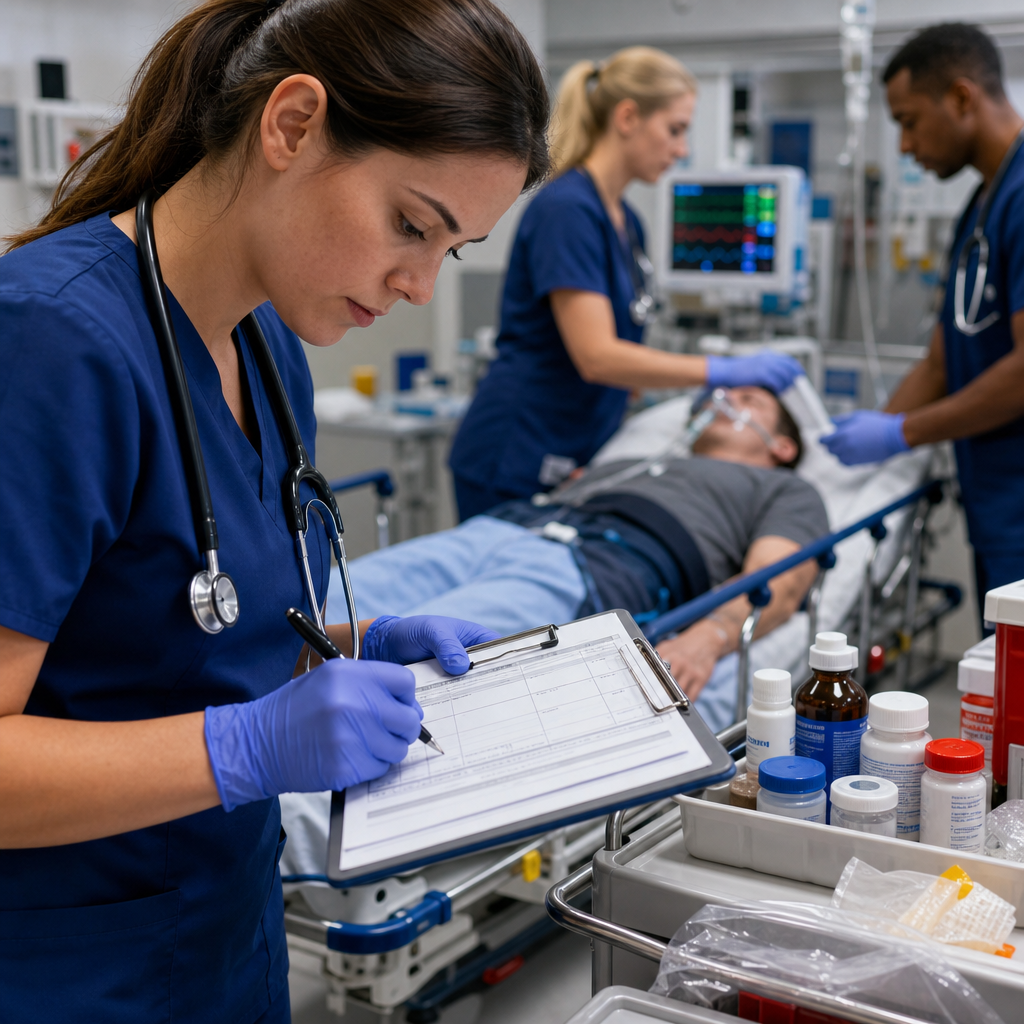
Create a written timeline as soon as possible, capturing information while details remain fresh. This documentation becomes part of the medical record and may support legal proceedings if needed.
Recovery Positioning and Ongoing Patient Monitoring
Once you’ve addressed immediate life threats, focus on preventing complications while the patient awaits hospital arrival and definitive treatment.
The recovery position protects airway integrity for unconscious patients. Place the patient on their side with the head tilted back slightly to keep the airway open. The upper leg bends at the knee for stability, and one arm supports the head. This position allows fluids, vomit, and secretions to drain from the mouth rather than entering the lungs.
Monitor the patient’s level of consciousness continuously. Watch for changes in responsiveness, coherence, or pupil size. These shifts indicate either improvement or deterioration and help guide your ongoing decisions about positioning and supportive care.
Observe vital signs every five to fifteen minutes depending on stability. Poisoned patients can experience sudden changes in heart rate, breathing pattern, or blood pressure. Early detection allows you to intervene before critical deterioration occurs.
Watch for signs of aspiration or respiratory distress. Rapid or labored breathing, wheezing, or changes in oxygen saturation demand immediate action—adjust positioning, provide supplemental oxygen, and alert paramedics to the change.
Prevent further contamination if the patient vomits. Have absorbent materials ready and turn the patient’s head to the side. If possible, collect vomit for hospital analysis, as it may contain identifiable substance particles.
Keep the patient as comfortable as possible while avoiding interventions that might complicate medical management. Reassure them that help is coming and that their symptoms are being monitored closely.
Ensure constant observation until paramedics arrive or the patient reaches definitive care. Never leave a poisoned patient unattended, as status can change suddenly.
Legal and Compliance Requirements for Poisoning Response
Healthcare professionals face specific legal and regulatory obligations when managing poisoning emergencies. Understanding these requirements protects you, your employer, and your patient.
Mandatory reporting applies to certain poisoning cases. Most states, including California, require healthcare providers to report suspected intentional poisoning, poisoning of children, and poisonings related to abuse or neglect. Familiarize yourself with your institution’s protocols and your state’s specific requirements.
Documentation standards demand accuracy and completeness. Your medical records may be reviewed in legal proceedings if the poisoning involves criminal intent or liability questions. Record facts objectively, avoid opinions, and use precise terminology. Document the substance, time, estimated quantity, symptoms, interventions, and patient response in chronological order.
Informed consent principles apply even in emergencies. Whenever possible, explain interventions to conscious patients before implementing them. If the patient is unconscious, implied consent allows you to provide emergency treatment, but document the circumstances that necessitated this decision.
Confidentiality obligations remain in effect for poisoning cases, even if they involve substance overdoses or intentional ingestion. Share patient information only with those directly involved in their care unless the patient consents or legal obligations override confidentiality.
Professional licensing boards expect healthcare professionals to maintain current knowledge in their specialty areas, including emergency response. Regulators increasingly view poisoning response competency as a standard expectation for many healthcare roles.
Workplace safety regulations may apply if the poisoning occurred in an occupational setting. Employers must report certain exposures to regulatory agencies and may face liability if they failed to provide adequate hazard training or protective equipment.
Our training programs are designed to align with current compliance standards and regulatory expectations across California’s varied healthcare settings, ensuring you meet legal obligations while protecting your professional standing.
How Our Blended First Aid Training Prepares You for Real Poisoning Emergencies
We’ve structured our advanced emergency training around real-world poisoning scenarios that you’ll encounter in California healthcare. Our blended learning approach combines online coursework with in-person skills practice, allowing you to master complex content efficiently while developing hands-on confidence.
The online modules cover toxicology fundamentals, toxidrome recognition, and protocol review. You learn at your own pace, accessing material from anywhere—at home in Sunnyvale, during breaks in Sacramento, or from your office in San Jose. This flexibility accommodates your busy schedule while ensuring comprehensive knowledge retention.
Our in-person skills sessions focus on scenario-based practice. With our experienced instructors in locations across the state—from Alameda to Bakersfield, from Redding to Visalia—you’ll practice patient assessment, positioning, communication, and documentation in realistic emergency environments. You’ll work with mannequins, props, and simulated patients to develop muscle memory for critical interventions.
Our instructors draw on extensive emergency medicine and healthcare backgrounds. They understand the clinical reality of poisoning cases, the uncertainty you face when substances are unknown, and the pressure of managing life-threatening emergencies. This authentic expertise shapes training that transfers directly to your clinical practice.
We emphasize decision-making frameworks rather than rigid protocols. Poisoning cases demand clinical judgment because every situation contains variables—unknown substances, mixed ingestions, patients with complicating medical conditions, and resource constraints. Our training equips you to think through these complexities systematically.
Our training includes hands-on practice with airway management, vital sign monitoring, patient communication, and documentation. These skills form the foundation of effective poisoning response, and practicing them repeatedly builds automaticity that serves you during actual emergencies when stress and time pressure challenge your cognitive resources.
Certification Programs That Meet Healthcare Professional Standards
We offer specialized certification programs designed for healthcare professionals who need poisoning response expertise as part of their scope of practice.
Our Advanced Emergency First Aid certification combines comprehensive emergency response with poisoning-specific modules. This program meets the needs of nurses, physicians, dentist teams, and EMS personnel across California. The certification is recognized by employers and maintains your professional credibility with licensing boards and regulatory agencies.
Our BLS (Basic Life Support) certification course focuses on cardiac emergencies and includes poisoning considerations relevant to adult resuscitation. Available in daily offerings at our Stockton CPR & BLS Certification location and throughout California, this foundational certification ensures you maintain current resuscitation skills.
We also provide Red Cross CPR & First Aid certification, incorporating poisoning response into comprehensive adult and pediatric first aid training. This program suits healthcare professionals, caregivers, and workplace safety coordinators.
Our ACLS (Advanced Cardiovascular Life Support) certification emphasizes cardiac emergencies while including poisoning-induced dysrhythmia management. For nurses and physicians managing critically ill poisoned patients, this credential ensures you’re equipped with advanced intervention skills.
Our PALS (Pediatric Advanced Life Support) certification addresses pediatric poisoning scenarios specifically. Children present unique challenges in poisoning cases—different dosing calculations, smaller medication volumes that create severe toxicity, and poisonings from household products that adults rarely encounter.
All our certifications include current knowledge updates, reflecting the latest protocols and evidence-based practices. Your certification remains valid for two years, after which recertification ensures you maintain currency with evolving standards.
Why California Healthcare Teams Choose Our Training Centers
Healthcare professionals across California choose us for our commitment to practical, accessible, expert-led training. Over 100 training locations throughout the state—including Berkeley, Concord, Oakland, Palo Alto, San Francisco, Fresno, and beyond—mean you’ll find convenient access to in-person skills sessions regardless of where you practice.
Our low price guarantee ensures you receive premium training at competitive rates. We believe expert instruction shouldn’t require choosing between quality and affordability, so we price our courses competitively while maintaining our commitment to experienced instructors and realistic, comprehensive scenarios.
We offer corporate group training with discount pricing, making it feasible for your entire healthcare team to pursue poisoning response certification together. Group training builds team cohesion, allows colleagues to practice together in scenarios that mirror your actual workplace dynamics, and reduces per-person costs significantly.
Our daily BLS offerings mean you can schedule certification when it fits your calendar, not months in advance. Whether you need training in Walnut Creek, Tracy, or Santa Rosa, we have multiple sessions available throughout each week.
Our blended learning model respects your time. Complete online modules when convenient, then attend a focused skills session at a location near you. This approach reduces classroom hours while maintaining the hands-on practice essential for emergency response competency.
Our CPR verification stations across California allow you to complete recertification efficiently. You don’t always need a full course—sometimes verification of your existing knowledge is sufficient, and our stations provide that service quickly and affordably.
Most importantly, we’re committed to training that matters. Our instructors aren’t simply delivering curriculum; they’re sharing expertise born from real emergency medicine experience. They understand why poisoning response matters, what you’ll actually face, and how to build the clinical judgment that transforms knowledge into effective action.
Ready to strengthen your poisoning response skills? Find a training location near you in California and schedule your advanced first aid or specialized emergency response certification. We’re here to ensure you’re prepared for the emergencies your patients and community need you to handle confidently and effectively.
Register for a class today.
Frequently Asked Questions (FAQ)
What makes our poisoning and ingestion response training different from basic first aid certification?
We combine virtual instruction on toxic substance identification and assessment protocols with in-person skills sessions where you practice real emergency scenarios. Our curriculum goes beyond general first aid to address the specific poisoning cases you’ll encounter in California healthcare settings, including drug overdoses, chemical exposures, and accidental ingestions. We ensure you’re prepared not just to recognize a poisoning emergency, but to execute the exact interventions your patients need within those critical first minutes.
Do we offer specialized certifications for healthcare providers who need poisoning response training?
Yes. We provide ACLS and PALS certifications that include comprehensive poisoning emergency protocols required for nurses, paramedics, and emergency care personnel. Our courses are designed to meet the mandatory compliance standards your employer and licensing board require. We offer daily class options across over 100 California locations, so you can complete your certification without disrupting your work schedule.
How does our low price guarantee work for poisoning and emergency response courses?
We commit to the lowest pricing on all our certified training courses throughout California. If you find our course price listed lower elsewhere, we’ll match it. We also offer corporate group discounts when your healthcare facility or EMS team trains together, which further reduces per-person costs while ensuring your entire department stays current on poisoning response protocols.