
Table of Contents
- The Challenge: Managing Mandatory Recertification Across Your Department
- Why Individual Certifications Create Budget and Scheduling Strain
- How Our Group Training Model Delivers Real Cost Savings
- Flexible Scheduling That Fits Hospital Operations
- Our Low-Price Guarantee Ensures Maximum ROI
- Seamless Blended Learning for Your Team's Workflow
- On-Site and Multi-Location Convenience Across California
- Compliance-First Instruction Your Team Can Trust
- How to Organize Your Department's Group Certification
- Next Steps: Schedule Your Hospital Group Training
- Frequently Asked Questions (FAQ)
The Challenge: Managing Mandatory Recertification Across Your Department
Running a hospital department means juggling competing priorities every single day. When ACLS (Advanced Cardiovascular Life Support) and PALS (Pediatric Advanced Life Support) recertifications come due for your team, the logistics can feel overwhelming. Your nurses, physicians, respiratory therapists, and support staff all need current certifications to maintain their licenses and meet hospital credentialing requirements, yet coordinating training around patient care schedules is genuinely difficult.
You’re managing multiple certification expiration dates, different staff schedules across shifts, and the financial impact of taking people offline for training. Individual course scheduling multiplies the administrative burden: separate registration dates, varied class times, repeated instructor onboarding, and scattered billing. Meanwhile, gaps in team certification create compliance risks and potential patient care delays during critical moments.
We designed our group training program specifically to solve this problem. Rather than treating certification as an individual responsibility, we handle the coordination, deliver focused instruction, and ensure your entire department stays compliant without disrupting operations.
Why Individual Certifications Create Budget and Scheduling Strain
When staff members book certifications separately, costs add up quickly and unpredictably. Each person pays a full individual rate, scheduling becomes fragmented across multiple class dates, and you lose visibility into who’s certified and when renewals are due. One nurse might complete training in January, another in March, creating staggered recertification deadlines that demand ongoing administrative tracking.
The scheduling conflicts are equally problematic. A respiratory therapist can’t leave the ICU during peak hours. A pediatric nurse works nights and needs evening options. An emergency department physician has unpredictable call schedules. Individual courses force you to find solutions that fit one person at a time, straining both staff and your HR department.
Compliance documentation also becomes scattered. You’re cross-referencing emails, certificate files in different folders, and renewal reminders spread across months. One forgotten recertification creates a credentialing gap that blocks that staff member from performing their duties until they’re current again.
Group training consolidates all these challenges into a single, coordinated event. You select the date, we provide the instruction, and your entire team completes certification together. This unified approach eliminates scheduling fragmentation and creates clear accountability across your department.
How Our Group Training Model Delivers Real Cost Savings
Our group pricing structure rewards departments for committing to team-wide certification. The more participants you enroll, the deeper your per-person savings. A department of 12 nurses and respiratory therapists saves substantially compared to booking 12 individual courses. A hospital system coordinating training across multiple departments in locations from Sacramento to San Francisco to San Jose unlocks even greater economies of scale.
Beyond the obvious per-person discount, group training reduces hidden costs. You’re not paying for 12 separate registrations, 12 individual administrative touches, or managing 12 different scheduling conflicts. Your HR team spends a fraction of the time coordinating one group event rather than tracking dozens of individual registrations. Staff take one focused training day instead of scattered time away from their departments.
We provide transparent group pricing with no hidden fees or surprise costs. You know the total investment upfront, budget accordingly, and gain predictable compliance expenses across your fiscal year. Our low price guarantee ensures you’re getting maximum value for your department’s training budget.

The financial impact compounds over time. Year after year, your renewal costs remain predictable and competitive, freeing budget for other essential department priorities.
Flexible Scheduling That Fits Hospital Operations
We understand that hospitals never truly close. Patient care continues 24/7, and you can’t simply shut down a department for training. That’s why we work directly with your leadership to find scheduling windows that work for your operations.
Many departments choose a half-day session that pulls staff in staggered rotations, maintaining adequate coverage while ensuring everyone participates. Others prefer a full day when patient volumes are predictably lower. Some schedule early morning sessions before shift changes, while departments with evening staff can arrange evening classes. Healthcare facilities in Fresno, Oakland, and Hayward have found creative scheduling solutions that keep the department running smoothly.
We also offer split sessions across consecutive days if your team is large or if you need to minimize simultaneous staffing gaps. Your ACLS instructors work through different scenarios while your PALS instructors train another group, then you rotate participants. This approach ensures thorough instruction without operational disruption.
Our virtual components provide additional flexibility. The knowledge-based content happens online on your team’s schedule, so the in-person session focuses exclusively on hands-on skills practice and scenario-based learning. Staff review materials during downtime, and you compress the in-person requirement into a shorter, more efficient timeframe.
Talk with your department manager about your typical scheduling constraints. We’ll design a session that protects patient care while ensuring complete team certification.
Our Low-Price Guarantee Ensures Maximum ROI
We stand behind our pricing because we’re confident in our value. Our low price guarantee means if you find a lower group rate elsewhere for equivalent ACLS or PALS certification, we’ll match it. You’re investing in training that meets your budget while maintaining the quality and compliance standards your department requires.
This guarantee removes the pressure to shop around endlessly or worry you’re overpaying. You negotiate a group rate with us, we lock it in, and your entire team receives instruction from experienced healthcare professionals without compromise. Departments across California, from Chico to Santa Cruz to Visalia, rely on this transparency to plan their training budgets confidently.
Consider the actual return on investment beyond just certification costs. Your staff maintain their licenses and credentialing status, avoiding costly gaps in staffing or compliance violations. You reduce the administrative overhead that currently consumes your HR team’s time. You build team cohesion through shared training experiences and collective accountability for patient safety skills.
The guarantee also applies to renewal cycles. If you certify a group today and return next year, we work to maintain competitive pricing that reflects your loyalty and growing relationship with us.
Seamless Blended Learning for Your Team’s Workflow
Our blended learning model combines the convenience of online preparation with the irreplaceable value of hands-on instruction. Your team members complete the knowledge portion on their own schedule, accessing course materials from any device whenever they have downtime. They review cardiac rhythms, medication algorithms, and pediatric crisis scenarios at their own pace.
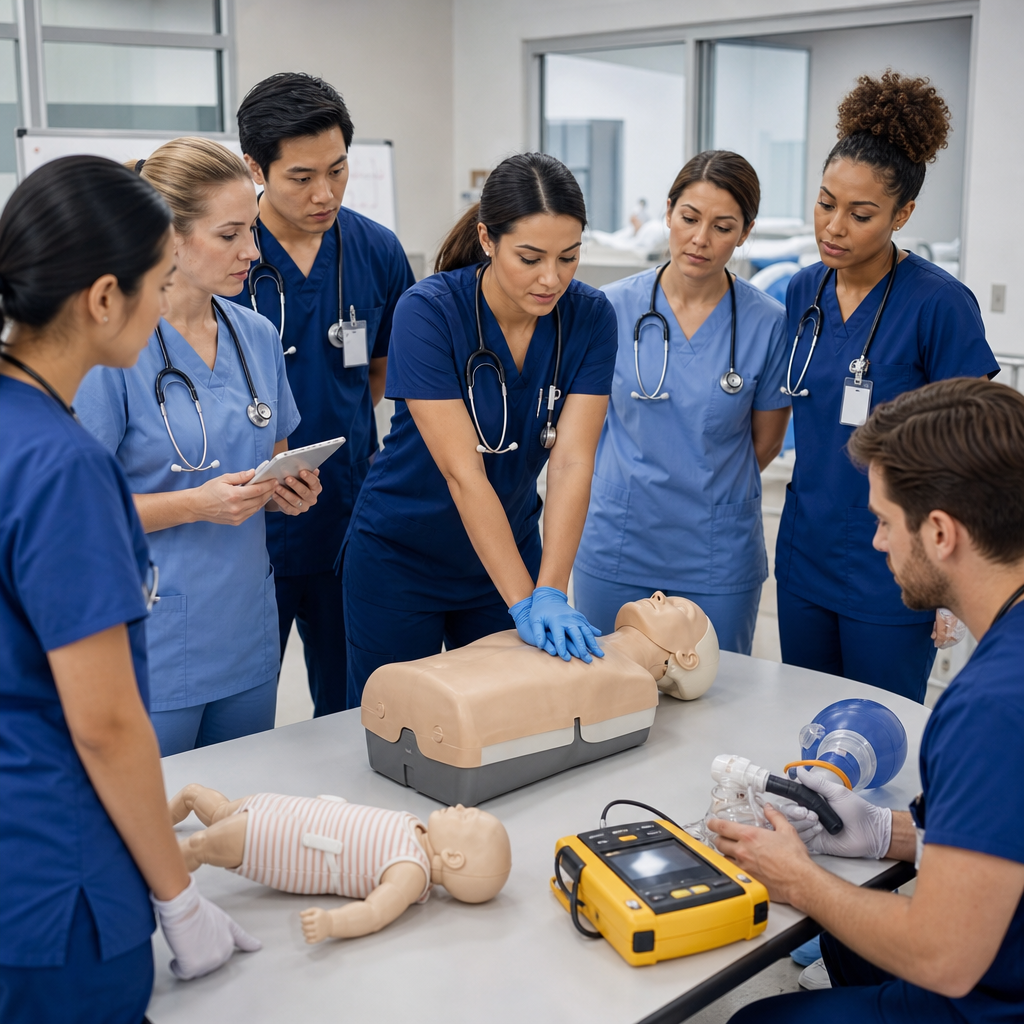
Then they arrive for the in-person session ready to practice. Our instructors focus on actual skill performance: chest compressions on manikins, airway management techniques, code leadership communication, and responding to real pediatric emergencies. Every minute of face-to-face time drives competency, not lecture.
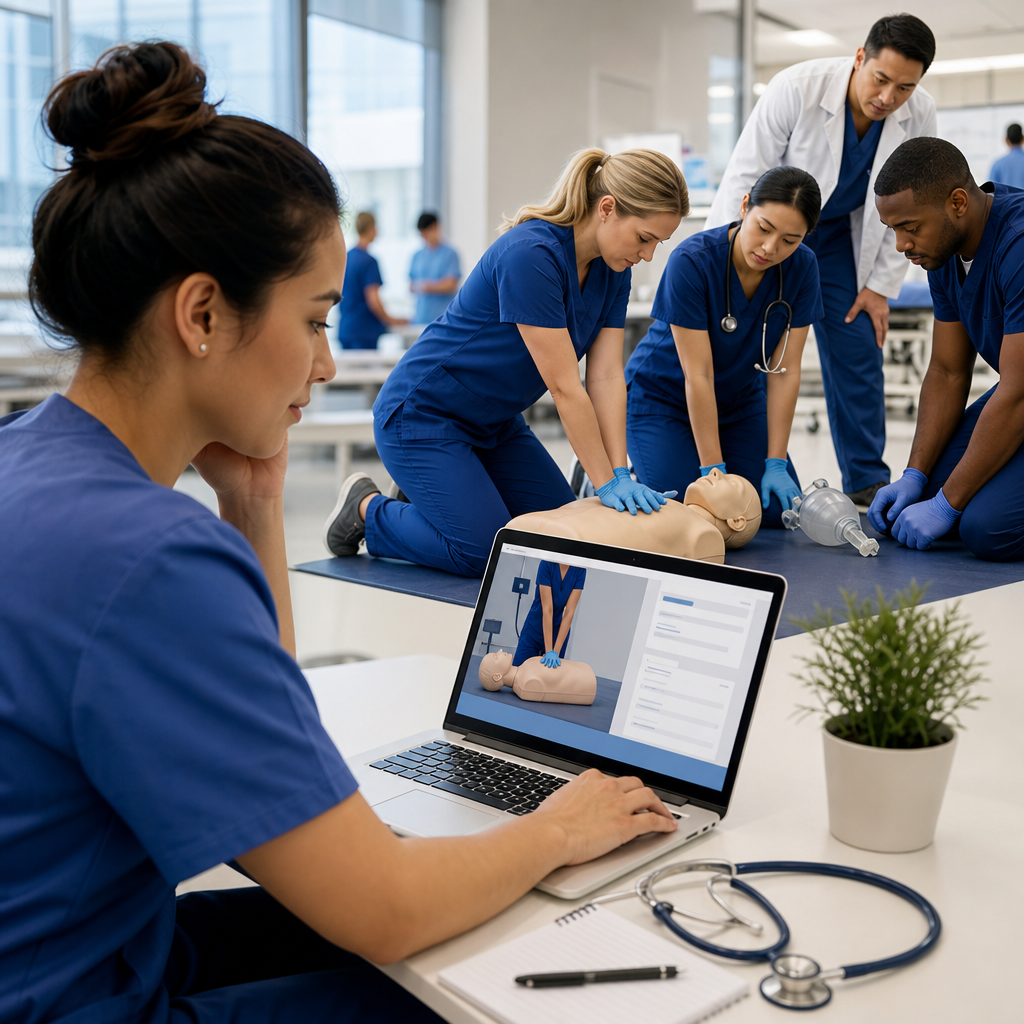
This approach respects your team’s intelligence and schedule. Experienced nurses and physicians don’t need to sit through basic information presentation; they need to practice skills and validate their decision-making under pressure. The blended model delivers exactly that.
Your team also gets immediate feedback from instructors. An ICU nurse practices ACLS scenarios and receives real-time coaching on compression depth and placement. A pediatric specialist practices PALS medication calculations and gets correction during the session, not weeks later. This direct feedback accelerates learning and builds confidence before they face actual emergencies.
On-Site and Multi-Location Convenience Across California
We operate over 100 training locations throughout California, from rural communities like Lathrop and Woodland to major metropolitan hubs like San Francisco and Los Angeles. This network means your hospital department can access training nearby, minimizing travel time and expenses.
Many facilities choose on-site training where we bring experienced instructors directly to your hospital. Your team trains in familiar spaces, reduces time away from the facility, and maintains operational continuity. We’ve delivered on-site group sessions in emergency departments in Concord, nursing units in Stockton, and surgical centers throughout the Bay Area.
For departments in smaller communities or those preferring dedicated training facilities, we offer convenient locations across Northern and Central California. Staff in Modesto travel to a nearby center while staff in San Ramon or Pleasanton access their local options. No one faces an unreasonable commute to maintain their certification.
We also coordinate multi-location training for healthcare systems spanning several cities. If your organization has departments in Sacramento, Folsom, and Davis, we schedule sessions at each location with consistent instruction and pricing. You maintain unified compliance standards across your system without requiring all staff to travel to one central location.
Compliance-First Instruction Your Team Can Trust
Every instructor we employ brings real healthcare experience. Our ACLS and PALS instructors are working or recently retired healthcare professionals who’ve managed actual cardiac emergencies, led resuscitation teams, and guided critical care decisions. They teach from experience, not just curriculum.
This background matters when teaching experienced clinicians. Your staff immediately recognize the credibility and practical application of the training. An instructor who’s actually called a code, managed a pediatric airway crisis, or led a resuscitation team in an actual emergency department speaks with authentic authority that resonates with your team.
Our curriculum aligns with current evidence-based guidelines for cardiac and pediatric emergency care. We update content regularly as clinical recommendations evolve, ensuring your team learns the protocols your hospital uses. We also customize scenarios to reflect your department’s specific workflows, equipment, and patient populations.
You receive comprehensive documentation of every staff member’s certification status, competency validation, and expiration dates. This documentation meets hospital credentialing requirements and supports your compliance audits. Digital records integrate easily with your existing credentialing systems.
How to Organize Your Department’s Group Certification
Starting the process is straightforward. First, identify your department’s certification needs. How many staff members need ACLS? How many need PALS? Are some staff current while others are expired or approaching expiration? Consolidating these details gives you a clear picture of your training scope.
Next, determine your preferred timeframe and scheduling window. Do you want to complete training within the next month? Next quarter? Are there predictable low-volume periods in your department when pulling staff for training creates minimal disruption? Having a target date helps us align instructor availability with your operational needs.
Then, gather basic contact information for your department liaison. This person serves as the single point of contact for scheduling, roster updates, payment, and documentation. We handle all the coordination with that one contact rather than juggling conversations with multiple staff members.
We’ll provide a formal group training proposal with pricing, session details, instructor assignments, and scheduling options. You review, adjust timing if needed, and confirm. From there, we handle registration, send pre-course materials to your team, and arrive ready to deliver instruction.
Close coordination matters, particularly for large departments or systems. We ask for your expected attendance list several weeks in advance, confirm any special accommodations or scheduling needs, and ensure instructors arrive with the right equipment and materials.
Next Steps: Schedule Your Hospital Group Training
Your department’s certification timeline doesn’t need to be complicated or expensive. We’ve helped healthcare teams across California, from Alameda to Redding to Santa Rosa, maintain compliance efficiently and affordably.
Contact us today to discuss your department’s specific needs. Share your team size, target training dates, and any scheduling constraints. We’ll develop a customized group training plan with transparent pricing and a schedule that protects your operations while ensuring complete team certification.
Visit our ACLS and PALS classes in California page to see available options at locations near your facility, or reach out directly to our group training coordinator. We’re ready to help your team stay current, certified, and confident in emergency response.
Register for a class today.
Frequently Asked Questions (FAQ)
How much can our hospital department save with group ACLS and PALS training?
We offer substantial discounts on our group rates compared to individual certification costs, and we guarantee our pricing is the lowest available. For example, a department training 20-30 staff members typically saves 30-40% per person on combined ACLS and PALS courses. We customize pricing based on your team size and certification needs, so we recommend contacting us directly with your department’s requirements for an exact quote.
Can we schedule training that works with our hospital’s staffing requirements?
We absolutely can, which is why we created our blended learning model specifically for healthcare teams like yours. Our instructors work with your department to schedule virtual components around patient care demands and conduct in-person skills sessions at times that minimize disruption to operations. With over 100 training locations throughout California and daily BLS courses available, we have the flexibility to accommodate multiple shifts and departments across your facility.
What if some of our staff members work at different hospital locations across California?
We make this straightforward by offering group training across our extensive network of facilities throughout the state. Whether your team is spread across the Bay Area, Sacramento region, Southern California, or anywhere in between, we can organize certification sessions at locations convenient to your staff members. Our group discount pricing applies to all participants regardless of which training location they attend, so your entire department receives the same cost benefits.