Table of Contents
- Why Healthcare Organizations Struggle with Mandatory CPR Certification Requirements
- The Hidden Costs of Traditional CPR Training for Large Teams
- How Our Blended Learning Approach Maximizes Training Efficiency
- Flexible Scheduling That Works Around Clinical Operations
- Our Low-Price Guarantee Ensures Budget Compliance
- Same-Day Certification Cards Keep Your Team Compliant Immediately
- On-Site and Virtual Options for Your Team's Needs
- Specialized Certifications for Nurses, Dentists, and EMS Personnel
- Real Savings: What Healthcare Organizations Actually Pay with Our Discounts
- Partner with California's Trusted Training Center Since 1989
- Frequently Asked Questions (FAQ)
Why Healthcare Organizations Struggle with Mandatory CPR Certification Requirements
Healthcare organizations across California face mounting pressure to keep their teams certified in life-saving skills while managing tight budgets and demanding schedules. We understand that mandating CPR certification for your nursing staff, dentists, EMS personnel, and clinical teams is non-negotiable, but the logistics and costs can quickly become overwhelming. At Safety Training Seminars, we’ve spent over three decades helping California healthcare organizations solve this exact challenge through corporate group training discounts and flexible delivery options designed specifically for medical professionals.
Every healthcare professional in California knows the requirement well: CPR and BLS (Basic Life Support) certification isn’t optional, it’s a condition of employment and licensure. For organizations managing dozens or hundreds of staff members across multiple departments and shifts, coordinating renewal cycles becomes a logistical puzzle that diverts time and resources away from patient care.
The core issue is timing. Your surgical nurses, ED staff, and clinic administrators don’t all need recertification on the same date, yet scheduling them individually creates inefficiencies and administrative friction. Additionally, many healthcare leaders struggle to balance the mandate for current certifications with the reality that pulling staff from clinical duties disrupts operations and increases labor costs. When employees must travel to distant training centers or attend sessions outside their normal work hours, you’re effectively paying double: once for the training itself and again through lost productivity or overtime compensation.
Another common challenge is tracking compliance across your organization. Expired certifications create liability exposure and can trigger licensing violations, yet maintaining a centralized renewal calendar for a large team requires dedicated administrative effort.
Our group training programs solve these coordination headaches by consolidating your team’s training into scheduled blocks that we customize around your operational calendar. This approach reduces per-employee costs while ensuring your entire organization maintains current certifications.
The Hidden Costs of Traditional CPR Training for Large Teams
When healthcare organizations price out individual training options, they often focus only on the per-person tuition. This narrow view misses the substantial hidden expenses that accumulate quickly with larger teams.
Travel and time costs represent the largest hidden expense. If your staff members must drive to training centers in San Francisco, Sacramento, or San Jose when your clinic operates in Antioch or Lathrop, you’re absorbing commute time, transportation wear-and-tear, and parking. For a nurse earning $50 per hour, a 90-minute commute represents $75 in lost wages before the training even begins. Multiply that across 20 team members and you’ve added $1,500 to your actual training cost.
Scheduling fragmentation also inflates expenses. When each employee attends different class times, your HR department spends hours coordinating individual registrations, sending reminders, managing cancellations, and tracking completion. This administrative overhead often goes unbudgeted but represents real labor cost.
Certification gaps create additional financial risk. If even one clinician allows their CPR certification to lapse, you face regulatory penalties, malpractice liability exposure, and the urgent expense of emergency recertification. Some healthcare organizations have reported penalties exceeding $5,000 for compliance lapses.
Downtime inconsistency is another factor. When staff attend training individually across multiple weeks, your unit experiences sporadic staffing disruptions. Group training consolidates these disruptions into planned, scheduled blocks that your operations team can staff around proactively.
Our corporate discounts reduce per-person costs significantly while our on-site and consolidated scheduling eliminate the hidden expenses that traditional individual enrollment models create.
How Our Blended Learning Approach Maximizes Training Efficiency
We’ve designed our blended learning model specifically to respect the time constraints of working healthcare professionals while delivering comprehensive, hands-on skill development.
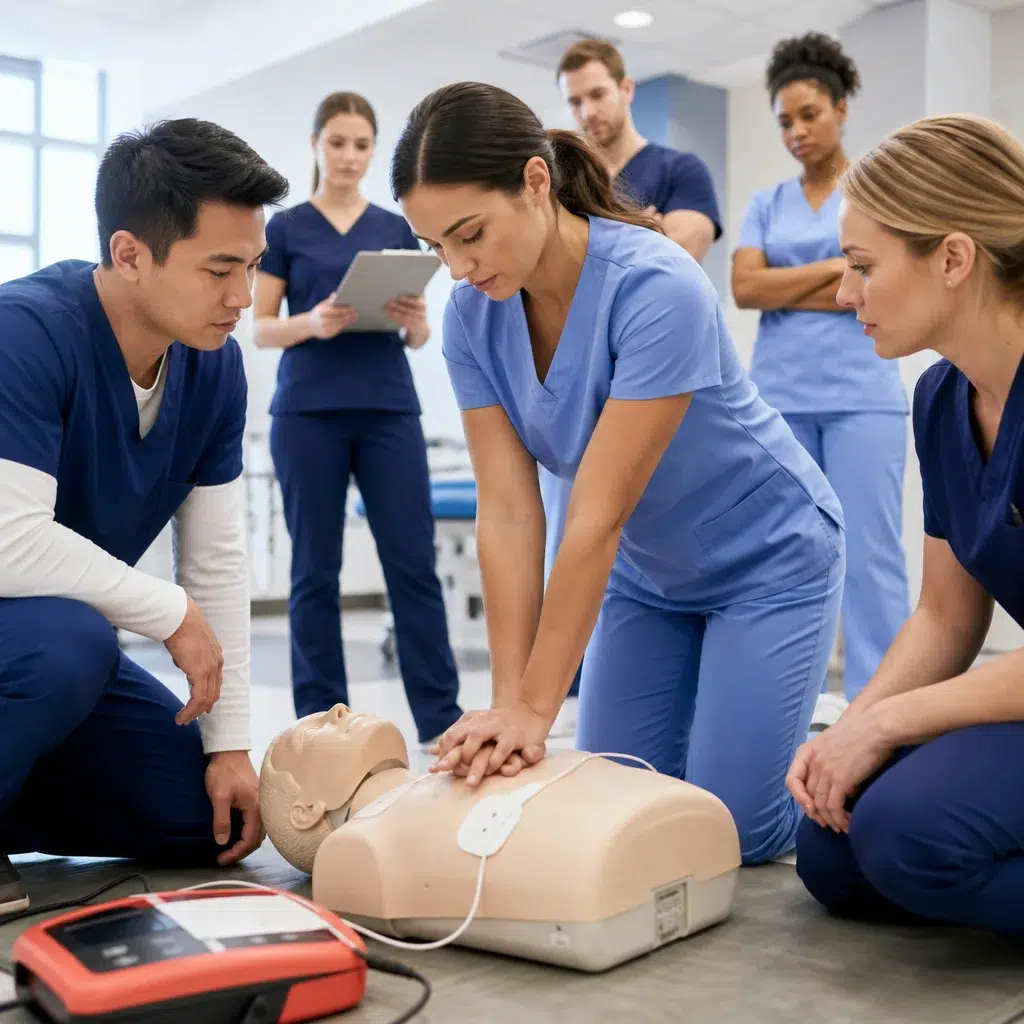
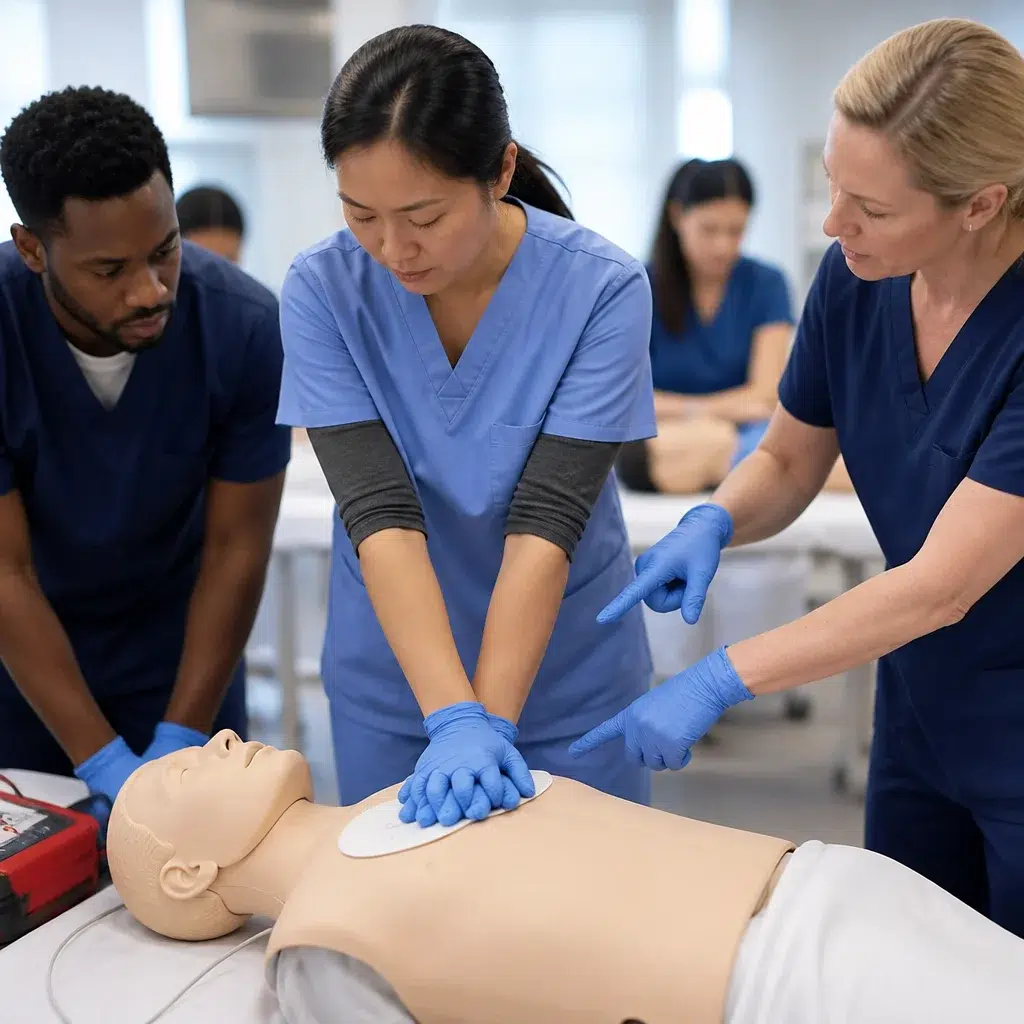
Here’s how it works: your team completes self-paced online modules covering CPR fundamentals, rescue breathing techniques, and cardiac emergency response protocols before arriving for the practical session. This front-loaded digital learning allows your instructors to maximize in-person time on actual skills practice, equipment operation, and scenario-based training where hands-on feedback matters most.
The efficiency gain is substantial. Instead of spending two hours in a classroom environment listening to lectures, your team spends 15-20 minutes reviewing core concepts at their own pace during a lunch break or downtime, then arrives prepared for focused skills practice. For an organization with 50 staff members, this efficiency difference translates to approximately 10 additional hours of consolidated practice time across your entire team.
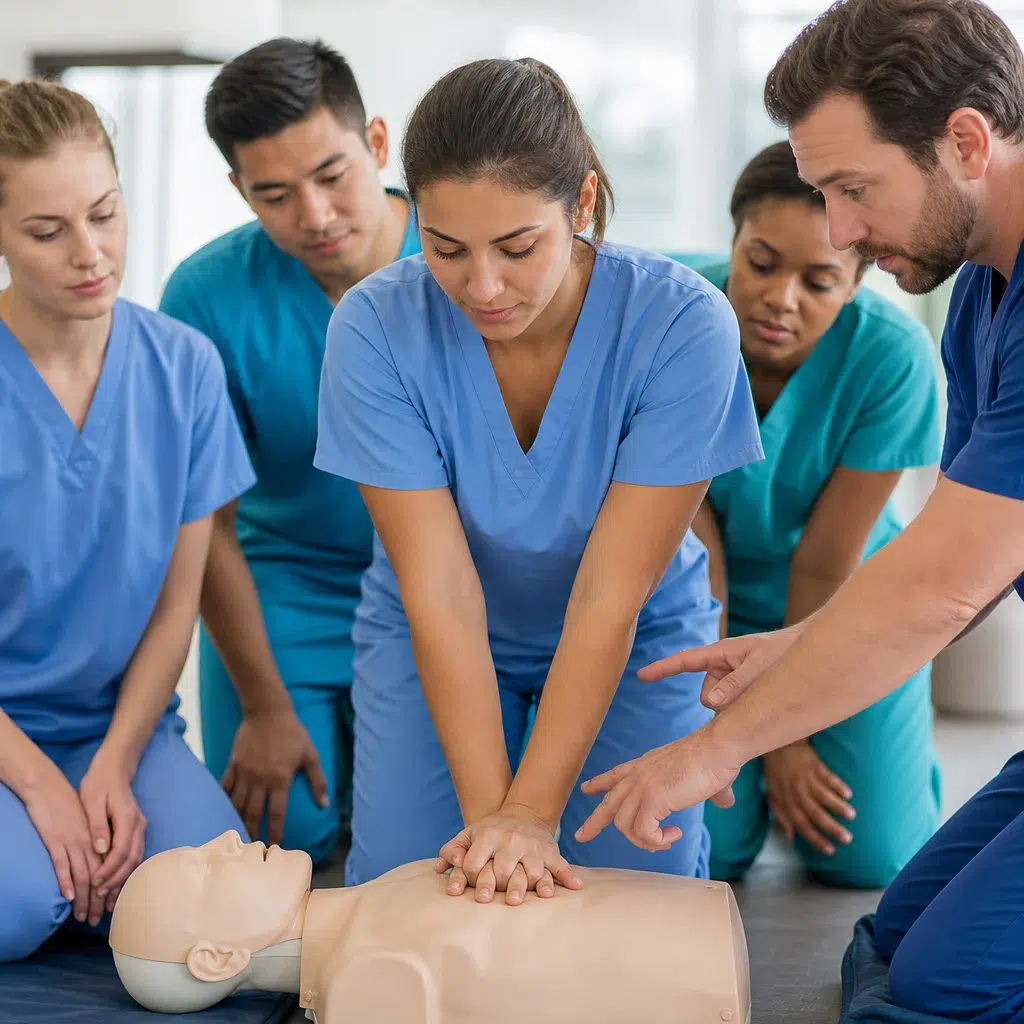
Retention improves significantly with this approach. Research consistently shows that blended learning produces better long-term skill retention than either purely online or purely classroom instruction, because your team applies digital knowledge immediately to real-world practice scenarios. When your ED nurse learns about two-handed chest compression technique online, then practices it on a manikin within 24 hours under your instructor’s guidance, the neural pathways formed are stronger and more durable.
Flexibility is built in throughout the process. Your team members can access online modules from home, the clinic, or anywhere with internet connection. This accommodates staff working different shifts, from the night nurses in your Sacramento facility to the daytime dentists in your Visalia practice.
Flexible Scheduling That Works Around Clinical Operations
Unlike rigid training calendars that force your organization to conform to standardized class times, we build schedules around your operational reality.
We offer multiple scheduling options:
- Weekend and evening sessions for teams that cannot spare weekday clinical hours
- Early morning classes before your clinic opens, useful for outpatient facilities
- Split-session formats where your team attends skills practice across two shorter sessions rather than one long block
- Rolling enrollment for smaller organizations that prefer staggered scheduling over consolidation
- Shift-specific sessions when your team works non-standard hours
Your operations director or HR manager coordinates directly with our scheduling team to identify windows that create minimal disruption. If your primary challenge is covering 24-hour ED operations, we can design a solution that trains one shift while you maintain full clinical staffing. If you operate traditional business hours, we might schedule Friday afternoons or block Saturday mornings when your facility can absorb brief staffing adjustments.
We maintain training locations throughout California including Berkeley, Concord, Dublin, Fremont, Oakland, Palo Alto, San Jose, and over 100 other communities statewide. This geographic distribution means your team trains locally, eliminating the travel burden entirely.
Our Low-Price Guarantee Ensures Budget Compliance
We’re confident in our pricing structure, so we stand behind it with a straightforward guarantee: if you receive a quote from another certified training provider for the same course within 30 days, we’ll match or beat that price.
Our low-price guarantee removes the anxiety many healthcare administrators feel when budgeting for mandatory training. You can confidently allocate funds knowing you’re getting the best rate available. This guarantee applies across all our corporate group programs including BLS, CPR, ACLS (Advanced Cardiac Life Support), PALS (Pediatric Advanced Life Support), and NRP (Neonatal Resuscitation Program) courses.
Volume discounts reduce per-person costs further as your team size grows. A training group of 15 staff members receives a better rate than five employees, and 50 staff members receive even greater discounts. We structure these reductions to recognize the administrative efficiency your organization creates by consolidating multiple team members into group sessions.
Corporate packages often include our CPR verification stations at no additional cost, allowing employees to log their practice sessions and maintain documentation of ongoing competency between formal recertification cycles.
Same-Day Certification Cards Keep Your Team Compliant Immediately
Compliance pressure eases significantly when your team walks out of training with physical certification cards in hand. This tangible evidence of current certification means your organization can immediately update credentialing records, satisfy licensing board requirements, and document compliance.
Many training programs issue digital-only credentials or require employees to wait for cards to arrive by mail, creating brief windows where your certification status appears ambiguous in your records. We eliminate this uncertainty by printing and issuing cards the same day your team completes training.

This same-day card approach proves especially valuable for staff members whose certifications expire within the next renewal cycle. Instead of waiting days or weeks for mail delivery while a licensing clock ticks forward, your team member leaves with proof of current certification, allowing your HR department to immediately close any compliance gaps.
For larger organizations managing certifications across multiple locations from Redding and Chico in the north to Fresno and Visalia in the south, consolidated completion documentation streamlines your compliance tracking immensely.
On-Site and Virtual Options for Your Team’s Needs
Not every organization has the flexibility to send staff to external training locations, and not every team is suited to purely virtual instruction. We offer multiple delivery configurations to match your specific organizational needs.
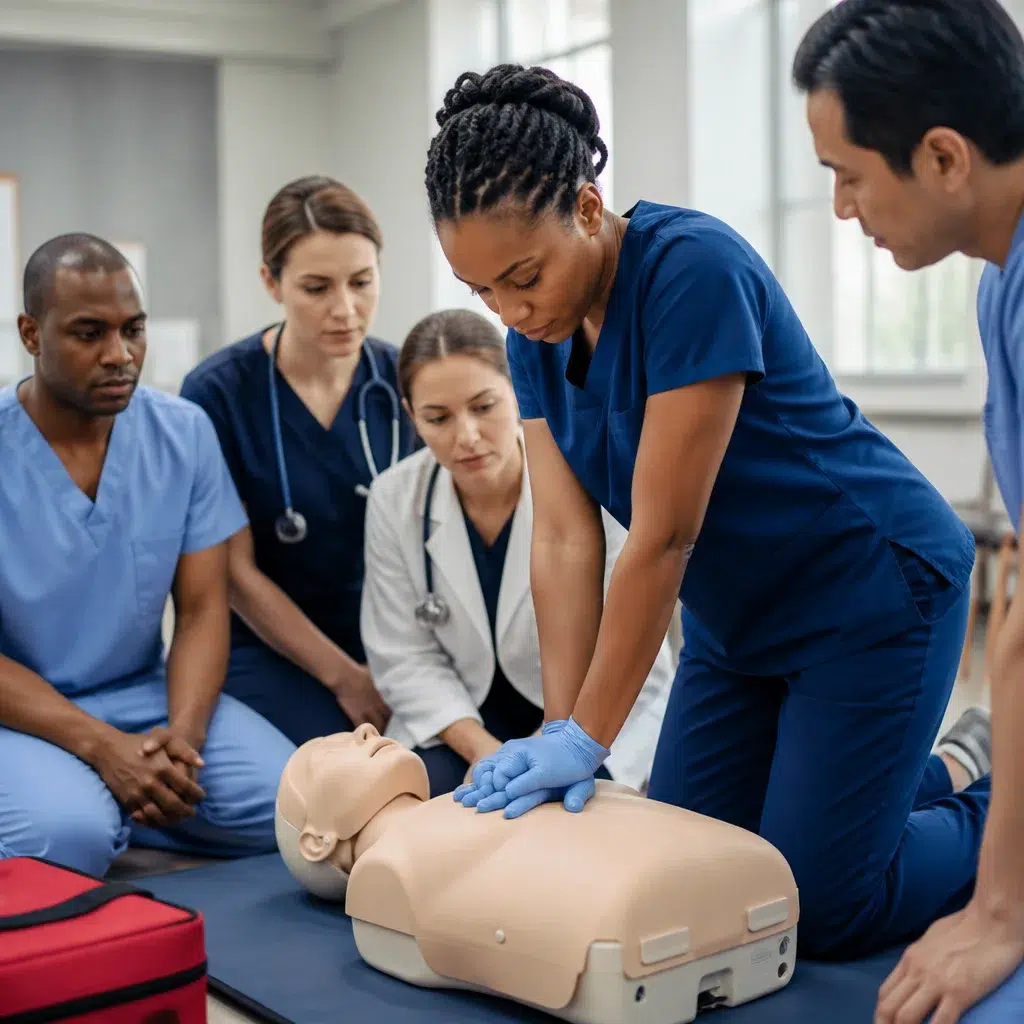
On-site training brings our instructors and equipment directly to your facility. Your team trains in familiar surroundings, eliminating commute time entirely and demonstrating organizational commitment to professional development. On-site programs work particularly well for larger groups (typically 15 or more staff members) where the cost-per-person approaches that of group center-based training while eliminating all travel burden.
Virtual sessions leverage video conferencing and instructor interaction for theory content, then require participants to practice skills on their own equipment or attend a brief in-person skills verification session. This hybrid approach works well for geographically dispersed teams or organizations with severe scheduling constraints.
Center-based group training at our facilities across the state remains the most popular option because it combines instructor expertise, specialized training equipment, and cost efficiency. Your team attends together at one of our locations in Pleasant Hill, Stockton, Sunnyvale, or any of our other California communities, creating team cohesion while keeping per-person costs minimal.
Many organizations use a combination of these approaches. For example, your core clinical team might attend on-site training while administrative staff complete a virtual or center-based option in a different month.
Specialized Certifications for Nurses, Dentists, and EMS Personnel
Healthcare professionals in different specialties require certification credentials tailored to their specific scope of practice and emergency scenarios they’re likely to encounter.
Our BLS certification covers fundamental cardiopulmonary resuscitation techniques relevant to all healthcare workers. This foundational credential satisfies requirements for nurses, dentists, dental hygienists, EMS personnel, and administrative clinical staff.
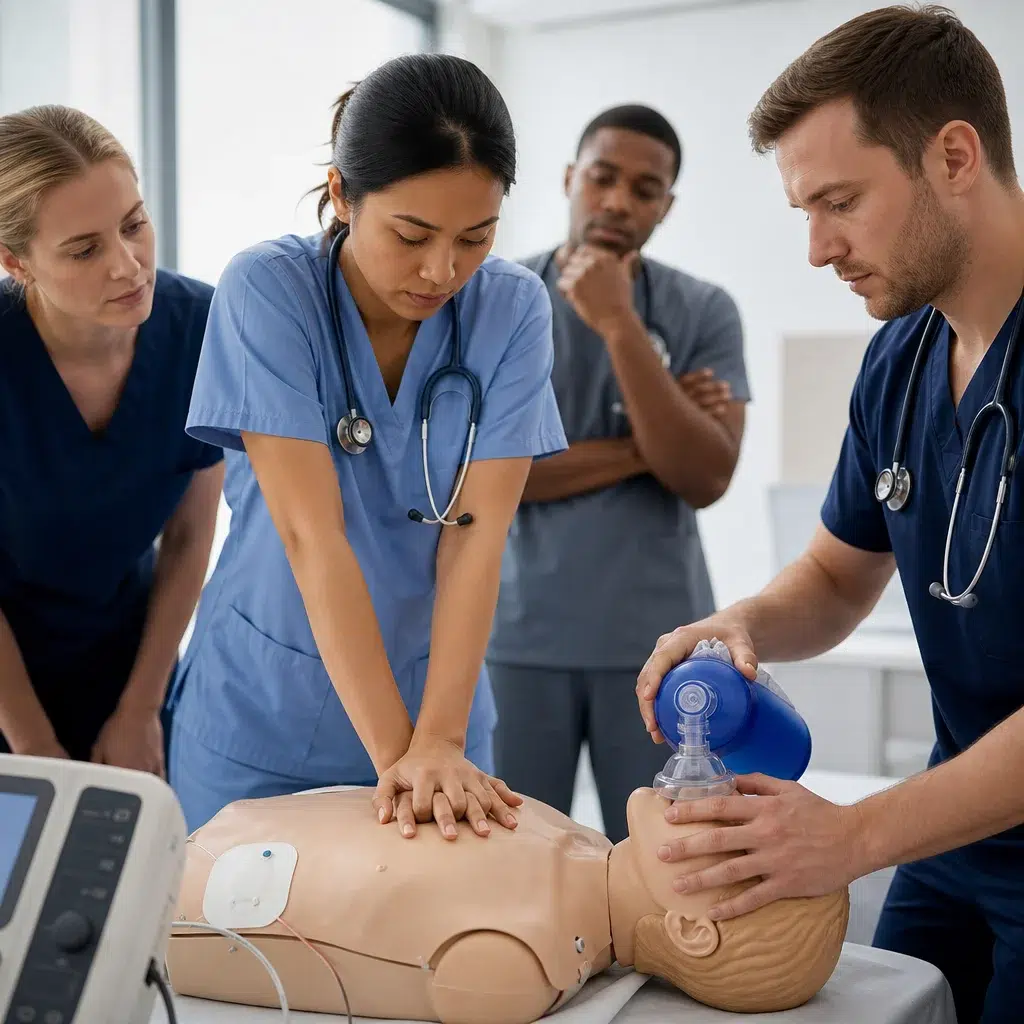
ACLS certification builds on BLS fundamentals and adds advanced cardiac life support techniques including medication administration, ECG interpretation, and advanced airway management. Emergency nurses, ED physicians, paramedics, and critical care staff typically require ACLS alongside their BLS credential.
PALS certification addresses pediatric-specific scenarios including infant CPR techniques, pediatric medication dosing considerations, and age-appropriate defibrillation protocols. Pediatric nurses, ED staff serving children, and dentists treating pediatric patients benefit from PALS-specific training.
NRP certification focuses specifically on newborn resuscitation and addresses the unique physiology and emergency response protocols relevant to neonatal environments. Labor and delivery nurses, neonatal intensive care staff, and obstetric practitioners require NRP credentials.
We design group training programs that reflect your organization’s actual specialty mix. A multi-specialty clinic might enroll nurses in ACLS while dental hygienists complete BLS, and your administration staff pursues basic CPR certification. Customization ensures each team member completes appropriate certification for their role without unnecessary duplication.
Real Savings: What Healthcare Organizations Actually Pay with Our Discounts
Let’s examine concrete numbers for a mid-sized healthcare organization. Consider a 40-person clinical team that includes 20 nurses, 10 dentists, 5 EMS personnel, and 5 administrative staff.
If each employee trained individually at standard rates, your total investment would typically approach $3,200 to $4,000 depending on credential level. Add travel time (15 hours minimum across the team at an average $40 per hour = $600), administrative coordination overhead (8-10 hours of HR time at $35 per hour = $315), and potential scheduling friction costs, and your true investment climbs to approximately $4,100 to $4,500.
Through our corporate group discount program, that same 40-person cohort typically costs between $1,600 and $2,200 depending on certification type and scheduling preferences. Group scheduling consolidates your team’s travel to essentially zero, reduces your HR coordination burden to 2-3 hours, and eliminates scheduling friction costs. Your true investment drops to $1,750 to $2,350.
The difference? Your organization saves $1,800 to $2,300 on a single training cycle. For organizations that recertify annually or maintain multiple training cycles across different teams throughout the year, these savings compound substantially.
A dental practice with 15 staff members training on a two-year recertification cycle might allocate $500 annually through our group program versus $800 plus travel and coordination time through individual enrollment. Over a five-year period, that practice realizes $1,500 in direct savings plus countless hours of administrative time recovered.
Partner with California’s Trusted Training Center Since 1989
For more than three decades, we’ve built our reputation by prioritizing the needs of California healthcare professionals. We understand the regulatory landscape, the clinical constraints of medical practice, and the administrative complexity of managing large-scale training programs because we’ve worked alongside healthcare teams across all of California’s communities from Alameda and Bakersfield to Woodland and Walnut Creek.
Our instructors are experienced healthcare professionals who teach from clinical perspective rather than following rote scripts. Your team benefits from instructors who have worked in emergency departments, operating rooms, and intensive care units, bringing real-world context to every skills lesson.
We maintain rigorous quality standards and certification alignment with current professional guidelines, ensuring your team’s credentials remain valid and respected by licensing boards throughout California. Our same-day certification and verification station access mean your compliance documentation stays current and audit-ready.
Getting started is straightforward. Contact our corporate training team with information about your team size, certification needs, preferred scheduling window, and any location preferences. We’ll provide a customized quote with our low-price guarantee, design a training schedule that fits your operations, and coordinate every detail so your team can focus on patient care while we handle the rest.
Your organization’s commitment to maintaining current, relevant CPR and BLS certifications strengthens your team’s competence and protects your patients. Let us make that commitment as convenient and affordable as possible.
Register for a class today.
Frequently Asked Questions (FAQ)
How much can we save on bulk CPR training for our healthcare team?
We offer tiered discount pricing based on your group size, with larger teams receiving greater per-person savings. Most healthcare organizations see 20-40% reductions compared to individual course pricing, and our low-price guarantee means if you find better rates elsewhere, we’ll match them. To get your specific quote, contact our team with your headcount and certification needs.
Can we schedule training around our clinical staffing needs?
We absolutely can work within your operational constraints. Our blended learning model lets us offer virtual theory sessions that your team completes flexibly, with in-person skills verification scheduled at times that minimize impact on patient care. We also provide on-site training at your facility across our 100+ California locations, eliminating travel time entirely.
What certifications do we need for different roles within our organization?
We specialize in certifications tailored to your specific roles: nurses typically need BLS and ACLS, dentists require BLS with pediatric considerations, and EMS personnel need both ACLS and PALS. We can customize training packages for mixed teams so everyone gets exactly what their position requires for compliance and licensing.