
California’s allied health workforce keeps patient care moving, from the pharmacist giving flu shots at a neighborhood pharmacy to the phlebotomist drawing blood in a hospital lab before sunrise. These roles look very different day to day, but they share one expectation: knowing exactly what to do in the first minutes of a cardiac arrest.
That’s why Basic Life Support (BLS) certification appears so often in California job postings, training program applications and, in some cases, state regulations. This guide explains why each of these four roles needs BLS, what California rules actually say, and how to earn an American Heart Association (AHA) BLS card quickly through Safety Training Seminars.
What BLS Covers and How It Differs From Standard CPR
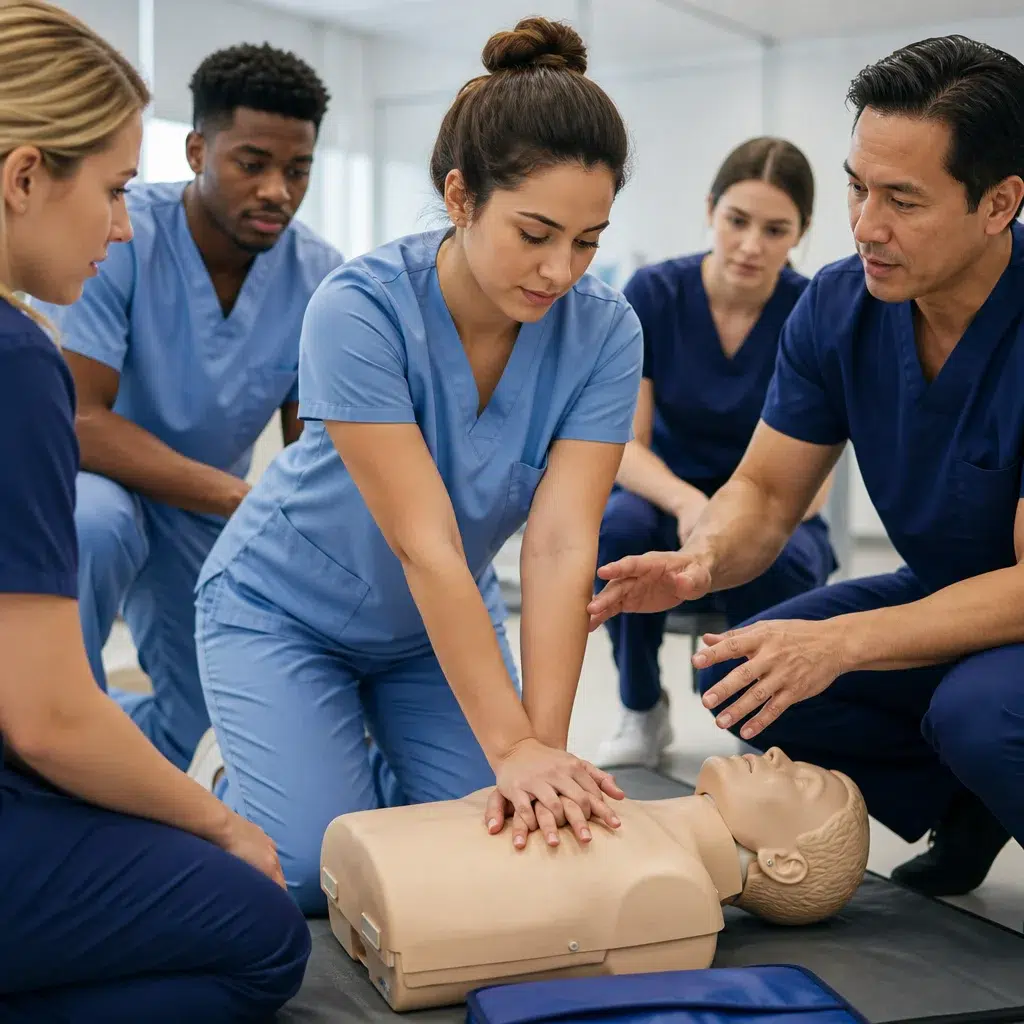
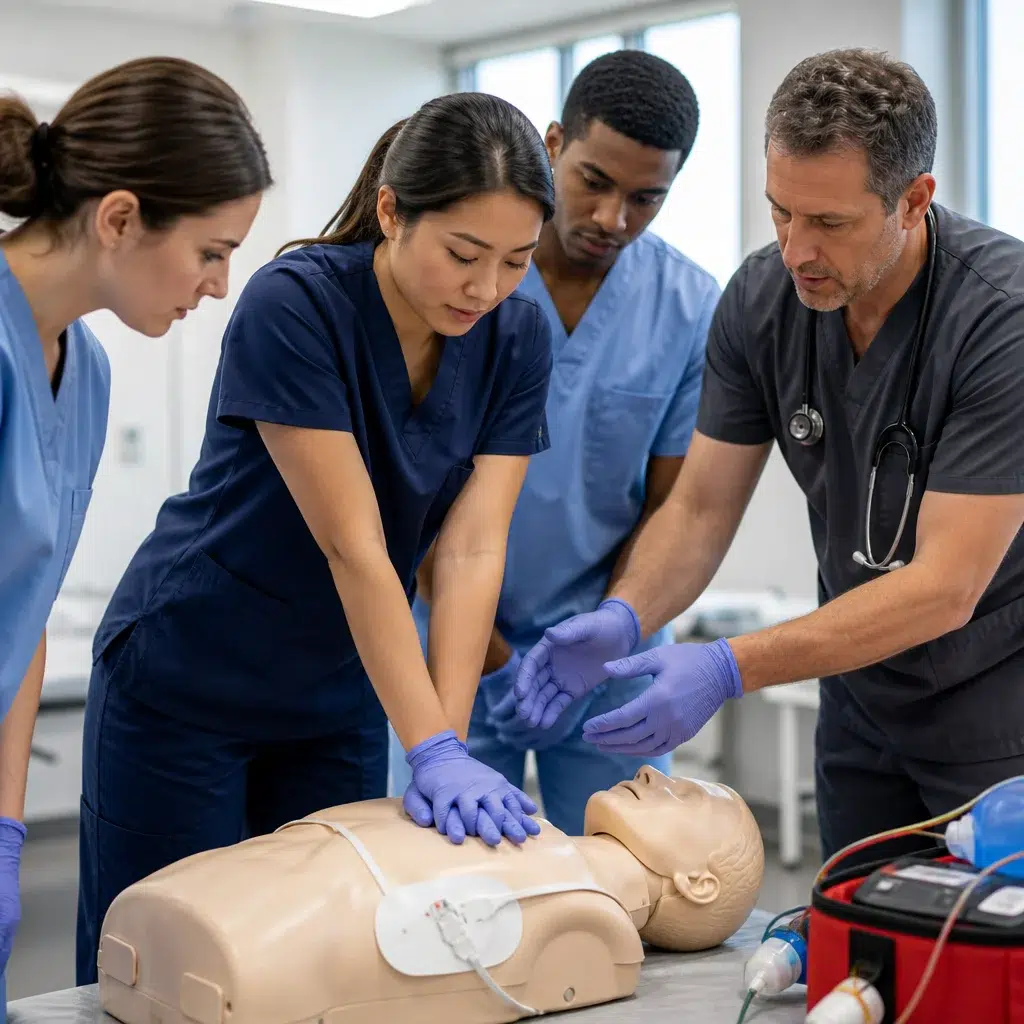
BLS is the healthcare-provider level of CPR training. It goes beyond a community CPR class by teaching skills built for clinical teams, including:
- High-quality CPR for adults, children and infants
- Automated external defibrillator (AED) use
- Bag-mask ventilation
- Two-rescuer and team-based resuscitation
- Choking relief for all ages
A standard CPR and First Aid course is designed for workplace employees, teachers, coaches and caregivers. If your job involves direct patient care, your employer will almost always expect BLS instead.
Why BLS Matters for Each Role in California
Pharmacists
For California pharmacists, BLS is more than an employer preference. Under Business and Professions Code section 4052.8, a pharmacist who initiates and administers vaccines must be certified in basic life support. California Board of Pharmacy regulations (16 CCR §1746.4) also require pharmacists to keep documentation of their BLS certification on site and available for inspection.
Pharmacy technicians who administer vaccines under a pharmacist’s supervision must be BLS certified as well. Because immunizing pharmacists may also give epinephrine or diphenhydramine for severe allergic reactions, strong emergency response skills are part of the job at retail, community and hospital pharmacies across Los Angeles, San Diego, Sacramento and the Bay Area.
Medical Assistants
California does not license medical assistants. Instead, MAs work under supervision within the limits set by Business and Professions Code sections 2069–2071 and Medical Board of California guidelines. Many pursue voluntary certification through agencies the Medical Board recognizes, such as the California Certifying Board for Medical Assistants.
Even without a state license, BLS is one of the most common requirements on MA job listings at physician offices, urgent care centers and outpatient clinics. Medical assistants take vitals, give injections and prepare patients for procedures, all moments when a sudden collapse can happen.
Certified Nursing Assistants (CNAs)
The California Department of Public Health (CDPH) certifies CNAs and requires 160 hours of approved training: 60 classroom hours and 100 supervised clinical hours. To renew, CNAs complete 48 hours of in-service training or continuing education every two years.
CNAs often spend more hands-on time with residents than anyone else in skilled nursing, long-term care and hospital settings. Many employers and training programs require current BLS for hiring or clinical placement, so keeping your card active protects both your patients and your job eligibility.
Phlebotomists
California is one of only four states that require phlebotomists to be certified. CDPH’s Laboratory Field Services oversees three levels: Limited Phlebotomy Technician (LPT), Certified Phlebotomy Technician I (CPT1) and Certified Phlebotomy Technician II (CPT2).
BLS often comes into play before you even start. Some California phlebotomy programs, including UCLA’s, require healthcare-provider BLS throughout the course, and hospital job postings commonly ask for a current AHA BLS card at hire. Fainting during blood draws is not unusual, and a BLS-trained phlebotomist can recognize when a routine faint becomes a true emergency.
Quick Comparison: BLS Expectations by Role
| Role | California oversight | How BLS is usually required | Common work settings |
| Pharmacist | California State Board of Pharmacy | Required by state law for pharmacists who give vaccines | Retail pharmacies, hospitals, clinics |
| Medical Assistant | Not licensed; works under Medical Board of California rules | Common employer requirement | Physician offices, urgent care, outpatient clinics |
| CNA | CDPH | Common employer and training program requirement | Skilled nursing, long-term care, hospitals |
| Phlebotomist | CDPH Laboratory Field Services | Common training program and employer requirement | Hospital labs, outpatient draw stations, blood centers |
How BLS Certification Works at Safety Training Seminars
Safety Training Seminars offers the AHA BLS Provider course in a blended format designed for busy healthcare workers:
- Online learning: 1–2 hours, completed at your own pace
- Hands-on skills testing: about 30 minutes with an instructor
- Card issuance: same day
- Certification: AHA BLS Provider card, valid for two years and accepted nationally
- Price: $120
- Options: initial certification or renewal
To earn your card, complete the online course and pass the in-person skills test. You can see full course details on our AHA BLS certification in California page.
With 100+ CPR training centers across California, you can book skills testing close to where you live or work, whether that’s between shifts near a downtown hospital or on a day off closer to home. In a state where a cross-town commute can take an entire afternoon, a nearby testing location makes renewal far easier to fit into your schedule.
BLS vs. CPR & First Aid: Which Course Do You Need?
| Course | Best for | Online time | Skills testing | Price |
| AHA BLS Provider | Pharmacists, MAs, CNAs, phlebotomists and other clinical staff | 1–2 hours | About 30 minutes | $120 |
| AHA CPR & First Aid | Workplace employees, teachers, childcare staff, caregivers and community members | 2–3 hours | About 1 hour | $120 (low price guaranteed) |
Both courses issue an AHA card the same day, valid for two years. If you work in patient care, choose BLS. If you also need first aid skills for a non-clinical job or workplace safety role, our CPR and First Aid certification in California course may be a good fit alongside it. When in doubt, confirm the exact requirement with your employer or training program before registering.
Tips for Staying Compliant
- Note your card’s expiration date and schedule renewal a few weeks early.
- Keep a digital copy of your card for HR, school or Board of Pharmacy inspection.
- Confirm your employer accepts AHA BLS before you enroll.
- Starting a CNA or phlebotomy program? Get BLS before clinical rotations begin.
Get BLS Certified in California With Safety Training Seminars
Whether you’re a pharmacist offering immunizations, a medical assistant starting at a new clinic, a CNA preparing for clinical rotations or a phlebotomist working toward your CPT1, an AHA BLS card is one of the simplest credentials to check off your list. Register with Safety Training Seminars today, finish the online course on your schedule and leave skills testing with your card the same day.
FAQs About BLS Certification for Pharmacists, Medical Assistants, CNAs and Phlebotomists in California
Do pharmacists in California need BLS certification?
Yes, if they initiate or administer vaccines. California Business and Professions Code section 4052.8 requires immunizing pharmacists to be certified in basic life support, and Board of Pharmacy rules require proof to be kept on site.
Is BLS required for medical assistants in California?
California does not license medical assistants, so there is no single state BLS mandate for every MA. However, most clinics, physician offices and urgent care centers require current BLS as a condition of employment.
Can CNAs use a regular CPR card instead of BLS?
It depends on the employer, but most hospitals and skilled nursing facilities expect healthcare-provider BLS rather than a community CPR card. Check with your facility or training program to be sure.
Do phlebotomy students need BLS before training?
Many California phlebotomy programs require current healthcare-provider BLS before or during the course, and employers often ask for it at hire. Getting certified early keeps your training and job search on track.
How long does BLS certification take at Safety Training Seminars?
The AHA BLS Provider course includes 1–2 hours of online learning and about 30 minutes of hands-on skills testing. You receive your card the same day, and it stays valid for two years.