
Table of Contents
- The Challenge: Managing EMS Team Certification Requirements Across California
- Why Traditional Training Models Fall Short for EMS Groups
- How Our Blended Learning Approach Streamlines Certification
- 100+ Training Locations: Training Your Team Where They Work
- Same-Day Certification Cards and Fast Checkout Process
- Cost Savings with Our Low Price Guarantee for Group Training
- RQI Simulation Stations with VAM Technology for Real Skill Building
- Flexible Scheduling That Works Around Call Shifts and Station Operations
- Compliance-First Instruction Aligned with Current Standards
- On-Site Group Training Options for Your Full Team
- Partner with California's Trusted Training Center Since 1989
- Get Your EMS Group Certified This Month
- Frequently Asked Questions (FAQ)
The Challenge: Managing EMS Team Certification Requirements Across California
EMS teams across California face a persistent challenge: keeping your entire roster current with life-saving certifications while managing rotating schedules, budget constraints, and the operational demands of emergency response. When recertification season arrives, coordination becomes a nightmare. You’re juggling availability across multiple shifts, finding training that fits your station’s call volume, and ensuring every paramedic, EMT, and support staff member maintains compliance without disrupting service capacity.
We’ve worked with hundreds of EMS agencies throughout California—from small volunteer stations in Woodland and Santa Cruz to large metro systems in Oakland and San Francisco—and we’ve learned that one-size-fits-all training simply doesn’t work for emergency services. Your team needs a partner who understands the realities of EMS operations and builds training around your constraints, not around a rigid schedule.
Running an EMS operation means you’re responsible for maintaining current BLS (Basic Life Support), ACLS (Advanced Cardiovascular Life Support), and specialized certifications for your entire roster. In California, these aren’t optional. They’re mandatory for employment, professional licensing, and credentialing with hospitals and healthcare systems.
The typical scenario unfolds like this: Your certification coordinator receives renewal notices. You identify gaps in your schedule—usually 2-4 weeks before expiration. You contact training providers and discover that available class times conflict with shift patterns. Maybe one paramedic can attend Thursday afternoon, but your other two are on a 48-hour rotation. Meanwhile, your newest hire needs initial certification before she can respond to calls independently.
What compounds this stress is that a single expired certification can sideline a crew member from patient-facing duties until recertification is complete. That’s lost response capacity during your busiest season.
The real cost isn’t just the training fee. It’s the operational disruption, the administrative burden of coordinating across multiple sessions, and the risk of gaps in your team’s readiness.
Why Traditional Training Models Fall Short for EMS Groups
Many training providers operate on a fixed schedule: classes run Tuesday and Thursday evenings at a single location, with a three-hour commitment each session. This model works well for nurses taking an individual class before their shift. For EMS groups, it’s a poor fit.
Here’s where the friction surfaces:
Your paramedics work irregular schedules. A class scheduled for Tuesday evening conflicts with a paramedic returning from a 48-hour rotation. Rotating the group through multiple sessions means some team members train three months apart, complicating your compliance tracking. Small EMS agencies can’t commit 8-12 people to a single location at a single time, especially when that location is 30 miles from your station.
Additionally, traditional models often separate online learning from skills practice. You might complete a module at home, then return weeks later for an in-person skills session. That gap between theory and hands-on practice diminishes retention. For EMS personnel, you need integrated learning where knowledge and muscle memory develop together.
Cost is another barrier. Group discounts are often minimal—perhaps 10-15% off individual pricing. With tight operational budgets, that barely moves the needle on your overall training expense.
How Our Blended Learning Approach Streamlines Certification
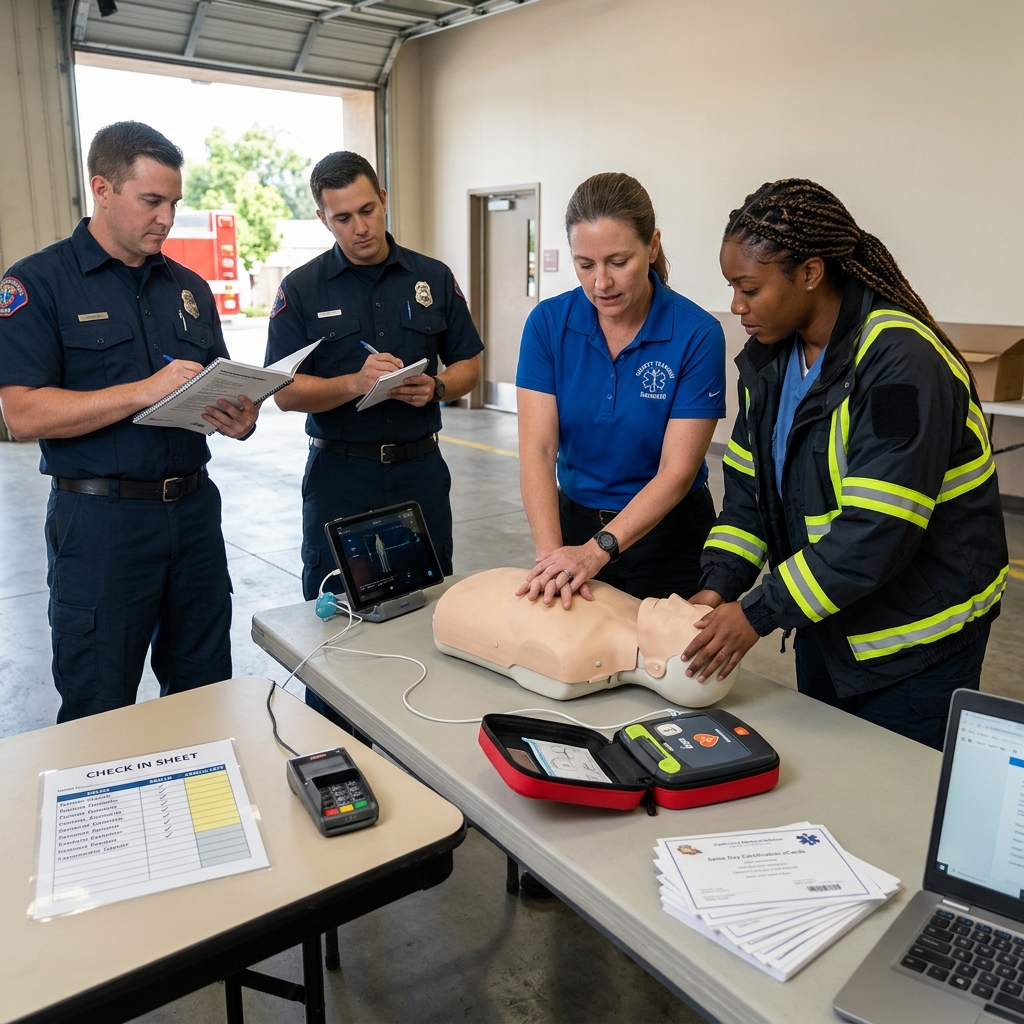
Our model integrates online modules with in-person skills sessions scheduled flexibly around your team’s needs. You don’t have to choose between convenience and rigor. Your paramedics complete the knowledge components on their own schedule, whether that’s 2 a.m. after a shift in Fresno or during a quiet call day in Concord. Then they attend a focused, hands-on skills session where our instructors walk through practical scenarios and provide direct feedback on chest compression technique, airway management, and protocol application.
This approach cuts training time to a fraction of what traditional full-day sessions require. Your team doesn’t lose four uninterrupted hours of availability. Instead, the knowledge load spreads across a two-week period, and the skills session is targeted to what matters most: muscle memory and confidence under pressure.
We also build in verification checks. Your paramedics track their own progress through our platform, and you receive automated updates on who’s completed what component. No more spreadsheets or follow-up emails asking where someone left off.
100+ Training Locations: Training Your Team Where They Work
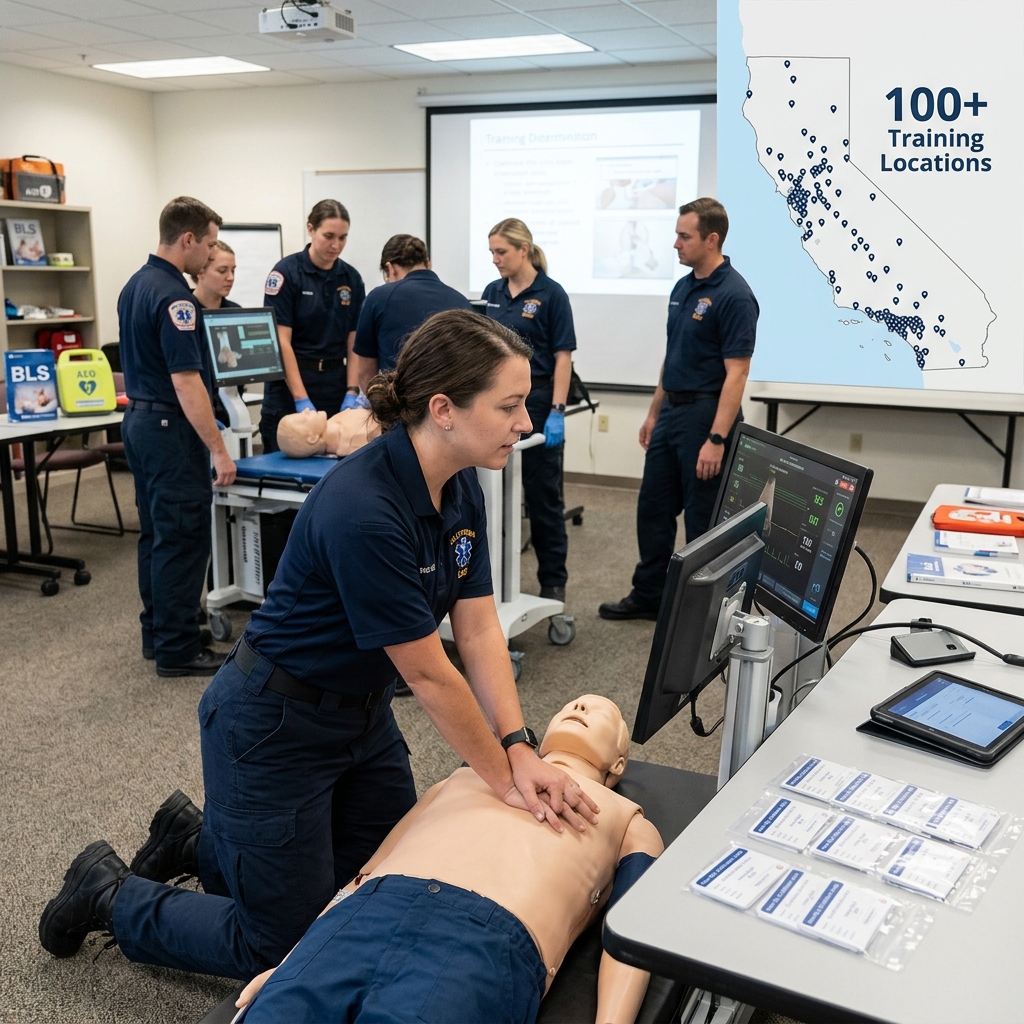
We operate over 100 training locations throughout California. Whether your station is in rural Davis, the Bay Area corridor from San Rafael to Sunnyvale, or the Central Valley stretching from Modesto to Visalia, we likely have a location within 15-20 minutes of your facility.
This proximity changes the logistics entirely. Instead of coordinating transportation or asking paramedics to drive an hour after their shift, your team attends skills sessions at a familiar, nearby venue. We have dedicated spaces in Sacramento (Arden, Midtown, Oak Park, Rosemont), San Francisco (Mission Bay, Nob Hill, Sunset), San Jose (Downtown, Willow Glen), and smaller communities like Pleasanton, Larkspur, and Lodi.
For larger agencies, we can also schedule multiple cohorts across different weeks, allowing your entire roster to cycle through training without any single session pulling too many people at once.
Next step: Check our location finder to identify the venue closest to your station. Once you know where you’ll train, scheduling becomes straightforward.
Same-Day Certification Cards and Fast Checkout Process
Your paramedics need their certification card immediately after passing their skills assessment. We issue same-day cards at our locations, so your team walks out with valid credentials they can present to the hospital or present during credentialing reviews without delay.
The checkout process is streamlined. After successfully completing the skills component, your paramedics simply verify their information, receive their card, and are done. We handle all verification station protocols directly at our facilities, eliminating the need for separate trips or waiting periods.
This speed matters operationally. If someone’s certification expired and they’ve just completed their renewal, they can return to full patient-facing duties the same day. That’s immediate relief on your scheduling pressure.
Cost Savings with Our Low Price Guarantee for Group Training
We stand behind a low price guarantee for all group training. When you bring your EMS team to us, you receive our best pricing, and if you find a lower rate elsewhere for the same certification level, we’ll match it.
Group discounts are substantial. A team of 8-12 paramedics typically sees per-person costs drop 25-40% compared to individual enrollment. For an agency recertifying 20 paramedics annually, that translates to meaningful budget relief without sacrificing quality.
We also offer flexible payment options for larger groups. You can invoice as a team or distribute costs across multiple billing cycles if that aligns with your budget cycle.
What to do next: Contact us with your roster size and recertification timeline. We’ll provide a detailed quote that reflects group pricing and our low price guarantee commitment.
RQI Simulation Stations with VAM Technology for Real Skill Building
Our training facilities include RQI (Resuscitation Quality Improvement) simulation stations equipped with VAM (Visual Airway Management) technology. This isn’t basic manikin practice. Your paramedics train on equipment that provides real-time feedback on compression depth, rate, and hand placement—the precise metrics that distinguish effective CPR from inadequate technique.
VAM technology lets trainees visualize airway positioning and tube placement, building the spatial awareness critical for intubation. For paramedics, these skills deteriorate without regular, deliberate practice. Our simulation stations bridge that gap by providing realistic, feedback-rich scenarios that reinforce the muscle memory your team depends on in the field.
We rotate scenarios and difficulty levels based on your team’s experience. New paramedics might start with straightforward single-patient cardiac arrest. Experienced crews might work through multi-casualty situations or cases with complicating factors like obesity or pregnancy.
Flexible Scheduling That Works Around Call Shifts and Station Operations
We understand that EMS operations don’t pause for training. A paramedic might be available Tuesday but pulled for an emergency call Wednesday. We offer rolling enrollment windows and makeup sessions, so if someone misses their original slot, they can complete the skills component within two weeks at a nearby location.
For larger agencies in areas like Oakland, San Francisco, or Sacramento, we can organize dedicated group sessions scheduled specifically around your operational calendar. If your station rotates crews on a three-week cycle, we schedule training during the lightest call period, minimizing impact on service delivery.
Evening and weekend sessions are available at most locations to accommodate paramedics coming off night shifts or those preferring to train outside their station hours.
Compliance-First Instruction Aligned with Current Standards
Our instructors are experienced healthcare professionals—many are current or former paramedics and nurses. They teach to current protocols and standards, ensuring your team receives instruction that aligns with California emergency medicine guidelines and the competencies your hospital partners expect.
Every course covers the essentials: high-quality CPR, rhythm recognition, medication administration, and post-resuscitation care. We don’t cut corners on content to save time. Instead, our blended approach ensures your paramedics retain knowledge and build skills efficiently without sacrificing depth.
Your team also gets real-world context. Instructors draw on clinical experience to explain why certain techniques matter, how they apply in the back of an ambulance, and what hospitals will assess when your crew arrives with a critical patient.
On-Site Group Training Options for Your Full Team
For agencies with 15 or more paramedics, we offer on-site training at your station. We bring instructors and equipment to you, eliminate travel time, and train your entire roster in one coordinated block.
This option works especially well for busy agencies in Fremont, Hayward, Stockton, or other high-volume systems. Your team trains between calls or during scheduled downtime. On-site training also reinforces team cohesion—your paramedics see colleagues succeed, ask questions in familiar surroundings, and return to daily operations with renewed confidence.
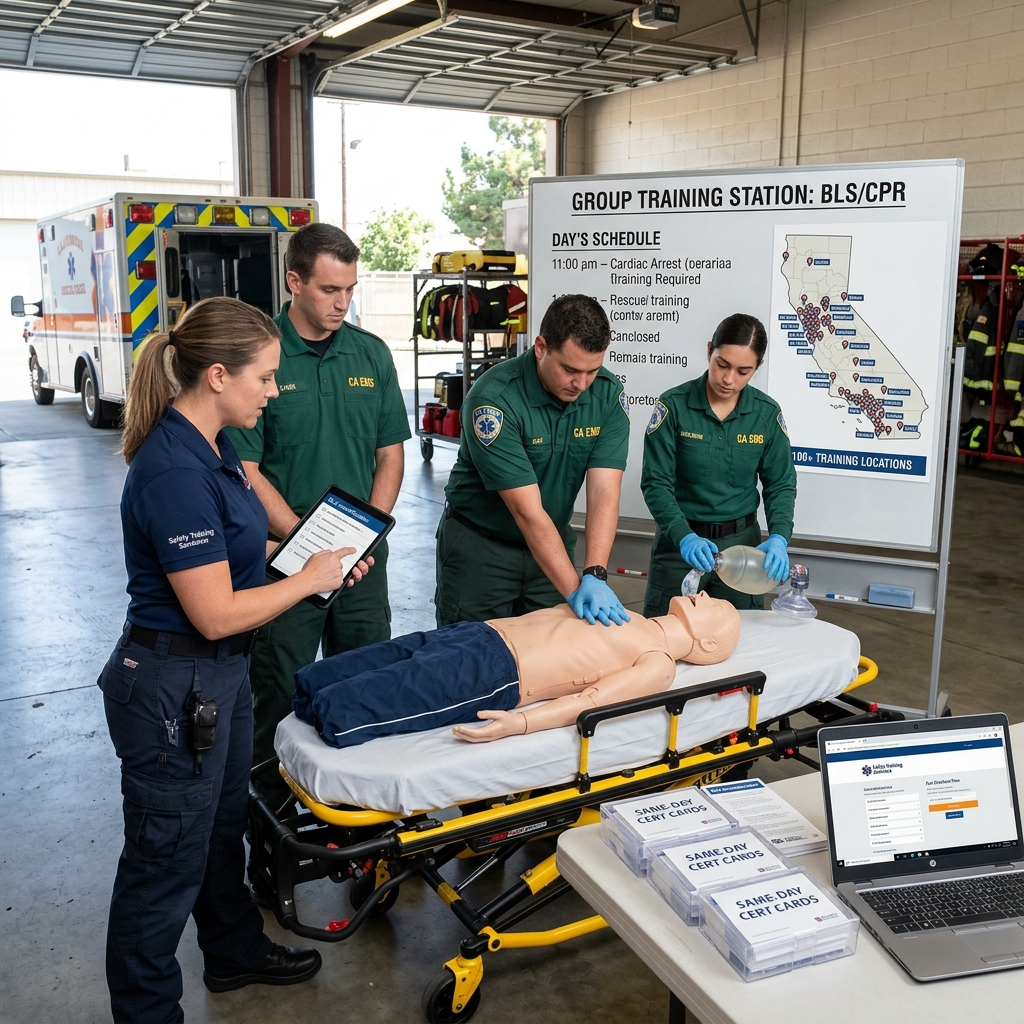
We handle all logistics: equipment setup, materials, scheduling coordination with your shift commanders, and completion documentation. You focus on operations while we ensure training happens.
Partner with California’s Trusted Training Center Since 1989
We’ve been training California emergency responders for nearly four decades. That longevity reflects consistent quality, instructor expertise, and a deep understanding of what EMS agencies actually need. Paramedics and nurses throughout California know us as a reliable, professional training partner.
We maintain current curriculum, invest in modern simulation technology, and adapt our approach as medical guidelines evolve. When you partner with us, you’re not just enrolling in a class. You’re connecting with an organization that views your team’s readiness and professional development as our priority.
Get Your EMS Group Certified This Month
Your team’s certification timeline doesn’t have to trigger stress and scrambling. We make group training accessible, affordable, and integrated into your operational reality.
Begin by identifying your recertification needs and preferred training locations. Contact us with your roster size, preferred dates, and any special considerations (e.g., new hires, specialized certifications). We’ll coordinate a training plan that works for your schedule and budget, issue same-day cards, and ensure every paramedic returns to duty fully credentialed and confident.
We’re ready to serve your EMS group. Reach out today and let’s build a training schedule that fits your team.
Register for a class today.
Frequently Asked Questions (FAQ)
How do we deliver certifications so quickly for EMS groups?
We use a streamlined process that combines virtual coursework with in-person skills validation at our RQI simulation stations. Once your team completes the online portion, they come in for hands-on practice with our VAM technology equipment, and we issue same-day certification cards immediately after successful demonstration. This blended approach means your crew can stay operational while meeting all compliance requirements without extended downtime.
Can we bring our entire EMS station in for group training?
Yes, we offer dedicated on-site group training at your station or one of our 100+ California locations that work best for your schedule. We customize the session around your call shifts and operational needs, and we provide volume discounts that deliver real cost savings compared to sending team members individually. Our instructors bring everything needed, so your team gets certified without traveling across the region.
What makes your pricing different for EMS recertification programs?
We maintain a low price guarantee across all our courses, which means we regularly undercut what other providers charge for the same certifications. For groups, we layer additional discounts on top of our already competitive rates, so larger EMS teams see meaningful savings that add up across multiple recertifications each year. We don’t hide fees or require memberships, so the price you see is exactly what you pay.