
Table of Contents
- The Real Cost of Certification Gaps in Your Clinic
- Why Traditional Training Models Drain Your Schedule
- How Blended Learning Keeps Your Team Operational
- Our Multi-Location Network Puts Certification Within Reach
- Flexible Scheduling Options That Work Around Your Workflow
- Same-Day Certification Cards Get Staff Back to Patients
- Group Training Discounts for Entire Clinical Teams
- Low Price Guarantee Protects Your Training Budget
- RQI Simulation Technology Ensures Competency First Time
- Compliance Standards Without the Operational Burden
- Getting Your Team Certified Without Sacrificing Patient Care
- Frequently Asked Questions (FAQ)
The Real Cost of Certification Gaps in Your Clinic
When staff members lack current Advanced Cardiovascular Life Support (ACLS) or Pediatric Advanced Life Support (PALS) certifications, your clinic faces more than compliance risk. You lose operational flexibility, face potential liability, and restrict which team members can respond in critical moments. A single nurse or EMS professional without valid credentials during an emergency can force you to turn away patients or redirect them to competitors.
The financial impact runs deeper. When you schedule training during business hours, patient care suffers. If a physician or dentist spends a full day in training, that’s lost revenue. If you send staff in staggered sessions to avoid shutdown, you multiply training costs across payroll, scheduling overhead, and instructor fees. Multiply this across a team of ten providers, and certification training becomes a genuine budget drain.
Beyond dollars, certification gaps create staffing anxiety. Clinicians worry about license renewal deadlines. Managers juggle scheduling conflicts. Your team feels the pressure of mandatory compliance requirements, and that stress affects morale and patient interactions. We understand this challenge because we work with clinics across California, from San Jose to Sacramento to San Francisco, facing identical scheduling constraints.
What to do next: Audit your current certification roster. Identify which staff members expire within the next 90 days, and calculate the true cost of traditional full-day training sessions.
Why Traditional Training Models Drain Your Schedule
Full-day, in-person-only certification courses demand a time commitment that small clinics struggle to accommodate. Your team sits in a classroom for six to eight hours when they could be treating patients, managing administrative work, or handling urgent calls. This model assumes that everyone learns at the same pace and can absorb dense procedural content in a single marathon session.
The scheduling bottleneck worsens when multiple clinicians need recertification simultaneously. You cannot send everyone at once without closing services. Staggering sessions stretches training timelines across weeks or months, delaying renewal dates and creating administrative friction. Staff members also dread the disruption, leading to procrastination and last-minute scrambles that compromise planning.
Geographic barriers add another layer of complexity. If your nearest training center is in Fremont or Pleasanton, travel time eats into productive hours. Commuting during peak traffic converts a four-hour course into a six-hour day when you account for transportation. That calculation multiplies across your entire team.
Traditional models also miss the reality of how healthcare professionals learn best. Clinicians perform better when they can study concepts independently first, then practice hands-on skills with immediate feedback. A single full-day session does not accommodate this natural learning progression.
What to do next: Calculate the total cost per staff member, including lost patient time, travel, and payroll. Compare that against what flexible training alternatives could save.
How Blended Learning Keeps Your Team Operational
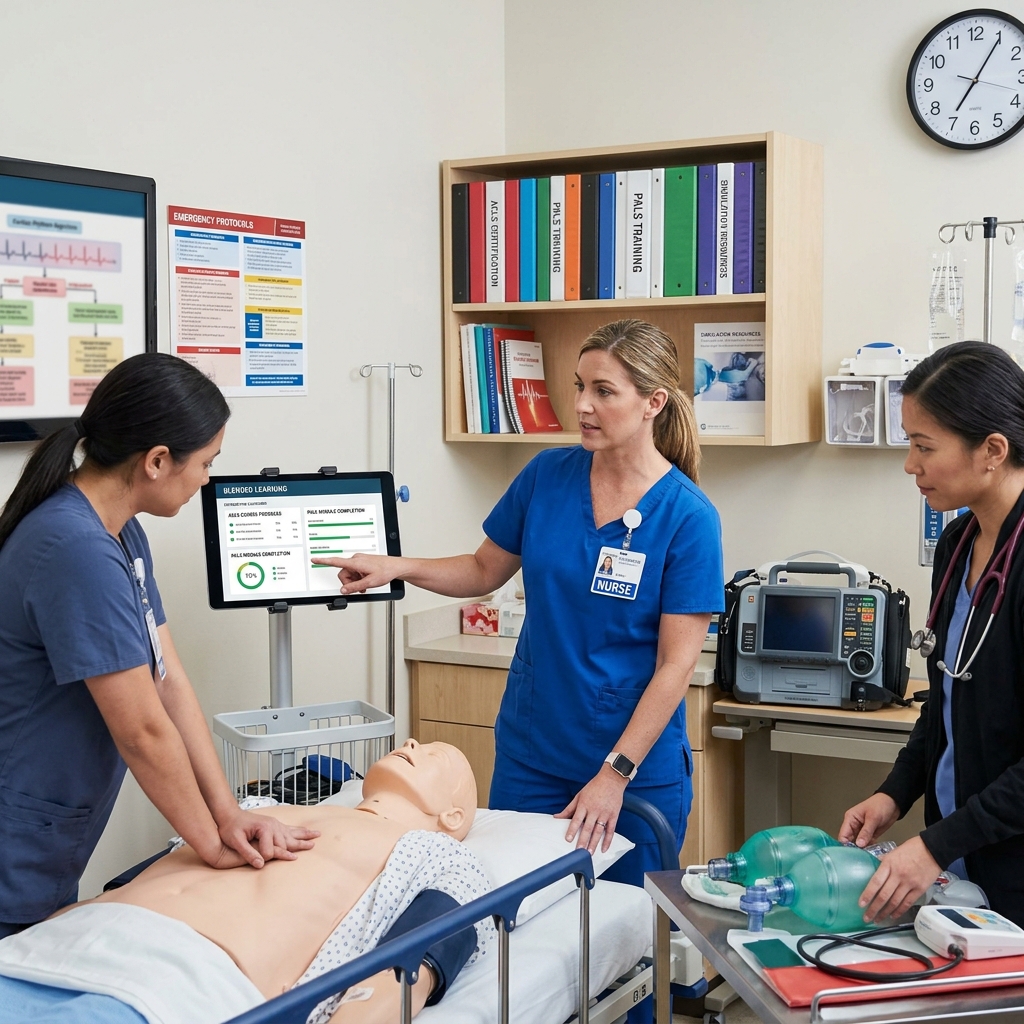
Blended learning separates conceptual study from hands-on skills practice. Your team completes theoretical modules online, on their own schedule, often during breaks or after hours. They review cardiac rhythms, medication protocols, and decision trees without leaving the clinic. Then they attend shorter, focused in-person sessions to practice skills on high-fidelity manikins with our certified instructors.
This approach reduces clinic disruption dramatically. A team member might spend two hours reviewing online content over three days, then attend a single two-hour in-person skills session. That is four hours total instead of eight, and the online portion happens outside business hours. Your clinic stays operational while staff still receive rigorous, hands-on instruction.
We have deployed blended learning across our California network, including locations in Oakland, Berkeley, San Mateo, and Walnut Creek. Clinicians tell us the flexibility transforms how they approach recertification. Parents in healthcare feel less guilty about time away. Busy practitioners appreciate the control over pacing. Managers appreciate faster staff throughput and reduced scheduling complexity.
The hands-on component remains non-negotiable for safety. Our instructors work directly with each participant on chest compressions, airway management, defibrillator operation, and scenario-based decision-making. You get the rigorous, skills-focused training your team needs without the all-day classroom burden.
What to do next: Ask your current training provider if they offer blended options. If they do not, request a demo of our online modules and schedule a skills session at a nearby location.
Our Multi-Location Network Puts Certification Within Reach
We operate over 100 training locations throughout California, from Visalia in the south to Redding in the north, with dense coverage across the Bay Area, Sacramento Valley, and Central Coast. Whether your clinic is in Campbell, Hayward, Davis, or Santa Rosa, a training site exists within reasonable distance.
This network eliminates geographic excuses for delay. Staff in Elk Grove can attend sessions in Sacramento. Clinicians in Newark or San Leandro can reach multiple Oakland or San Francisco locations. A dentist in Los Gatos has options in both San Jose and the surrounding region. Geographic accessibility removes one major barrier to timely recertification.
Our location strategy also enables scheduling flexibility. With multiple sites offering courses on different days and times, your team finds sessions that fit their personal workflow, not your clinic’s single preferred date. A scheduler in Concord might take evening classes. A physician in Fresno might prefer weekend sessions. This distributed capacity speeds up team certification without forcing everyone into identical timeslots.
The breadth of coverage also matters for onboarding. When new hires join your clinic, they can locate nearby training quickly. When someone moves or changes roles, they adapt to local offerings easily. We remove the logistics friction that delays certification and extends your vulnerability window.
What to do next: Search our location finder for sites near your clinic. Note the day and time options available at your nearest facility to understand what flexibility already exists.
Flexible Scheduling Options That Work Around Your Workflow
We offer morning, afternoon, and evening classes, plus weekend sessions at select locations. This flexibility recognizes that healthcare professionals have unpredictable schedules. A practitioner with heavy Monday clinic hours can attend Wednesday evening. An early riser prefers 6 AM sessions before patient schedules begin. Managers can stagger staff across multiple time slots without repeating instructors or courses.
Daily offerings at many locations mean your team never waits weeks for the next available class. If someone needs urgent recertification before a licensing deadline, we find solutions quickly. If you prefer to train your entire group at once, we accommodate group bookings with dedicated instructors and specialized scheduling.
The blended model also means your staff controls pacing. They complete online modules when they have fifteen-minute breaks between patients. They schedule their in-person session when demand dips. This personalized timing reduces stress and increases retention because people study when alert and motivated, not when forced into a rigid all-day format.
We also work with clinics in Modesto, Santa Clara, Stockton, and beyond to customize training calendars. If your team prefers monthly cohorts or quarterly group sessions, we build schedules around your operational rhythm instead of asking you to reshape your clinic around ours.
What to do next: Share your clinic’s busiest and slowest seasons with our scheduling team. They design a training calendar that minimizes impact on patient care.
Same-Day Certification Cards Get Staff Back to Patients
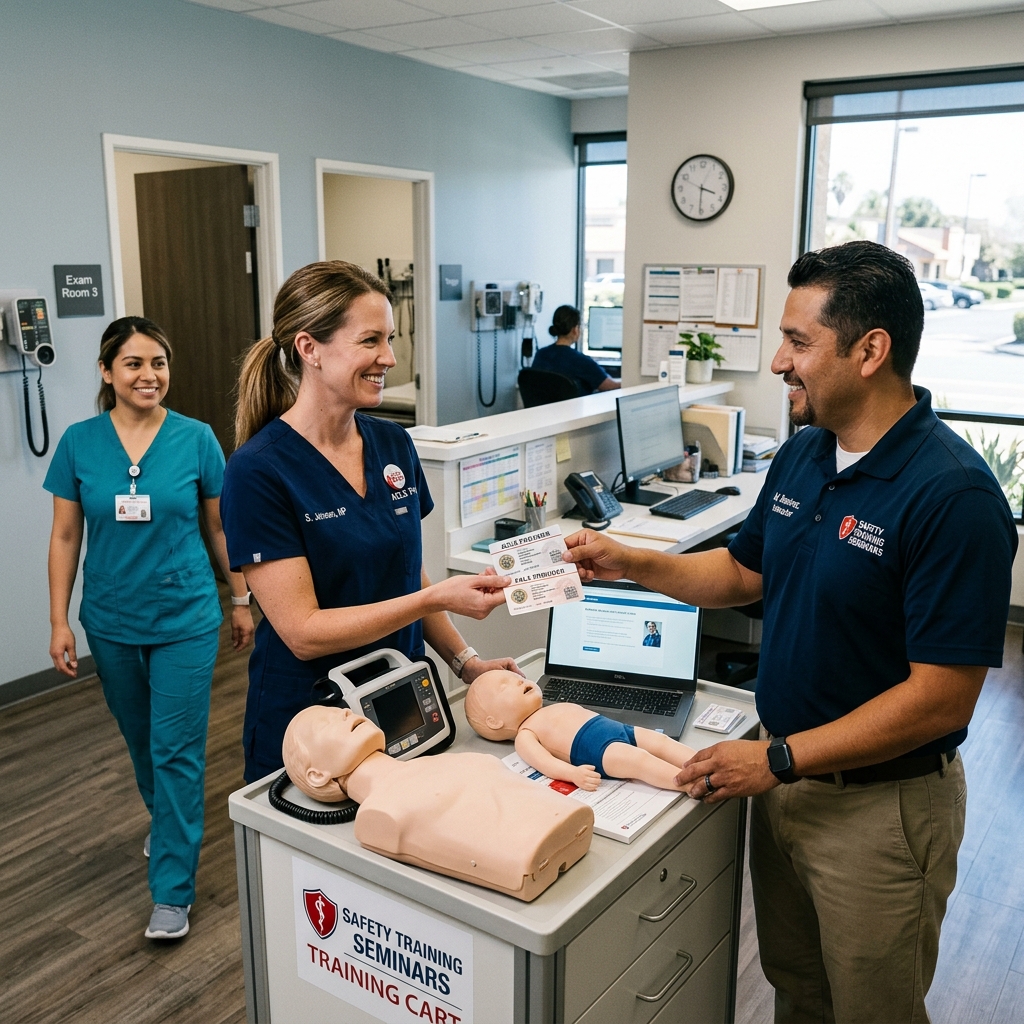
Verification of competency happens immediately after skills practice. Once your team member completes the hands-on assessment with our instructor, they receive their certification card the same day or within hours. No waiting. No separate credential processing. No administrative delays.
This rapid turnaround matters for compliance and morale. Your staff member feels validated immediately. Managers update credential files without chasing paperwork. Patient-facing evidence of current certification is tangible and instant. For roles requiring active ACLS or PALS cards during patient interactions, same-day issuance eliminates the gap between training completion and operational readiness.
We also provide digital verification through our system, allowing credential verification during hiring or licensing audits. Clinics in Petaluma, Vallejo, and other remote areas appreciate the certainty of immediate credentials rather than waiting for mailed certificates.
The same-day model also reduces administrative burden on your clinic. You do not need to track pending certifications, send reminder emails about credential delivery, or manage staggered go-live dates. Training concludes, certification activates, and your team returns to full operational capacity within hours.
What to do next: Confirm that your current training provider issues cards same-day or within 24 hours. If not, factor that processing delay into your recertification timeline.
Group Training Discounts for Entire Clinical Teams
When multiple staff members train together, we reduce the per-person cost significantly. Group CPR certification discounts apply to ACLS and PALS cohorts as well. A clinic sending five providers to a shared session pays less than five individual enrollments. Clinics in Livermore, Davis, and San Rafael leverage group pricing to train entire teams affordably.
Group training also creates operational efficiency. A single instructor manages your team for both online and in-person phases. Your scheduling coordinator books one cohort instead of individual appointments. Your budget forecast simplifies because costs are predictable and proportional to team size.
Beyond economics, group training builds team cohesion. Your staff reviews scenarios together, shares real-world challenges during simulations, and reinforces safety culture collectively. A dentist and hygienist training side-by-side understand each other’s roles better. Nurses from different shifts practice together and strengthen communication patterns that matter in emergencies.
We have trained entire clinics at once in locations from Antioch to Sunnyvale. The format works whether your team is three people or thirty. We coordinate directly with your clinic manager to customize the group experience around your team’s specialties and needs.
What to do next: Gather a list of staff members needing recertification within the next six months. Request a group training quote and compare it against individual enrollment costs.
Low Price Guarantee Protects Your Training Budget
We stand behind our pricing. Our low price guarantee ensures that your investment in training remains competitive. If you find comparable ACLS or PALS certification elsewhere in California at a lower rate, we match it. This commitment means your clinic can allocate training budget confidently without worrying that you overpaid.
The low price guarantee also simplifies vendor evaluation. You do not need to spend time shopping multiple providers to ensure you received the best deal. Our pricing is transparent, competitive, and backed by a promise. Clinics in Morgan Hill, Danville, and Napa appreciate this clarity when planning annual training budgets.
This pricing structure also eliminates hidden fees. No surprise instructor charges. No credential processing costs. No facility surcharges. The price you see is the price you pay, including materials, instruction, and same-day certification.
Value extends beyond price to what you actually receive. Our blended approach, flexible scheduling, multiple locations, and same-day cards represent far more value than traditional full-day classroom training at any price. Clinics realize they save money not just on tuition but on lost patient revenue, payroll during training time, and scheduling administration.
What to do next: Request formal pricing for your team size and preferred course format. Compare against your most recent training provider invoices to quantify savings.
RQI Simulation Technology Ensures Competency First Time
Our instructors use high-fidelity simulation manikins that respond realistically to compressions, medications, and procedures. These devices provide immediate feedback. If a team member performs chest compressions incorrectly, the manikin signals poor technique, and the instructor corrects form instantly. If airway positioning is off, ventilation resistance increases, guiding adjustment. This real-time feedback accelerates skill mastery.
Simulation-based practice also builds muscle memory. Repetition with realistic feedback creates automatic, reliable responses during actual emergencies. A nurse who practices a dozen compression cycles on our simulation equipment performs better under real stress because her body knows the correct motion instinctively.
We have deployed simulation technology at our high-traffic locations including Sacramento, Fresno, San Francisco, and San Jose. The investment in equipment reflects our commitment to competency-first training. Your team leaves certification not just with a card but with genuine, practiced confidence in life-saving skills.
Scenario-based simulations also prepare clinicians for decision-making under pressure. Our instructors run cardiac arrest situations where team members must recognize rhythms, choose interventions, manage family communication, and lead resuscitation. These realistic simulations are far more valuable than lecture-based instruction because they mirror actual emergency patterns and stress.
What to do next: Request a walkthrough of our in-person skills session format. Observe how our manikins provide feedback and how instructors guide technique correction.
Compliance Standards Without the Operational Burden
Your staff receives training that meets all licensing and credentialing requirements in California. Our courses align with current guidelines, emphasize evidence-based protocols, and include the procedural depths that regulatory bodies expect. Nurses, dentists, EMS personnel, and physicians complete rigorous instruction designed specifically for their roles.
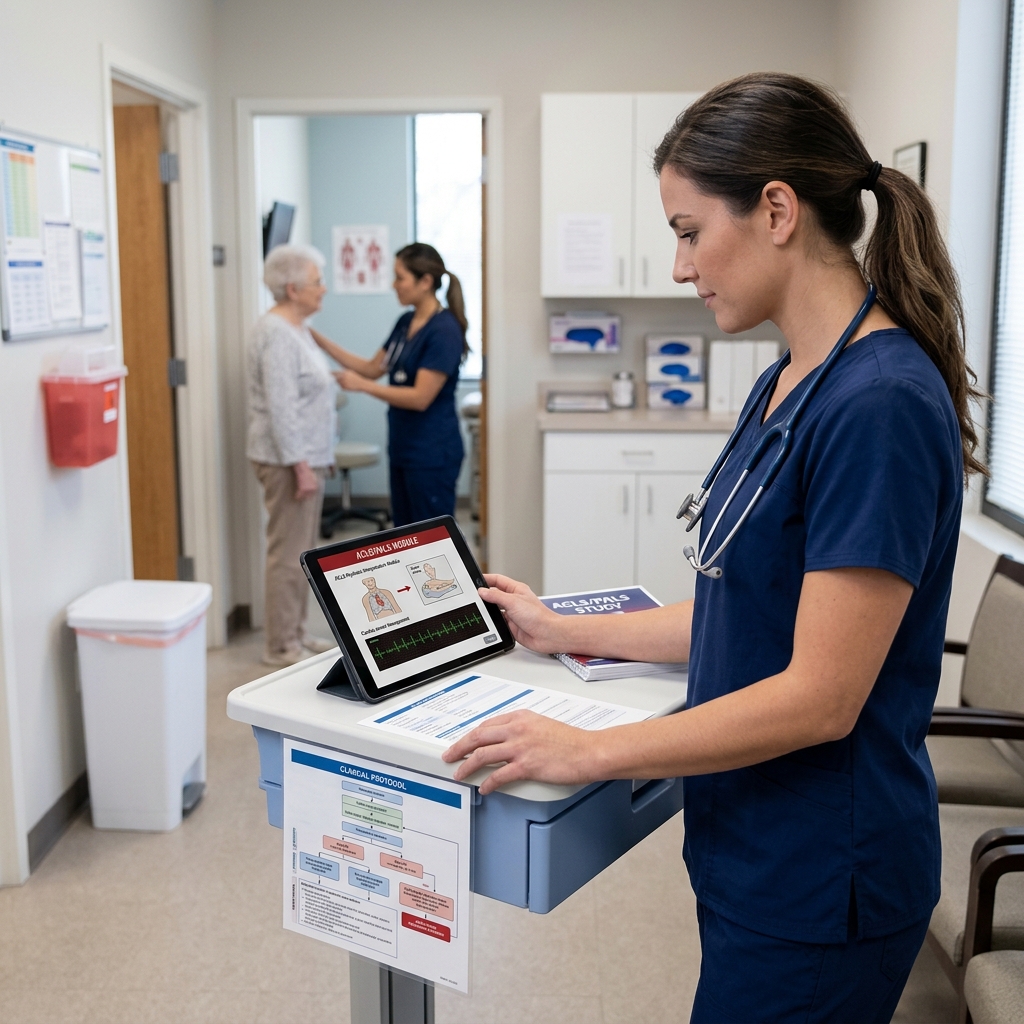
We handle the compliance documentation so your team focuses on learning. Instructors verify attendance, assess competency, generate credentials, and maintain records that satisfy board reviews and audits. When a licensing board asks for evidence of current ACLS or PALS training, you provide a credential card and our course documentation. No scrambling. No gaps.
Clinics in Woodland, Tracy, and Lodi appreciate this straightforward compliance pathway. They train staff confidently knowing that credentials meet every regulatory requirement without guessing whether off-the-shelf programs are sufficient.
The compliance rigor also protects your clinic legally. Your team has demonstrable, current life-saving training. If an emergency occurs and someone asks whether your staff was properly trained, your credentials answer decisively. This protection is particularly valuable for smaller practices where every decision balances competing demands.
What to do next: Review your state and local licensing requirements. Verify that ACLS and PALS training meets those standards. If unsure, contact our compliance team to confirm alignment.
Getting Your Team Certified Without Sacrificing Patient Care
The central challenge of staff training is this: how do you invest in safety without disrupting the clinic operations that depend on your team? Our blended approach, flexible scheduling, and distributed locations solve this tension systematically.
Your team spends minimal time away from patients. Online modules happen outside hours. In-person skills sessions last two to four hours and can be scheduled during slow periods. Staff rotates through training staggered across weeks, keeping the clinic fully staffed and operational every day.
Multiple team members training simultaneously at your nearest location further reduces disruption. A group from your clinic attends a single dedicated session. Scheduling is seamless. Cost per person drops. Your team returns to full operational strength faster.
The end result is a fully certified team without the operational chaos that traditional training models inflict. Your clinicians have current, validated life-saving skills. Your clinic maintains patient flow and revenue. Your licensing compliance stays current. And your training budget remains reasonable.
We partner with clinics across California, from Petaluma to Pleasanton, to make safety training an investment in your team rather than a burden on your operation. When you choose our courses, you choose certification that works around your workflow instead of asking your workflow to adjust to training schedules.
Schedule your team’s ACLS or PALS training today at a location near your clinic. Explore our flexible options, request group pricing, and experience how blended learning transforms safety training from a necessary chore into an efficient, manageable part of your professional development cycle.
Register for a class today.
Frequently Asked Questions (FAQ)
How does blended learning help our clinic staff get certified without disrupting patient care?
We combine virtual coursework with focused in-person skills sessions, so your team learns theory at their own pace and only needs to come in for hands-on practice. This approach cuts training time significantly compared to traditional full-day seminars, meaning fewer hours away from the clinic floor. Our staff can complete online modules during quieter periods and attend brief skills verification at one of our 100+ California locations near you.
Can we schedule group training for our entire clinic team?
We absolutely accommodate group training and offer substantial discounts when multiple staff members train together. Our flexible scheduling lets us work around your clinic’s busiest times so you’re never short-staffed. We’ll coordinate with you to find dates and times that minimize workflow interruptions while getting everyone current on their ACLS, PALS, or BLS certifications.
What happens if we find a lower price for the same certification elsewhere?
We guarantee our pricing is the lowest available for legitimate certification courses. If you locate a lower price for the same course type, we’ll match it. This commitment protects your training budget while ensuring you’re not compromising quality or instructor expertise for cost savings.