
Table of Contents
- 1. Establish a Centralized Certification Tracking System
- 2. Implement a 90-Day Pre-Expiration Renewal Schedule
- 3. Choose Training Providers with Flexible Scheduling Options
- 4. Utilize Blended Learning for Maximum Staff Participation
- 5. Conduct Quarterly Compliance Audits and Documentation Reviews
- 6. Create Role-Specific Training Pathways for Different Medical Staff
- 7. Partner with a Training Provider Offering Same-Day Certification Cards
- Frequently Asked Questions (FAQ)
1. Establish a Centralized Certification Tracking System
Managing CPR certification compliance across a large medical team isn’t just about scheduling classes and hoping everyone completes training. When you’re responsible for 40 or more healthcare professionals, each with different schedules, specialties, and certification requirements, the administrative burden can quickly spiral out of control. Nurses, dentists, EMS personnel, and clinical staff all need current certifications for job compliance and professional licensing. One person lets their BLS expire, and suddenly your facility faces regulatory exposure. The solution lies in building systematic processes that prevent lapses before they happen.
We’ve helped hundreds of medical teams across California tackle this exact challenge. Through our experience with everyone from small clinics in Davis to large medical networks across San Francisco, Oakland, and Sacramento, we’ve identified the practices that actually work. Here’s how to keep your entire team current and compliant without the chaos.
The foundation of any compliance program is visibility. You cannot manage what you cannot see. A centralized tracking system gives you a single source of truth for every team member’s certification status, expiration date, and training type.
Start by documenting each staff member’s current certifications, including the certification date, expiration date, and issuing credential. Use a shared spreadsheet or dedicated compliance software that your entire team can access. The key is standardization: everyone records information the same way, using the same date format and certification categories. This prevents confusion and makes audits straightforward.
Color-coding helps at a glance. Mark certifications expiring within 6 months in yellow, within 3 months in orange, and expired in red. This visual system lets managers immediately identify at-risk staff without digging through rows of data. Set automatic alerts so that when someone’s certification enters the yellow zone, a notification triggers for their supervisor.
Assign one person as the compliance coordinator. This doesn’t have to be a full-time role, but designating clear ownership prevents gaps. That person reconciles the system monthly, follows up on missing documentation, and coordinates with training providers.
Your next step: audit your current system this week. If you’re using scattered emails or spreadsheets across departments, consolidate everything into one master list.
2. Implement a 90-Day Pre-Expiration Renewal Schedule
Waiting until someone’s certification is about to expire creates urgency and scrambling. A 90-day lead time flips the script. You’re working proactively rather than reactively.
When a staff member enters their 90-day window, their supervisor receives notification. This gives them three full months to schedule training around their work calendar without last-minute panic. For medical teams, this buffer accommodates vacation time, shift rotations, and unexpected staffing gaps that inevitably occur.
The 90-day approach also smooths your training volume. Instead of having 15 people needing certification in one month, you’re distributing training across a quarter. This means you’re not scrambling to book classroom seats during peak demand periods, and your team members aren’t competing for limited slots.
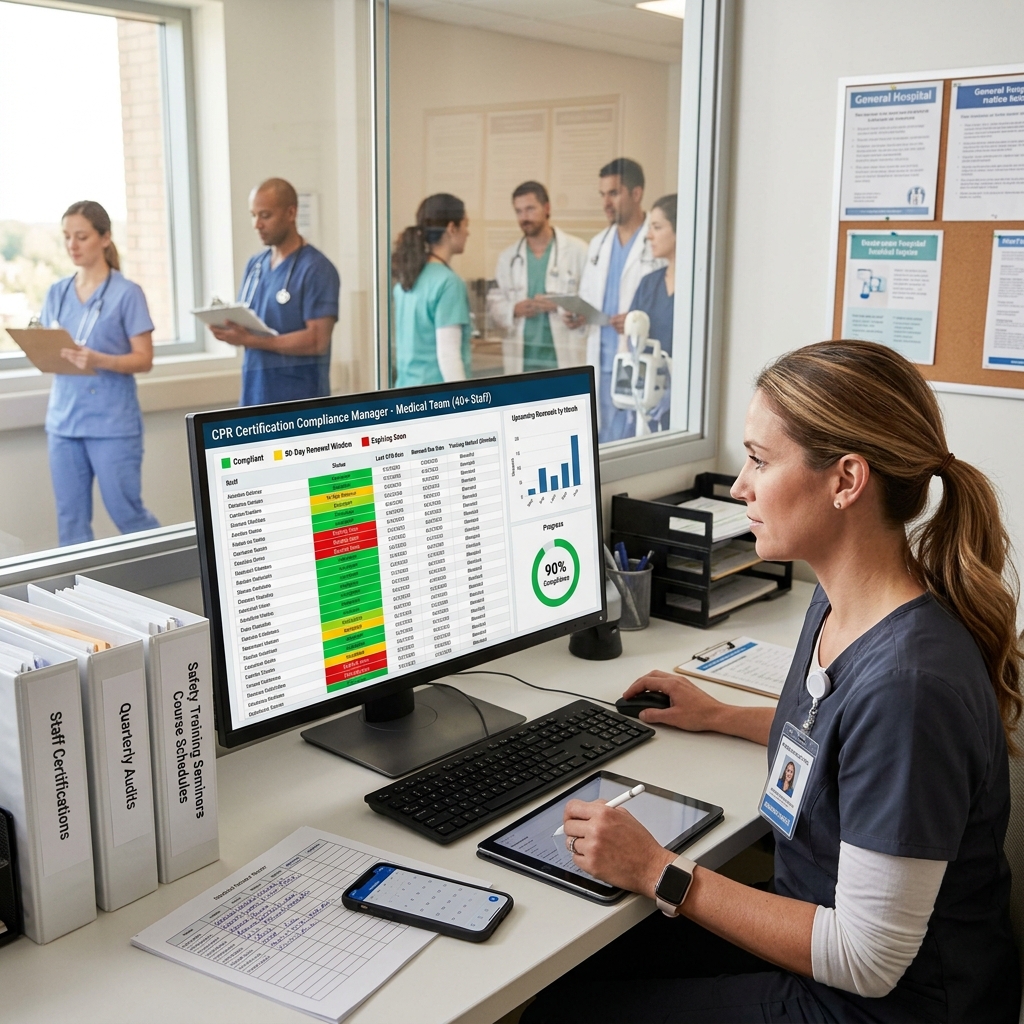
Create a renewal schedule visible to your entire team, much like you would with continuing education requirements. When people see that renewal is expected in Q2, they can plan accordingly and avoid the stress of last-minute arrangements. Staff members at facilities in Fremont, Hayward, and San Jose have told us this approach feels more manageable than the traditional “scramble three weeks before expiration” model.
Document your renewal timeline clearly in your employee handbook or compliance manual. Make it a shared expectation rather than something that surprises anyone.
3. Choose Training Providers with Flexible Scheduling Options
Your training provider can either help or hinder your compliance efforts. When a provider only offers classes on Tuesday mornings and your team works rotating 12-hour shifts, scheduling becomes a nightmare. You need a partner with genuine flexibility built into their operations.
Look for providers who offer classes across multiple time slots: early morning sessions for day-shift staff, evening classes for those working afternoons, and weekend options for people with complex schedules. The ideal provider also maintains training locations near your team’s workplace. If your main facility is in Napa but your provider is only in Visalia, you’re adding travel time that makes attendance harder.
Blended scheduling matters more than many realize. A provider offering both in-person skills practice and virtual coursework lets your team complete theory at home and practice hands-on skills during a shorter session. This is far more efficient than requiring a full eight-hour day away from clinical work.
We operate over 100 training locations throughout California, from Alameda to Woodland, and offer classes daily at multiple times. This geographic spread and scheduling frequency means your team members can typically find a nearby class that fits their availability. Whether your staff works in Redwood City, Sacramento, or San Ramon, we likely have options within a short drive.
When vetting providers, ask for their complete schedule for the next quarter and confirm they can accommodate your team size without wait-listing.
4. Utilize Blended Learning for Maximum Staff Participation
Traditional full-day classroom training works for some, but it’s increasingly unrealistic for busy healthcare professionals juggling patient care, family commitments, and other obligations. Blended learning combines self-paced online modules with shorter, focused in-person skills sessions. This format consistently achieves higher completion rates because it meets people where they are.
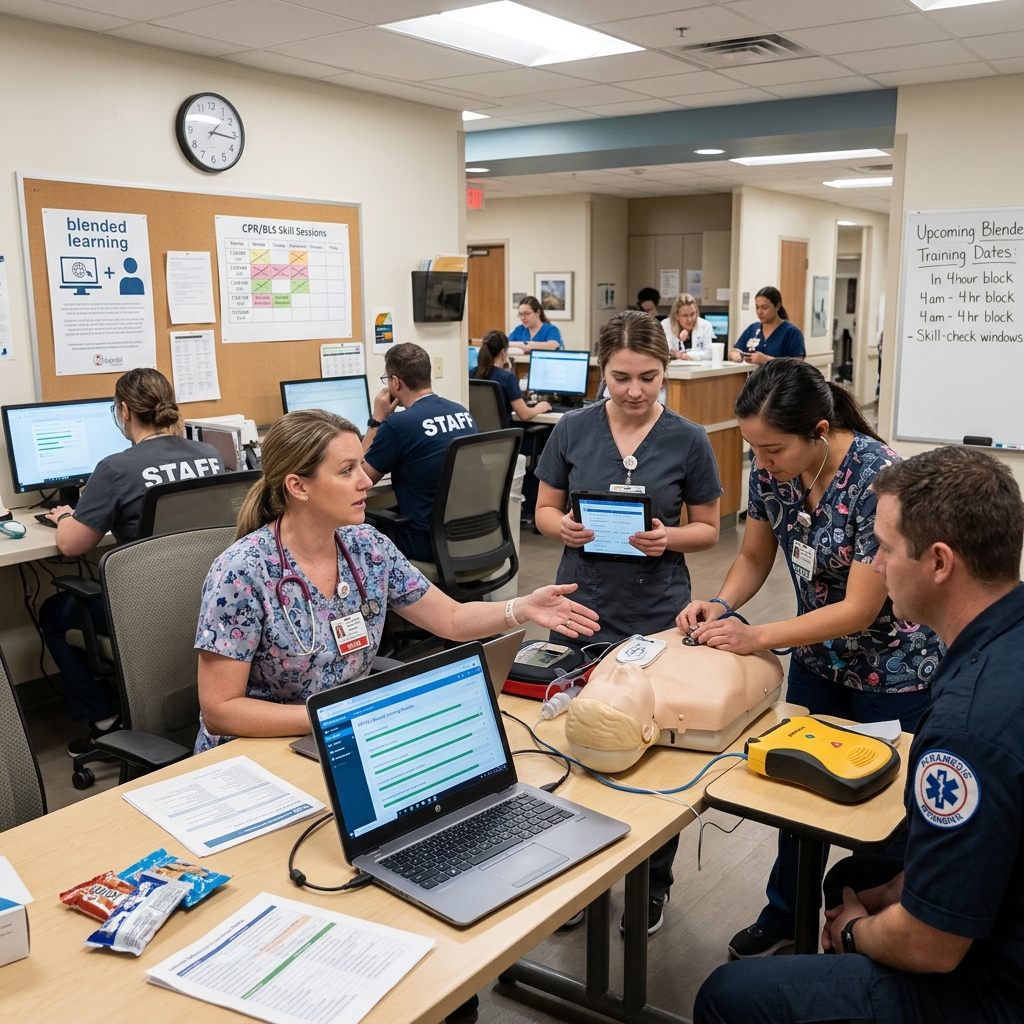
Your team members complete the knowledge portion online at their own pace, reviewing videos, taking quizzes, and refreshing their understanding of guidelines. Then they attend a shorter in-person session where they practice chest compressions, airway management, and scenario-based applications with a certified instructor. The instructor can identify gaps in technique and provide personalized feedback during this concentrated practice window.
Blended learning also accommodates learners who absorb information differently. Some people thrive in lecture settings; others do better with video modules they can pause and rewatch. This flexibility removes a barrier to participation.
We’ve found that staff from busy facilities in Oakland, San Francisco, and San Jose particularly appreciate blended training because it respects their demanding schedules while ensuring they develop genuine skill competency. They’re not sitting through hours of material they already understand, but they’re getting the hands-on practice that builds confidence and muscle memory.
Confirm with your provider that their blended model allows participants to complete theory online on their own timeline, with skills sessions scheduled around your team’s availability.
5. Conduct Quarterly Compliance Audits and Documentation Reviews
Knowing your team is current and knowing it with documented evidence are two different things. Regulatory bodies and legal reviews focus on your ability to demonstrate compliance, not just assume it.
Schedule quarterly audits on a fixed calendar. Set them for the same month each quarter, say January, April, July, and October. This predictability makes them easier to manage and gives staff clear expectations about when compliance reviews happen.
During each audit, pull your centralized tracking system and verify that documentation matches reality. Check physical certificates, verify with your training provider that records are accurate, and confirm expiration dates in your system match what training providers have on file. This catches data-entry errors before they become compliance issues.
Document your audit process thoroughly. Write down who conducted the review, the date, which staff members were included, whether any lapses were found, and what action was taken. This documentation becomes critical if anyone ever questions your compliance efforts. You can demonstrate that you had a systematic process and followed it consistently.
If an audit reveals someone’s certification has quietly expired, don’t assume negligence. Use it as a problem-solving moment: Was your notification system working? Did someone miss the renewal reminder? Did life circumstances prevent them from scheduling? Use what you learn to refine your process.
Facilities in Stockton, Modesto, and other larger centers often benefit from rotating auditors so different people review the system, catching blind spots that one person might miss.
6. Create Role-Specific Training Pathways for Different Medical Staff
Not every team member needs the same certification. Nurses, dentists, and EMS personnel have different statutory requirements. Creating role-specific pathways ensures everyone gets exactly what they legally need without unnecessary training.
Dentists typically need CPR and BLS (Basic Life Support). Nurses in critical care may need ACLS (Advanced Cardiovascular Life Support) in addition to BLS. EMS personnel need ACLS and possibly PALS (Pediatric Advanced Life Support). Administrative staff might need CPR only. Clarify these requirements through your state licensing board and your facility’s legal compliance team, then document them.
Build this clarity into your tracking system. When you view a staff member’s profile, their required certifications should be immediately obvious. This prevents confusion and ensures supervisors know who needs to take what.
Role-specific pathways also help with budget planning. If your team includes 30 nurses, 5 dentists, and 3 EMS personnel, you already know you need more BLS classes than PALS classes. This lets you negotiate better group rates with your provider. We offer Group CPR Certification Classes with corporate discount pricing, which becomes valuable when you’re coordinating training for multiple roles.
Tailor your compliance communications too. Nurses don’t need reminders about EMS requirements, and administrative staff don’t need information about specialty cardiac courses. Targeted communication feels respectful and reduces notification fatigue.
7. Partner with a Training Provider Offering Same-Day Certification Cards
This might seem like a small detail, but it’s the difference between theoretical compliance and operational readiness. Some training providers mail certificates weeks after training concludes. During that wait, your staff member has completed the course but has no credential to show if they need to verify their status immediately.
We issue same-day certification cards so your team members leave the course with their physical credential in hand. This matters if someone needs to prove certification for a shift, a patient procedure, or an external audit. There’s no gap, no wondering whether the certificate is arriving tomorrow or next week, no delays due to postal service timing.

Same-day cards also improve staff satisfaction. People feel immediately validated for their effort and investment. They walk out knowing they’ve met their compliance requirement with documentation in pocket.
We maintain training locations throughout California, from Folsom to Petaluma, and our instructors provide same-day credentials across all our BLS certification courses offered daily. This reliability eliminates a common source of administrative friction.
When finalizing your training provider partnership, confirm their credential delivery timeline in writing. Make it a contractual expectation so you’re never surprised by delays.
—
Managing CPR certification compliance for a large medical team requires systematic thinking, not just good intentions. The practices outlined here work together: centralized tracking gives you visibility, the 90-day schedule prevents crises, flexible providers accommodate real-world logistics, blended learning boosts participation, quarterly audits document your diligence, role-specific pathways prevent unnecessary training, and same-day credentials eliminate gaps.
We’ve built our entire operation around making this easier for healthcare teams across California. With over 100 locations, daily class scheduling, blended learning options, corporate discount pricing with a low price guarantee, and same-day certification cards, we’re designed to be the compliance partner that removes friction. Your team can focus on patient care while we handle the training logistics.
Ready to simplify your compliance program? Contact us to discuss a group training plan tailored to your team’s specific needs and schedule. We’ll help you build the system that keeps everyone current and your facility protected.
Register for a class today.
Frequently Asked Questions (FAQ)
How does your blended learning format help us manage CPR compliance across large medical teams?
We combine virtual instruction with in-person skills sessions, allowing your staff to complete coursework on their schedule while ensuring hands-on competency assessment. This flexibility means your team members can participate in training without disrupting patient care operations, and we offer over 100 training locations throughout California so your staff can find convenient local sessions.
Can you provide same-day certification cards for our medical team’s renewal dates?
Yes, we issue certification cards immediately upon successful completion of our courses at every location. We understand that compliance deadlines matter for your licensing and credentialing, so we’ve built our process to get your staff certified and documented on the same day they train with us.
What tracking support do we get to monitor our team’s certification expiration dates?
We recommend establishing your own centralized system to track renewal dates, and we suggest scheduling recertifications 90 days before expiration to avoid gaps in compliance. Our team can work with your scheduling needs to coordinate training dates across multiple staff members, and we maintain detailed records for each participant that you can reference for your quarterly compliance audits.