Table of Contents
- Why BLS Certification is Non-Negotiable for Your Dental Practice
- The Unique Challenges Dental Teams Face in Emergency Situations
- How Our BLS Program Meets California Dental Compliance Requirements
- Blended Learning: Flexibility That Works for Busy Dental Schedules
- Hands-On Skills Practice with Simulation Technology
- Fast Certification and Same-Day Cards for Your Staff
- Group Training Solutions and Corporate Pricing for Dental Practices
- Keeping Your Team Current with Recertification Options
- Getting Your Dental Office Started with BLS Training Today
- Frequently Asked Questions (FAQ)
Why BLS Certification is Non-Negotiable for Your Dental Practice
Your dental team encounters medical emergencies. A patient collapses during a routine cleaning. Someone faints in the waiting room. A severe allergic reaction unfolds mid-procedure. Without trained staff who know Basic Life Support (BLS) protocols, those critical first minutes can determine whether a patient survives with full recovery or faces permanent harm.
BLS certification isn’t optional for most California dental practices. State licensing boards, malpractice insurers, and professional standards all expect dentists and hygienists to maintain current certification. Beyond compliance, though, BLS training gives your team the confidence and muscle memory to act decisively when seconds count. Your staff will know exactly how to position a patient, perform chest compressions with proper technique, and operate automated external defibrillators (AEDs).
We’ve trained thousands of dental professionals across California locations including San Francisco, Oakland, Sacramento, San Jose, and Fresno. The dentists and hygienists who complete our program consistently report feeling more prepared and less anxious about potential emergencies.
The Unique Challenges Dental Teams Face in Emergency Situations
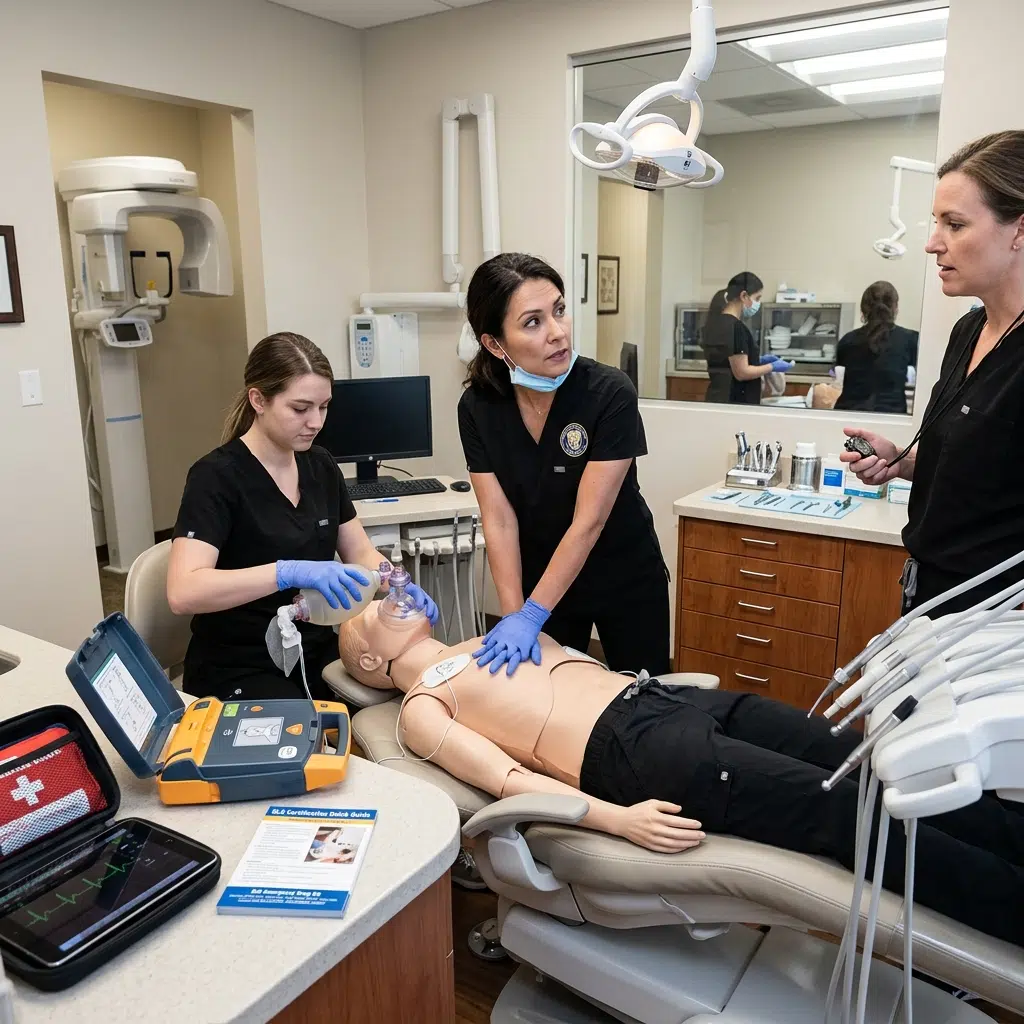
Dental emergencies differ from scenarios taught in generic CPR classes. Your operatory chair isn’t designed for CPR. Patients may be reclined at awkward angles. Equipment, suction hoses, and overhead lights create obstacles. Hand positioning becomes tricky. Space constraints force you to think differently about patient positioning and rescuer placement.
Additionally, dental anesthetics complicate response protocols. Local anesthetics can trigger allergic reactions or vasovagal responses. Nitrous oxide use requires specific considerations. Your team needs to recognize signs of adverse reactions specific to dental settings, not just generic cardiac events.
Dental staff also manage anxious patients regularly, which can mask early warning signs of serious problems. A patient’s trembling might seem like dental anxiety when it’s actually a sign of arrhythmia or shock. Training tailored to dental practice patterns helps your team distinguish between normal patient behavior and genuine medical emergencies.
How Our BLS Program Meets California Dental Compliance Requirements
We designed our BLS curriculum specifically to align with California state dental board requirements and current professional standards. Our instructors understand what dental licensing boards expect from practicing dentists and hygienists.
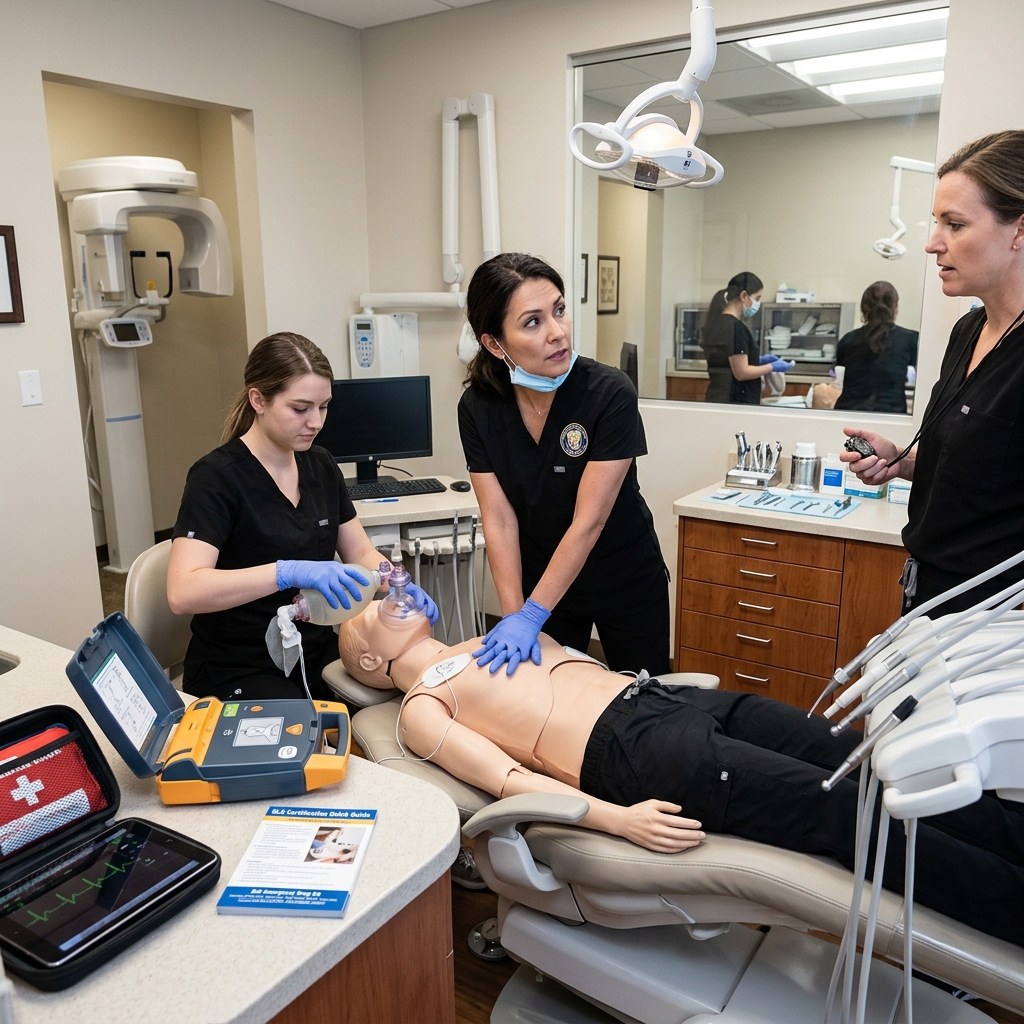
Our program covers:
- Two-rescuer CPR techniques adapted for dental operatory environments
- Recognition of cardiac and respiratory emergencies in dental patients
- Proper AED use within confined spaces
- Documentation and reporting obligations specific to California dental practice
- Communication protocols during medical emergencies
- Legal and liability considerations for California practitioners
Every course meets the standards required for licensure renewal and malpractice insurance coverage. Your staff will receive verification of completion that satisfies state requirements. We offer training at convenient California locations including Walnut Creek, Modesto, Santa Rosa, Stockton, and dozens more throughout the state, so you don’t need to send staff on lengthy commutes.
Blended Learning: Flexibility That Works for Busy Dental Schedules
Dental practices operate on tight schedules. You can’t close your office for two days while staff attend training, and coordinators can’t step away during patient appointments.
We offer blended learning that separates theory from hands-on skills. Your team completes the knowledge portion online, at their own pace, during off-hours. They watch video modules, review scenarios, and take quizzes from home or during lunch breaks. This eliminates sitting in a classroom for eight hours while covering basic concepts that work better in self-directed format.
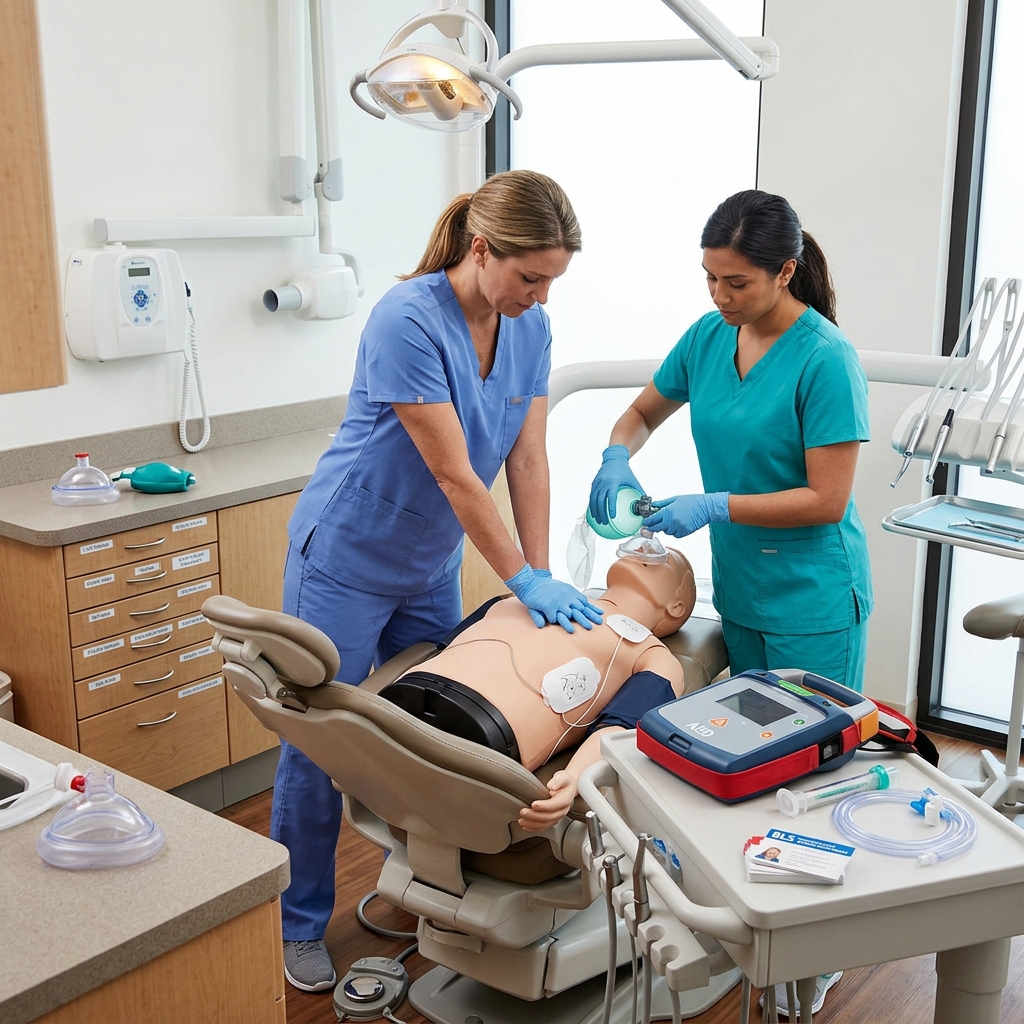
Then your staff attends a focused in-person skills session, typically two to three hours. During this time, our instructors guide hands-on practice with manikins and AED trainers. You get real technique feedback, scenario practice, and the confidence that comes from doing CPR with an expert watching and correcting your form.
The flexibility means you can schedule skills sessions during slower days or after hours. We operate training locations across the Bay Area, Central Valley, and Southern California, with options in Berkeley, Livermore, Concord, Danville, Pleasanton, and many other communities. Find a time and place that works for your staff’s availability.
Hands-On Skills Practice with Simulation Technology
Online videos can’t teach muscle memory. Chest compressions require proper depth, rate, and hand positioning. CPR effectiveness depends on technique, and technique only develops through repetition with corrective feedback.
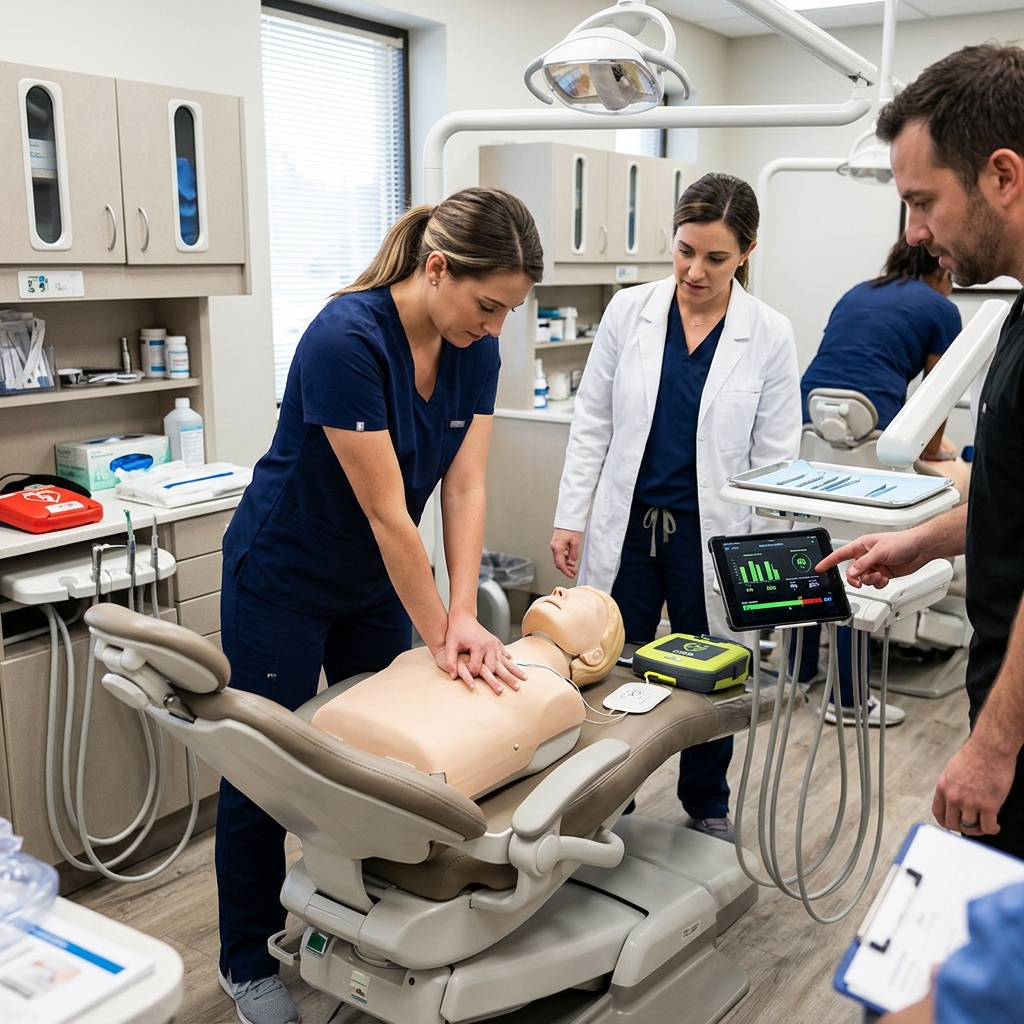
Our in-person sessions use realistic manikins that provide tactile feedback. When your staff compresses the chest, they feel resistance. They hear the click of proper depth. They practice two-rescuer scenarios where one person performs compressions while another manages the airway. Our instructors watch every compression and every breath, making real-time adjustments.
We also incorporate AED training with simulators that respond to your staff’s actions. They’ll practice shock delivery sequences, rhythmic analysis, and switching roles. By the time your dentist or hygienist returns to the operatory, they’ve practiced the actual motions dozens of times under expert guidance.
This simulation approach builds automaticity. During a real emergency, your brain doesn’t have time to deliberate. Your body performs the trained response. That automatic response is what we develop during hands-on practice.
Fast Certification and Same-Day Cards for Your Staff
After completing both online and in-person components, your staff receives certification cards the same day. No waiting for certificates to arrive by mail. No delays in updating your compliance records.
We issue cards on the spot because we understand that dental practices need documentation immediately. Your staff walks out with proof of current certification, ready to return to their positions. If anyone needs a digital copy for licensure board submissions, we provide that within minutes.
Certification remains valid for two years, giving your practice a clear recertification window. We’ll help you track renewal dates so no one accidentally lets certification lapse.
Group Training Solutions and Corporate Pricing for Dental Practices
When multiple staff members need certification, group training makes financial and logistical sense. Rather than scheduling individuals into different class dates, we offer Group CPR Certification sessions customized for your practice.
We can arrange training at your office location or at one of our 100+ California facilities. Your entire team trains together on a schedule that fits your practice calendar. Group pricing reduces per-person costs significantly compared to individual registrations, especially when you’re training five or more staff members.
For larger dental groups with multiple offices, we provide volume discounts and flexible scheduling across our network of locations serving Alameda, Sacramento, Fresno, and throughout California. Let us know your team size and preferred location, and we’ll create a training plan that works.
Keeping Your Team Current with Recertification Options
BLS certification expires after two years. Rather than wait until the last minute, we recommend planning recertification at least 90 days before expiration dates. Recertification follows the same blended format: online knowledge review plus hands-on skills session.
Recertification courses are shorter and more streamlined than initial training, since your staff already understands core concepts. The focus stays on reviewing updates, refreshing technique, and practicing skills under realistic conditions.
Many practices schedule all staff recertifications on the same day each year, rotating through classes so patient care continues uninterrupted. We have morning, afternoon, and evening options available at locations convenient to your practice.
Getting Your Dental Office Started with BLS Training Today
Starting is straightforward. Contact us with your team size, preferred location, and preferred dates. We’ll provide pricing and help you select dates that minimize disruption to your schedule.
Your initial step is choosing between individual or group training. Most dental practices find group training more efficient and cost-effective. Tell us how many staff members need certification and whether you prefer training at your office or at one of our nearby California locations like San Jose, Davis, Visalia, or Napa.
Next, we’ll set up online accounts for each team member. They complete the knowledge portion on their own timeline, then join the in-person skills session as a group. After passing the practical skills assessment, everyone receives same-day certification cards and documentation.
We stand behind our pricing with a low price guarantee. You won’t find better value for California-compliant BLS training tailored to dental practice. Your team gets expert instruction, hands-on practice, immediate certification, and the confidence that comes from professional life-saving training. Reach out today to schedule your dental practice’s BLS training and ensure your staff is truly ready for any emergency.
For further reading: Group CPR Certification.
Register for a class today.
Frequently Asked Questions (FAQ)
Why do we require hands-on skills practice in our BLS courses for dental teams?
We include hands-on simulation because practicing chest compressions and rescue breathing on manikins is the only way your team can build muscle memory for real emergencies. Our instructors guide each participant through proper technique during in-person sessions, ensuring everyone leaves confident and capable. When an actual patient emergency occurs, your staff will know exactly what to do without hesitation.
How quickly can our dental office get certified through your program?
We offer BLS certification courses daily across our 100+ California locations, and most participants complete training and receive their certification cards on the same day. Our blended learning approach means your team can complete online coursework on their schedule, then come in for just the skills portion, which takes only a few hours. This flexibility helps busy dental practices maintain compliance without disrupting daily operations.
What makes your group pricing different for dental offices?
We’ve structured our corporate rates specifically to make BLS training affordable when you’re certifying your entire dental team at once. Our low price guarantee means you won’t find better rates elsewhere in California, and we handle scheduling multiple team members across our various locations to match your staff’s availability. We understand dental offices operate on tight budgets, so we’ve designed pricing that protects your bottom line while ensuring everyone meets their certification requirements.