Table of Contents
- Why Healthcare Professionals Need Flexible Certification Training
- The Challenge of Balancing Work and Compliance Requirements
- How Blended Learning Solves the Scheduling Problem
- Our Virtual Instruction Meets California Standards
- In-Person Skills Sessions at 100+ Convenient Locations
- Same-Day Certification Cards and Immediate Compliance
- Low Price Guarantee Across All Our Programs
- RQI Simulation Technology for Real-World Competency
- Specialized Certifications for Nurses, Dentists, and EMS
- Our Track Record: Woman-Owned Since 1989
- Getting Started with Your Blended Certification Today
- Frequently Asked Questions (FAQ)
Why Healthcare Professionals Need Flexible Certification Training
Your nursing shift ends at 7 p.m., and you’ve got three days to renew your BLS certification before your hospital’s deadline. Finding time for a full in-person course feels impossible when your schedule already stretches thin. This is the reality for thousands of healthcare professionals across California, from nurses and dentists to EMS personnel who juggle patient care with mandatory compliance training.
We recognize that your professional licensing requirements don’t pause for convenience. CPR and advanced life support certifications are non-negotiable for your role, yet traditional training models often force you to choose between your job and your education. That’s why we built our training around your life, not the other way around.
The healthcare professionals we serve need certifications that fit reality: earned on their timeline, verified quickly, and delivered without sacrificing the hands-on competency that saves lives. Blended learning makes this possible by splitting instruction into manageable virtual sessions paired with focused in-person skills practice.
The Challenge of Balancing Work and Compliance Requirements
Most healthcare settings require current BLS (Basic Life Support) certification, with many nurses and dentists needing ACLS (Advanced Cardiovascular Life Support) or PALS (Pediatric Advanced Life Support) as well. Your employer expects these credentials maintained, yet scheduling a full day or multiple days for classroom training competes directly with patient care responsibilities and personal commitments.
The burden intensifies when recertification cycles cluster around the same months. A nurse in San Jose might face three renewal deadlines within a single quarter. An EMS team in Fresno coordinates certification across multiple paramedics, each with conflicting schedules. A dental practice in Redwood City needs all staff current simultaneously, yet finding a single date everyone can attend often requires weeks of planning.
Traditional single-block courses amplify stress because they demand full-day or multi-day commitments when your schedule doesn’t allow it. Missing a single classroom session means rescheduling the entire course. For professionals already stretched thin, the administrative friction becomes a barrier to staying compliant.
How Blended Learning Solves the Scheduling Problem
Blended learning separates what you can do asynchronously from what requires hands-on practice. You complete online modules at midnight, during your lunch break, or on a day off, learning cardiac physiology, algorithm recognition, and decision-making frameworks without an instructor watching the clock. Then you attend a focused in-person skills session where you practice compressions, airway management, and team communication under expert supervision.
This structure cuts scheduling friction dramatically. Instead of blocking an entire Saturday, you might spend two hours online across a few days, then attend a single two-hour skills verification station at a location near your workplace. Healthcare professionals in Oakland, Sacramento, and Bakersfield report that blended training fits their reality far better than traditional formats.

The virtual component builds knowledge at your pace. You rewatch a difficult concept, pause to take notes, and move forward only when you’re confident. The in-person session ensures you don’t just understand CPR but can execute it flawlessly under pressure, with an instructor correcting your hand placement and validating your readiness for real emergencies.
Our Virtual Instruction Meets California Standards
Our online curriculum aligns with current California healthcare training standards while maintaining the depth healthcare professionals expect. You’ll study the same evidence-based guidelines that in-person courses cover, delivered through clear video instruction, interactive scenarios, and knowledge checks that confirm you’ve mastered each section before moving to the next.
Your virtual sessions include real-world case studies: a patient presenting with chest discomfort during a shift, a pediatric emergency requiring rapid intervention, a team response requiring clear role assignment. These scenarios mirror what you’ll actually encounter, building clinical reasoning alongside technical knowledge.
All instructors delivering our virtual content hold current certifications and bring years of healthcare experience. They understand the pressures you face and design instruction accordingly, cutting unnecessary complexity while ensuring you grasp the principles that guide every intervention.
In-Person Skills Sessions at 100+ Convenient Locations
We operate over 100 training locations throughout California, from coastal communities like San Francisco, San Rafael, and Santa Cruz to inland regions including Modesto, Visalia, and Redding. Whether you work in a busy urban hospital or a smaller rural facility, you’ll find a skills session within reasonable distance.
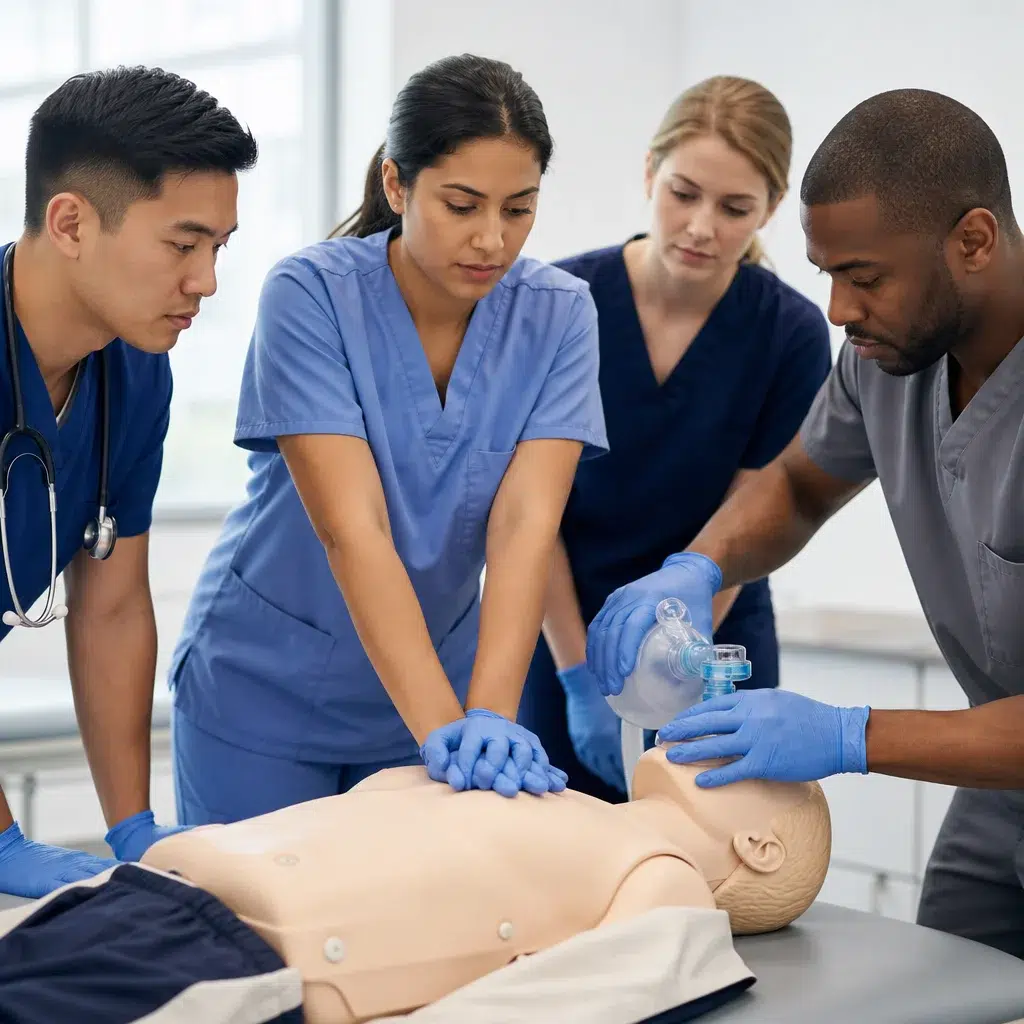
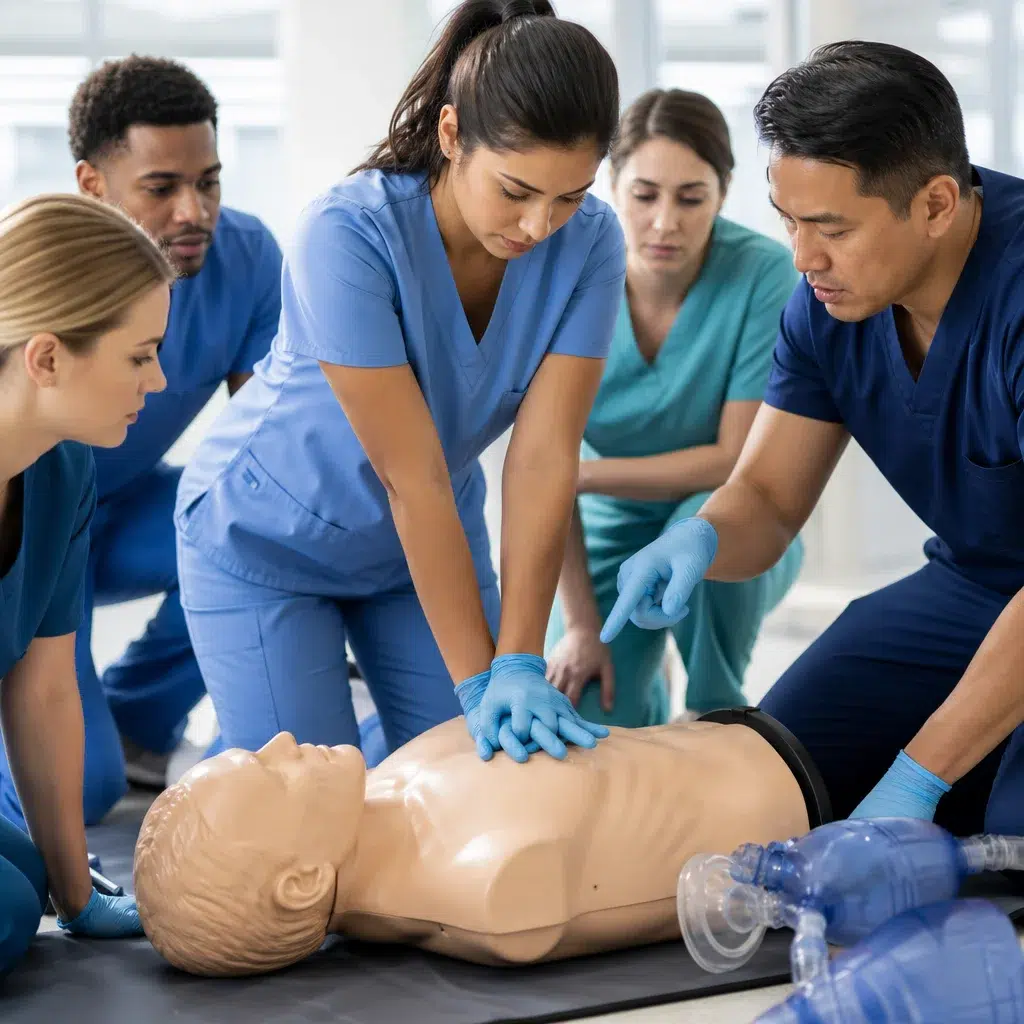
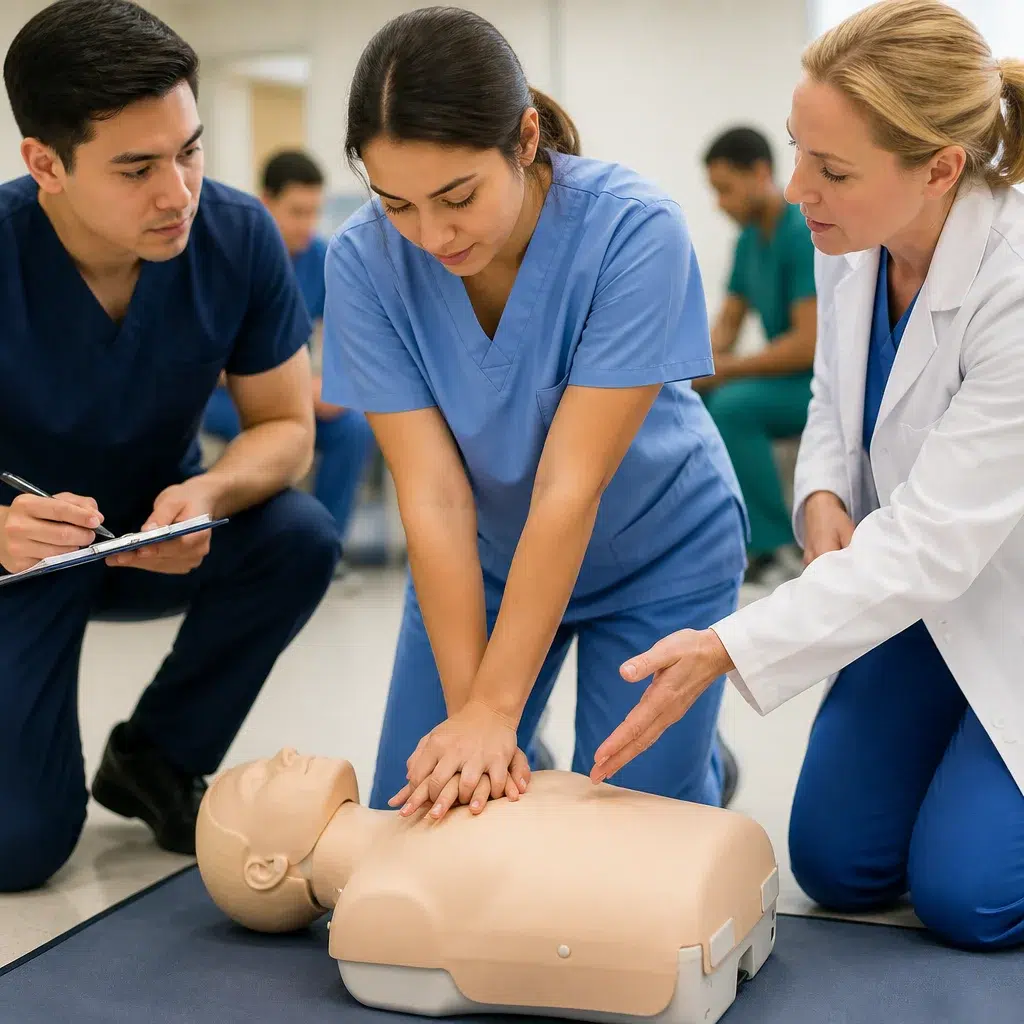
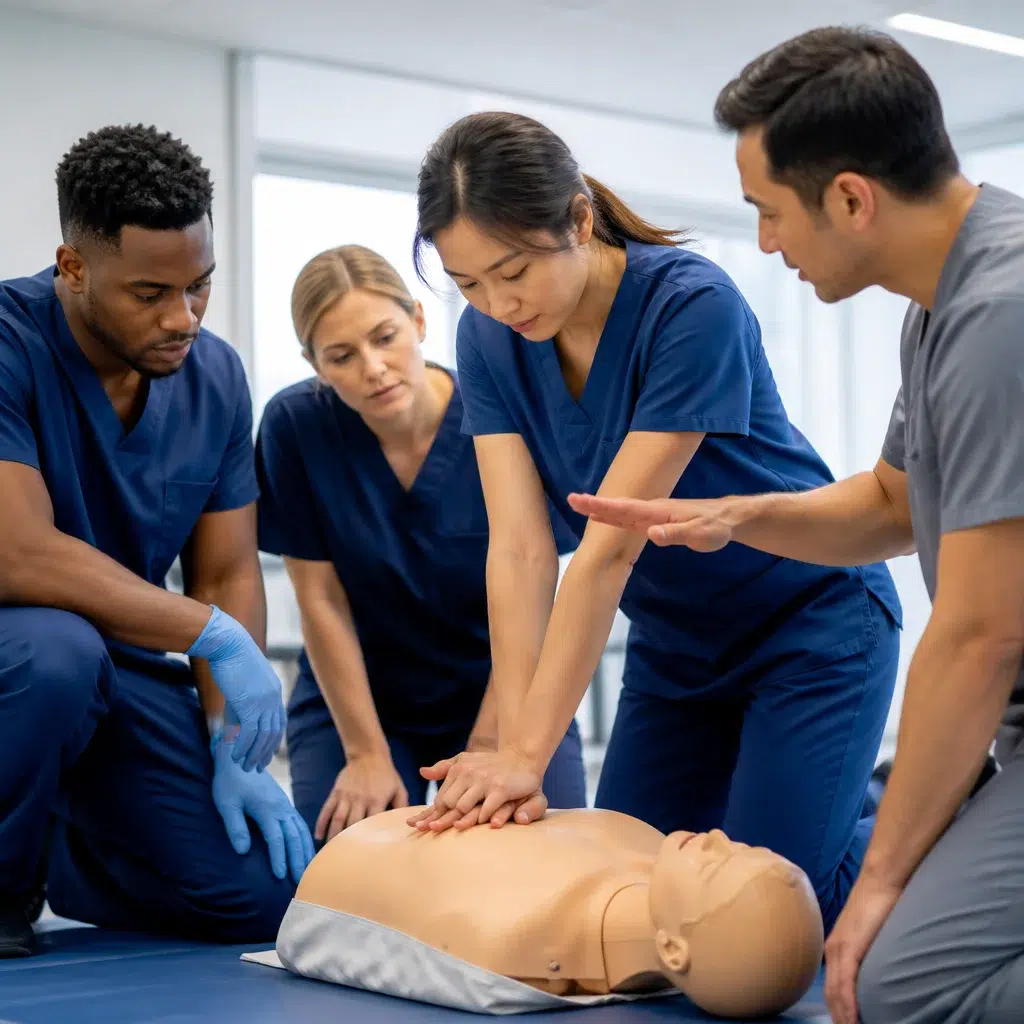
Your hands-on session typically lasts two to three hours and focuses entirely on demonstration, practice, and feedback. You’ll perform CPR compressions on a manikin until your technique becomes reliable, practice rescue breathing and defibrillator operation, and if you’re pursuing ACLS or PALS, drill rhythm recognition and medication administration under realistic conditions.
Locations like our centers in San Jose, Sacramento, Fremont, and other major hubs offer multiple session times throughout the week, including early mornings and evenings for healthcare shift workers. We schedule skills sessions frequently so you never wait weeks for an opening.
Same-Day Certification Cards and Immediate Compliance
Once you pass your in-person skills assessment, you receive your certification card before leaving the session. No waiting for mailed credentials, no administrative delays. Your employer sees proof of current certification immediately, and you remain compliant with licensing requirements without any gap.
This speed matters for healthcare professionals on tight renewal timelines. If your BLS expires in two weeks and you’ve just completed training, that same-day card means you’re immediately current. Nurses in Hayward, dentists in Campbell, and paramedics in Stockton appreciate certification they can show their employer or licensing board the moment they finish.
Your digital certificate is also available instantly through our secure portal, useful for documentation purposes and easier to share with multiple employers or licensing boards if needed.

Low Price Guarantee Across All Our Programs
We stand behind our low price guarantee, meaning you won’t pay more for our blended courses than you’d pay elsewhere in California. We’ve built efficiency into our blended model: streamlined virtual delivery reduces instructor overhead, and focused skills sessions maximize practice time without wasted instruction.
That efficiency translates directly to your wallet. A BLS blended course typically costs less than a traditional full-day classroom version, and ACLS or PALS courses follow the same philosophy. We pass savings to you without cutting quality or instructor expertise.
For healthcare organizations coordinating group training, our corporate discounts make compliance even more affordable. Contact us for pricing on team certifications across your clinic, hospital department, or emergency response unit.
RQI Simulation Technology for Real-World Competency
Our in-person skills sessions use RQI simulation technology, which provides real-time feedback on compression depth, rate, and hand placement during CPR practice. This technology removes guesswork from learning: you’ll see exactly whether your compressions meet the guideline standard of 100 to 120 beats per minute and 50 to 60 millimeters of depth.
Feedback loops accelerate competency development. You perform a round of compressions, the device provides data, you adjust technique, and you practice again until you’re consistently effective. By the time you complete your skills session, CPR becomes muscle memory rather than a procedure you perform hesitantly.
This same approach applies to ACLS and PALS training, where simulation helps you practice team communication, medication administration, and decision-making under conditions that mirror actual emergency departments and critical care units. The confidence you build translates directly to better performance when real emergencies arise.
Specialized Certifications for Nurses, Dentists, and EMS
We offer specialized tracks because your role shapes your training needs. Nurses typically pursue BLS and ACLS, sometimes PALS if you work in pediatrics or neonatal settings. Dentists need BLS and often ACLS given the risks of patient sedation and cardiovascular complications during dental procedures. EMS personnel require BLS as a foundation, with many pursuing ACLS and sometimes PALS for advanced-role certifications.
Each specialized track emphasizes scenarios relevant to your setting. Our ACLS curriculum for nursing includes code management in hospital units and ICUs. Our dental-focused BLS addresses the specific risks of sedated patients in clinical settings. Our EMS training incorporates field decision-making and resource-limited environments.
Professionals across California, from small practices in Morgan Hill and Los Gatos to major medical centers in San Francisco and Sacramento, trust our specialized approach because it reflects the actual work you do.
Our Track Record: Woman-Owned Since 1989

We’ve been training healthcare professionals since 1989, building expertise and relationships across California’s healthcare community. As a woman-owned business, we bring a perspective that emphasizes accessibility, affordability, and respect for the working professionals we serve.
Three decades of experience means we’ve refined every aspect of our training model through feedback from nurses, dentists, paramedics, and other healthcare professionals. We understand certification requirements in California because we’ve watched regulations evolve and helped thousands stay compliant through each change.
This longevity also means our instructor network is deep and experienced. Many of our instructors have taught with us for years, bringing both expertise and continuity to your learning experience.
Getting Started with Your Blended Certification Today
Beginning your certification is straightforward. Visit our website to select your course type (BLS, ACLS, PALS, or specialty certifications), choose a location convenient to you from our 100+ California centers, and pick a virtual schedule that fits your availability. You’ll receive login credentials for your online modules immediately.
Complete your virtual instruction at your own pace, typically over one to two weeks. Once finished, you’ll schedule your in-person skills session at your preferred location. Attend the two to three hour session, demonstrate competency, and leave with your certification card in hand.
Healthcare professionals in Alameda, Antioch, Berkeley, Chico, Fresno, Livermore, Modesto, Napa, Novato, Oakland, Petaluma, Pleasanton, Redwood City, Roseville, San Francisco, San Jose, San Leandro, Santa Rosa, Sunnyvale, Vallejo, Walnut Creek, and throughout California choose blended training because it respects their time while ensuring they’re genuinely prepared for emergencies.
Take the first step toward hassle-free certification today. Our team is ready to answer questions about course options, scheduling, and pricing for your specific situation.
Register for a class today.
Frequently Asked Questions (FAQ)
What makes our blended learning approach different from traditional in-person CPR courses?
We combine virtual instruction with hands-on skills sessions at over 100 California locations, so you can complete theory work on your schedule and practice critical techniques with our certified instructors when it’s convenient for you. This means you’re not waiting weeks for a full-day class or traveling long distances for every session. We’ve designed this model specifically for healthcare professionals balancing clinical shifts with mandatory certification requirements.
Can I get certified the same day I complete my course with us?
Yes, we offer same-day certification cards at our in-person skills sessions. Once you finish your virtual coursework and demonstrate competency during your hands-on appointment, you’ll receive your card immediately, so you’re compliant with your employer’s requirements right away.
How do we keep our pricing the lowest in California?
We operate directly with healthcare professionals rather than through middlemen, and our 30-plus years of experience streamlined our delivery model across our extensive location network. We guarantee our prices are the lowest available, and we’re transparent about what you pay. No hidden fees or surprise costs.