
Table of Contents
- Why Healthcare Professionals Need Flexible Certification Options
- The Challenge of Balancing Work and Mandatory Training Requirements
- Our Blended Learning Approach to CPR and ACLS Certification
- How Our Virtual Components Prepare You for Skills Sessions
- Our In-Person Skills Practice with Certified Instructors
- Real-Time Feedback and Hands-On Simulation Technology
- Same-Day Certification and Your Professional Timeline
- Scheduling Flexibility Across Over 100 California Training Locations
- Group Training Solutions for Healthcare Teams and Departments
- Our Low Price Guarantee on Quality Certification
- Getting Started with Your Blended CPR and ACLS Training Today
- Frequently Asked Questions (FAQ)
Why Healthcare Professionals Need Flexible Certification Options
You know your schedule doesn’t bend. Between patient care, shift rotations, and professional obligations, finding time for mandatory certification renewal feels impossible. We’ve designed our blended CPR and ACLS skills sessions specifically for nurses, dentists, EMS personnel, and other healthcare professionals across California who refuse to sacrifice quality training for convenience.
Flexible learning options aren’t luxuries—they’re necessities in healthcare. You need training that respects your time while delivering the hands-on competency your license depends on. Our hybrid approach combines online coursework with in-person skills practice, allowing you to learn theory when it fits your schedule and demonstrate proficiency when you’re ready. This model acknowledges that one-size-fits-all classroom days don’t work for professionals managing complex schedules.
Whether you’re based in Sacramento’s Midtown area, San Jose’s Downtown location, or working across the Bay Area, our blended format ensures you maintain your credentials without disrupting patient care or exhausting yourself. You complete foundational knowledge at home, then arrive for focused, efficient skills verification with our instructors.
Action: Start by identifying which certification you need—BLS, ACLS, PALS, or NRP. This determines your course length and helps us recommend the best blended path for your specific role.
The Challenge of Balancing Work and Mandatory Training Requirements
Mandatory certifications keep you licensed and compliant, but scheduling them is often the hardest part of renewal. Traditional all-day classroom sessions require you to request specific dates off, coordinate with your employer, and hope the timing aligns with your next certification window. For many of you, that’s unrealistic.
The real challenge isn’t learning CPR or ACLS fundamentals—most healthcare professionals understand these concepts. The challenge is fitting structured training into weeks already packed with twelve-hour shifts, on-call responsibilities, and clinical duties. Add travel time to training centers, and many of you postpone renewal until the last minute, increasing stress when deadlines approach.
We’ve observed this pattern across our training locations from Alameda to Visalia. Healthcare teams tell us they want to renew early but can’t coordinate logistics. Others complete online modules only to struggle finding in-person sessions nearby when their skills practice is due. This gap creates frustration and puts your employment at risk if renewal lapses.
Our blended model solves this directly. You control when you absorb the online content—evening, weekend, between shifts, or whenever your mind is freshest. Skills sessions are scheduled daily at over 100 locations, so you book the specific date that actually works for you, not the date the only available class runs.
Action: Check your current certification expiration date. If you’re within six months of renewal, blended training lets you start immediately without waiting for the next rigid class schedule.
Our Blended Learning Approach to CPR and ACLS Certification
We combine the flexibility of self-paced online learning with the critical hands-on practice that certifies you for real-world emergencies. Here’s how the structure works: you complete interactive online modules covering theory, algorithms, and scenario-based questions. Then you attend a focused in-person skills session where our certified instructors verify your competency through live practice and assessment.
This two-part approach is grounded in how healthcare professionals actually learn. You absorb knowledge best when you can pause, review, and integrate material at your own pace. You master skills through repetition and feedback from experienced instructors watching your technique in real time. Blending these modalities creates what we call combined virtual and classroom life-saving training—it’s more effective than either approach alone.
The online portion typically takes 1-3 hours depending on your certification level. You’ll review case studies, practice decision trees, and answer knowledge checks that ensure readiness for skills assessment. Then you come to a session at one of our California locations—whether that’s Fremont, Bakersfield, Santa Rosa, or Sacramento—and spend 2-4 hours with an instructor practicing compressions, airway management, and scenario response on realistic manikins.
You leave with verified skills and your credential. No waiting, no mailing anything in. Most participants complete the entire process in one to two weeks.
Action: Confirm your preferred learning style. If you’re comfortable with self-paced online work, blended training is ideal. If you need live instruction throughout, ask about our full in-person options.
How Our Virtual Components Prepare You for Skills Sessions
The online modules you complete before your skills session are more than knowledge checks. We’ve designed them to prepare your hands and muscle memory for the manikin practice ahead.
Each virtual component uses interactive scenarios that mirror real-world situations. You’ll see a patient presentation, decide your immediate action, and receive instant feedback on whether you chose correctly. This reinforces the decision-making process—recognizing cardiac arrest, knowing when to call for help, understanding when to start or continue compressions. By the time you arrive for skills practice, these patterns are familiar.
We also use the online section to teach you proper technique visually and verbally. Video demonstrations show compression depth, hand placement, and airway positioning. You understand the “why” behind each movement, which helps you execute it correctly during live practice rather than asking basic clarification questions when your instructor could be giving you personalized feedback.
The virtual platform also tracks your progress, so you arrive at your skills session prepared. Instructors can see which scenarios challenged you and prioritize those during hands-on time. This personalized approach means your two to four hours in-person focuses entirely on strengthening your weaknesses and building confidence, not reviewing material you’ve already mastered.
Participants across our locations from Livermore to San Rafael consistently report they felt ready when arriving for skills practice because the online modules built genuine understanding, not just awareness.
Action: Schedule your skills session only after completing all online modules. This ensures you’re not rushing through theory while an instructor watches. Most people complete online work within 5-7 days.
Our In-Person Skills Practice with Certified Instructors
When you arrive for your skills session, you’re in a training facility staffed by certified instructors with extensive healthcare experience. Many of our instructors are active nurses, paramedics, or physicians who understand exactly why these skills matter in your daily work. This matters because instruction feels relevant, not abstract.
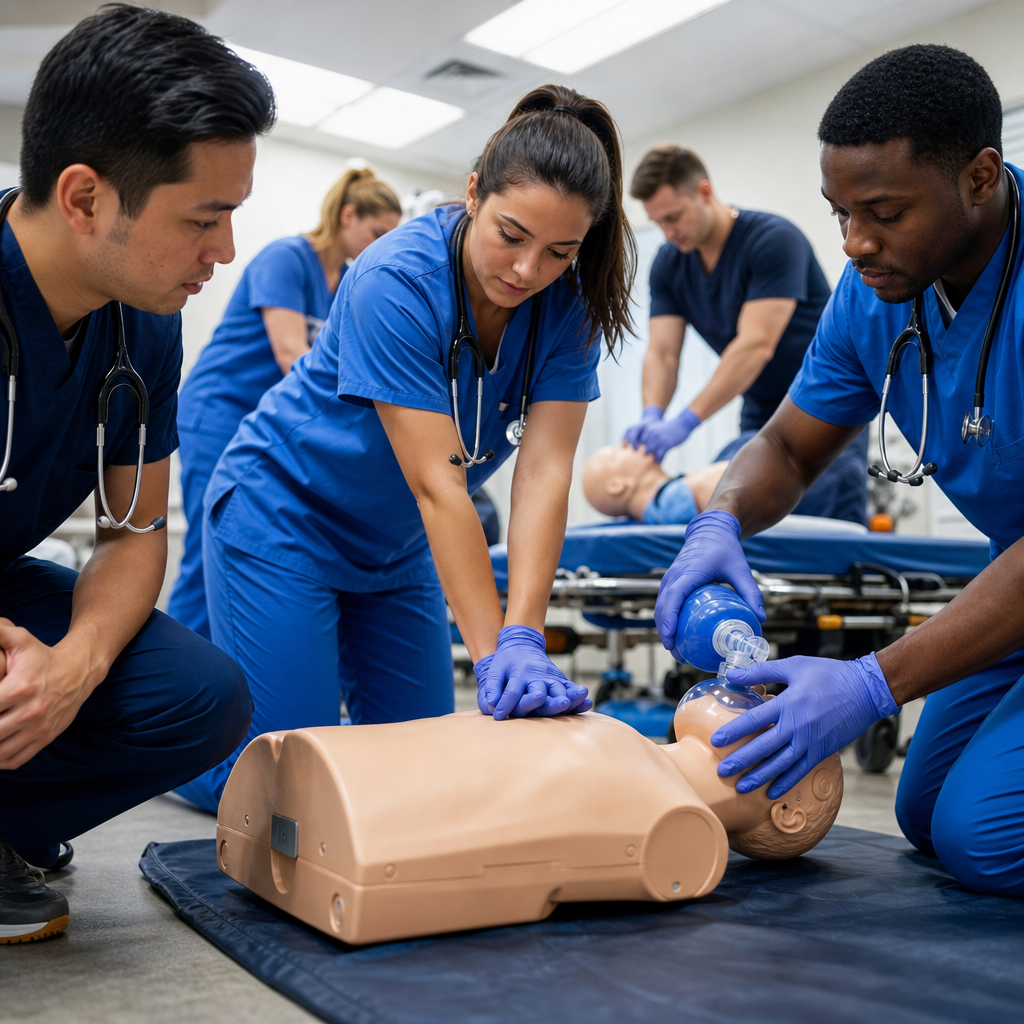
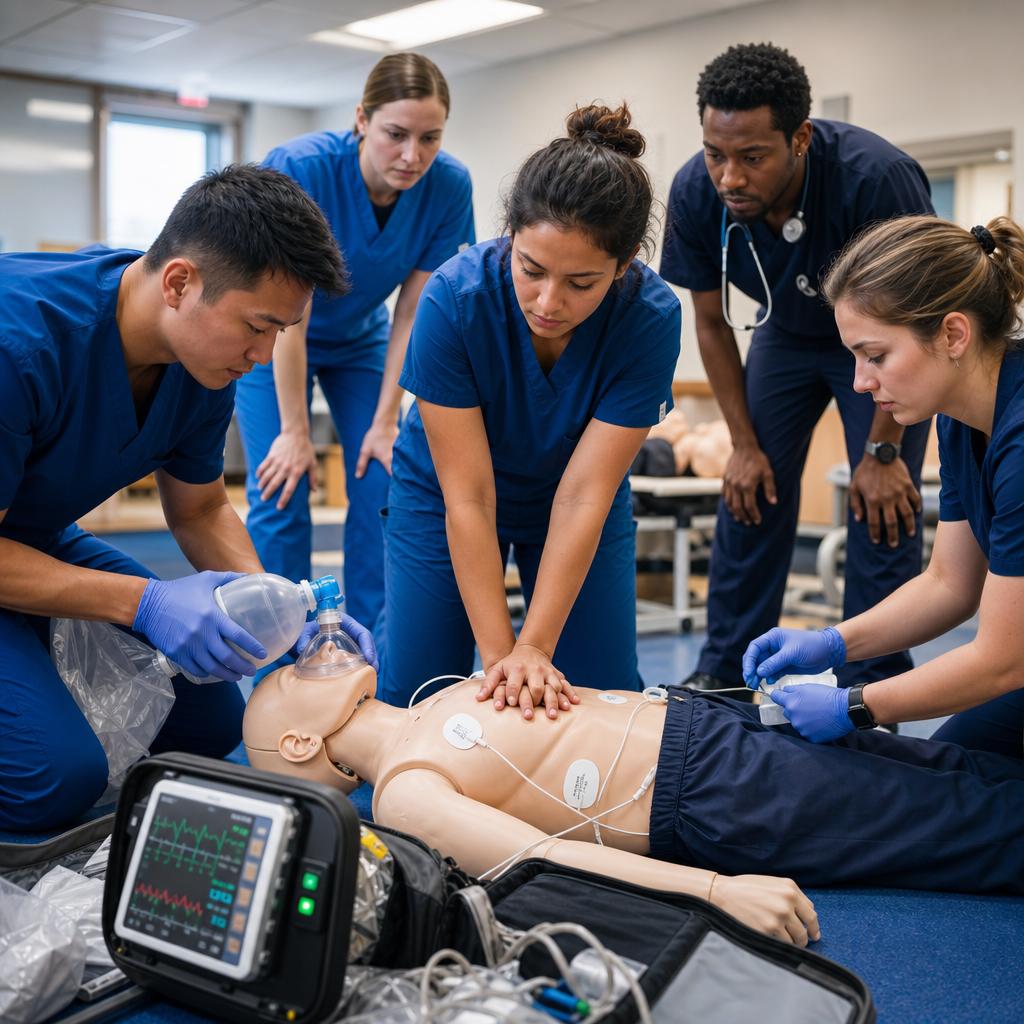
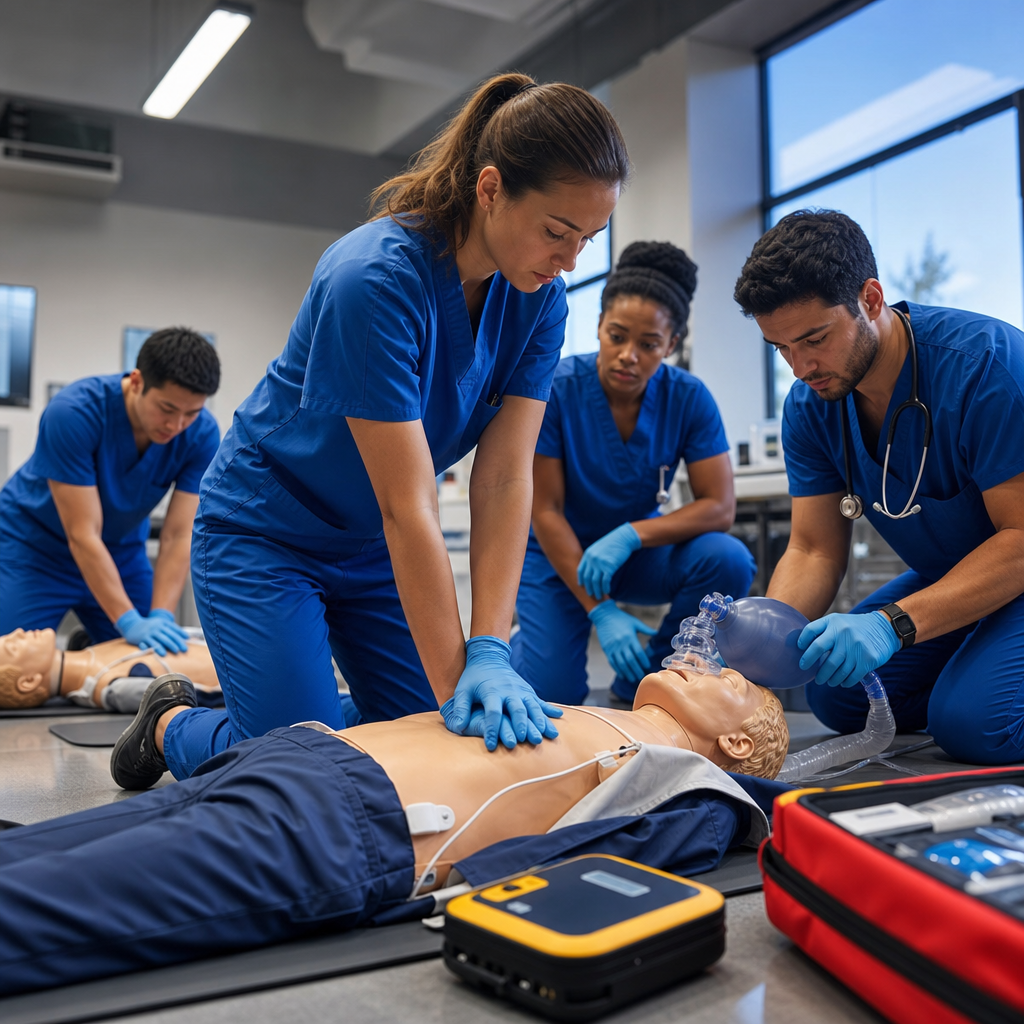
The skills practice is hands-on and immediate. You’ll perform chest compressions on high-fidelity manikins that provide realistic feedback. You’ll practice airway management, two-rescuer scenarios, and emergency response under simulated stress. Our instructors watch closely, offering real-time corrections: “Your compressions need more force,” or “Excellent—your hand position is textbook.” This feedback-correction cycle builds genuine competency.
We typically conduct skills sessions in small groups, which means you get personal attention rather than being one of thirty people rotating through stations. Each participant completes mandatory scenarios and demonstrates proficiency before receiving certification. You’re not rubber-stamped through—you’re genuinely verified.
Sessions run throughout the day at our training centers in Berkeley, Concord, San Francisco, San Jose, Oakland, and dozens of other California communities. We schedule early morning, midday, and evening classes because we know shift workers need options. Weekend sessions are available too, recognizing that many healthcare professionals have unpredictable schedules.
Action: Arrive 10-15 minutes early to your skills session. This gives you time to acclimate to the environment and ask any last-minute questions without rushing through your assessment.
Real-Time Feedback and Hands-On Simulation Technology
The manikins we use in skills sessions are sophisticated training tools. They’re designed to respond realistically—if your compressions are too shallow, the manikin won’t register proper chest rise. If you’re checking a pulse incorrectly, the manikin can be programmed to pulse or not pulse based on your actions. This immediate, physical feedback teaches correct technique faster than any verbal instruction alone.
We also use simulation technology to create realistic scenarios. Your instructor might ask you to respond to a patient in cardiac arrest while simulating a chaotic environment with background noise and multiple variables. You practice not just the physical movements but the decision-making and communication under stress. This bridges the gap between training and actual emergency response.
Real-time feedback from certified instructors personalizes the experience further. As you practice, your instructor observes and corrects form, pace, and decision-making. Rather than waiting for feedback at the end, you adjust immediately. This iterative process builds muscle memory and confidence simultaneously.
Participants in our locations from Pleasanton to Modesto, Davis to Santa Cruz, consistently report that hands-on practice with immediate feedback was the most valuable part of their certification. It transforms knowledge into skill.
Action: Ask your instructor for specific, actionable feedback. Don’t settle for “good job.” Request clarification on exactly what you did well and what needs refinement before you leave.
Same-Day Certification and Your Professional Timeline
One of the most significant advantages of blended training is that you can walk out certified on the same day you attend your skills session. Your instructor verifies your competency, completes the paperwork, and you receive your credential immediately. No waiting for processing, no mailing delays, no uncertainty about when your renewal actually takes effect.
This matters enormously when you’re renewing within your employment window or need to maintain uninterrupted credentials for your position. You know exactly when you’re covered. If your employer requires proof of certification before you return to a restricted duty, you have it in hand the moment you finish your skills session.
We process certifications daily across all our training locations—whether you’re in Vallejo, Fresno, Chico, or San Mateo. Our same-day verification system means you’re never waiting weeks to confirm your status. Your digital and physical credentials are ready immediately.
This also reduces the anxiety many healthcare professionals experience during renewal. You’re not stressed about tight renewal windows or administrative delays. You complete training and move forward knowing you’re compliant.
Action: Confirm the specific credential format your employer requires when you book your skills session. We provide digital verification immediately; physical cards follow within a few business days if needed.
Scheduling Flexibility Across Over 100 California Training Locations
We operate more than 100 training locations throughout California, from small communities like Lathrop and Rocklin to major medical hubs like San Francisco and Los Angeles. This network means you can attend a skills session close to your home, workplace, or commute route. You’re not driving two hours to the nearest training center.
Our locations include multiple options in major population centers. In the San Francisco Bay Area, we have sessions in San Francisco’s Mission District, Nob Hill, and Parnassus/UCSF areas, plus Oakland’s Fruitvale and Lake Merritt locations, and additional centers across the Peninsula and East Bay. In the Sacramento region, we offer training in Arden, Midtown, Oak Park, and Rosemont. In Silicon Valley, you can attend in San Jose’s Downtown, Japantown, or South locations, plus nearby centers in San Leandro, Milpitas, and Sunnyvale.
Daily scheduling means you book whatever date works for you—not the date a class happens to be offered. Whether you need morning, afternoon, or evening sessions, we accommodate your schedule across these locations. This flexibility is critical for healthcare professionals who can’t request specific days off on short notice.
Action: Enter your zip code on our scheduling page and filter by preferred time and day. You’ll likely find multiple options within your area.
Group Training Solutions for Healthcare Teams and Departments
If your healthcare facility, clinic, or department needs multiple team members certified, we offer group training with streamlined scheduling and discounted pricing. This is substantially more efficient than having each person schedule individually.
Group training allows you to coordinate schedules so your team attends together. Your facility manager can arrange a cohort session, and we’ll work around your department’s operational needs. Rather than staggering certifications across weeks, you accomplish bulk renewal in focused sessions. This reduces the overall impact on your team’s availability and scheduling burden.
We also simplify the administrative process. One point of contact, one invoice, one completion report—rather than tracking a dozen individual registrations. For department leaders managing compliance, this is invaluable.
Discounted group pricing applies when five or more team members from the same organization train together. We’ve worked with healthcare systems across California from Redding to San Diego, hospitals in the Bay Area, dental practices in suburban communities, and EMS departments statewide. Each arrangement respects your facility’s specific timeline and budget.
Action: Contact our group training coordinator if your organization has five or more people needing certification within the same window. We’ll customize scheduling and provide specific pricing for your group.
Our Low Price Guarantee on Quality Certification
Quality training shouldn’t require paying premium prices. We’ve built our pricing structure to deliver verified, thorough certification at competitive rates across all our California locations. Our low price guarantee means you’re never paying more than necessary for legitimate certification.
This guarantee applies to standard BLS, ACLS, PALS, and NRP certifications. If you find a competitor offering the same credential for less after your enrollment, we’ll match that price. Our goal is transparency and fairness, not inflated margins.
We’re able to maintain competitive pricing because we’ve optimized our blended model. Virtual components reduce overhead compared to fully in-person programs. Our network of 100+ locations spreads costs efficiently. We reinvest savings into instructor quality and student experience rather than corporate bloat. This means you get certified instructors, hands-on simulation technology, and same-day credentials without unnecessary expenses.
Many healthcare professionals are surprised how affordable comprehensive blended training actually is, especially compared to single-venue options or programs with mandatory extras.
Action: Compare our pricing clearly with what you might find elsewhere. Include what’s actually being provided—instructor experience, location accessibility, same-day certification, and follow-up support—not just base tuition.
Getting Started with Your Blended CPR and ACLS Training Today
Beginning your blended certification process is straightforward. First, identify which certification you need—BLS for most healthcare providers, ACLS if you work in cardiac care or advanced roles, PALS if you’re in pediatric healthcare, or NRP if you’re delivering neonatal care. Your employer’s requirements will clarify which credential you need.
Next, visit our website and select your preferred training location from our network across California. Whether you’re in Walnut Creek, Petaluma, Morgan Hill, or Tracy, find the center most convenient to you. Then choose your preferred skills session date and time. You can begin the online portion immediately while you wait for your session.
Complete the online modules at your own pace, reviewing scenarios and demonstrating knowledge readiness. Once you’ve finished, you’re all set for your skills session. Arrive on your scheduled date, practice with our instructors, demonstrate competency, and leave with same-day certification.
Our team is available to answer questions throughout this process. Whether you need clarification about which certification applies to your role, scheduling assistance, or technical support with the online platform, we’re here to support your path to renewal.
You’ve worked hard to earn your healthcare credential. Keeping it current shouldn’t be a logistical nightmare. Our blended training approach respects your time, your professional obligations, and your need for quality, accessible certification.
Action: Visit our website today and schedule your skills session for the next available date that works with your calendar. You can start your online modules immediately while securing your preferred in-person time slot.
Register for a class today.
Frequently Asked Questions (FAQ)
What’s included in our blended CPR and ACLS training format?
We combine online coursework with hands-on skills sessions so you learn theory at your own pace, then practice real techniques with our certified instructors. Our virtual modules cover the essential knowledge, and our in-person sessions focus entirely on skills verification, real-time feedback, and scenario-based simulation. This approach lets you complete the classroom portion whenever fits your schedule while ensuring you master the practical skills your job requires.
Can I get certified the same day as my skills session?
Yes, we issue certifications immediately after you successfully complete your in-person skills practice with us. We understand healthcare professionals need their credentials quickly for job requirements and licensing deadlines, so we verify your competency on-site and provide your documentation right away without delays or waiting periods.
How do I schedule training across your California locations?
We operate over 100 training centers throughout California, so you can find a location and time that works with your shift schedule. We offer daily BLS courses and regular ACLS, PALS, and NRP sessions at each site, and our online components mean you can start from anywhere before coming in for your hands-on practice session.