
Table of Contents
- Why Healthcare Professionals Need Burn Care Competency
- Understanding Thermal Burns: Classification and Immediate Response
- Chemical Burns: Decontamination and Treatment Protocols
- Electrical Burns: Unique Hazards and Life-Saving Techniques
- Critical First Aid Steps for All Burn Types
- When to Escalate Care: Knowing Burn Severity
- Our Comprehensive Burn Care Training Programs
- Blended Learning Approach for Real-World Scenarios
- Same-Day Certification and On-Site Training Options
- Flexible Scheduling Across California Locations
- Get Certified and Stay Compliant Today
- Frequently Asked Questions (FAQ)
Why Healthcare Professionals Need Burn Care Competency
Burn injuries represent a significant portion of emergency department visits across California, and your ability to respond confidently directly impacts patient outcomes. Whether you’re a nurse, dentist, or EMS professional, burn care knowledge separates competent emergency response from critical errors that compromise healing.
Burns vary dramatically in cause, depth, and treatment approach. A thermal burn from a kitchen accident requires fundamentally different first aid than a chemical spill or electrical contact injury. Without proper training, even well-intentioned providers can worsen tissue damage, increase infection risk, or miss life-threatening complications.
Your certification in burn care demonstrates to employers, licensing boards, and patients that you’re equipped to handle these high-stakes situations. Most healthcare facilities mandate current burn management competency as part of professional licensing requirements. Beyond compliance, mastering burn care builds confidence and ensures you provide the exact intervention each injury type demands.
Understanding Thermal Burns: Classification and Immediate Response
Thermal burns occur when skin contacts flame, hot liquid, steam, or heated objects. The damage depth determines treatment urgency and long-term outcomes, so rapid assessment is essential.
Burn degree classification guides your response:
First-degree burns involve the epidermis only and present with redness, mild swelling, and pain. These typically heal without scarring and require only cool water and pain management.
Second-degree burns extend into the dermis, creating blistering, severe pain, and risk of infection. The wound appears red or mottled and weeps fluid. These injuries demand careful wound care and monitoring for infection.
Third-degree burns destroy both epidermis and dermis, reaching subcutaneous tissue. The burn appears white, charred, or leathery and paradoxically causes less pain because nerve endings are destroyed. These injuries require immediate hospital care.
Your immediate action for thermal burns follows this sequence: move the person away from the heat source, cool the burn with running water for 10-20 minutes, remove constrictive jewelry or clothing before swelling worsens, and cover with a clean, dry cloth. Never apply ice directly to skin, as rapid cooling causes additional damage.
Thermal burns larger than three percent body surface area, burns involving the face, hands, joints, or genitals, or any third-degree burn demands emergency transport. Inhalation injury from enclosed-space fires adds another critical layer of assessment—look for singed nasal hair, carbonaceous sputum, or difficulty breathing.
Chemical Burns: Decontamination and Treatment Protocols
Chemical burns present unique complexity because the agent continues damaging tissue until completely removed. Your priority shifts from cooling to rapid, thorough decontamination.
Begin by identifying the chemical if safely possible, then immediately flush the affected area with large volumes of water for at least 15-20 minutes. Unlike thermal burns, longer water irrigation is appropriate for chemical injuries. Remove contaminated clothing carefully to avoid spreading the chemical or exposing yourself.
Some chemicals require specific protocols. Hydrofluoric acid burns demand calcium gluconate application to prevent systemic toxicity and cardiac dysrhythmias. Alkali (base) chemicals cause deeper tissue penetration than acids, often requiring extended irrigation. White phosphorus particles ignite when exposed to air, so keep these burns covered with wet dressing until complete removal occurs.
Never attempt to neutralize the chemical with an opposite substance. Exothermic reactions from acid-base mixing generate heat that worsens injury. Water is the universal decontaminant for nearly all chemical exposures.
After decontamination, treat the chemical burn like a thermal burn of equivalent depth. Cover with sterile dressing, manage pain, and monitor for systemic absorption of toxic compounds. Some chemicals enter the bloodstream through damaged skin and cause organ damage hours after the initial injury, making careful observation essential.
Document the chemical name, concentration, and exposure time whenever possible. This information guides hospital-based management and helps predict delayed complications your patient may face.
Electrical Burns: Unique Hazards and Life-Saving Techniques
Electrical injuries often deceive providers because surface burns underestimate internal tissue damage. Current travels in straight lines through the body, destroying muscle and nerves along its path while skin entry and exit wounds appear minimal.
Your assessment begins with scene safety. Never touch a person still in contact with electrical current. Ensure the power source is off or use a non-conductive object like wooden broomstick to move the person away from contact.
Electrical current disrupts the heart’s electrical system, causing ventricular fibrillation, asystole, or other dysrhythmias. Even low-voltage injuries can trigger dangerous rhythms minutes after exposure. Any person with suspected electrical injury requires continuous cardiac monitoring and immediate transport, regardless of apparent stability.
The path electrical current takes through the body determines injury severity. Hand-to-hand contact causes current to cross the chest and heart, creating highest risk. Hand-to-foot contact is more common with industrial injuries. Current intensity and duration both matter; household voltage (120 volts) typically causes localized burns, while high-voltage injuries (greater than 1000 volts) cause devastating internal damage.
Look for entry and exit wounds, which appear as small, defined burns. The areas between them may harbor deep muscle necrosis invisible on initial inspection. This hidden damage releases myoglobin into the bloodstream, causing acute kidney injury if not aggressively managed with fluid resuscitation.
Treat visible burns with cool water and sterile dressing. Manage pain and monitor for dysrhythmias. Transport all but the most trivial electrical injuries to a facility with cardiac monitoring and trauma capacity.
Critical First Aid Steps for All Burn Types
Despite their differences, all burn injuries follow core first aid principles that prevent complications and prepare the patient for definitive care.
Your immediate sequence includes:
Stop the burning process by removing the person from the heat source, removing hot clothing, or applying water as appropriate for the burn type. Continued exposure worsens depth and extent.
Assess airway, breathing, and circulation. In enclosed-space fires, inhalation injury may develop before or after burn assessment. If the person is unresponsive or showing respiratory distress, manage the airway immediately.
Cover burns with clean, dry cloth or sterile dressing. This reduces pain from air exposure and prevents contamination. Avoid adhesive dressings that stick to wound surfaces.
Elevate burned extremities above heart level if possible to reduce swelling and improve circulation. Circumferential burns (wrapping around a limb) can act as a tourniquet, so notify receiving facilities immediately.
Manage pain with appropriate analgesia. Burns cause severe pain; don’t undertreat it while waiting for transport. Intravenous analgesia is often necessary for extensive injuries.
Do not apply home remedies like butter, oil, or ice directly to burns. These interventions cause harm and delay appropriate care. Your role is rapid, evidence-based first aid followed by expert hospital management.
When to Escalate Care: Knowing Burn Severity
Understanding when to call emergency services and when to transport directly separates competent assessment from dangerous delay. Several factors mandate immediate emergency response.
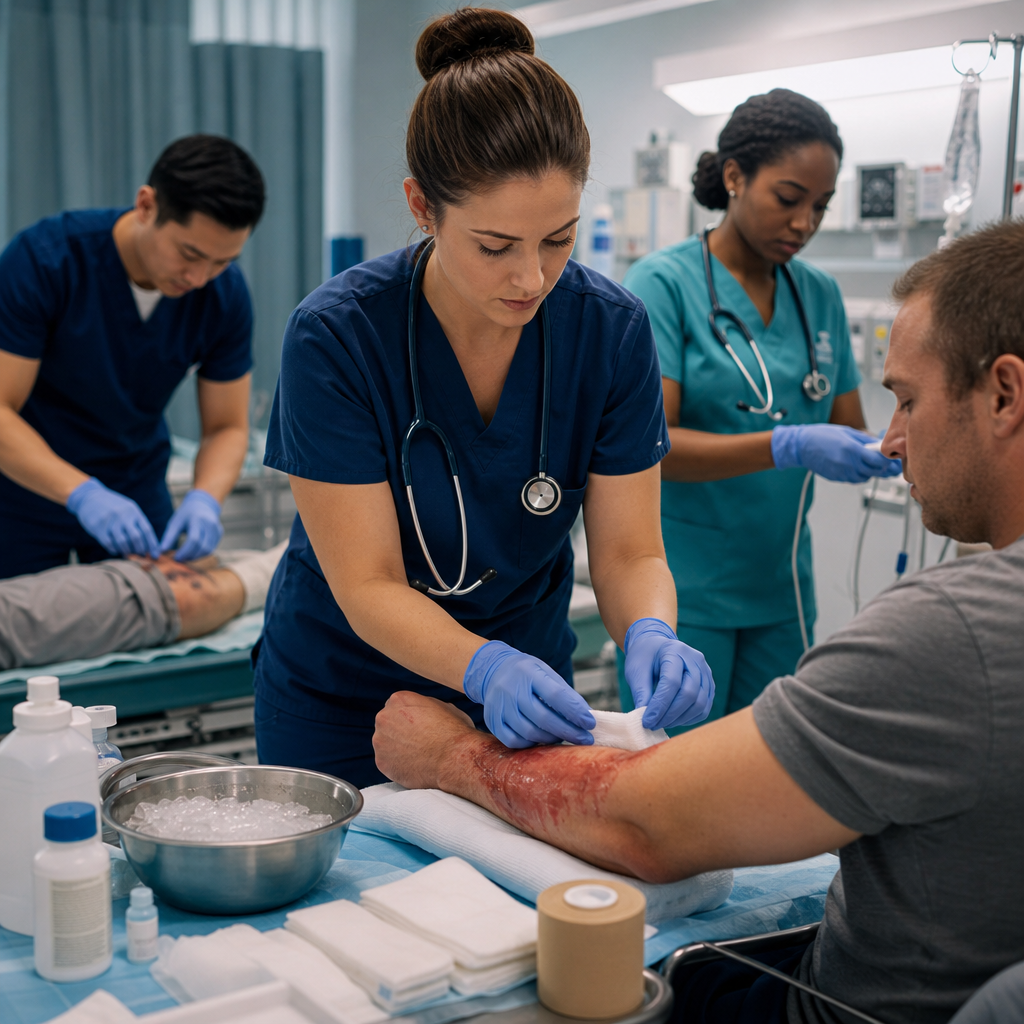
Call 911 for any burn larger than three percent body surface area. A quick rule of thumb: your patient’s palm represents approximately one percent of their body surface area. Any burn covering more than a few palms’ worth requires professional evaluation.
Deep partial-thickness (second-degree) and full-thickness (third-degree) burns always require emergency transport. First-degree burns covering the face, hands, genitals, or joints need evaluation even if small, because function and cosmetic outcomes depend on expert wound care.
Burns in children and elderly patients escalate quickly to serious, so lower your threshold for emergency transport. Very young and very old patients tolerate burn injury less well physiologically.
Inhalation injury, electrical injury, chemical injury, or any burn involving trauma makes immediate hospital care essential. Circumferential burns of the chest may restrict breathing. Circumferential burns of extremities may cut off circulation.
Your uncertainty is itself an indication to escalate. When in doubt, arrange emergency transport. Hospital providers can safely discharge minor burns, but missing a serious injury causes preventable morbidity.
Our Comprehensive Burn Care Training Programs
We’ve designed burn care curriculum specifically for healthcare professionals like you who need current, practical knowledge for workplace compliance. Our instructors bring real emergency experience, and our training reflects current evidence-based protocols used in California’s top trauma centers.
Our programs integrate burn assessment, treatment decision-making, and hands-on practice with realistic scenarios. You’ll learn the subtle differences between burn types, practice rapid triage decisions, and build confidence responding to burn emergencies in your own clinical setting.
We offer specialized modules covering thermal, chemical, and electrical burns with dedicated attention to complications, escalation criteria, and advanced management. Whether you’re a nurse preparing for hospital orientation, a dentist managing office injuries, or an EMS provider responding to emergencies, our curriculum addresses your professional context.
Our low price guarantee means you’ll access quality burn care training without breaking your professional development budget. We believe competency shouldn’t be expensive or inconvenient.
Blended Learning Approach for Real-World Scenarios
We combine online theoretical modules with in-person skills sessions that mirror the decisions you’ll make under pressure. This blended approach lets you study burn classification, pathophysiology, and decision trees on your schedule, then apply that knowledge with our instructors in realistic practice scenarios.
Your in-person sessions include hands-on practice with burn wound assessment, dressing application, and rapid escalation decisions. Our instructors use high-fidelity simulation to recreate the urgency and complexity of real emergency response. You’ll practice communication under stress, document burns accurately, and make split-second triage calls with immediate feedback.
The online component means you spend less time in the classroom while maintaining thorough knowledge. You can review modules multiple times, reference specific protocols, and prepare questions before your skills session. When you arrive for in-person training, you’re ready to focus entirely on application and practice.
This model accommodates your existing schedule. Many healthcare professionals can’t take full days off for training, and our blended approach respects that reality. You’ll complete the knowledge work when convenient, then attend one focused skills session at our California training locations to demonstrate competency.
Same-Day Certification and On-Site Training Options
We understand scheduling challenges in healthcare. That’s why we offer same-day certification options at many locations, allowing you to complete your entire burn care training and receive your certificate within hours rather than weeks.
For larger healthcare facilities, we bring our burn care training directly to your facility. Our instructors can work with your schedule, conduct training during off-peak times, and customize scenarios to reflect your specific clinical environment. On-site training builds team competency efficiently and allows immediate application of skills in familiar surroundings.
Corporate group training qualifies for discount pricing, reducing per-person costs when multiple staff members need certification. Facilities managing teams of nurses, EMS providers, or dental professionals benefit significantly from consolidated training.
We can arrange burn care training at your preferred location throughout California. Whether you’re based in Sacramento, San Francisco, Los Angeles area, or anywhere between, same-day and on-site options ensure training fits your professional reality.
Flexible Scheduling Across California Locations
Our network spans over 100 training sites across California, from Alameda and Oakland in the Bay Area to Sacramento, Stockton, Fresno, and Visalia in the Central Valley, plus coastal locations like Santa Cruz and Santa Rosa. This geographic reach means you’ll find a location convenient to your workplace or home.
We offer BLS Certification Courses offered daily, with multiple class times accommodating early morning, evening, and weekend preferences. Whether you work hospital day shifts, nursing home nights, or emergency services rotations, we schedule classes around your availability.
Evening and weekend sessions let you earn certification without using vacation time. Many professionals appreciate classes starting at 6 PM or Saturday morning sessions that don’t disrupt their work week.
Our CPR verification stations provide quick refreshers and credential updates between full recertification cycles. If you need a brief skills check or documentation of continued competency, these stations offer efficient options at numerous California locations.
Search your nearest location to check available times. Most California professionals find multiple class times within 10-15 minutes of their workplace.
Get Certified and Stay Compliant Today
Burn care competency protects your patients, satisfies your employer’s compliance requirements, and demonstrates professional commitment to emergency preparedness. Whether you’re renewing an expiring credential or building new skills, now is the time to schedule your burn care training.
Your certification shows licensing boards, hospitals, and patients that you meet current standards for emergency response. It opens career advancement opportunities and builds confidence in high-stakes situations.
Visit our website to find burn care training near you, check available class times, and register for same-day certification. We’ll guide you through the simple scheduling process and answer any questions about course content or format.
Don’t wait until you face a burn emergency unprepared. Invest in your competency today, and you’ll respond with confidence whenever these challenging injuries present. We’re here to support your professional development with convenient, affordable, expert-led training across California.
Register for a class today.
Frequently Asked Questions (FAQ)
Why do we offer burn care training if it’s not part of standard CPR certification?
We recognize that healthcare professionals need practical burn response skills beyond basic life support to handle real emergencies effectively. Our burn care training fills a critical gap in professional competency that many nurses, dentists, and EMS personnel encounter regularly in their work. We integrate this specialized instruction into our comprehensive safety training programs because our customers tell us it’s essential for their job performance and patient safety.
How does our blended learning approach help with burn care skills?
We combine virtual instruction with hands-on in-person practice sessions so you can master the theoretical knowledge and then apply it immediately in realistic scenarios. Our instructors guide you through thermal, chemical, and electrical burn responses using actual treatment protocols you’ll use in the field. This method ensures you’re confident and prepared when you encounter burn injuries in your professional practice.
Can we accommodate burn care training at our facility or schedule it quickly?
Yes, we offer on-site training at your workplace and maintain same-day certification options across our 100+ California locations, so we can work around your schedule. Whether you need individual certification or group training for your entire team, we have flexible options to minimize disruption to your operations. We also guarantee our pricing is competitive so cost won’t prevent you from getting the training your team needs.