
Table of Contents
- The Downtime Challenge: Why Scheduling Staff Certifications Matters
- Individual Recertification Scheduling: Time Drain and Operational Headaches
- How Our Group ACLS and PALS Training Minimizes Clinic Disruption
- Comparing Scheduling Flexibility: Individual Appointments vs Coordinated Group Sessions
- Cost Efficiency and Budget Impact: Single Trips vs Multiple Staff Absences
- On-Site Training Solutions: Bringing Certification to Your Clinic
- Same-Day Certification Cards and Compliance: Rapid Return to Full Operations
- Why Healthcare Facilities Choose Our Blended Learning Approach
- Our Verified Track Record Across 100+ California Locations
- Start Your Group Recertification Plan Today
- Frequently Asked Questions (FAQ)
The Downtime Challenge: Why Scheduling Staff Certifications Matters
Every healthcare facility faces a reality: your Advanced Cardiovascular Life Support (ACLS) and Pediatric Advanced Life Support (PALS) certifications expire, and your team needs recertification. The question isn’t whether this happens, but how you manage it without sacrificing patient care and operational efficiency.
When staff members leave the clinic for individual certification appointments scattered across weeks or months, the impact compounds quickly. A nurse attending a 4-hour session means adjusted patient schedules, coverage gaps, and potential delays. Multiply that across your team, and downtime becomes a significant budget drain and scheduling nightmare. The American Heart Association (AHA) mandates these certifications for compliance, so postponing isn’t an option.
We’ve worked with healthcare teams across California, from Alameda to Visalia, and we consistently see one pattern: clinics that coordinate group recertification strategically report better operational continuity than those juggling individual appointments. Coordinated scheduling protects your revenue, maintains service quality, and keeps your team current with life-saving protocols all at once.
Individual Recertification Scheduling: Time Drain and Operational Headaches
Scheduling staff for individual certification appointments creates a cascade of problems that extend far beyond the classroom hours.
When each team member books their own session independently, you’re managing multiple calendars, multiple dates, and multiple absences staggered throughout the year. One nurse recertifies in March, another in June, a third in September. Your clinic never gets a unified window where everyone holds current certifications simultaneously. This fragmented approach means continuous coverage adjustments and knowledge gaps across your clinical team.
The coordination burden falls on your office manager or clinic director. They’re fielding requests, checking availability, confirming attendance, and troubleshooting no-shows. If an employee misses their appointment and reschedules again, that’s another gap in your scheduling. Even with the best intentions, individual scheduling creates friction that eats administrative time.
Transportation logistics matter too. Staff members traveling to different training facilities across the greater Sacramento, Bay Area, or Central Valley regions spend time commuting. A 30-minute drive each way turns a 4-hour course into a 5-hour absence from the clinic. When your team members are scattered at separate locations, you lose the operational cohesion that comes from unified training.
Actionable takeaway: Review your current certification calendar. Count how many individual staff absences you’ve managed in the past 12 months related to recertification. That number becomes your baseline for measuring improvement through group scheduling.
How Our Group ACLS and PALS Training Minimizes Clinic Disruption
Group recertification coordinated through our facility works differently. We schedule your entire clinical team on a single date or consecutive days, concentrating the impact into a defined, manageable window rather than spreading it across months.
Our blended learning approach combines online didactic modules with focused, hands-on skills sessions. Your team completes theoretical content on their own schedule before arriving, so our in-person time prioritizes the practice, simulation, and verification that drives competency. This structure means your team needs fewer total hours away from the clinic compared to traditional all-day classroom formats.
We maintain over 100 California locations throughout the state, including multiple sites in key healthcare regions like Oakland, San Jose, Sacramento, and San Francisco. This geographic reach means your team likely finds a location close to your facility, eliminating lengthy commutes and keeping absences focused. If you operate a clinic in Morgan Hill, Pleasanton, or Fresno, we have convenient options that reduce travel friction.
Our instructors work with your team’s specific clinical context. Whether you’re a dental practice needing PALS or an emergency clinic needing ACLS, our instruction aligns with real-world protocols your staff actually uses. That relevance keeps engagement high and certification outcomes strong.
Comparing Scheduling Flexibility: Individual Appointments vs Coordinated Group Sessions
The flexibility conversation often assumes individual scheduling offers more options, but the reality is inverted when you consider operational needs.
Individual appointment scheduling offers employees personal control over timing, but creates coordination chaos for clinic leadership. Your staff might choose sessions that conflict with peak patient hours, creating cascading coverage problems. One person’s convenient afternoon slot means someone else must cover their patients.
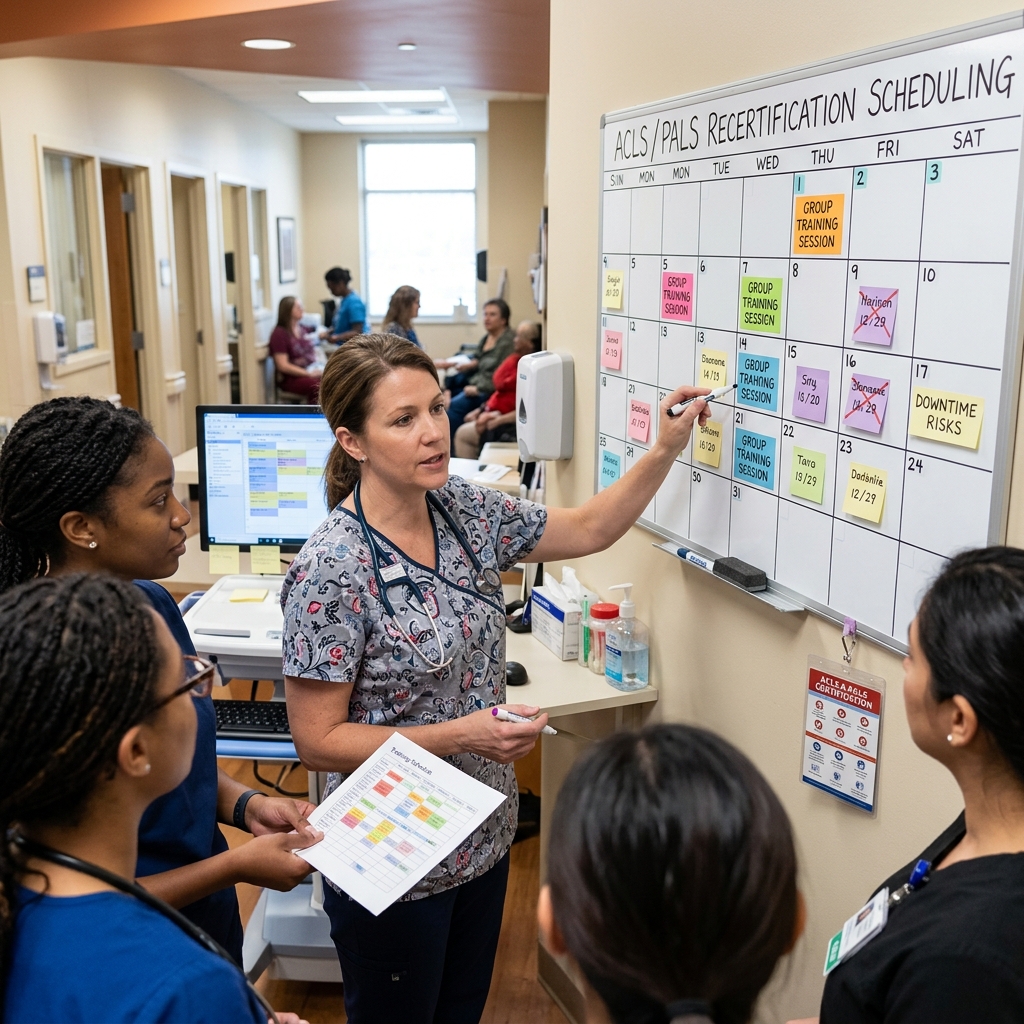
Coordinated group sessions allow you to choose dates that align with your clinic’s natural slow periods or built-in staff development days. You control when the training happens. We offer dates across multiple time slots including evenings and weekends, giving you genuine flexibility while keeping your team synchronized.
With group training, everyone leaves on Tuesday and returns Wednesday after their certifications are current. Your scheduling board updates once. Your compliance documentation consolidates. Your team understands exactly when they’ll be away and can mentally prepare accordingly. Patients get clear communication about temporary coverage arrangements.
We work with healthcare facilities to find optimal timing. If your clinic traditionally closes for continuing education days, we coordinate group sessions into that existing structure. You’re not creating new disruption, you’re replacing scattered individual absences with a unified, planned event.
Cost Efficiency and Budget Impact: Single Trips vs Multiple Staff Absences
Individual certification scheduling disguises its true cost by spreading expenses across the calendar. When you add up mileage reimbursements, hourly wages during multiple absences, administrative coordination time, and lost productivity, the per-employee cost of scattered individual training exceeds group training significantly.
A team of eight staff members each attending individual 4-hour sessions means 32 hours of combined clinic closure. If your average healthcare professional earns $35 per hour in fully loaded cost, that’s $1,120 in direct payroll expense for training time alone. Add mileage, scheduling coordination, and coverage gaps, and the number climbs to $1,500 or more.
Group training consolidates that impact. Eight staff members attending coordinated group sessions over one or two days reduces total calendar disruption and administrative overhead. Instead of eight separate scheduling conversations, you have one. Instead of staggered travel costs, you coordinate group transportation or limit it to nearby facilities.
We offer competitive group rates that reduce per-person certification costs compared to individual enrollment. Our low-price guarantee ensures your group doesn’t pay premium rates. Facilities that move from scattered individual scheduling to coordinated group training typically see 20-30% cost reductions on total certification expenses when accounting for all operational factors.
Actionable takeaway: Request a group training quote from us for your team. Compare the all-in cost (tuition, travel, lost productivity) to your current individual scheduling approach. The difference often justifies shifting to group training immediately.
On-Site Training Solutions: Bringing Certification to Your Clinic
We take flexibility further through on-site group training delivered directly at your facility. This eliminates commuting entirely and maximizes operational efficiency by reducing absences to pure instruction time.
Our instructors arrive at your clinic with all necessary materials and equipment, including RQI simulation stations with VAM (Visual Acuity Monitoring) technology. Your team completes online didactic work beforehand, then participates in focused skills sessions right in your facility. Staff members walk down the hallway to training rather than traveling across town.
On-site training also strengthens team cohesion. Your ACLS or PALS session becomes a shared professional development experience rather than individual accomplishments scattered across months. Staff work through scenarios together, reinforce protocols as a unit, and return to patient care with aligned, current knowledge.
For healthcare facilities in areas like Concord, Walnut Creek, Livermore, or Stockton, on-site training eliminates geographic barriers entirely. Your clinic’s schedule drives the training calendar. We coordinate with your leadership on optimal timing and customize the experience to your clinical environment.
Same-Day Certification Cards and Compliance: Rapid Return to Full Operations
Certification verification matters for compliance and staffing completeness. When staff finish training, they need official documentation immediately so you can confirm full-team compliance without gaps.
We issue same-day certification cards upon course completion, so your staff returns to active patient care with verified, documented certifications in hand. Your compliance record updates that day. There’s no waiting for credentials to arrive, no temporary gaps where staff are retrained but not officially certified, no administrative follow-up needed.
This rapid turnaround proves especially valuable during group sessions. When your entire team completes training over one or two days and walks out with valid credentials, your clinic returns to full operational status immediately. Your scheduling board resets. Your compliance documentation consolidates into a single checkpoint rather than scattered throughout the year.
For facilities managing multiple locations or large clinical teams, same-day certification accelerates your path to 100% team compliance. You’re not managing credential processing delays or worrying about expiration dates staggered across your staff roster.
Why Healthcare Facilities Choose Our Blended Learning Approach
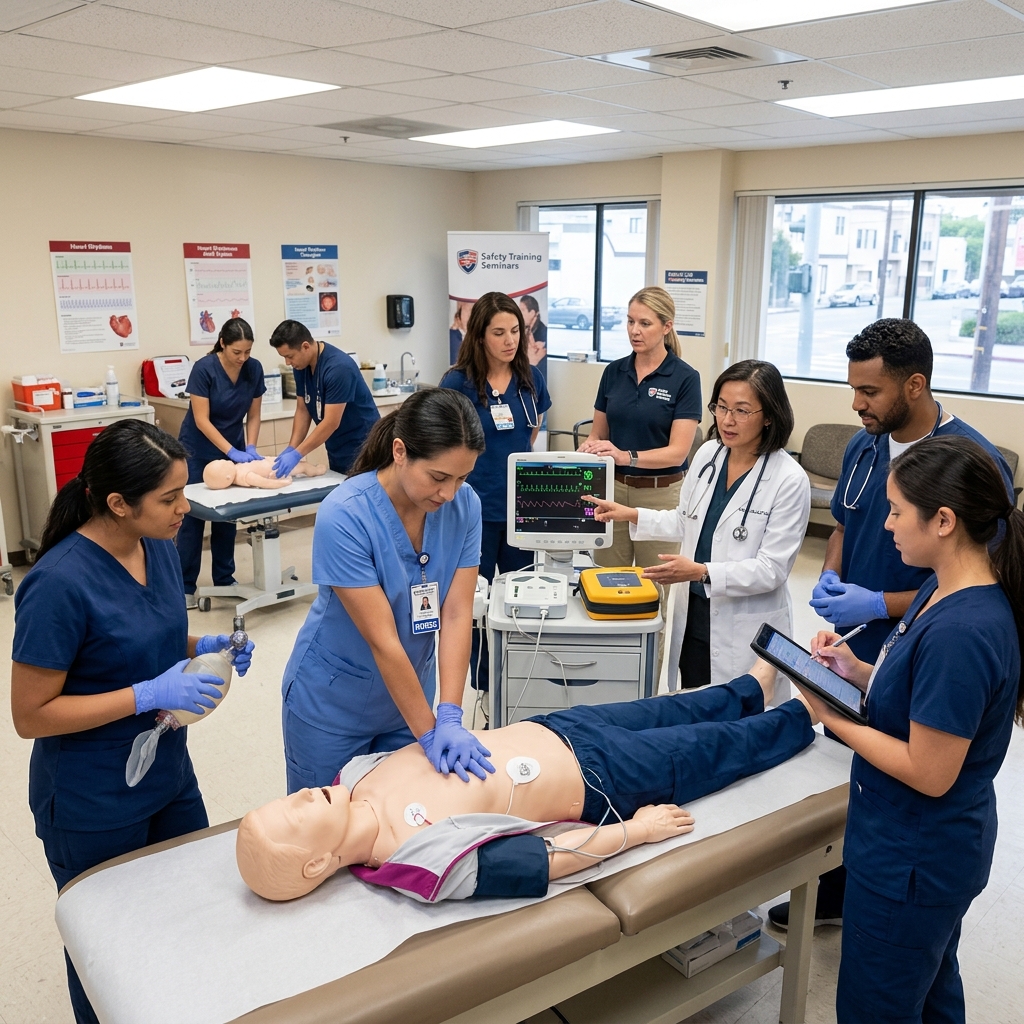
Our blended model works because it respects how working professionals actually learn and need to practice.
Online didactic modules allow staff to complete theoretical content on personal time, whether early morning before shifts, during lunch, or on their own schedule. This flexibility respects individual learning paces and doesn’t force everyone into a classroom at the same moment. By the time staff arrive for in-person sessions, they’ve absorbed foundational knowledge and are ready to apply it.
Skills sessions focus entirely on hands-on practice, simulation, and verification. Your team works directly with instructors on chest compressions, airway management, medication administration, and scenario-based decision-making. This applied practice is where competency actually develops. Our RQI simulation stations replicate real clinical environments, so your team practices in context that matches their actual work.
Healthcare professionals appreciate this structure because it respects their expertise while ensuring competency. You’re not sitting through hours of foundational material you already know. You’re jumping directly to the skills and scenarios that matter for your specific role, whether that’s a nurse in Palo Alto, a paramedic in Fresno, or a dentist in Santa Cruz.
Facilities report higher engagement and better learning outcomes with blended training compared to traditional all-day classroom formats. Staff retention improves because the experience feels efficient and relevant rather than time-consuming and generic.
Our Verified Track Record Across 100+ California Locations
We’ve been delivering AHA-aligned certification training since 1989, building a foundation of trusted instruction across California’s diverse healthcare landscape. Our woman-owned training organization spans over 100 locations, serving healthcare professionals, medical and dental schools, EMS personnel, childcare providers, educators, and corporate teams throughout the state.
Facilities in Oakland, San Francisco, San Jose, Sacramento, and throughout the Central Valley rely on our consistent quality, responsive instruction, and compliance-first approach. Healthcare leaders know our name means verified, accessible training with the logistical support to handle their team’s needs.
We maintain daily BLS Certification Course availability across our network, so scheduling accommodation is always possible. Our CPR verification stations ensure quick, reliable credential documentation. Our commitment to low-price guarantees means you’re not paying premium rates despite our breadth and quality.
This track record reflects real relationships with healthcare teams who’ve trusted us with their certification requirements year after year. We understand California’s regional healthcare landscape because we operate across it.
Start Your Group Recertification Plan Today
If your clinic currently manages scattered individual certification scheduling, the operational and financial case for group recertification is compelling. You’ll reduce clinic downtime, lower costs, simplify administrative coordination, and maintain unified team compliance through a single, planned event.
Contact our team to discuss your clinic’s needs. We’ll help you identify optimal timing, confirm facility location options convenient to your team, and provide a transparent group rate quote. For teams across California, from Brentwood to Visalia, Hayward to Redding, we have the locations, instructors, and blended learning structure to make group recertification seamless.
Your team deserves certification training that respects their time and your clinic’s operational needs. Group scheduling through our California network transforms ACLS and PALS recertification from a disruptive necessity into an efficiently managed professional development investment. Let’s schedule your group training today and reclaim the operational efficiency your clinic deserves.
Register for a class today.
Frequently Asked Questions (FAQ)
How does group ACLS/PALS training at our facility reduce our clinic’s operational disruption?
We schedule your entire team during a single session rather than staggering individual appointments across multiple days, which means your staff returns to full duty simultaneously instead of trickling back one or two at a time. Our blended learning model lets us compress your team’s certification timeline, and we issue same-day cards so your team is compliant and operational immediately after training concludes.
What’s the actual cost difference between sending staff individually versus bringing a group to us?
When we train your group together, you eliminate multiple trips, parking costs, and the cumulative lost productivity from staff scattered across different appointment times throughout the month. We offer corporate group discounts on top of our low price guarantee, so your total investment is significantly lower than coordinating individual certifications while maintaining the same quality instruction.
Can we schedule on-site training at our clinic facility?
We absolutely bring our certified instructors to your location across our 100+ California training centers, which eliminates travel time entirely for your team and lets us customize the session around your operational schedule. We provide the same rigorous blended learning and same-day certification cards whether we train at one of our facilities or directly at your clinic.