Table of Contents
- The Challenge Hospital Staff Face With Standard Certification Programs
- Why One-Size-Fits-All Training Fails Your Healthcare Team
- Our Blended Learning Approach Saves Time and Money
- Same-Day Certification Cards for Immediate Compliance
- Over 100 California Locations for Maximum Convenience
- Specialized Certifications for Every Hospital Department
- How Our Group Discounts Reduce Training Costs
- RQI Simulation Stations with Advanced VAM Technology
- Flexible Scheduling That Works Around Hospital Shifts
- Corporate Support and Compliance Documentation
- Why Healthcare Leaders Choose Us for Staff Development
- Frequently Asked Questions (FAQ)
The Challenge Hospital Staff Face With Standard Certification Programs
Hospital administrators and nursing managers know the struggle well: keeping your entire staff current with American Heart Association (AHA) certifications feels like herding cats. Every nurse, respiratory therapist, and emergency department technician needs their Basic Life Support (BLS) or Advanced Cardiac Life Support (ACLS) credential valid and ready, yet scheduling around 12-hour shifts, on-call rotations, and patient care responsibilities becomes a logistical nightmare.
Traditional certification programs often force staff to attend rigid, fixed-schedule classes that conflict with hospital operations. Staff members miss training deadlines, creating compliance gaps that put your facility at risk. When individuals finally complete training, they return to the floor with minimal hands-on practice and limited retention of critical skills. The result: certifications that satisfy paperwork requirements but don’t meaningfully improve team readiness.
We understand these pressures. Healthcare organizations across California, from small community hospitals in Fresno to large medical centers in San Francisco, tell us the same story: finding a training solution that balances compliance, schedule flexibility, and genuine skill development feels nearly impossible.
Why One-Size-Fits-All Training Fails Your Healthcare Team
Your emergency department staff need different training than your surgical nurses, just as your pediatric team operates under distinct protocols compared to intensive care units. Yet most standard certification programs treat all healthcare professionals identically, covering only basic resuscitation without acknowledging the specialized demands of different departments.
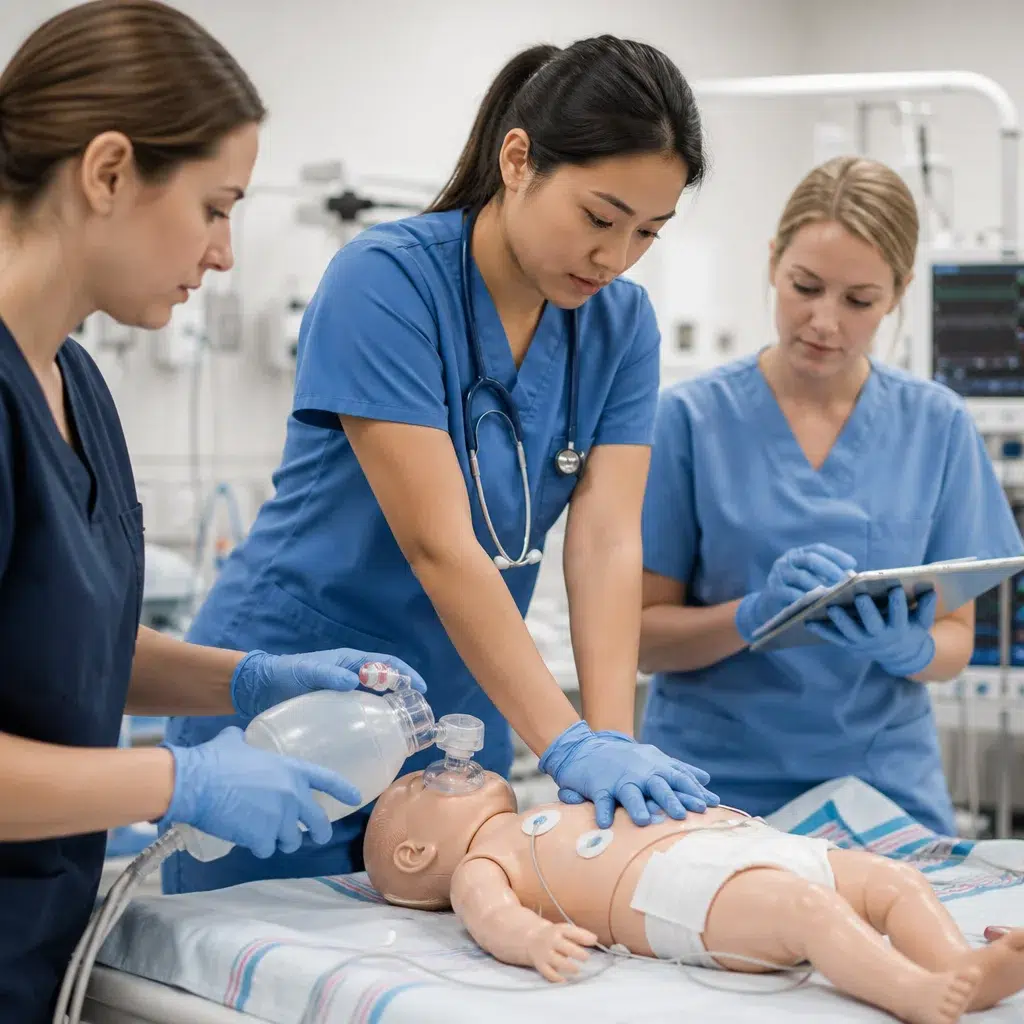
A pediatric resuscitation scenario differs dramatically from adult cardiac arrest management. Neonatal Resuscitation Program (NRP) skills require specialized knowledge that general CPR courses simply don’t address. Similarly, emergency medicine staff benefit from scenario-based training that mirrors the chaotic, high-stress environment they work in daily, while clinic nurses might prioritize different competencies entirely.
Beyond departmental differences, staff members learn at different speeds. Some grasp airway management techniques after one practice session; others need multiple repetitions before confidence develops. Group classes move at a single pace, leaving faster learners bored and struggling learners behind. This one-size-fits-all mentality undermines retention and real-world application when seconds matter most.
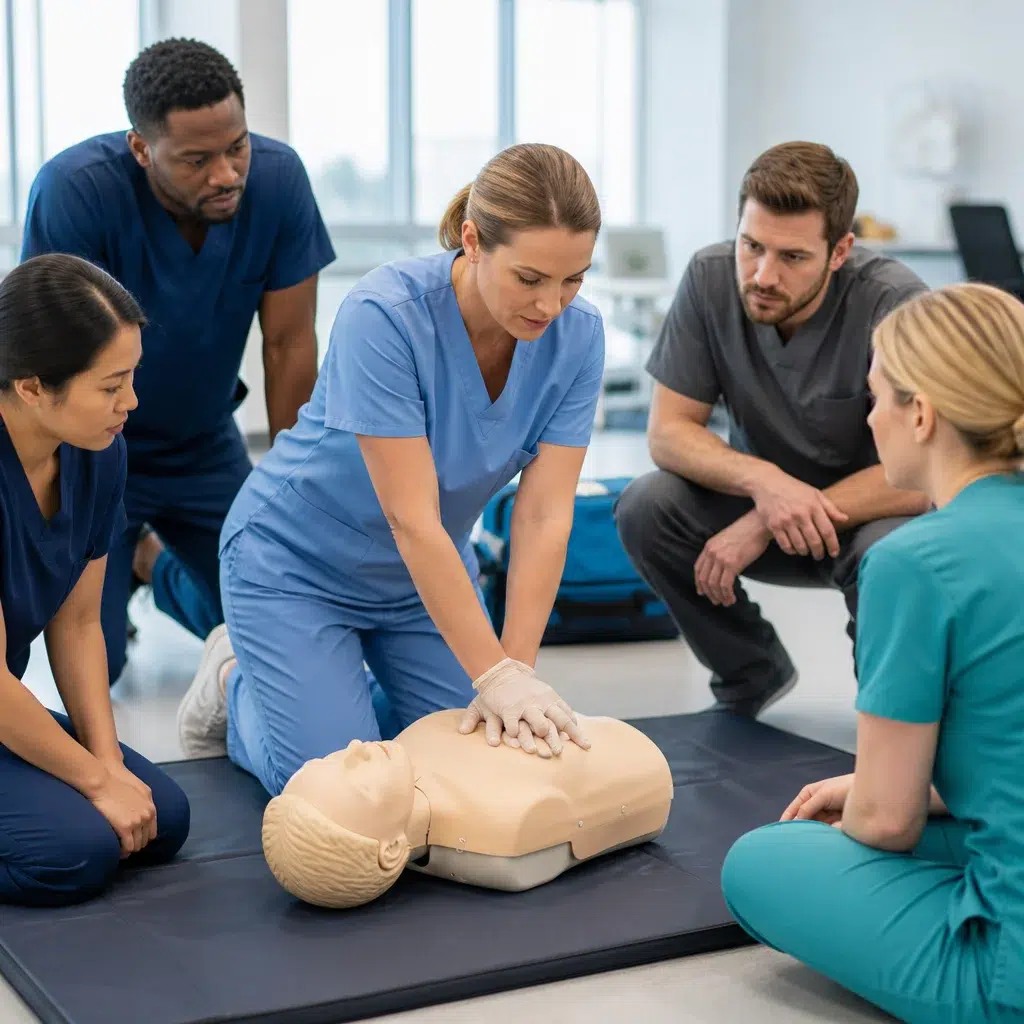
Our approach recognizes that your ICU team in Sacramento requires distinct preparation compared to your urgent care staff in Walnut Creek. We design group training that addresses your specific department’s protocols and patient populations, ensuring every learner walks away with immediately applicable skills.
Our Blended Learning Approach Saves Time and Money
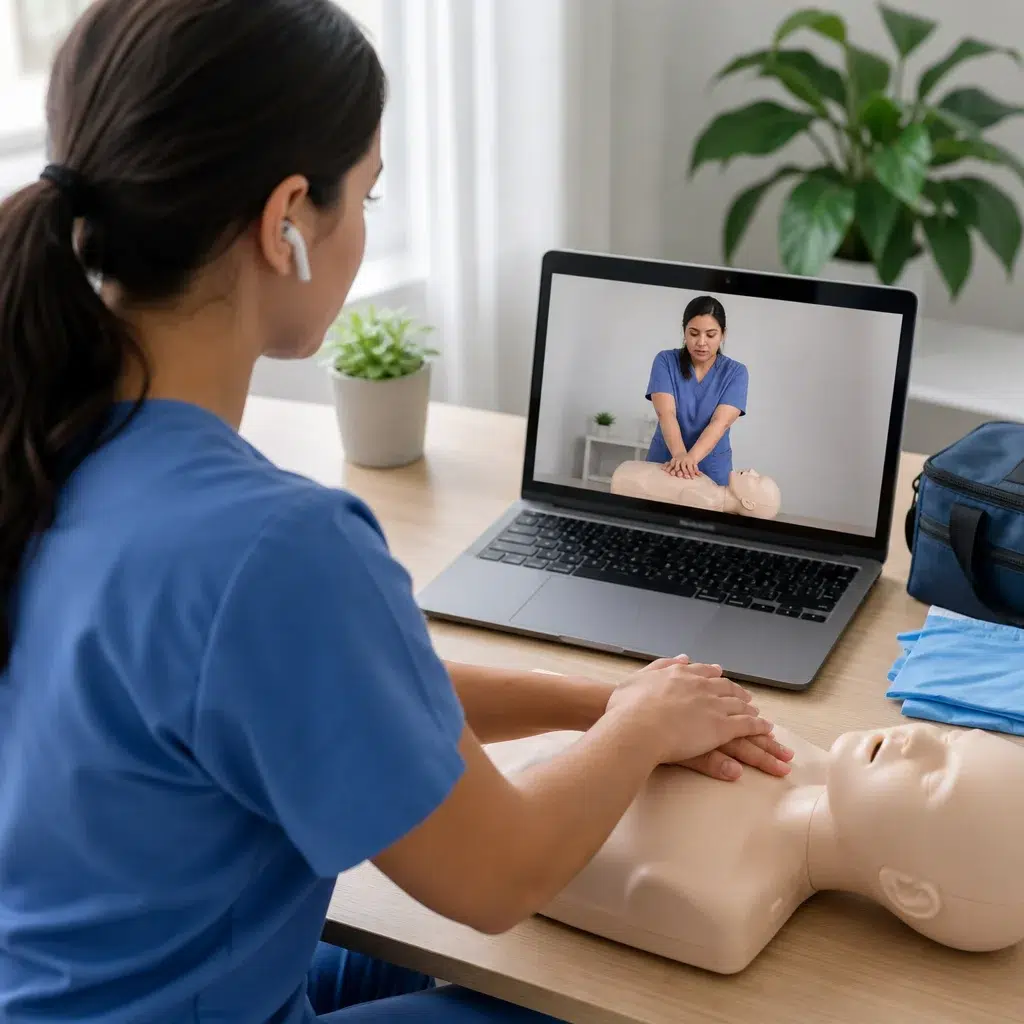
We’ve engineered a blended learning model that combines virtual instruction with hands-on skills practice, creating efficiency gains that standard classroom-only programs cannot match. Your staff completes online coursework on their own schedule, reviewing AHA guidelines, anatomy concepts, and decision-making algorithms whenever they have quiet moments, whether that’s during lunch breaks or late evening at home.
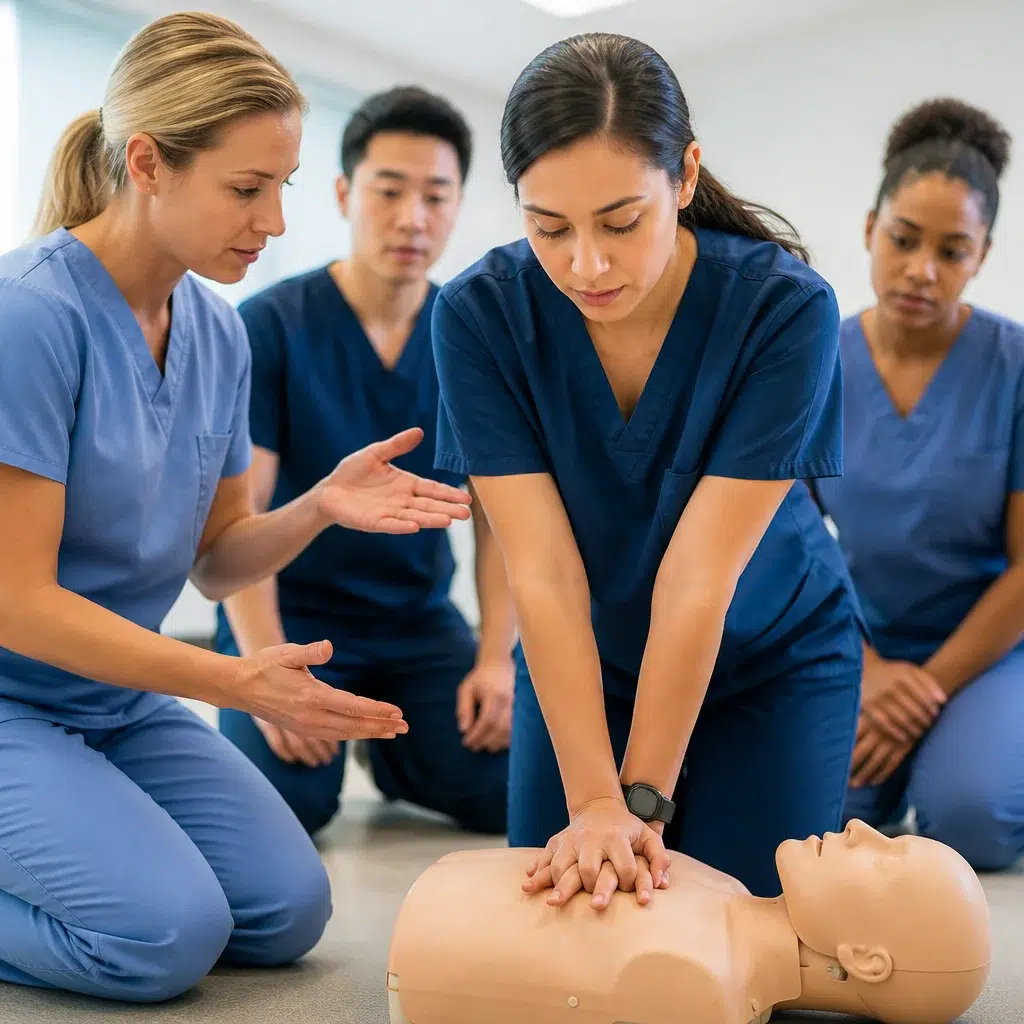
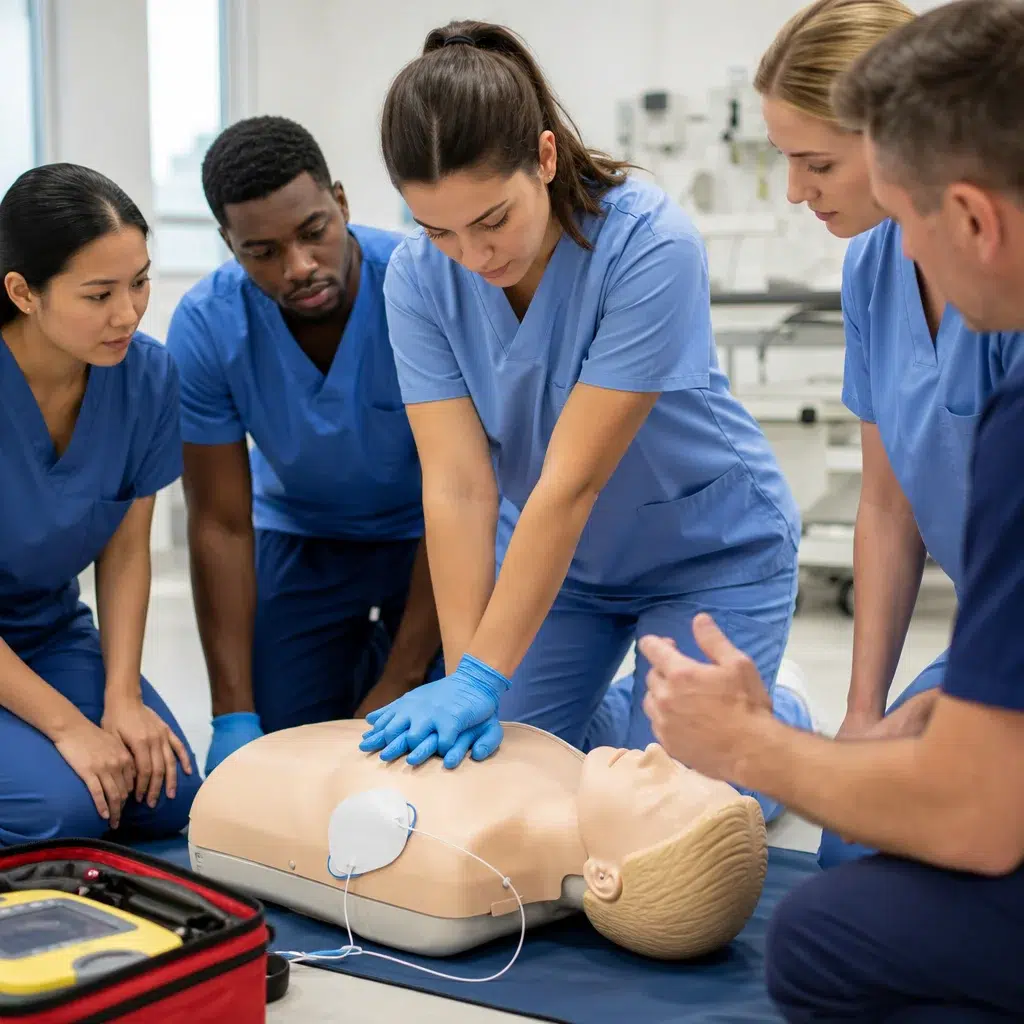
This flexibility eliminates the need for everyone to sit through hours of lecture material simultaneously. Instead, your team gathers for focused, instructor-led practice sessions where every minute targets skill development. Our instructors spend less time lecturing and more time coaching individuals through chest compressions, rescue breathing, defibrillator operation, and scenario-based decision making.

For a hospital with 50 nursing staff, this blended approach reduces classroom hours from the typical 6-8 hours down to 2-3 hours of in-person training. Staff members complete prerequisites independently, then arrive ready to practice immediately. Your training budget stretches further, your staff loses less productive time, and certification rates improve because people actually retain what they learn.
What to do next: Contact us with your staff roster and department breakdown. We’ll design a blended learning schedule that aligns with your hospital’s fiscal year and operational calendar, whether you’re based in Berkeley, Stockton, or anywhere across our 100+ California locations.
Same-Day Certification Cards for Immediate Compliance
Waiting days or weeks for official certification cards to arrive creates unnecessary anxiety and administrative burden. Your compliance officer needs documented proof that staff members are current; your staff need confidence that their credentials are official and recognized.
We issue American Heart Association certification cards immediately upon successful course completion, both digital and printed versions. No delays. No separate mailing process. Staff members walk out with credentials ready to add to their personnel files or upload to hospital systems that same day.
This same-day issuance matters more than convenience alone. When new hires start, when certification renewals approach deadlines, or when your facility undergoes accreditation reviews, having instant documentation prevents scrambling and demonstrates genuine compliance preparedness.
Over 100 California Locations for Maximum Convenience
Scheduling becomes simpler when training happens close to where staff actually work. We operate more than 100 training locations throughout California, from Northern California communities like Redding and Chico down through Sacramento, the Bay Area, and into Southern California.
Whether your staff works in Oakland, San Jose, or smaller communities like Danville and Petaluma, we likely have a training center nearby. This geographic spread means your employees spend less time commuting and less time away from their families. Short commutes also reduce the friction that leads to missed training appointments.
For hospital systems with multiple campuses, we coordinate multi-location scheduling so you can train different shifts or departments at facilities convenient to each group. San Francisco medical centers can schedule sessions at our Mission Bay or Parnassus/UCSF locations; Fresno facilities can train locally rather than traveling. This distributed model works particularly well for large healthcare networks.
Specialized Certifications for Every Hospital Department
Beyond standard BLS, we offer Advanced Cardiac Life Support (ACLS) for physicians and senior clinical staff, Pediatric Advanced Life Support (PALS) for pediatric and emergency departments, and Neonatal Resuscitation Program (NRP) certification for obstetric and neonatal teams. Each certification incorporates department-specific protocols and scenario training.
Our instructors understand clinical contexts. They’ve worked bedside, managed complex resuscitations, and recognize what knowledge actually transfers to real emergencies. Training scenarios reflect the kinds of cases your team encounters: the unstable cardiac dysrhythmia on a telemetry unit, the septic shock presentation in the ICU, the pediatric airway emergency in the ED.
For example, when we train your Petaluma or Vallejo emergency department staff, we build scenarios around their typical patient presentations. Your team practices not just technical skills but decision trees and communication patterns that feel authentic to your hospital’s environment.

How Our Group Discounts Reduce Training Costs
Training 20 or 50 staff members as a cohort costs substantially less per person than individual registrations. Our group pricing reflects economies of scale, and we pass these savings directly to healthcare organizations.
For a hospital scheduling 25+ staff members, we typically reduce per-person costs by 20 to 35 percent compared to individual course pricing. A department training 50 staff receives even greater discounts. We also build payment flexibility into group contracts, allowing you to spread costs across multiple budget periods if preferred.
Concrete example: A 30-person group BLS/ACLS training program in Livermore or Morgan Hill might cost roughly $4,500 to $5,500 total, compared to $6,000 to $8,000 if individuals registered separately. For large health systems training multiple departments annually, accumulated savings often reach thousands of dollars.
Our low-price guarantee means if you find legitimate training at a lower cost, we’ll match it. We’re confident in our pricing and transparent about our value.
RQI Simulation Stations with Advanced VAM Technology
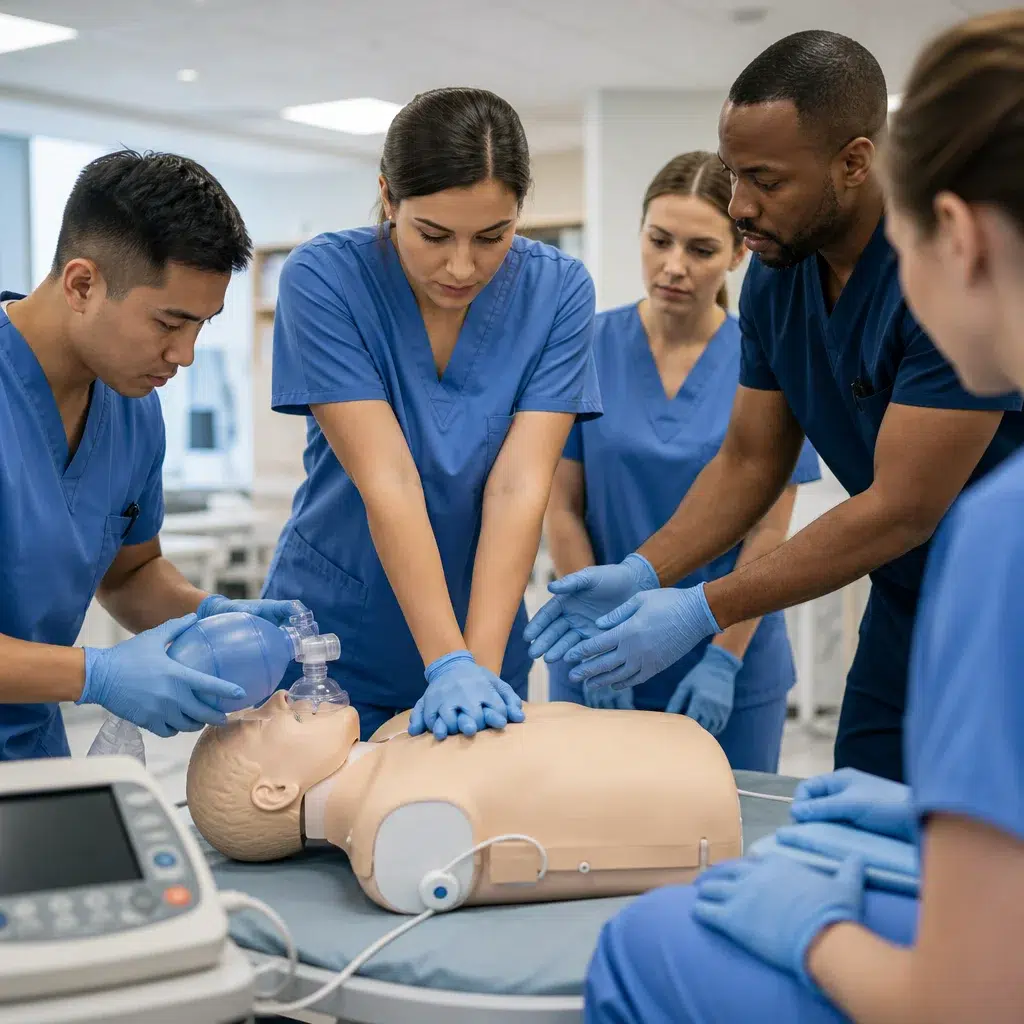
Our training facilities include RQI (Resuscitation Quality Improvement) simulation manikins equipped with VAM (Visual Feedback Arm Module) technology, allowing instructors and learners to see real-time feedback on compression depth, rate, and hand placement. This immediate visual feedback accelerates skill development dramatically compared to older training equipment.
Learners watch their performance data on screens, understand exactly what they’re doing right or wrong, and adjust technique instantly. Studies show that this real-time feedback increases retention and confidence compared to standard practice alone. Your staff leaves training knowing not just that they can perform CPR, but understanding the physiologic targets they’re meeting.
Flexible Scheduling That Works Around Hospital Shifts
We offer early morning sessions for night shift staff preparing to transition, lunch-hour trainings for day shift workers, and evening classes for those finishing clinical duties. Weekend options accommodate staff who prefer off-shift training, and we can schedule private sessions directly at your hospital facility if you prefer.
Most standard programs operate on fixed schedules that rarely align with healthcare workflows. We build schedules around your staffing patterns, whether your team needs morning classes at our Campbell, Dublin, or Concord locations, or evening sessions after clinical shifts conclude.
For large group trainings, we often coordinate multiple session times at the same location, allowing different units or shifts to attend without disrupting patient care. Your nursing director doesn’t need to pull 30 people simultaneously; instead, small cohorts rotate through training across several days while maintaining floor coverage.
Corporate Support and Compliance Documentation
We handle the administrative details that keep your compliance office running smoothly. We provide detailed rosters showing which staff completed training, completion dates, certification expiration dates, and renewal deadlines. These reports integrate into your hospital’s compliance tracking systems or exist as standalone documentation for accreditation reviews.

Our corporate account managers work directly with your training coordinator or compliance officer, proactively flagging upcoming expirations and suggesting renewal scheduling before deadlines approach. We maintain records for seven years, meeting Joint Commission and other regulatory body requirements.
When your facility undergoes accreditation surveys, you’ll have clean, organized documentation demonstrating that your staff maintain current certifications. This support extends beyond training delivery; we’re partners in your compliance infrastructure.
Why Healthcare Leaders Choose Us for Staff Development
Hospital administrators and nursing education specialists across California choose us because we combine genuine logistical flexibility with clinical credibility. Our instructors aren’t reading scripts from generic curricula; they’re experienced healthcare professionals who understand your staff’s real-world pressures and learning needs.
We’ve trained thousands of California healthcare professionals across our 100+ locations, from large academic medical centers to community hospitals in places like Roseville, Novato, and Santa Rosa. Healthcare leaders recognize that we balance compliance requirements with genuine skill development, delivering certifications that actually improve team readiness.
Your choice matters. Beyond checking a compliance box, you’re investing in staff confidence, patient safety, and a training partner who understands healthcare culture. That’s why we’ve earned the trust of California’s most respected medical institutions.
Next step: Contact our corporate training team today. Share your facility’s size, staff composition, and current training challenges. We’ll design a customized group training program that reduces administrative burden, improves scheduling convenience, and ensures your team stays current with AHA certifications. With same-day certification cards, flexible scheduling across more than 100 California locations, and proven group discounts, we make compliance training work for your hospital, not against it.
Register for a class today.
Frequently Asked Questions (FAQ)
How quickly can our hospital staff receive their certification cards after completing group CPR training?
We issue same-day certification cards upon completion of our in-person skills session, so your team can immediately meet compliance requirements without waiting for processing. Our blended learning model combines virtual coursework with hands-on practice, allowing us to complete certifications efficiently while maintaining the rigorous standards required for healthcare professionals.
What makes your group training different from standard certification programs?
We customize our approach around your hospital’s specific needs rather than forcing your staff into generic classes. Our instructors work with your departments to schedule training during shifts that minimize disruption, and we provide advanced RQI simulation stations with VAM technology to ensure realistic, clinically relevant practice that your team will actually use on the job.
Do you offer specialized certifications beyond basic CPR for different hospital departments?
Yes, we provide ACLS for physicians and nurses, PALS for pediatric specialists, NRP for labor and delivery teams, and BLS for all healthcare personnel. We understand that different departments require different skill sets, so we’ve designed our curriculum to address the specific life-saving techniques each area of your hospital depends on.