Table of Contents
- Why Hospitals Need Streamlined ACLS and PALS Training Solutions
- The Challenge of Managing Multiple Staff Certifications
- How Hospital Invoicing Simplifies Your Training Budget
- Our Blended Learning Approach for Healthcare Professionals
- Flexible Scheduling Across California Locations
- Same-Day Certification and Compliance Documentation
- Specialized Training for Your Medical Team
- Group Discounts and Volume Pricing Options
- Supporting Your Hospital's Credentialing Requirements
- Getting Started with Institutional Training
- Frequently Asked Questions (FAQ)
Why Hospitals Need Streamlined ACLS and PALS Training Solutions
Healthcare facilities face a critical challenge: keeping your entire staff current with Advanced Cardiovascular Life Support (ACLS) and Pediatric Advanced Life Support (PALS) certifications while managing tight budgets and operational demands. We understand that your nurses, physicians, and emergency personnel need mandatory renewal training, and doing so efficiently directly impacts your hospital’s accreditation status and patient safety standards.
Traditional training models force you to juggle multiple vendors, inconsistent scheduling, and complicated payment processes. We’ve built our institutional training program specifically for hospitals like yours, with hospital invoicing built in from the start. This means your finance team receives one clear invoice covering your entire cohort, your staff completes training on your timeline, and everyone earns valid certifications that meet regulatory requirements.
The result: your credentialing team spends less time tracking individual course completions, your staff stays current without excessive time away from patient care, and your hospital demonstrates compliance proactively.
The Challenge of Managing Multiple Staff Certifications
Coordinating ACLS and PALS renewals across your medical team creates operational friction. Your ED nurses might renew in January, your telemetry staff in March, your pediatric nurses in June. Each person’s certification expires on a different date. Without a centralized system, you risk gaps in coverage, missed compliance deadlines, and the administrative burden of chasing down verification certificates.
Consider a typical 50-bed community hospital: you might have 80 staff members requiring ACLS renewal annually. If each person registers individually at different facilities, your HR and credentialing teams field endless inquiries: “Did Sarah renew yet?” “Where’s the verification certificate for the new cardiologist?” “Why wasn’t the batch processed in time?”
This scattered approach also complicates budget forecasting. You don’t know your true training costs until staff members register independently, making it difficult to allocate resources effectively across departments. When multiple vendors are involved, you’re managing separate invoicing timelines and varying price points for essentially the same certification.
We’ve seen hospitals in Sacramento, San Francisco, and across the Bay Area solve this by consolidating their training with a single partner who handles invoicing, scheduling, and documentation in one integrated system.
How Hospital Invoicing Simplifies Your Training Budget
Our hospital invoicing model eliminates the administrative maze. Instead of processing individual payments, purchase orders, or reimbursement claims, we bill your institution directly. You specify your training needs, we coordinate the schedule with your team, and your finance department receives a single, itemized invoice covering everyone.
Here’s what changes for your hospital:
Clear cost visibility: You know exactly what ACLS and PALS training will cost before the fiscal year begins, making budget planning straightforward.
Consolidated payments: One invoice beats dozens of individual transactions, reducing accounting overhead and simplifying your audit trail.
Flexible batch scheduling: Rather than limiting training to set class dates, we work with your hospital’s calendar to schedule cohorts when it fits your staffing model.

Volume discounts built in: Our group pricing automatically applies, so you’re not negotiating per-person rates; you’re getting institutional pricing from day one.
Hospitals in Fremont, Oakland, and San Jose have found that this model frees their finance teams from micromanaging individual course payments. Your credentialing coordinator can focus on verifying competencies instead of chasing receipts.
Our Blended Learning Approach for Healthcare Professionals
We recognize that clinical staff can’t afford to spend two full days in a classroom away from patient care. That’s why we’ve designed blended ACLS for CA hospitals combining virtual learning with in-person skills sessions.
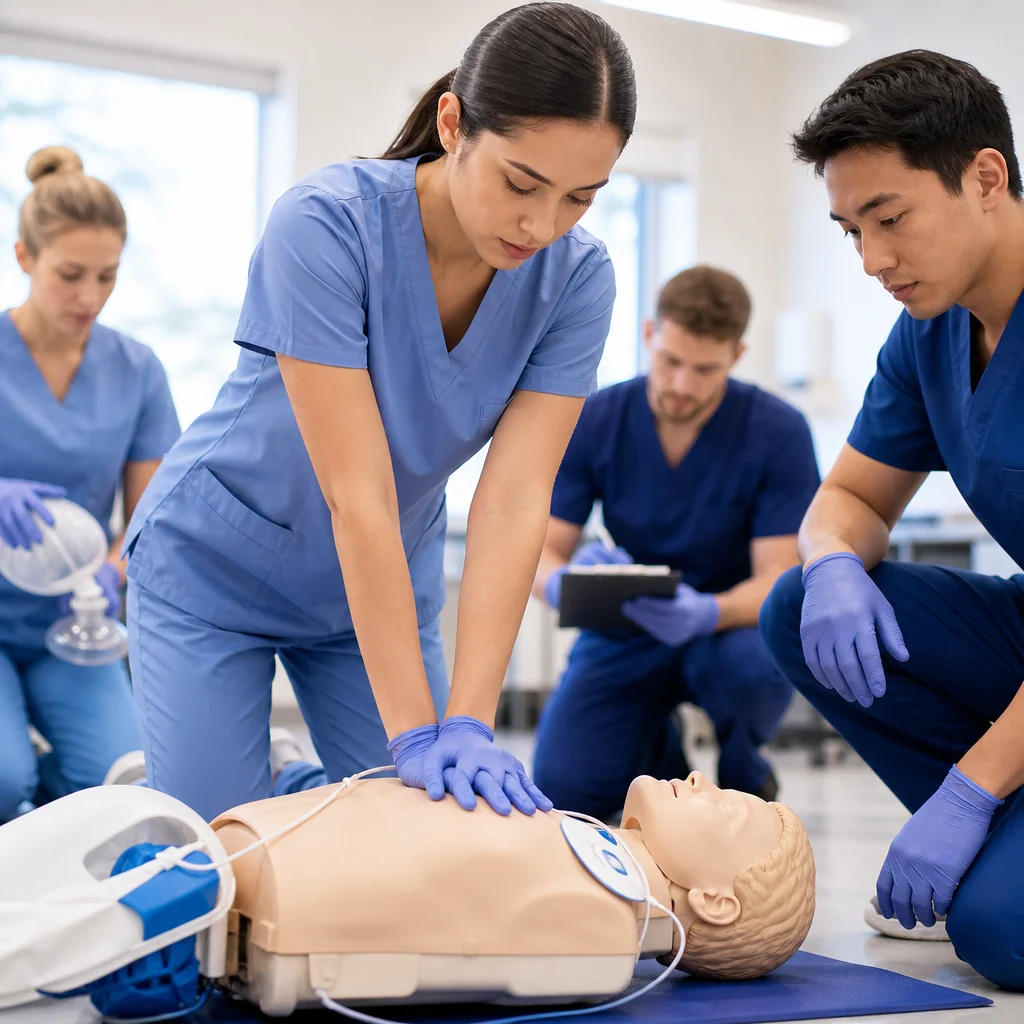
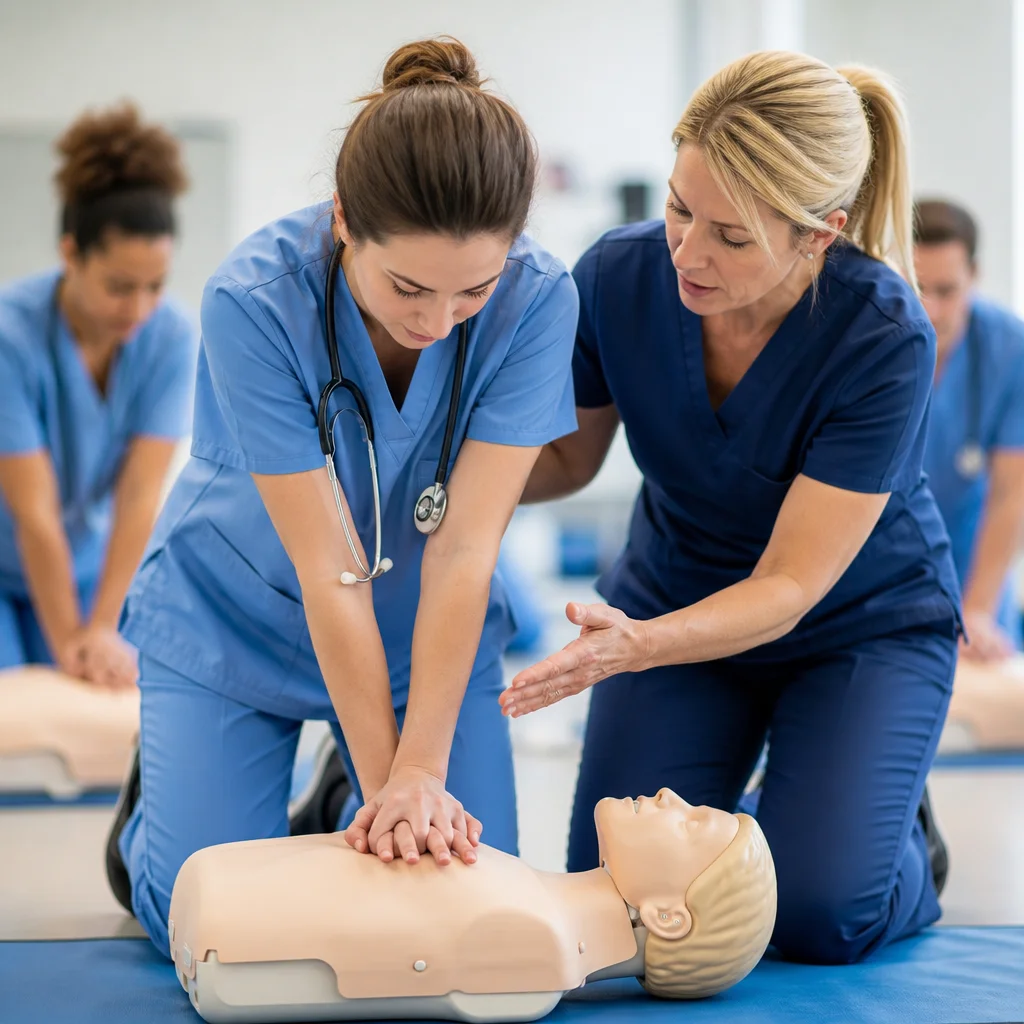
Your team completes the cognitive component online at their own pace, reviewing core algorithms, drug dosages, and decision-making scenarios. Then they attend a focused hands-on session where they demonstrate CPR techniques, practice resuscitation sequences on manikins, and receive real-time feedback from our instructors. This approach cuts classroom time in half while ensuring genuine competency.
For PALS specifically, pediatric resuscitation requires precision. The blended model lets your team review pediatric-specific content remotely, then arrive at your skills session ready to practice. Our instructors focus on the technical work: verifying proper compression depth on pediatric manikins, practicing medication calculations, and running through real pediatric arrest scenarios.
Hospitals in Pleasanton, Davis, and Napa have reported that staff appreciate this flexibility. Nurses can complete the online portion during lunch or before their shift, then dedicate a focused two-hour block to hands-on training without sacrificing too much floor time.
Flexible Scheduling Across California Locations
We operate over 100 training locations throughout California, from Redding in the north to Visalia in the south, and everywhere in between. Whether your hospital is in Bakersfield, Sacramento, or San Francisco, we can deliver training locally or arrange sessions at your facility.
Our scheduling flexibility means you’re not forcing staff to travel across town or wait months for the next available class. Need your ED team certified by the end of Q2? We coordinate dates that work for your shift rotations. Have a new pediatric critical care unit opening? We schedule PALS training for your incoming staff before they start.
We maintain active training partnerships across major metro areas and regional hubs, including locations in Alameda, Berkeley, San Jose, Oakland, Concord, Walnut Creek, Petaluma, Santa Rosa, and throughout the Central Valley. This geographic reach means your hospital rarely needs to send staff far from home, reducing travel time and cost.
Same-Day Certification and Compliance Documentation
After your team completes ACLS or PALS training, they leave with immediate, valid certification. No waiting for verification cards to arrive by mail. No gap between course completion and official credential status.
We provide comprehensive compliance documentation that flows directly to your credentialing department. Your team receives both wallet cards and detailed verification certificates that list competency areas, expiration dates, and instructor credentials. This documentation aligns with your hospital’s credentialing audit requirements and satisfies regulatory bodies.
Your staff can immediately show valid ACLS or PALS certification to preceptors, supervisors, or during patient care transitions. For hospitals in San Leandro, San Mateo, Redwood City, and similar facilities, this immediate credential status reduces the administrative lag between training completion and clinical readiness.
Specialized Training for Your Medical Team
Not all ACLS training is identical. We recognize that your emergency department nurses require different scenario focus than your ICU team, and your pediatric nurses need PALS content tailored to your patient population.

We offer specialized track options for various healthcare roles:
ED-focused ACLS: Emphasis on rapid response protocols, multi-patient scenarios, and post-resuscitation care aligned with your emergency workflow.
Perioperative ACLS: Specific to anesthesia staff and OR nurses managing intraoperative cardiac events with modified equipment access.
Critical care ACLS: Advanced content for ICU and telemetry nurses managing complex dysrhythmias and multi-system failure.
Neonatal Resuscitation Program (NRP): Specialized for obstetric and neonatal teams, covering fetal heart rate monitoring, meconium aspiration, and newborn resuscitation algorithms.
Your instructors customize scenarios to reflect your hospital’s equipment, protocols, and patient population. A team in Palo Alto teaching advanced heart failure cases learns on the same medications and monitors they use clinically. Your Fresno or Stockton facility receives training tailored to your volume and patient demographics.
Group Discounts and Volume Pricing Options
We price our group ACLS and PALS clinics aggressively because we believe certification shouldn’t strain your budget. Our volume discounts increase as your cohort size grows, and our institutional pricing beats individual course registration every time.
Here’s a realistic example: a 50-person hospital cohort renewing ACLS receives significantly lower per-person cost than each individual registering separately. At 100 people, your per-person cost drops further. We reward you for consolidating your training with us.
We also offer tiered pricing for multi-year commitments, allowing hospitals to lock in rates across your entire staff for consistent budget planning. If your institution has turnover or onboarding cycles, we can build rolling group sessions into your agreement so new hires complete certification without administrative friction.
Hospitals across Northern California, the Bay Area, and beyond have found our pricing competitive and transparent, with no hidden fees or surprise charges. Your invoice shows exactly what you’re paying per person, per discipline, with no ambiguity.
Supporting Your Hospital’s Credentialing Requirements
Your credentialing committee needs solid documentation. We provide detailed attendance records, competency verification, and instructor qualifications that meet your hospital’s bylaws and accreditation standards.
Each course generates a comprehensive report listing every participant, completion date, expiration date, and performance notes. We maintain digital records for easy audit retrieval. Your credentialing team can pull any staff member’s training history within seconds rather than hunting through file cabinets or multiple vendor portals.
We also support your ongoing compliance needs. If a staff member completes ACLS with us on January 15th, our system flags their renewal window 90 days before expiration. We can proactively notify your credentialing team or your staff member directly, preventing lapses.
For hospitals in Morgan Hill, Lodi, Tracy, or any of our California locations, this record-keeping infrastructure aligns seamlessly with Joint Commission standards, state regulations, and internal credentialing policies.
Getting Started with Institutional Training

Ready to simplify ACLS and PALS training for your hospital? Start by contacting our institutional training team. We’ll schedule a brief conversation to understand your current certification status, anticipated volume, budget timeline, and preferred scheduling model.
Here’s what happens next:
- Assessment call: We discuss your hospital’s training needs, staff size, and renewal cycle to build an accurate proposal.
- Proposal with pricing: We deliver a clear quote showing per-person cost, total institutional cost, and available discount tiers based on volume.
- Schedule coordination: We work with your HR or credentialing team to identify optimal training dates that minimize clinical impact.
- Training delivery: Your staff completes blended or in-person training at one of our California locations or at your facility.
- Documentation and billing: You receive verification certificates immediately, and your finance team gets a single invoice.
We maintain availability across more than 100 California locations, so whether your hospital is in Visalia, Chico, Vallejo, or anywhere between, local training is within reach. Our team is ready to make institutional training painless.
Visit our website today to request an institutional training proposal, and let’s get your hospital’s ACLS and PALS training on a sustainable, efficient schedule. Your clinical staff deserves certification training that respects their time, and your hospital deserves a vendor who simplifies the process.
Register for a class today.
Frequently Asked Questions (FAQ)
How does hospital invoicing work for our ACLS and PALS courses?
We bill your institution directly for group training sessions, eliminating the need for individual staff members to pay upfront. Our team coordinates with your finance department to establish invoicing schedules that align with your budget cycles and credentialing timelines. We handle all the administrative paperwork so your staff can focus on their training and certification.
Can we schedule ACLS and PALS training for our entire medical team at one of your California locations?
Yes, we accommodate institutional group training at our 100+ locations throughout California, including dedicated healthcare training centers in major cities like San Francisco, Los Angeles, and Sacramento. We work with your department to find flexible scheduling that minimizes disruption to patient care, and we offer volume pricing discounts based on your group size. Our blended learning format allows both virtual prep work and in-person skills sessions on dates that work for your staff.
What compliance documentation do we receive after our team completes training?
We provide same-day certification credentials and detailed compliance documentation suitable for your hospital’s credentialing files and regulatory requirements. Each participant receives their official certification upon successful completion, and we generate institutional reports showing your entire team’s completion status and expiration dates. This streamlines your ability to maintain current medical staff certifications and meet your accreditation standards.