
Table of Contents
- 1. Understanding Your Mandatory ACLS and PALS Renewal Timeline
- 2. Blended Learning Options That Balance Convenience and Competency
- 3. Same-Day Certification Cards for Immediate Compliance Proof
- 4. Low-Price Guarantee Without Sacrificing Quality Instruction
- 5. Flexible Scheduling Across 100+ California Training Locations
- 6. RQI Simulation Stations with VAM Technology for Superior Skills Assessment
- 7. Expert Instructors Aligned with Current AHA Curriculum Standards
- Frequently Asked Questions (FAQ)
1. Understanding Your Mandatory ACLS and PALS Renewal Timeline
As a California nurse, you know that Advanced Cardiovascular Life Support (ACLS) and Pediatric Advanced Life Support (PALS) certifications aren’t optional. They’re requirements tied directly to your licensure, employment, and ability to practice in acute care settings. Yet finding the right renewal provider that fits your schedule, budget, and learning style can feel overwhelming. We’ve built our entire operation around solving this exact problem for healthcare professionals across California, and we want to share what makes an effective renewal pathway.
The stakes are high when your certification lapses. Beyond the immediate compliance risk, you lose the ability to respond to cardiac emergencies with the confidence that comes from current, hands-on training. This article walks you through seven critical factors that separate good renewal options from truly outstanding ones, using our approach as the standard for what you should expect.
Your certification expiration date is non-negotiable, and understanding exactly when you need to renew prevents costly gaps in your credentials. ACLS and PALS certifications remain valid for two years from the date of completion, which means tracking multiple renewal dates across your career requires intentional planning.
We recommend starting your renewal process at least 60 days before expiration. This window gives you flexibility to find a course that aligns with your schedule without rushing into a suboptimal training experience. Many nurses we work with in Sacramento, Oakland, and San Jose build renewal reminders into their annual calendar as soon as they complete their initial certification.
The challenge intensifies if you hold multiple certifications. A nurse might need ACLS, PALS, and Basic Life Support (BLS) renewals at staggered intervals. Missing even one renewal can complicate your employment status and require immediate remediation. Keep a simple spreadsheet with all expiration dates, or ask us when you’re exploring options since we track this for you and send renewal reminders before deadlines approach.
Actionable takeaway: Create a renewal calendar for the next three years right now. Note each expiration date and block off the 60-day window before each one for course completion.
2. Blended Learning Options That Balance Convenience and Competency
Nobody wants to spend two days sitting in a classroom. Yet pure online learning without hands-on practice misses the entire point of cardiac resuscitation training. The solution isn’t choosing between convenience and competency. It’s finding a provider that gives you both through blended learning.
We structure our renewal courses with an online theoretical component that you complete on your own schedule, followed by focused in-person skills sessions where you practice compressions, rescue breathing, and scenario-based decision-making with certified instructors. This approach lets you absorb knowledge at night or on weekends, then arrive at your session in Fremont, Pleasanton, or wherever is closest to your location already familiar with the curriculum.
The beauty of blended training is retention. When you arrive for the skills portion, you’re not learning concepts for the first time. You’re drilling application. Nurses who use this model report higher confidence in their ability to respond correctly under pressure, which translates directly to better patient outcomes.
Your in-person session is also where instructors can identify knowledge gaps and provide targeted feedback. Unlike a purely online certificate that arrives via email, you leave the skills session knowing exactly what you did right and where you need continued practice during your next shift.
Actionable takeaway: Avoid any provider offering 100% online certification without in-person skills validation. Your employer and your patients depend on your actual capability, not just your online completion.
3. Same-Day Certification Cards for Immediate Compliance Proof
Employment verification deadlines wait for no one. If your hospital requires proof of current certification by Friday, an online certificate that arrives via email Monday is too late. We provide physical certification cards immediately upon course completion, which means you walk out with proof in hand.
This matters more than it sounds. HR departments often want to see the physical card or verify your certification number directly from us. When you have a wallet-sized card from your session in Stockton, Dublin, or San Mateo, you’ve solved that verification instantly. No waiting for processing. No following up with customer service a week later.
The same-day card also provides psychological closure. You’ve invested your time, practiced your skills, and completed the requirement. Holding that card reinforces the accomplishment and creates a tangible reminder of your commitment to staying current with life-saving protocols.
If you need certification documentation for multiple roles or credentialing bodies, we can issue duplicate cards during your session and provide verification letters on request. This small detail often goes overlooked until it becomes urgent, so address it upfront with whichever provider you choose.
Actionable takeaway: When booking your renewal, confirm that your chosen provider delivers physical certification cards on the same day you complete the skills session. If they can’t, move to a provider who can.
4. Low-Price Guarantee Without Sacrificing Quality Instruction
Budget constraints are real for healthcare professionals. A certification renewal shouldn’t cost a month’s worth of groceries. Yet you’ve probably noticed pricing varies wildly across providers, raising the question: are the expensive options actually better, or are you just paying for marketing?
We maintain transparent pricing with a low price guarantee. If you find the same course elsewhere for less, we’ll match it. This commitment reflects our confidence that competitive pricing and rigorous instruction aren’t mutually exclusive. We invest in experienced instructors and multiple training locations throughout California because we believe access shouldn’t be premium.
The guarantee also eliminates shopping fatigue. You don’t need to spend hours comparing courses from five different providers, hoping you catch a limited-time discount. When you find us, you know the price is fair.
Many nurses assume that a higher price buys better instruction. The opposite is often true. Expensive providers may be funding marketing campaigns and glossy materials rather than dedicating resources to instructor development. Our investment goes directly into hiring certified professionals who teach regularly in clinical settings. An instructor who works as a critical care nurse in Berkeley and teaches on weekends brings real-world relevance that no amount of marketing can buy.
Actionable takeaway: Don’t automatically assume the most expensive provider is the best. Compare instructor credentials and teaching experience alongside price, then make your decision.
5. Flexible Scheduling Across 100+ California Training Locations

Finding a course near you shouldn’t require flexibility on your part. You have a schedule. We accommodate it. With more than 100 training locations throughout California, from Redding in the north to Visalia in the south, we offer courses in your area regularly.
Whether you live in Campbell, Hayward, Bakersfield, or Napa, you can attend a session within a reasonable commute. We offer courses multiple times per week at many locations, including evening and weekend options for nurses working day shifts. This eliminates the need to take a full day off work or drive 90 minutes each way.
The variety also means you can find a time that works. If your preferred location is fully booked on a specific date, we likely have availability at a nearby center. You’re not forced to choose between the wrong date or the wrong location.
Morning sessions work best for some nurses, while others prefer evening classes after their shift. A few colleagues want Saturday mornings to keep their weekday schedule intact. Our network of training centers in Walnut Creek, Redwood City, San Jose, and dozens of other cities supports all these preferences.
Actionable takeaway: Check availability at your nearest location first, but don’t stop there. If your ideal time isn’t available, look at centers within 15 minutes of your location. You’ll likely find a session that fits.
6. RQI Simulation Stations with VAM Technology for Superior Skills Assessment
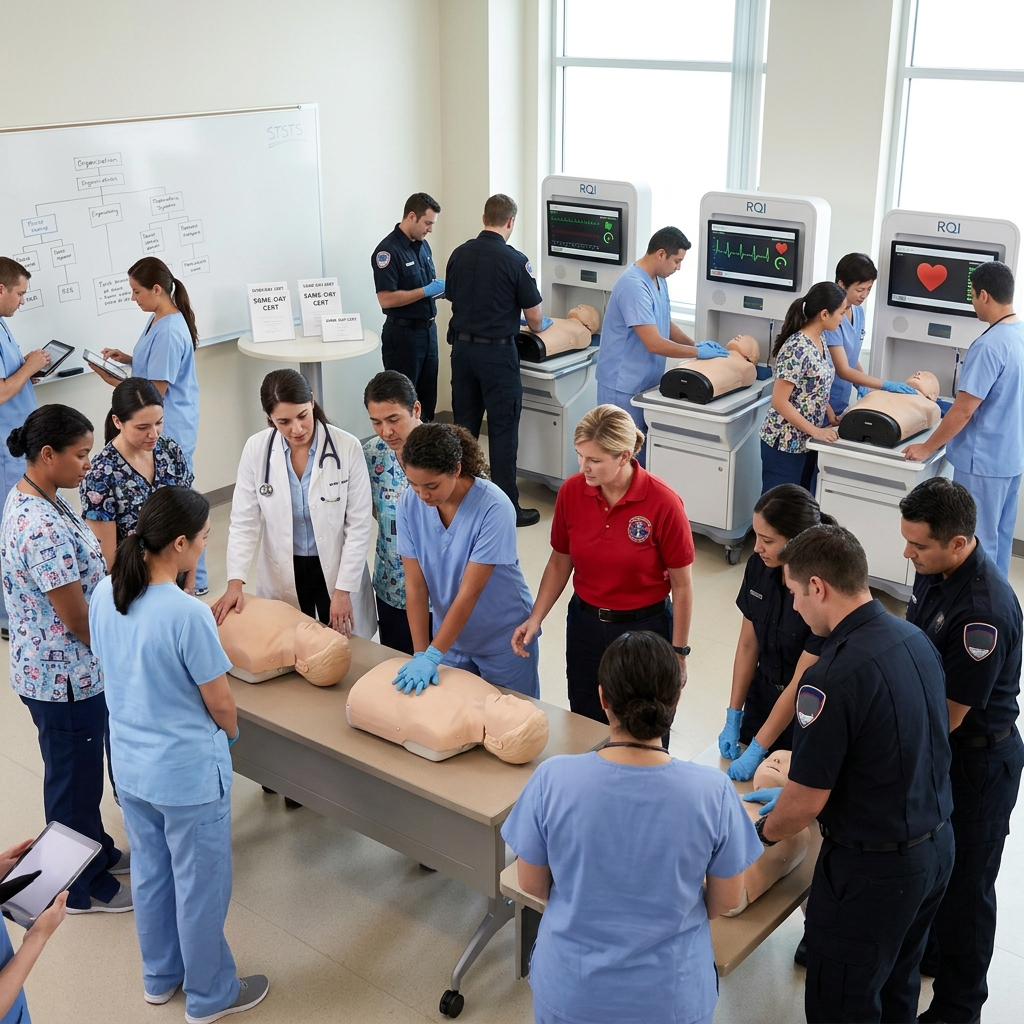
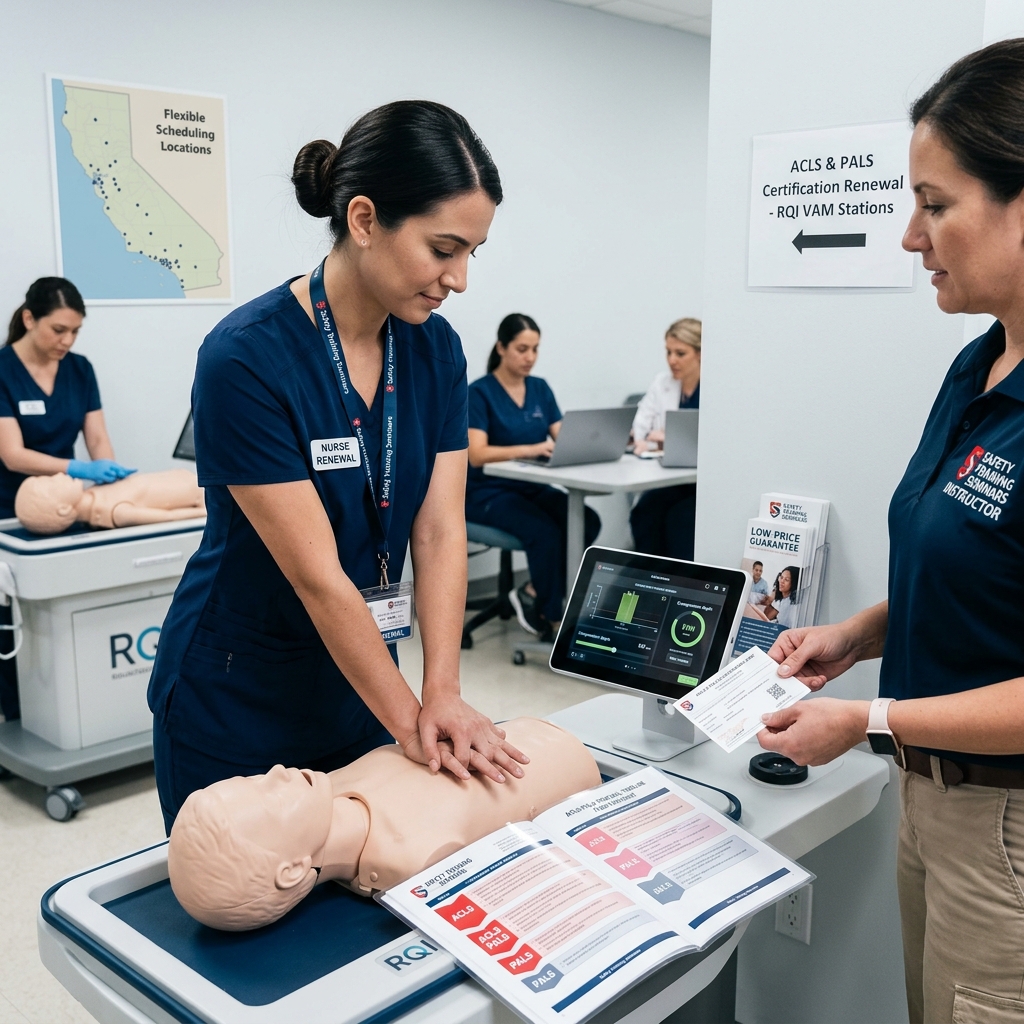
The quality of your hands-on practice directly impacts your readiness for real emergencies. We use RQI (Resuscitation Quality Improvement) simulation stations equipped with VAM (Vital Assessment Module) technology that provides real-time feedback on your compression depth, rate, and hand placement during practice.
This technology matters because CPR quality is measurable and specific. Your compressions need to be 2 to 2.4 inches deep at a rate of 100 to 120 compressions per minute. VAM equipment instantly shows you whether you’re in the target range, allowing you to adjust during practice rather than discovering deficiencies during an actual emergency.
We also offer RQI station rental for workplaces that want to maintain skills between formal renewals. Many hospitals in Sacramento, San Francisco, and Fresno use these stations as part of their internal competency programs, creating a continuum of learning and reassessment throughout your employment.
The equipment provides objective data, removing guesswork from skills assessment. When your instructor reviews your compression performance, they’re referencing measurable metrics, not subjective observation. This precision builds your confidence because you know exactly what you’re doing right and exactly where improvement is needed.
Actionable takeaway: Prioritize training providers who use objective feedback systems like VAM technology. Your practice sessions should improve your actual performance, not just fulfill a checkbox requirement.
7. Expert Instructors Aligned with Current AHA Curriculum Standards
Instructors make or break a certification course. A knowledgeable, personable instructor transforms two hours of practice from awkward and stressful into engaging and empowering. Conversely, an instructor reading slides verbatim creates resentment and wasted time.
Our instructors are certified professionals with active clinical experience. Many work as nurses, paramedics, or respiratory therapists in hospitals throughout California. They don’t teach CPR because it’s a side gig. They teach because they understand how directly this training connects to saving lives, and they maintain their certifications with the same rigor we expect from you.

All our instruction aligns with current American Heart Association curriculum standards and evidence-based protocols. Your certification carries weight because the content reflects current best practices, not outdated guidelines. When you practice megacode scenarios or discuss the latest recommendations for post-resuscitation care, you’re learning what your colleagues in the emergency department are using today.
The instructional environment also matters. Effective instructors create psychological safety, allowing nurses to ask questions, admit knowledge gaps, and practice without judgment. You’re not being evaluated. You’re being coached. This distinction changes how you engage with the material and how much you retain.
Actionable takeaway: Before enrolling, research your instructor’s credentials and clinical background. A provider who matches instructors with nursing experience to RN cohorts shows they understand how to make learning relevant to your specific role.
—
Your ACLS and PALS renewal is an investment in your professional competence and your patients’ safety. The right provider gives you convenience, quality instruction, objective skills assessment, and transparent pricing without forcing trade-offs. We’ve structured our entire operation around those four priorities because we work directly with thousands of California nurses, and we listen to what you actually need.
We invite you to explore our available courses at a location near you. Compare our pricing, review our instructor credentials, and experience our blended learning model. When you see the difference that professional, accessible, high-quality instruction makes, you’ll understand why nurses across California keep coming back to us for every renewal cycle.
Register for a class today.
Frequently Asked Questions (FAQ)
How often do we require nurses to renew their ACLS and PALS certifications?
We follow the standard renewal cycle of every two years for both ACLS and PALS certifications. Your certification expiration date is printed on your card, and we recommend scheduling your renewal at least 30 days before that date to ensure continuous compliance with your employer’s requirements. We offer renewal courses at all our 100+ California locations with flexible scheduling to fit your work calendar.
Can we issue same-day certification cards after completing renewal training?
Yes, we issue certification cards immediately upon successful completion of your skills assessment and written exam. Our RQI simulation stations with VAM technology provide rapid verification of your competency, so you can leave with proof of current certification the same day. This means you won’t experience any gaps in your professional credentials or employment eligibility.
What makes our blended learning approach different for busy healthcare professionals?
We combine virtual coursework with in-person skills sessions so you complete knowledge content on your own schedule, then attend a shorter hands-on session at one of our conveniently located California training centers. This method reduces overall classroom time while ensuring you receive direct instructor feedback on critical skills like chest compressions and airway management. We’ve designed this specifically for nurses, dentists, and EMS personnel who need efficient, compliant training.