
Table of Contents
- Why California Nurses Need Current AHA Certifications
- Understanding Your State Licensing Board Requirements
- The Real Challenge: Balancing Compliance with Your Schedule
- How Our Blended Learning Approach Solves Your Certification Gap
- Specialized Programs for Healthcare Professionals Like You
- Same-Day Certification Cards and Flexible Scheduling Options
- Why Nurses Across California Choose Safety Training Seminars
- Getting Your Next Certification: Our Simple Enrollment Process
- Maintaining Your Credentials Throughout Your Career
- Frequently Asked Questions (FAQ)
Why California Nurses Need Current AHA Certifications
Your nursing license depends on staying current with life-saving skills. California’s Board of Registered Nursing requires nurses to maintain active certification in Basic Life Support (BLS) as a condition of licensure. Beyond the regulatory mandate, BLS and Advanced Cardiovascular Life Support (ACLS) certifications directly impact your ability to respond effectively in critical moments on the job.
These certifications are more than checkboxes. They represent your commitment to patient safety and your professional competence in emergency response. Whether you work in acute care, outpatient settings, or specialized roles, your employer likely requires proof of current AHA certification before you can practice. Missing a renewal deadline creates immediate employment risk and potential disciplinary action from your licensing board.
The stakes are high, but so is the opportunity. When you maintain current certifications, you demonstrate readiness to handle cardiac emergencies, airway obstructions, and other life-threatening situations with confidence and precision. We see this commitment in nurses across California every day, from San Francisco’s Mission Bay to Fresno and beyond.
Action step: Review your current certification expiration dates right now. Note which certifications expire within the next 90 days so you can plan your renewal schedule proactively.
Understanding Your State Licensing Board Requirements
California’s Board of Registered Nursing sets clear expectations. All registered nurses must hold valid BLS certification from an approved provider. Many specialty roles, including critical care, emergency department, and cardiac unit positions, also require ACLS certification. Some facilities mandate Pediatric Advanced Life Support (PALS) for nurses working with children.
The specifics vary by employer and practice setting. A nurse in an intensive care unit may need BLS, ACLS, and potentially Neonatal Resuscitation Program (NRP) certification simultaneously. A nurse in an outpatient surgery center might require only BLS and ACLS. Your nursing manager or human resources department can clarify your facility’s exact requirements.
California also ties continuing education credits to licensure renewal. The state requires a certain number of CE hours every two years for license renewal. Many nurses use their certification courses as a way to earn and track these hours simultaneously, making training serve dual purposes: compliance and professional development.
Understanding these requirements prevents surprises and ensures you’re pursuing the right certifications for your role. Different nursing specialties have different needs, and we help you navigate that complexity by offering specialized programs designed specifically for healthcare professionals in varied clinical settings.
Action step: Contact your employer’s education or compliance department this week to confirm which certifications you need and when they expire.
The Real Challenge: Balancing Compliance with Your Schedule
Nurses know the struggle. Your shifts are unpredictable. You might work twelve-hour days, rotating between days and nights. Finding time to sit in a classroom for four to eight hours feels nearly impossible when you’re managing patient care, documentation, and the physical demands of clinical practice.
Traditional training models assume you have large blocks of uninterrupted time. They don’t account for the reality of nursing work. You can’t just block off your entire Saturday when your schedule changes weekly. You can’t commit to a full day in the classroom when call-ins might leave your unit understaffed.
Many nurses delay certification renewal simply because scheduling feels insurmountable. Others rush into evening or weekend classes that feel like stealing precious off-duty time. The financial cost is real too, but the hidden cost is the stress and disruption to your already demanding schedule. This creates a painful cycle: compliance becomes a burden rather than a routine professional responsibility.
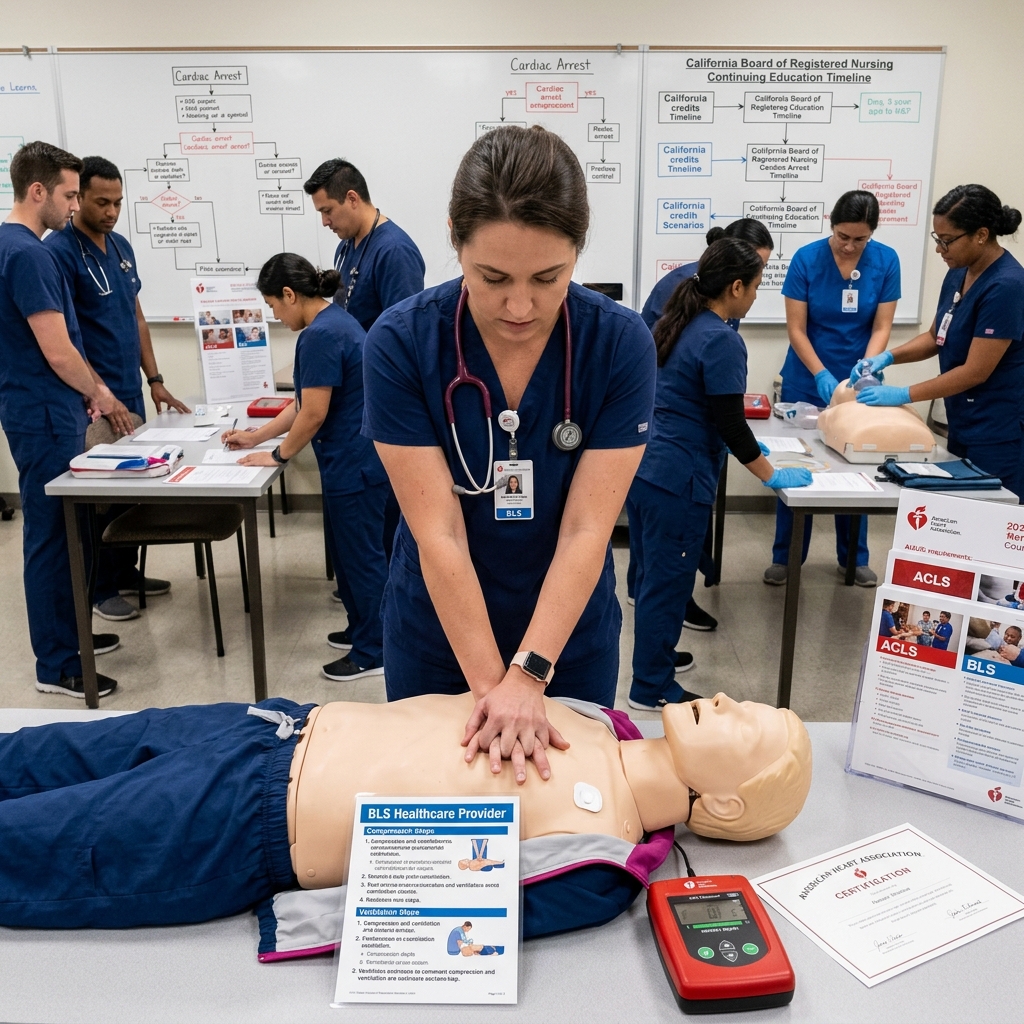
We designed our approach specifically to address this challenge. You shouldn’t have to choose between your career requirements and your personal wellbeing.
Action step: Identify your three preferred dates or times for training over the next 60 days, even if they’re not consecutive days.
How Our Blended Learning Approach Solves Your Certification Gap
We combine virtual learning with hands-on skills practice to fit your actual life. You complete the knowledge-based content online whenever it works for you: early morning before a shift, during a lunch break, or late evening after the kids are in bed. The material covers cardiac physiology, emergency response protocols, and decision-making frameworks without requiring you to sit in a classroom for hours.
Then you attend a focused, shorter in-person session for hands-on skills validation. Instead of eight hours in one day, you might attend a two-hour skills session where you practice compressions, airway management, and scenario-based responses with our instructors. This hybrid model respects your time while ensuring you get real hands-on practice with equipment and feedback from experienced educators.
Our network spans over 100 training locations throughout California, including Sacramento (Midtown, Arden, Oak Park, Rosemont), San Jose (Downtown, Japantown, South, Willow Glen), Oakland (Lake Merritt, Fruitvale, Piedmont), and dozens more. You choose the location nearest to your home or workplace, and you schedule your skills session around your shifts.
The flexibility doesn’t compromise quality. Our instructors are experienced healthcare professionals who understand your world. They’ve managed codes, trained teams, and practiced emergency response in real clinical environments. Your learning happens in context, with examples drawn from actual nursing practice.
Action step: Browse our training locations and identify which one is most convenient to your home or primary workplace.
Specialized Programs for Healthcare Professionals Like You
We offer certifications specifically designed for registered nurses and other healthcare providers. BLS for Healthcare Providers covers the protocols and techniques you actually use in clinical settings, different from public CPR training. ACLS certification teaches you to lead and manage acute cardiovascular emergencies, interpret cardiac rhythms, and administer appropriate medications and interventions.
For nurses in pediatric settings, PALS certification focuses on pediatric assessment, airway management, and resuscitation in children from newborn through adolescent. If you work in obstetrics, NRP certification prepares you for neonatal emergencies at delivery.
These specialized programs aren’t watered-down versions of generic CPR training. They use case studies, algorithms, and decision trees specific to your clinical environment. You’ll practice with equipment you actually use: defibrillators, bag-mask devices, and medications your facility stocks. The scenarios reflect real emergency calls you might encounter.
Our instructors teach these courses regularly, so they understand the nuances of healthcare provider certification. They can answer your questions about protocol variations between settings, explain the clinical reasoning behind guidelines, and help you translate training into your workplace practice.
We maintain competitive pricing across all specialized programs and offer group discounts for your facility or department. When multiple nurses from the same unit train together, you build team cohesion and alignment on protocols while reducing individual costs.
Action step: Identify which specialized certification applies to your current role and any certifications you might need for a future position you’re considering.
Same-Day Certification Cards and Flexible Scheduling Options
You pass your skills assessment, and you walk out with your certification card the same day. No waiting for processing. No delays before you can return to your assigned duties. This immediate credential validation means you can renew your employment health requirements without administrative lag.
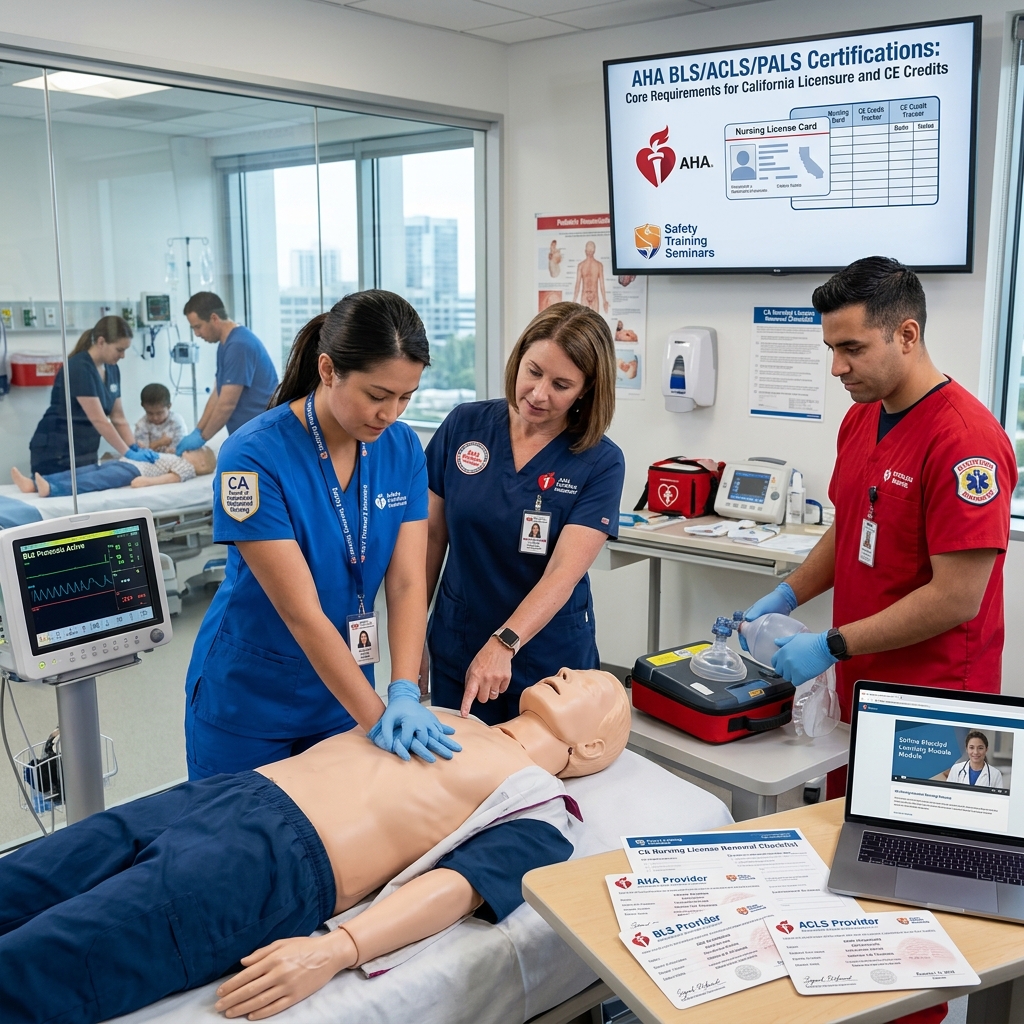
We offer classes daily across our California locations, so you can find sessions that truly fit your schedule. Early morning classes work for night-shift nurses who can sleep in their regular time. Evening sessions accommodate day-shift workers. Weekend options serve nurses who prefer to handle certification during days off rather than taking time during shift cycles.
Scheduling is straightforward through our online system. You select your location, choose your preferred date and time, and confirm your attendance. We send you clear instructions about what to bring, what to expect, and how the blended learning flow works. No surprises. No confusion.
Our low-price guarantee means you’re not paying inflated fees for scheduling convenience. We keep certification affordable so cost doesn’t compound your scheduling challenges. When you need to renew multiple certifications, the combined cost remains reasonable.
If life changes and you need to reschedule, our policies accommodate that. Healthcare workers understand that unexpected situations arise: staffing emergencies, family needs, illness. We work with you to find alternative dates that actually work.
Action step: Check our online scheduling system for your preferred location and set a calendar reminder to register at least two weeks before your target certification date.
Why Nurses Across California Choose Safety Training Seminars
Nurses throughout California have made us their certification provider because we respect their time and their expertise. From Bakersfield to the Bay Area, from Sacramento to Santa Cruz, thousands of nurses return to us year after year because our approach actually works.
We’ve built our reputation on delivering what we promise: convenient scheduling, experienced instructors, immediate certification cards, and affordable pricing. We don’t use inexperienced instructors or high-pressure sales tactics. We don’t overcomplicate the process. We simply make certification accessible for busy professionals.
Our instructors are nurses, paramedics, and respiratory therapists who actively work in healthcare. They’re not detached educators lecturing from theory. They bring real experience from emergency departments, critical care units, transport services, and other clinical settings. When they teach you ACLS, they’re drawing on codes they’ve managed. When they review algorithms, they explain how they use them in practice.
The blended learning model we pioneered keeps you engaged without demanding impossible time commitments. Thousands of nurses have completed certifications through us while maintaining full clinical schedules. They tell us consistently that our approach made compliance achievable rather than burdensome.
We also maintain verification stations where you can verify your certifications with employers or maintain documentation for licensing purposes. This removes another administrative hurdle from your renewal process.
Action step: Ask colleagues in your unit which certification providers they’ve used recently and why they chose them.
Getting Your Next Certification: Our Simple Enrollment Process
Registration takes just a few minutes. Visit our California CPR and BLS classes website, select your location and desired certification type, choose your preferred date, and complete your registration. You’ll receive a confirmation email with all course details, access to your online learning materials, and instructions for your in-person skills session.
Review the knowledge content online at your own pace. Most nurses complete the material in one to three sessions, depending on how their schedule permits. The content is interactive, with scenario questions and quick checks to reinforce key concepts. You’re not passively watching videos; you’re actively engaging with material that applies directly to your work.
Show up for your skills session at your scheduled location. Bring your registration confirmation and a valid ID. Our instructors will guide you through hands-on practice, assess your competency, answer your questions, and issue your certification card upon successful completion. The entire skills session typically takes two to three hours.
That’s it. No lengthy application processes. No confusing requirements. No hidden fees or surprise add-ons. Transparent pricing, clear timelines, and straightforward execution.
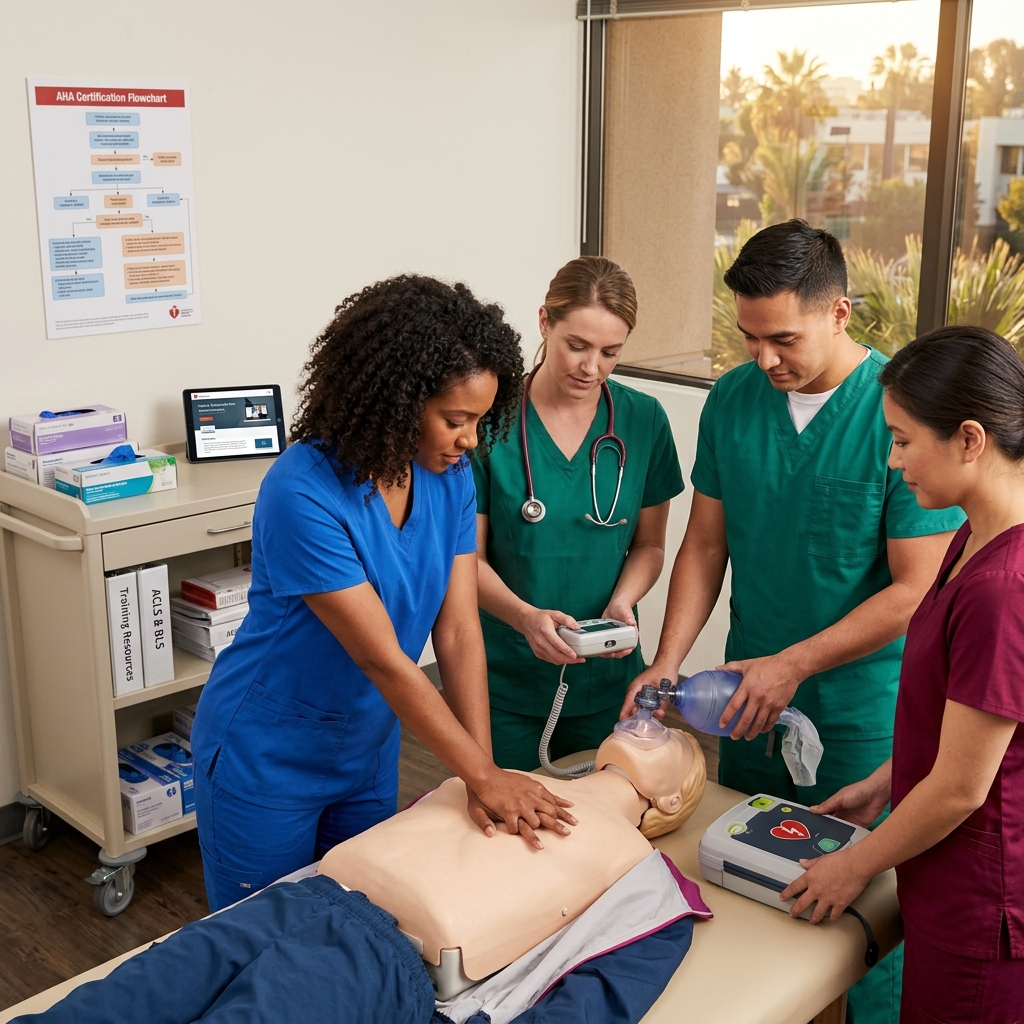
If you have questions during your registration, our support team is available to help. If you have clinical questions during your learning, your instructor will clarify during your skills session. We’ve designed every step to be accessible and stress-free.
Action step: Complete your registration today for a certification that expires within the next 90 days. Don’t delay until the expiration date creates urgency.
Maintaining Your Credentials Throughout Your Career
Certification renewal is ongoing throughout your nursing career. Most BLS and ACLS certifications are valid for two years. Building a renewal routine now prevents crisis renewals later. Consider marking renewal dates in your personal calendar the day you receive your new card.
We recommend starting your renewal process about six months before expiration. This gives you ample flexibility to find a convenient training date without scrambling. Many nurses schedule renewal training during slower periods if their unit rotates through seasonal demand cycles.
As your career evolves, your certification needs may change. A nurse transitioning from medical-surgical units to critical care might need to add ACLS if they don’t currently hold it. A nurse moving into a leadership role might want to maintain multiple certifications for credibility and flexibility. We offer all specialized healthcare provider certifications so you can adjust your skill profile as your career develops.
The commitment to current certification is really a commitment to patient safety and professional responsibility. It’s a visible way you demonstrate that you take your role seriously. Employers notice. Your colleagues respect it. And when an emergency happens, you’re genuinely prepared to respond effectively because you’ve practiced recently and systematically.
Think of certification renewal not as a compliance burden but as a professional habit that supports your competence and confidence. When you maintain current skills, you bring that readiness into every shift. That matters for your patients, your team, and yourself.
We’re here to support that commitment by making renewal as convenient and affordable as possible. Your certification should be accessible, not another source of stress in an already demanding profession.
Action step: Map out your certification renewal calendar for the next 24 months. Identify which certifications need renewing and roughly when. Then prioritize scheduling your next renewal at least three months out.
Register for a class today.
Frequently Asked Questions (FAQ)
What certifications do we offer for California nurses?
We provide BLS, ACLS, and specialized healthcare certifications that meet California nursing board requirements. Our courses are designed specifically for nurses who need current credentials for licensure renewal and professional practice. We offer both in-person skills sessions and blended learning options at over 100 locations throughout California to fit your schedule.
How does our blended learning format help busy healthcare professionals like you?
We combine virtual instruction with hands-on skills sessions, so you can complete coursework on your own time before coming in for practical training. This approach lets you study when it works for you while still getting the face-to-face certification you need. We also offer same-day certification cards when you complete your final session, getting you current faster.
Can we accommodate your location and scheduling needs?
We have training locations across California in major cities and surrounding areas, plus we offer classes daily at many of our sites. Whether you need early morning, evening, or weekend sessions, we work to schedule options that fit your nursing shifts and calendar. You can find your nearest location and available dates directly on our website to book what works best for you.