
Table of Contents
- 1. Choose Blended Learning for Maximum Flexibility and Compliance
- 2. Enroll in Approved In-Person Skills Sessions Near You
- 3. Verify Your Current Certification Status Before Renewal
- 4. Select Same-Day Certification Card Options for Immediate Proof
- 5. Take Advantage of Statewide Training Locations for Convenience
- 6. Utilize RQI Simulation Stations for Advanced Skills Practice
- 7. Schedule Your Recertification Well Before Your Expiration Date
- Frequently Asked Questions (FAQ)
1. Choose Blended Learning for Maximum Flexibility and Compliance
Maintaining your ACLS (Advanced Cardiovascular Life Support) certification as a healthcare professional in California isn’t just a box to check on your renewal form. It’s a commitment to staying current with evidence-based emergency protocols that could save a patient’s life. If you’re a nurse, dentist, EMS provider, or other licensed clinician, you already know the pressure of juggling mandatory continuing education alongside your patient care responsibilities.
The challenge is finding a recertification path that fits your schedule, meets California’s strict compliance standards, and doesn’t force you to sacrifice quality instruction. We’ve designed our ACLS renewal program to address exactly these pain points. Here are seven proven strategies to streamline your California ACLS recertification and maintain your professional credentials without unnecessary hassle.
Blended learning combines online coursework with hands-on in-person skills practice, giving you the flexibility to review theory on your own time while ensuring you receive proper instruction on critical techniques. This hybrid approach recognizes that healthcare professionals have unpredictable schedules.
We offer blended ACLS courses that let you complete the knowledge-based portion at your own pace, then attend a focused skills session to demonstrate competency with a qualified instructor. This means you’re not locked into a full eight-hour classroom day. You can study the algorithms, rhythm recognition, and pharmacology when it works for you, whether that’s early morning or late evening.
The compliance advantage is significant. California regulatory boards and your employer’s credentialing committee recognize blended instruction as equivalent to traditional classroom training because the skills validation happens in real time with a certified instructor present. You avoid the trap of online-only certification, which many facilities don’t accept for initial licensure compliance.
What to do next: Check whether your employer’s continuing education policy accepts blended learning formats. Most do. Then explore our course calendar to find the in-person skills session dates that align with your availability.
2. Enroll in Approved In-Person Skills Sessions Near You
Your ACLS recertification isn’t complete without demonstrating hands-on competency. This is non-negotiable, and it shouldn’t be inconvenient. We operate over 100 training locations throughout California, from Santa Rosa CPR & BLS Classes to Fresno, Visalia to Redding, and everywhere in between including Alameda, Sacramento, San Francisco, and San Jose.
The benefit of distributed in-person sessions is proximity. Instead of driving 45 minutes to the nearest training center, you can often find a classroom within your local area. Our instructors are experienced healthcare educators who understand the real-world decisions you face in emergency situations. They don’t just walk through algorithms; they discuss case studies, common pitfalls, and integration with your facility’s specific protocols.
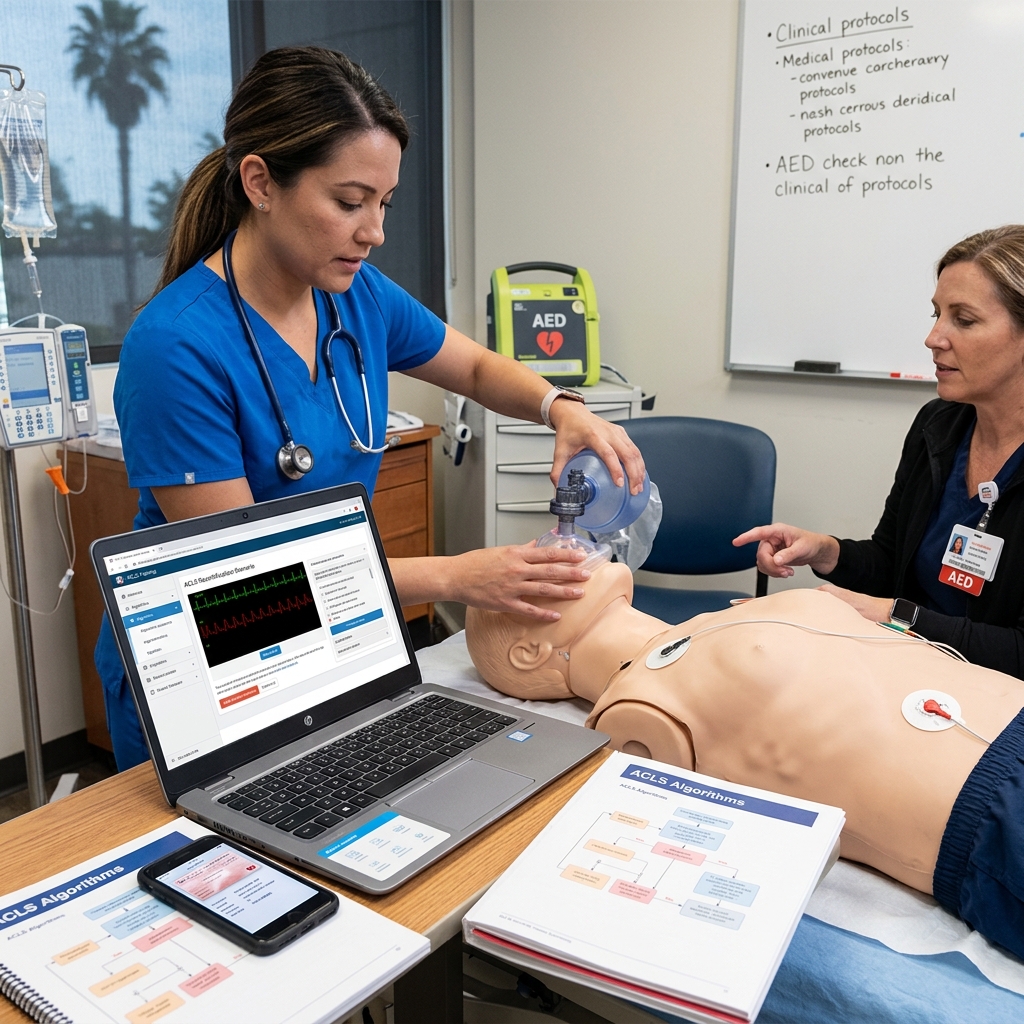
In-person sessions also provide the verification you need immediately. You’ll practice chest compressions, medication administration, rhythm analysis, and team communication in a supervised environment. Your instructor documents your performance and can issue your certification card on the spot, eliminating the wait for processing.
What to do next: Visit our location finder and identify the three closest training centers to your workplace or home. Call or book online to reserve your preferred session date.
3. Verify Your Current Certification Status Before Renewal
Many healthcare professionals discover their ACLS is expiring only when they receive a notice from their employer or credentialing department. This reactive approach creates unnecessary stress and sometimes forces you into inconvenient last-minute scheduling.
We recommend a proactive verification step: check your current certificate at least 90 days before expiration. Note the exact expiration date, any special requirements your state license board or employer has added, and whether you need recertification or renewal (they’re different processes). Some positions require both ACLS and other certifications like PALS (Pediatric Advanced Life Support) for nurses working in pediatric settings, or NRP (Neonatal Resuscitation Program) for delivery room staff.
This verification step also clarifies whether you need a full recertification course or if your employer accepts skills refresher sessions. Some healthcare facilities offer in-house verification for their staff, though external, independent certification like ours carries more weight during credentialing reviews.
What to do next: Pull your current ACLS card and circle the expiration date on your calendar. Add a reminder for 90 days before that date to enroll in recertification.
4. Select Same-Day Certification Card Options for Immediate Proof
One of the most frustrating aspects of traditional recertification is the waiting period. You complete your course on Friday, and your certification card arrives by mail two weeks later. If you need immediate proof for a new job, shift coverage, or credentialing submission, this delay creates obstacles.
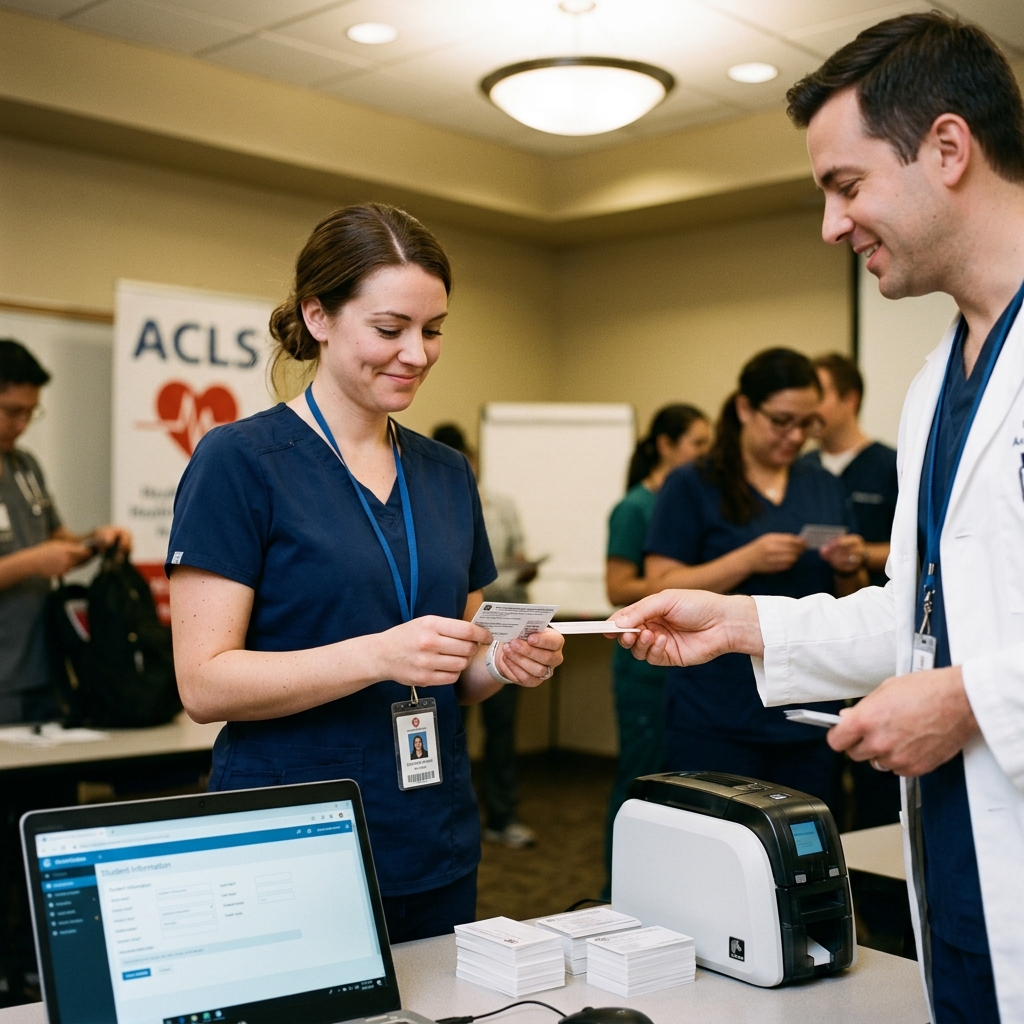
We provide same-day certification card options at our in-person skills sessions. Once you demonstrate competency and pass the written assessment, you walk out with your updated credential in hand. This is especially valuable if you’re starting a new position, switching facilities, or need to submit proof to your state licensing board on a specific timeline.
Same-day cards also eliminate the risk of misfiled paperwork or lost mail. You have physical verification immediately, plus we maintain digital records that can be verified by your employer or credentialing committee at any time.
What to do next: When booking your recertification session, confirm that same-day card issuance is available. Our staff will guide you through the process on course day.
5. Take Advantage of Statewide Training Locations for Convenience
California’s geography is vast. If you’re working in Visalia, driving to San Francisco for ACLS training makes no practical sense. Our network of over 100 locations reflects this reality. We maintain active training centers in urban hubs like San Francisco (with locations in the Mission District, Nob Hill, Sunset, and near UCSF), Oakland (Fruitvale, Lake Merritt, and Piedmont), San Jose (Downtown, Japantown, South, and Willow Glen), and Sacramento (Arden, Midtown, Oak Park, and Rosemont).
We also serve smaller communities and suburban areas that larger training providers often overlook. Whether you work in Walnut Creek, Pleasanton, Davis, Stockton, or Tracy, you’ll find accessible training nearby. This decentralized approach means less time commuting and more flexibility in scheduling around your shifts.
The real advantage here is continuity. You can complete your initial ACLS and any required recertifications at the same local center, building relationships with instructors who understand your community’s healthcare landscape.
What to do next: Identify the training location closest to your commute. Set a quarterly reminder to check our calendar for upcoming sessions at that center.
6. Utilize RQI Simulation Stations for Advanced Skills Practice
Beyond standard recertification, we offer RQI (Resuscitation Quality Improvement) simulation stations where you can practice advanced scenarios in a low-stress environment. These stations use manikins and realistic equipment to simulate cardiac arrest, rhythm changes, and multi-rescuer coordination.
RQI practice is especially valuable if you work in a high-acuity setting like the ICU, emergency department, or operating room. It bridges the gap between classroom instruction and real patient care. You can practice your facility’s specific protocols, work with your team members, and receive feedback from instructors without the pressure of a formal assessment.
Many hospitals now include RQI time as part of their annual competency verification. Having access to simulation stations independent of your facility gives you extra practice opportunities and keeps your skills sharp between formal recertifications.
What to do next: Ask your manager whether your facility offers or requires RQI practice hours. If not, consider scheduling one or two sessions annually at our simulation stations to maintain confidence in high-stakes situations.
7. Schedule Your Recertification Well Before Your Expiration Date
The single most effective strategy is planning ahead. ACLS certifications are valid for two years, so calendar renewal immediately after earning your card. This gives you a twelve-month window to schedule recertification without urgency.
Scheduling early has several advantages: you get your preferred course date and time, you avoid peak enrollment periods that force you into inconvenient slots, and you eliminate the risk of missing the renewal window due to unexpected schedule conflicts. It also signals to your employer that you’re proactive about compliance, which reflects well during performance reviews and credentialing updates.
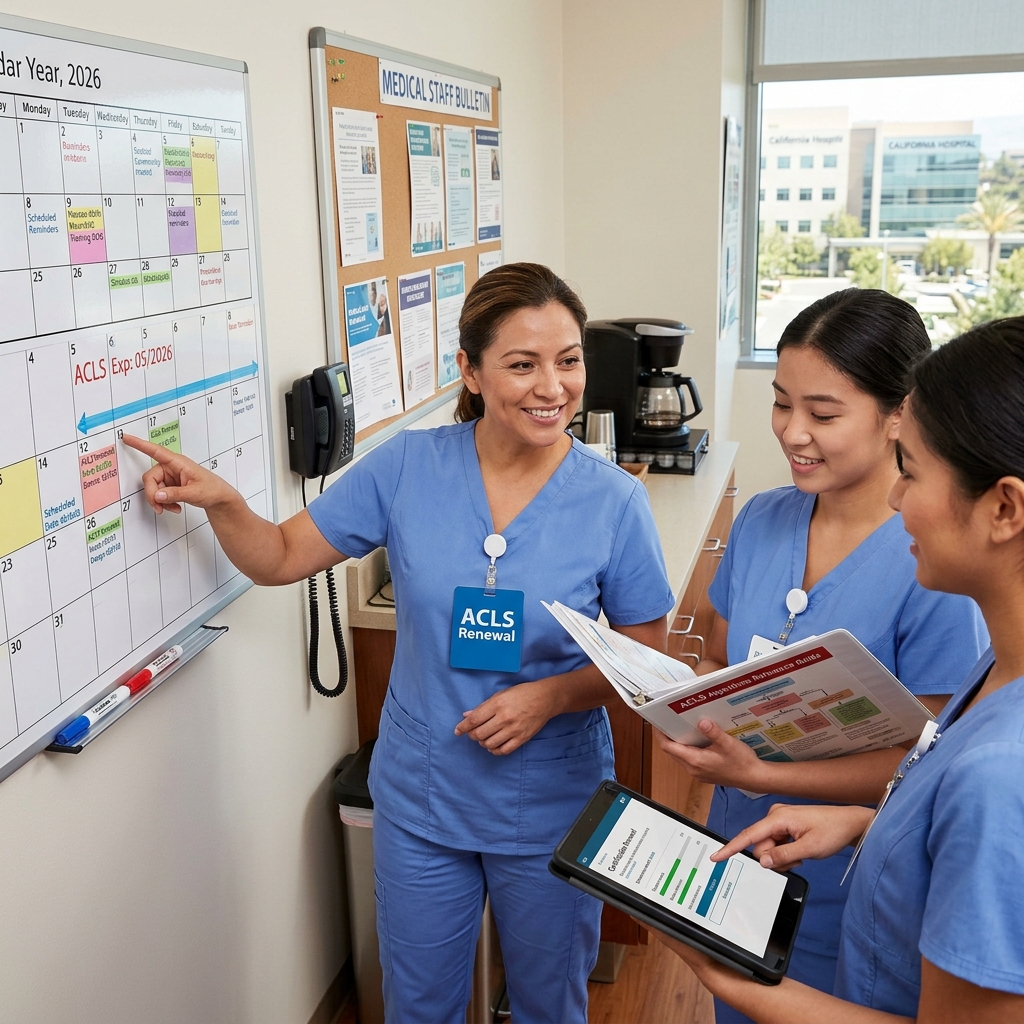
We recommend scheduling your recertification 60 to 90 days before expiration. This timeline ensures completion while giving you breathing room if your first choice of dates fills up.
What to do next: Choose your course and book now rather than waiting until three months before expiration. Many professionals build this into their annual calendar alongside other continuing education commitments.
—
Meeting California ACLS recertification requirements doesn’t have to be stressful or time-consuming. The combination of blended learning flexibility, accessible in-person training across our 100+ locations, same-day certification cards, and proactive planning removes the common barriers that healthcare professionals face.
We’re committed to making recertification straightforward and convenient. Our instructors understand the clinical realities you navigate, our locations span California from the coast to the mountains, and our same-day card option means you walk out certified and ready. Contact us today to schedule your recertification session and maintain the credentials your patients and employers depend on.
Register for a class today.
Frequently Asked Questions (FAQ)
How do I renew my ACLS certification in California?
We offer both blended learning and in-person options to fit your schedule. Our courses combine online coursework with hands-on skills sessions at one of our 100+ California locations, allowing you to complete recertification efficiently while meeting all state requirements. We can provide your certification card the same day you finish your skills session, so you’ll have immediate proof of renewal for your employer.
What’s the difference between our blended learning and traditional in-person ACLS recertification?
With our blended approach, we let you complete the knowledge portion online at your own pace, then attend a shorter in-person skills session to practice and demonstrate competency. Our traditional in-person option consolidates everything into one session at your nearest training location. Both methods fulfill California recertification requirements equally, so you can choose based on what works best for your schedule.
How far in advance should I schedule my ACLS recertification?
We recommend scheduling your renewal at least 30 days before your certification expires to ensure you have an available class slot near you. Since we offer daily BLS and ACLS courses across the state, you’ll typically find multiple options, but scheduling early prevents any gaps in your certification coverage for work compliance.