
Table of Contents
- Why Healthcare Professionals Need Flexible BLS Certification Options
- The Challenge with Traditional In-Person BLS Training
- How Blended Learning Transforms Your Certification Journey
- Our Proven Blended BLS Format: Theory Online, Skills In-Person
- Multiple California Locations for Your Convenience
- Fast-Track Certification Without Compromising Quality
- Same-Day Certification Cards and Immediate Compliance
- Specialized Programs for Healthcare Professionals
- Corporate Group Training and Volume Pricing
- Get Your BLS Certification Starting Today
- Frequently Asked Questions (FAQ)
Why Healthcare Professionals Need Flexible BLS Certification Options
Your schedule as a healthcare professional is rarely predictable. Between patient care, shift rotations, and mandatory continuing education, carving out time for certification renewal feels impossible. We understand that constraint, which is why blended learning BLS certification has become essential for nurses, dentists, EMS personnel, and other medical professionals across California.
You need certification that fits your life, not the other way around. A blended approach gives you that control by splitting coursework into manageable online theory sessions and focused in-person skills practice. This flexibility means you can complete classroom content when it suits you, then show up for hands-on training confident and prepared.
The stakes matter here. Your BLS certification isn’t just a credential to display on your wall. It’s a legal requirement for employment, a professional responsibility, and proof that you can respond to cardiac emergencies. We design our blended programs to make this requirement achievable while maintaining the rigor healthcare settings demand.
Your next step: Assess whether your current certification path gives you the flexibility and convenience you deserve. If not, explore options that respect your time while meeting compliance standards.
The Challenge with Traditional In-Person BLS Training
All-day in-person courses create real friction for working professionals. You’re expected to block 8 hours, travel to a training facility, and sit through material you may already understand conceptually, just to get to the skills practice portion that actually requires an instructor.
For someone juggling 12-hour shifts, on-call schedules, or multiple job locations across the Bay Area or Central Valley, this format is impractical. You might postpone certification renewal, rack up late fees, or face compliance issues if your credential lapses during a busy season. Some healthcare facilities even penalize staff who miss renewal deadlines.
Beyond scheduling, traditional formats waste your time. Not every participant needs the same amount of theory instruction. A veteran nurse reviews CPR fundamentals differently than someone early in their career. Yet everyone sits through identical lectures at identical paces, creating frustration for both groups.
The cost compounds the problem. Travel time, parking, and the opportunity cost of being away from work or family make these sessions feel expensive beyond the course tuition itself. We’ve seen professionals skip renewal years entirely because the burden felt too high.
Actionable insight: Calculate your true cost of traditional training, including travel time and lost work hours. When you compare that to a blended model where you study theory at home, you’ll quickly see the efficiency gain.
How Blended Learning Transforms Your Certification Journey
Blended learning restructures the entire experience around your reality. You complete theoretical content online at your own pace, then attend a focused in-person session where every minute centers on hands-on skills that demand live instruction.
This approach respects your expertise while ensuring thoroughness. You’re not wasting time on material you already know. Instead, you move quickly through foundational concepts, then spend concentrated time practicing actual chest compressions, rescue breathing, and defibrillator use with an instructor present to correct your technique in real time.
The psychology shifts too. When you show up for the skills session already prepared, you’re confident. You ask better questions. You practice with intention rather than confusion. That confidence translates directly into muscle memory and real-world readiness.
We’ve observed that professionals complete blended courses faster than traditional formats while reporting higher satisfaction. The structure works because it mirrors how adults actually learn. You absorb information independently, then practice and refine under expert guidance.
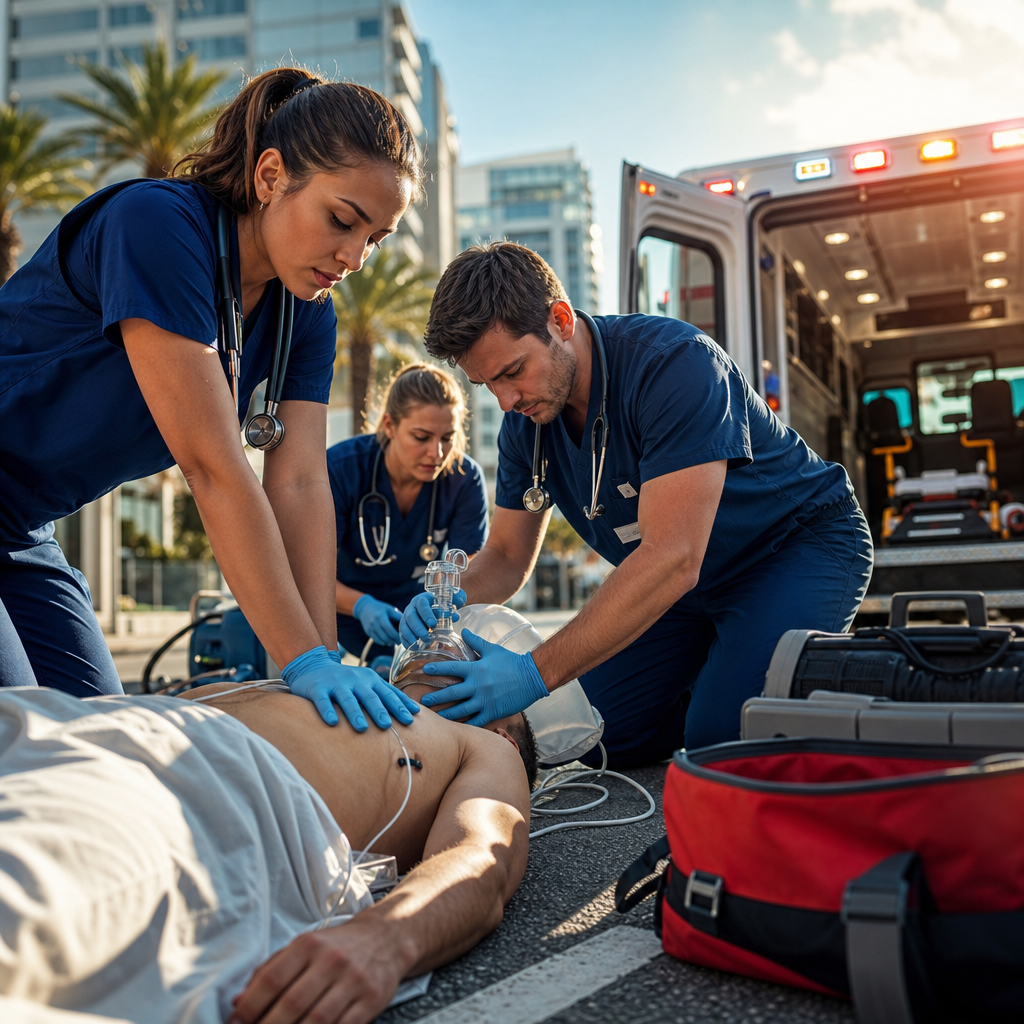
Travel becomes manageable when you only need to visit a training facility once. Whether you’re in Stockton, San Jose, Sacramento, or San Francisco, you can find a convenient location for your single in-person session. The rest happens on your terms.
What to implement: Check whether the BLS option you’re considering actually offers asynchronous online content. Not all “hybrid” programs give you genuine flexibility; some just split a traditional day into two shorter sessions at fixed times.
Our Proven Blended BLS Format: Theory Online, Skills In-Person
Our blended model separates content strategically. Your online portion covers Basic Life Support fundamentals, chain of survival principles, CPR techniques, AED operation, and rescue breathing protocols. You progress through modules, take knowledge checks, and complete an exam demonstrating mastery before you arrive for the skills session.
This isn’t passive video watching. Our online content includes interactive scenarios, skill demonstrations, and targeted questions that prepare you specifically for what you’ll do in person. You’re not memorizing trivia; you’re building the conceptual foundation that makes hands-on practice meaningful.
The in-person component runs differently than traditional courses. You arrive having already absorbed theory. Your instructor reviews any unclear concepts quickly, then you immediately move to stations where you practice compressions on manikins, operate defibrillators, and perform rescue breathing under direct supervision.
Our instructors are experienced healthcare professionals themselves. They’ve worked as nurses, paramedics, and emergency responders. That background means they understand the exact scenarios you’ll face in your clinical setting and can teach skills with context and practical realism.
The entire experience moves efficiently. Your in-person session typically runs 3-4 hours versus the 8-hour traditional day. You leave with the same certification level, the same skill competency, and vastly less time invested.
Immediate action: Verify that any course you choose offers a comprehensive online exam before the in-person session. This ensures you’re truly prepared when you arrive and that instructors aren’t wasting time reviewing theory.
Multiple California Locations for Your Convenience
We operate over 100 training locations throughout California, from San Francisco and the Bay Area communities like Oakland, Berkeley, and Walnut Creek, through the Central Valley including Sacramento, Stockton, and Fresno, down to Southern California areas. Whether you work in Alameda, Antioch, Campbell, Davis, Folsom, or anywhere in between, you’ll find a facility within reasonable distance.
This geographic spread matters practically. You’re not driving 90 minutes across the state for a skills session. Instead, you pick a location closest to your home or workplace and schedule around your local routine. Professionals in Palo Alto find training steps away from their practice. Those in Visalia or Merced have dedicated facilities rather than traveling to distant metropolitan centers.
Our location strategy also solves a common frustration with centralized training: availability. We maintain multiple sessions across different times throughout each week and month. If your preferred location is booked on Tuesday evening, we likely have space on Thursday afternoon or Saturday morning at another nearby facility.
Urban healthcare professionals benefit from options like our San Francisco locations in Mission Bay, the Sunset District, and Telegraph Hill. Rural and regional professionals have facilities in communities like Redding, Lathrop, and Woodland. This distribution means no one in California faces unreasonable travel barriers.
Next step: Visit our location finder and identify the three facilities closest to you. Check their posted schedules and availability rather than assuming everything is booked. Our high-volume, multi-location model means spaces open regularly.
Fast-Track Certification Without Compromising Quality
Speed doesn’t require sacrifice. Our blended format actually delivers faster certification than traditional methods while maintaining rigorous standards. You complete your online exam, attend one focused skills session, and walk out with your credential. Total time investment might span a week, whereas traditional all-day courses ask you to block your calendar for a single marathon day that still requires travel and setup time.
Fast-track options exist for professionals facing compliance deadlines. If your certification lapses next month, we can accelerate your timeline with intensive online modules and next-available skills sessions. We’ve helped countless professionals regain compliance quickly without the panic that traditional systems would impose.
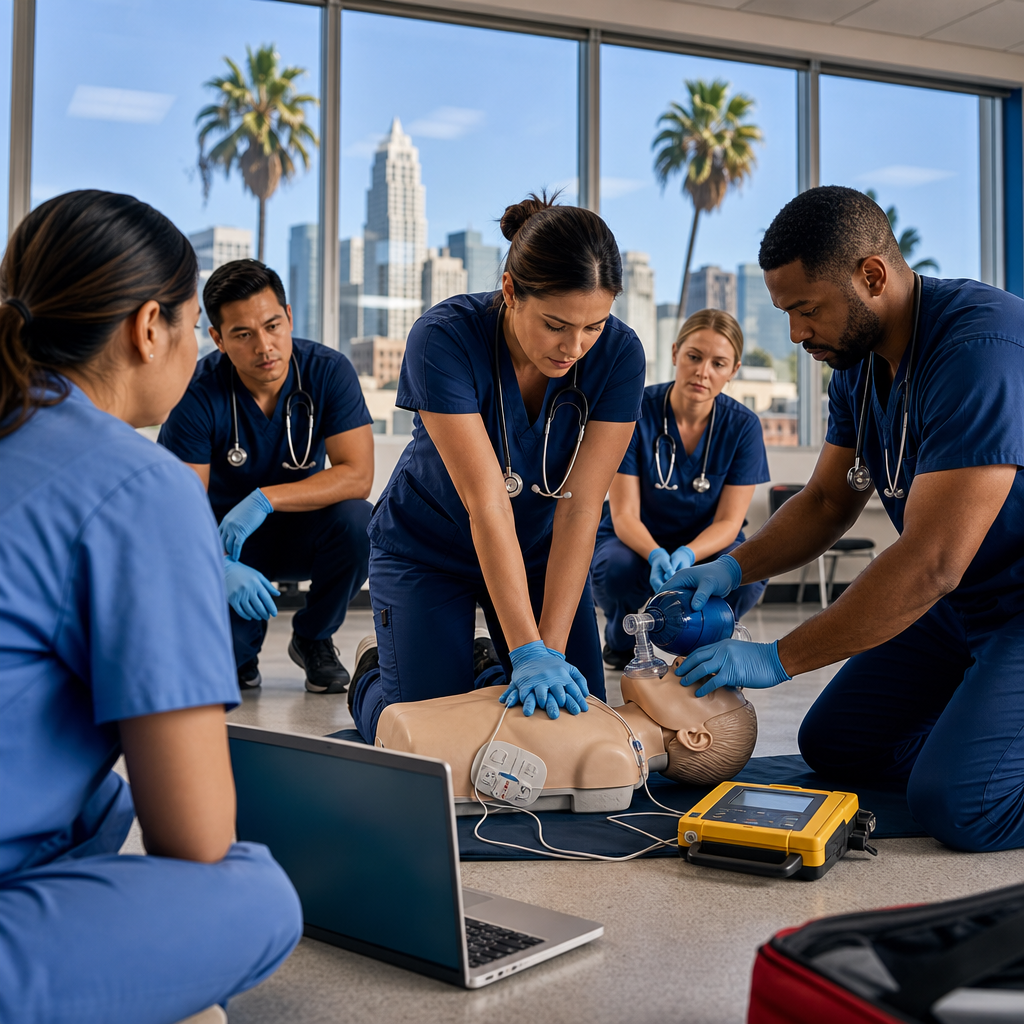
The speed works because we eliminated inefficiency, not rigor. Your instructor still assesses every skill. You still demonstrate competency on compressions, airway management, and defibrillator operation. You still pass an exam. The difference is that you’re not sitting through redundant lectures or waiting for everyone else to complete practice rounds before your turn comes.
Healthcare employers recognize this. Our graduates pass credential verification checks just as thoroughly as those from any traditional program. Your certification carries identical weight for employment, licensing boards, and patient safety protocols.
Actionable takeaway: If you’re planning your annual continuing education, don’t wait until your cert is near expiration. Book your blended course 2-3 months ahead so you have breathing room and can take advantage of scheduled sessions rather than emergency fast-track options.
Same-Day Certification Cards and Immediate Compliance
The moment you complete your skills assessment successfully, you’re certified. We issue credentials the same day your in-person session ends. You leave with your card in hand, ready to present it to your employer or licensing board the next morning.
This immediate credential eliminates compliance stress. You don’t wait weeks for documentation to process. You don’t risk your employment status during a verification gap. The card you receive reflects current certification valid for the full 2-year term.
Digital credentials supplement physical cards. You receive documentation immediately upon completion that you can email to your healthcare facility, share with administrators, or submit to licensing bodies the same day. This dual-documentation approach means you have immediate proof of compliance whether your employer prefers physical or digital records.
Same-day issuance has real professional impact. Many healthcare settings require current certification before allowing independent clinical practice. Immediate cards mean you can return to full duties without delay. For casual per-diem staff, this means no gap in available work assignments.
We maintain this efficiency across all our California locations, whether you test in Stockton, Sacramento, San Jose, or San Francisco. Our system is standardized so that professional nurses in Palo Alto receive the same same-day credential process as EMS personnel in Bakersfield.
Important consideration: Verify your specific employer’s requirements before enrolling. Most accept same-day credentials immediately, but some older systems require processing time. A quick call to your compliance department takes minutes and prevents any misunderstanding.
Specialized Programs for Healthcare Professionals
Not all BLS courses are identical. Healthcare providers need certifications scaled to their specific roles and responsibilities. We offer specialized programs beyond basic BLS that address the realities of clinical practice.
Our ACLS (Advanced Cardiovascular Life Support) courses build on BLS foundations and cover the management of cardiac emergencies, arrhythmia recognition, and medication protocols. Nurses, physicians, and emergency responders rely on ACLS certification for advanced clinical settings. We structure ACLS in blended format too, meaning you study rhythm strips and medication algorithms online, then practice on simulators and review case scenarios in person.
PALS (Pediatric Advanced Life Support) serves pediatric nurses, respiratory therapists, and emergency staff who work with children. Pediatric resuscitation differs significantly from adult protocols. Equipment scales differently. Drug doses change. PALS training reflects those realities, and our blended approach ensures you’re confident performing pediatric compressions on appropriately sized manikins during your in-person session.
NRP (Neonatal Resuscitation Program) focuses on newborn delivery rooms and NICU environments. Obstetric nurses and neonatologists need this specialized credential. The skills differ from both adult and pediatric BLS, and we provide dedicated training with equipment and scenarios matching your clinical environment.
These specializations matter for career advancement and clinical credibility. Your certification demonstrates that you understand the specific protocols your patient population requires. Employers value this specificity because it reduces orientation time and increases patient safety.
Strategic move: Consider stacking credentials across a few months. Complete BLS now, then pursue ACLS or PALS within your next renewal window. Spacing them prevents certification chaos and spreads your continuing education investment across your professional calendar.
Corporate Group Training and Volume Pricing
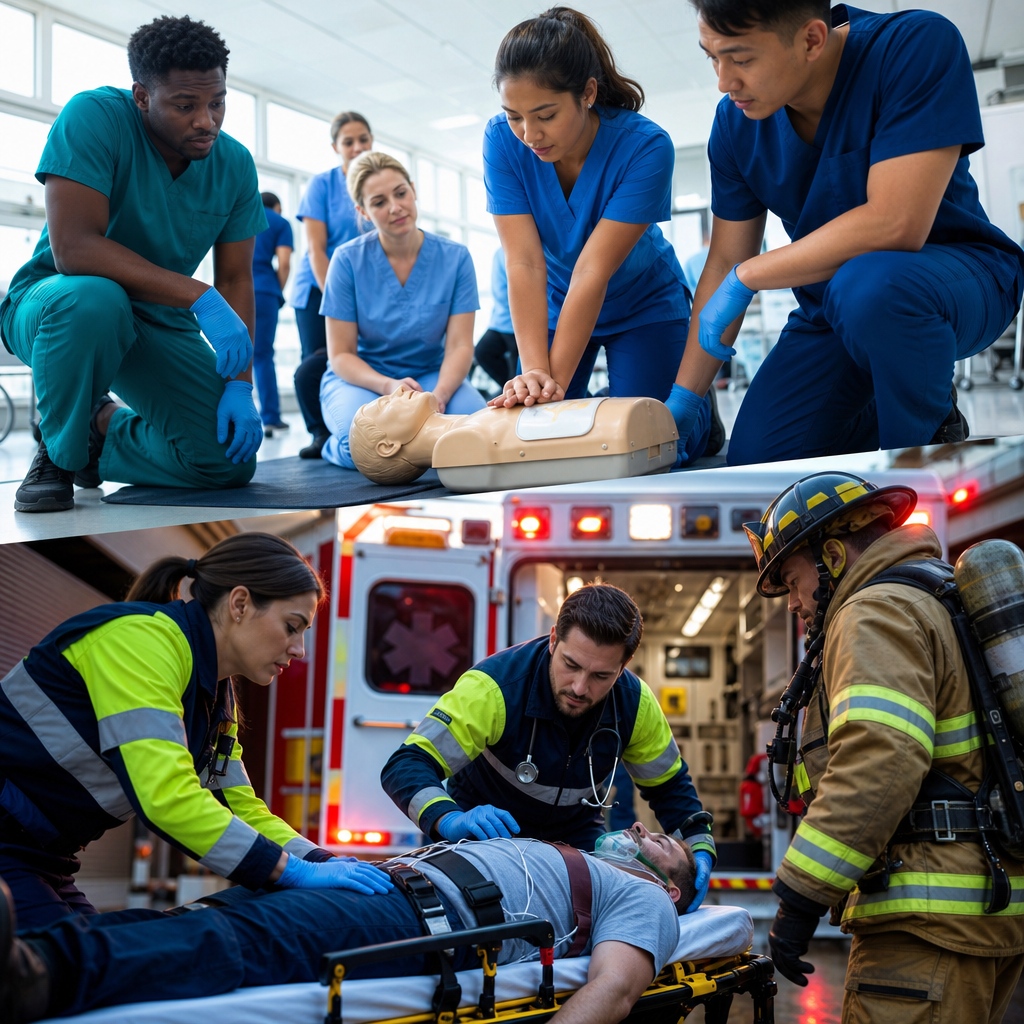
Healthcare facilities, clinics, and medical organizations face the burden of keeping entire teams certified. Coordinating 50 nurses or 30 EMS personnel through traditional training creates logistical nightmares and significant expense. We solve this through corporate group training programs.
Our volume pricing model reduces per-person costs substantially when your organization books multiple participants. A 50-person cohort pays less per seat than a solo professional taking one course. That savings compounds across your entire team over multiple years.
We customize group scheduling around your facility’s needs. Don’t disrupt patient care by pulling everyone for training the same day. Instead, we run rotating sessions that let you stagger participants across weeks. Your daytime staff can test on Tuesday evenings; night shift personnel can attend Saturday or Sunday sessions. This flexibility keeps your operation running while ensuring 100% compliance.
Corporate blended programs include administrative tracking. You receive reports showing who’s completed certification, whose credentials expire soon, and compliance status across your entire organization. This visibility simplifies renewal management and prevents accidental lapses affecting patient care or licensing status.
We’ve worked with dental practices across the Bay Area, nursing homes in the Central Valley, and emergency departments throughout California. Each organization has unique scheduling constraints and staffing patterns. Our blended model scales to accommodate those realities in ways traditional training simply cannot.
Efficiency measure: If you’re a department manager or compliance officer, schedule a conversation with our corporate team. We’ll assess your team size, renewal schedule, and budget to structure a program that reduces administrative overhead and saves money versus individual course bookings.
Get Your BLS Certification Starting Today
Your path forward starts with one decision: commit to certification that respects your professional schedule. Blended learning removes the friction between your work requirements and your actual availability. You complete theory when it suits you, show up for hands-on skills confidently, and leave certified the same day.
We’re ready to support your certification journey. Visit Safety Training Seminars to explore current course schedules, check availability at your nearest California location, and register for your blended BLS session. Whether you’re in the Bay Area, Central Valley, or anywhere else across California, we have facilities and schedules that work for your life.
Your professional credentials shouldn’t force you to sacrifice time with family, miss work, or navigate logistical barriers. Blended certification makes compliance achievable on realistic terms. Register this week to secure your spot and move forward with confidence.
Register for a class today.
Frequently Asked Questions (FAQ)
What makes your blended BLS format different from traditional in-person training?
We split our certification into two components to fit your schedule better. You complete the theory portion online at your own pace, then join us for a focused in-person skills session where we verify your hands-on competency. This approach lets you study when it works for you while ensuring we meet all certification standards during the practical demonstration.
Can I get my BLS certification card on the same day as my skills session?
Yes, we issue our certification cards immediately after you pass the in-person skills assessment. We understand that many of our healthcare professionals need compliance documentation quickly for employment or licensing requirements, so we handle verification and card issuance right there during your session.
Do you offer BLS training at locations near me in California?
We operate over 100 training locations throughout California, from San Francisco to Visalia and everywhere in between. You can find a convenient location for your in-person skills session on our website, and since the online theory portion works from anywhere, proximity is only a factor for the hands-on component.