
Table of Contents
- Why Healthcare Providers Need Specialized Dog Bite First Aid Training
- Understanding Dog Bite Wounds and Infection Risks
- Immediate First Aid Response to Dog Bites
- Proper Wound Cleaning and Bleeding Control Techniques
- When to Seek Medical Attention and Vaccination Requirements
- Infection Prevention Strategies and Bacterial Concerns
- Documentation and Reporting Requirements for Bite Incidents
- How Our First Aid Certification Prepares You for Real Emergencies
- Our Blended Learning Approach to First Aid Mastery
- Convenient Training Locations Throughout California
- Get Your First Aid Certification Today
- Frequently Asked Questions (FAQ)
Why Healthcare Providers Need Specialized Dog Bite First Aid Training
Dog bites represent a significant occupational hazard for healthcare professionals working in emergency departments, urgent care clinics, and field settings. When an injured patient arrives with a bite wound, your ability to assess severity and provide immediate care directly influences infection outcomes and patient safety.
Unlike general first aid, dog bite treatment requires understanding the unique characteristics of puncture wounds and contamination risks. You’ll encounter bites in contexts where standard protocols may not apply, especially in emergency situations where other injuries complicate the picture. Specialized training teaches you to recognize which bites demand immediate physician evaluation versus those manageable through careful cleaning and monitoring.
We recognize that your clinical role demands confidence in handling trauma situations with precision. Having structured knowledge about animal bite protocols strengthens your credibility with patients and supports your facility’s liability protections.
Understanding Dog Bite Wounds and Infection Risks
Dog bites create puncture wounds that differ fundamentally from lacerations or abrasions. Teeth penetrate deeply, creating small surface openings that conceal deeper tissue damage. This anatomy traps bacteria from the dog’s mouth into subcutaneous layers where they multiply rapidly.
The bacterial contamination rate in dog bites ranges from 50 to 90 percent, with Pasteurella multocida being the most common pathogen. Other organisms including Staphylococcus aureus, Streptococcus species, and anaerobic bacteria complicate infection potential. When puncture wounds go unrecognized or under-treated, infection develops within 24 to 72 hours.
Several factors increase infection severity:
- Depth and location of the puncture (hand and foot bites carry highest risk)
- Delay in wound cleaning beyond 12 hours
- Immunocompromised patient status
- Presence of devitalized tissue
- Inadequate initial irrigation
You should also consider that patients sometimes minimize bite incidents or delay reporting, which means thorough wound assessment becomes your responsibility during initial evaluation.
Immediate First Aid Response to Dog Bites
Your first priority is controlling bleeding and preventing further contamination. Have the patient sit or lie down in a comfortable position, keeping the affected area supported at or above heart level.
Begin by applying direct pressure with a clean cloth if active bleeding is present. Most dog bites bleed minimally because puncture wounds typically seal quickly, which can work against you by trapping bacteria inside. After bleeding subsides, resist the urge to close the wound prematurely.
Next, remove any jewelry, watches, or constrictive items from the affected limb. Swelling often develops within minutes to hours, and tight items can compromise circulation. If the bite is on a hand or foot, elevate it immediately to slow inflammatory response.
Photograph the wound if your facility protocols allow documentation. This creates a baseline for monitoring progression and supports medical records accuracy.
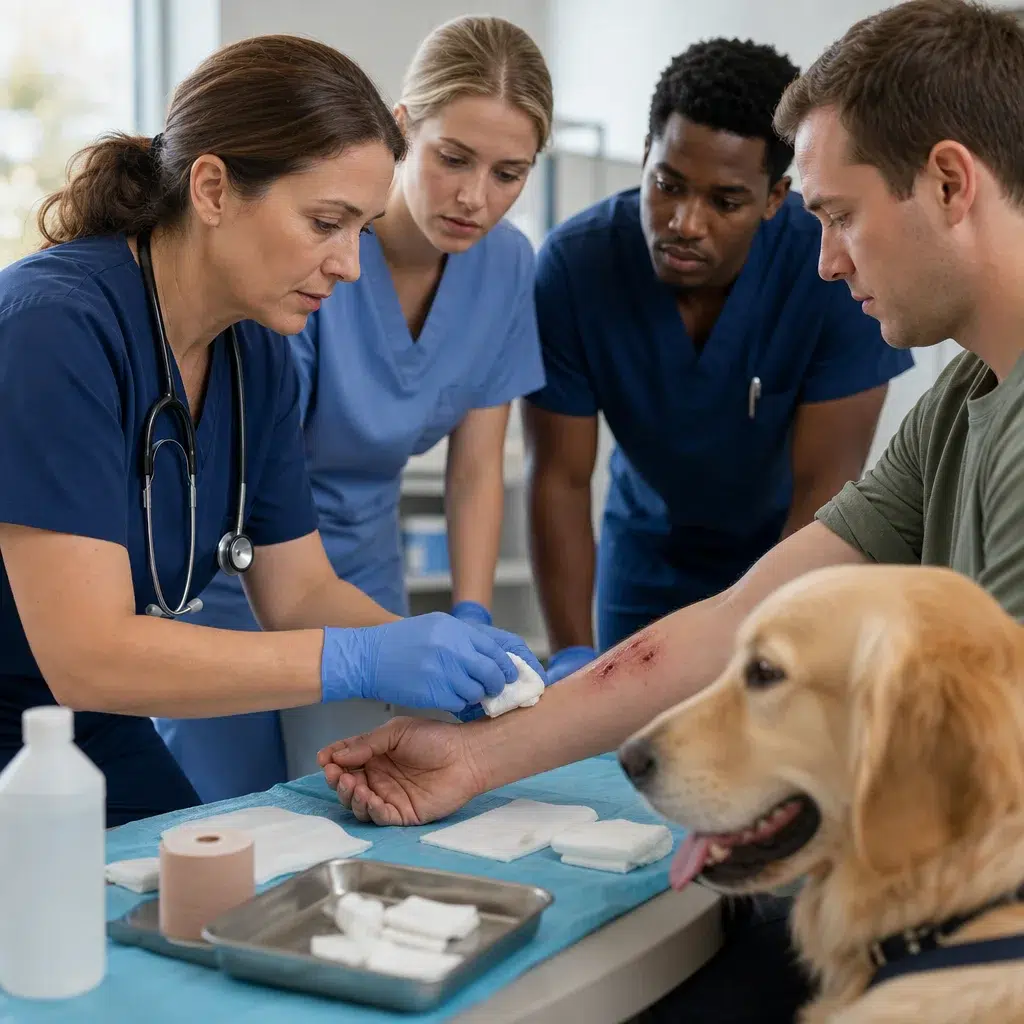
Have the patient provide bite history details immediately while memory is fresh:
- Time and date of bite
- Dog’s appearance and behavior
- Whether the dog was provoked
- Owner contact information if known
- Vaccination status of the dog (if available)
This information proves critical for rabies risk assessment and public health reporting requirements that follow.
Proper Wound Cleaning and Bleeding Control Techniques
Thorough irrigation is the single most effective intervention for preventing infection in dog bite wounds. This step cannot be rushed or understated in its importance.
Use copious amounts of clean running water or sterile saline, irrigating for at least five minutes. Direct the stream forcefully into the wound to flush bacteria and debris from all tissue planes. If the puncture is deep, allow the irrigation solution to flow through the entire wound tract.
For wounds with visible contamination, debris, or tissue crushing, extend irrigation to 10 to 15 minutes. After initial irrigation, scrub gently with a soft brush or gauze to remove superficial contaminants. Do not scrub aggressively, as this damages tissue and increases bleeding.
Follow irrigation with a mild soap wash, then final rinse. Some facilities use dilute antiseptic solutions like povidone-iodine or chlorhexidine; your facility protocols should guide this choice.
After cleansing, assess whether you need to control ongoing bleeding. Most bites respond to gentle pressure and elevation. If bleeding persists, you may apply a topical hemostatic agent or pressure dressing, but avoid tight bandaging that could restrict circulation or trap moisture against the wound.
Allow the wound to air dry slightly before dressing. Healthcare professionals often recognize that moist environments favor bacterial growth, so moisture management matters even in these early stages.
When to Seek Medical Attention and Vaccination Requirements
Your facility should have clear protocols defining which bites require physician evaluation. Generally, refer immediately if the wound is:
- Located on the face, hand, foot, or over joints
- Deep or gaping
- Associated with significant tissue crushing or devitalization
- On an immunocompromised individual
- Older than 12 hours without professional cleaning
- Accompanied by systemic symptoms like fever or lymphadenopathy
Rabies exposure represents the most serious concern with dog bites. If the dog’s vaccination status is unknown or the animal showed signs of illness, post-exposure prophylaxis (PEP) becomes necessary. Rabies PEP consists of rabies immune globulin and a series of rabies vaccines given on days 0, 3, 7, and 14 after exposure.
Tetanus status also requires assessment during initial evaluation. If the patient’s last tetanus vaccination was more than five years ago, a booster dose should be administered, particularly given the wound contamination.
Many jurisdictions require healthcare facilities to report dog bites to public health authorities, which will investigate the dog’s vaccination status and observe the animal for rabies symptoms.
Infection Prevention Strategies and Bacterial Concerns
Beyond initial wound cleaning, infection prevention relies on prophylactic antibiotics in most dog bite scenarios. Empiric coverage should target the common pathogens we discussed earlier, particularly Pasteurella multocida.
Recommended prophylactic antibiotics typically include amoxicillin-clavulanate, which addresses aerobic and anaerobic organisms effectively. For penicillin-allergic patients, fluoroquinolones or clindamycin plus a fluoroquinolone provide alternatives.

Antibiotic timing matters significantly. Prophylaxis started within 24 to 48 hours of the bite shows measurable benefit, though earlier administration (within hours) provides optimal protection. Most courses run five to seven days.
Consider prophylaxis carefully in puncture wounds, crush injuries, or bites on high-risk body areas. Hand bites particularly warrant prophylactic treatment because of infection complication rates and potential for functional impairment.
Patient education following the bite should emphasize:
- Keeping the wound clean and dry
- Watching for increased redness, swelling, warmth, or drainage
- Reporting fever or red streaking (lymphangitis) immediately
- Completing the full antibiotic course
- Returning if symptoms develop during the monitoring period
Follow-up evaluation within 48 hours allows assessment of early infection signs and wound healing progression. This touchpoint catches developing cellulitis before it becomes serious.
Documentation and Reporting Requirements for Bite Incidents
Thorough documentation protects you, your facility, and supports public health surveillance. Your records should include:
- Time, date, and location of the bite
- Complete description of the bite (number of punctures, location, depth)
- Circumstances of the incident
- Dog description and behavior observed
- Owner information if available
- Bite victim’s vaccination and medical history
- Detailed description of first aid and cleaning procedures provided
- Photographs of the wound (with patient consent)
- Rabies and tetanus status assessment
- Any referrals made or physician consultations
- Prophylactic treatments administered
Documentation should be specific rather than general. Instead of “bite to hand,” write “three puncture wounds to dorsal surface of right hand between thumb and index finger, approximately 5mm deep, minimal active bleeding.”
Many states require health care facilities to report dog bites to local health departments within 24 to 72 hours. This triggers animal observation protocols and helps track rabies exposure incidents. Public health authorities will contact the dog owner and determine whether the animal requires confinement observation.
Keep copies of any incident reports separate from the patient medical record but cross-referenced appropriately. This supports both clinical continuity and legal defensibility if questions arise later.
How Our First Aid Certification Prepares You for Real Emergencies
We design our first aid certification to move beyond textbook scenarios into the real-world decisions you’ll face in clinical settings. Our instructors, many with extensive emergency department and field experience, teach you to think through complex bites involving multiple injuries, patient factors, and time constraints.
Our curriculum specifically addresses the decision-making framework you need: How do you prioritize a dog bite when the patient also has chest pain? What protocols apply when an elderly immunocompromised patient arrives with a bite from an unknown dog? These scenarios build confidence for the unpredictable situations emergency and primary care environments present.
We emphasize hands-on practice with actual wound assessment and cleaning techniques. Seeing how different puncture patterns behave during irrigation, practicing pressure application on realistic manikins, and running through rabies assessment algorithms transforms knowledge into muscle memory and confident action.
Our certification covers the documentation requirements that protect your license and your facility. You’ll understand not just what to document, but why each detail matters for legal protection, public health surveillance, and clinical follow-up.
Our Blended Learning Approach to First Aid Mastery
We offer blended learning options combining online theory with in-person skills sessions. This structure fits healthcare professional schedules, allowing you to complete didactic content when convenient while guaranteeing hands-on practice with certified instructors.
Your online portion covers anatomy of bite wounds, infection pathophysiology, antibiotic protocols, and documentation requirements. You move through these concepts at your pace, then apply everything during your in-person session with real instructors and realistic equipment.

During skills sessions, you practice wound assessment on moulage models, perform irrigation techniques, and work through scenario-based decisions with immediate feedback. Our instructors watch your technique, correct your approach, and ensure you’re confident before certification.
This blended model keeps you engaged and prevents the passive learning that characterizes many online-only courses. You retain knowledge better because you’ve both studied concepts and practiced application.
Convenient Training Locations Throughout California
We maintain over 100 training locations throughout California, ensuring you can access certification without unreasonable travel. Whether you work in Sacramento, San Jose, San Francisco, Fresno, or coastal communities like Santa Cruz and Petaluma, local options minimize time away from your practice.
Our scheduling accommodates shift work and clinical demands. We offer morning, afternoon, evening, and weekend sessions across our facilities in major healthcare hubs including Oakland, Berkeley, Fremont, and throughout the Bay Area. If you’re based in inland regions, we serve Davis, Modesto, Stockton, and Visalia with consistent scheduling.
You can find class dates and locations that align with your calendar, often with same-week or next-week availability depending on your location.
Get Your First Aid Certification Today
Your expertise in managing dog bites protects patients and strengthens your professional practice. Whether you work in urgent care, emergency medicine, primary care, or field settings, our first aid certification ensures you’re prepared for these encounters with evidence-based protocols and practical confidence.
We offer competitive pricing with our low-price guarantee across all California locations. Your certification remains current and recognized by employers and licensing boards statewide.
Visit our website to browse available classes at California training locations, check schedules that work for your availability, and register today. Your next dog bite patient will benefit from the skills and knowledge you gain through our instruction.
Register for a class today.
Frequently Asked Questions (FAQ)
What makes our first aid training different when it comes to handling animal bites?
We combine hands-on skills practice with real-world scenarios that teach you how to properly manage wound care, control bleeding, and recognize infection risks specific to bite injuries. Our instructors draw from their experience with actual emergency situations to show you exactly what you’ll encounter in the field, and we offer daily certification courses at over 100 locations throughout California so you can train when it works for your schedule.
How does our blended learning format help me master first aid techniques for puncture wounds?
We structure our courses so you complete foundational knowledge online, then come to one of our training centers for hands-on skills sessions where you practice wound assessment and treatment protocols with our certified instructors. This approach lets you focus your in-person time on the practical techniques that matter most, rather than sitting through lectures you could learn at home.
Are your certifications accepted by healthcare employers in California?
Yes, we provide recognized certifications that meet the requirements California healthcare professionals need for their licenses and employment compliance. We guarantee our low pricing across all our courses, and we offer verification stations so you can maintain your credentials conveniently near your home or workplace.