Table of Contents
- The Hidden Costs of Provider Switching: Why Hospitals Hesitate
- Operational Challenges When Changing Certification Programs
- Minimizing Staff Downtime During Provider Transitions
- Our Blended Learning Model: Flexibility for Healthcare Teams
- Same-Day Certification and Immediate Compliance
- Over 100 California Locations for Convenient Access
- Customized Group Training and Discounted Pricing
- Low Price Guarantee and Cost Predictability
- Real-World Success: How Other California Hospitals Made the Switch
- Getting Started with Your Provider Transition
- Frequently Asked Questions (FAQ)
The Hidden Costs of Provider Switching: Why Hospitals Hesitate
Switching healthcare certification providers feels risky. Your staff needs current CPR, BLS (Basic Life Support), ACLS (Advanced Cardiovascular Life Support), and PALS (Pediatric Advanced Life Support) credentials to maintain compliance and patient safety standards. A misstep during transition could leave clinicians without active certifications, jeopardize licensing requirements, or force last-minute scheduling chaos.
We understand this concern because California healthcare teams face it regularly. Changing providers doesn’t have to mean operational strain. With the right partner and clear transition planning, you can upgrade your training experience, reduce costs, and actually improve staff scheduling flexibility.
Most hospital administrators worry about three things when considering a provider switch: certification gaps, scheduling complexity, and hidden fees that make the switch more expensive than staying put.
Certification gaps happen when staff certifications lapse during the changeover window. If your team finishes with one provider on a Friday and can’t schedule sessions with the new provider until three weeks later, you’ve created a compliance vulnerability. Nurses, emergency department technicians, and EMS personnel all face licensing requirements tied directly to current certifications. Even a two-week gap can trigger documentation issues with state boards and create liability exposure.
Scheduling complexity multiplies when you’re managing two providers simultaneously during transition. Staff members book sessions with the old provider, then coordinate new appointments elsewhere. Coordinating availability across departments and multiple training sites becomes administrative overhead that diverts your team from patient care priorities.
Cost unpredictability adds another layer of hesitation. Many providers advertise low per-person rates but bundle in facility fees, materials costs, or mandatory group minimums that inflate the final invoice. You commit to switching, then discover the actual price exceeds your budget, leaving you mid-transition without a clear path forward.
We address these concerns head-on by offering same-day availability, transparent pricing with no hidden fees, and coordination support during your transition window.
Operational Challenges When Changing Certification Programs
The logistical reality of switching creates several obstacles that extend beyond simple scheduling.
First, your clinical staff operates on competing demands. Nurses juggle patient loads. EMS teams respond to emergencies. Dentists maintain appointment books. Finding four hours for a BLS recertification course or eight hours for ACLS training requires coordinating around existing patient care obligations, not replacing them. When certification renewal deadlines cluster (as they often do in hospitals), suddenly dozens of staff members need training simultaneously.
Second, different providers use different course formats and curriculum emphasis. Switching means your team learns new instructor teaching styles, potentially different drill sequences, and updated case scenarios. While standardized certifications exist, the delivery and reinforcement approach varies. Some providers emphasize online modules before in-person skills practice; others structure content differently. This transition period may briefly affect staff confidence or create questions about protocol differences.
Third, documentation and record-keeping transfer between systems. Your current provider maintains digital records of completed certifications. The new provider needs clean enrollment data, staff credentials, and historical completion records for compliance audits. Incomplete transitions here create double-work for HR and training coordinators.
Finally, staff skepticism about change is real. Clinicians grow accustomed to familiar instructors and course rhythms. Introducing a new provider may prompt questions about quality, instructor expertise, or whether the new approach will work for your specific hospital culture.
We simplify this transition by handling coordination calls directly with your team, maintaining detailed records from day one, and assigning a dedicated account manager to your hospital who understands your specific workflow needs.
Minimizing Staff Downtime During Provider Transitions

Downtime isn’t measured in hours; it’s measured in lost productivity and delayed skill maintenance. Reducing it requires strategic scheduling before transition day arrives.
Start by mapping your certification expiration calendar. Pull data showing which staff members’ certifications expire in the next 60 days and which expire further out. Prioritize scheduling your current provider for expiring certifications first, then schedule immediately with us for renewals and new certifications. This staggered approach prevents the bunching problem where everyone needs training in the same two-week window.
Second, identify your highest-volume certification needs. If 40% of your nursing staff requires ACLS renewal, schedule those courses first with us. Smaller groups (EMS technicians, dental staff, specialized roles) can follow. Hospitals in larger regions like the Sacramento area (including our Arden, Midtown, Oak Park, and Rosemont locations) benefit from having multiple training sites available, allowing staff to choose convenient times and places that fit their schedules.
Third, leverage virtual components where applicable. Our blended learning model combines self-paced online modules with in-person skills sessions. Staff can complete knowledge assessments and scenario reviews remotely, then attend focused in-person practice for hands-on scenarios. This structure reduces total time away from clinical duties while maintaining certification rigor.
Fourth, coordinate with department managers to identify low-volume periods. Scheduling CPR renewal during slower patient census days keeps operational impact minimal. We offer daily course schedules across over 100 California locations, so finding off-peak training time is straightforward.
As a practical next step, gather your current provider’s expiration list and our course calendar, then block training dates two weeks before each expiration deadline.
Our Blended Learning Model: Flexibility for Healthcare Teams
We designed our training approach specifically for working healthcare professionals. Unlike rigid, full-day classroom models, we integrate virtual preparation with concentrated in-person skills practice.
Here’s how it works: staff members begin with online modules covering CPR fundamentals, pharmacology updates (for ACLS), or pediatric considerations (for PALS). They complete knowledge checks and review scenario videos from their phone, laptop, or tablet, anytime between 10 p.m. and 6 a.m. if that suits their schedule. No rigid classroom sitting required during clinical hours.
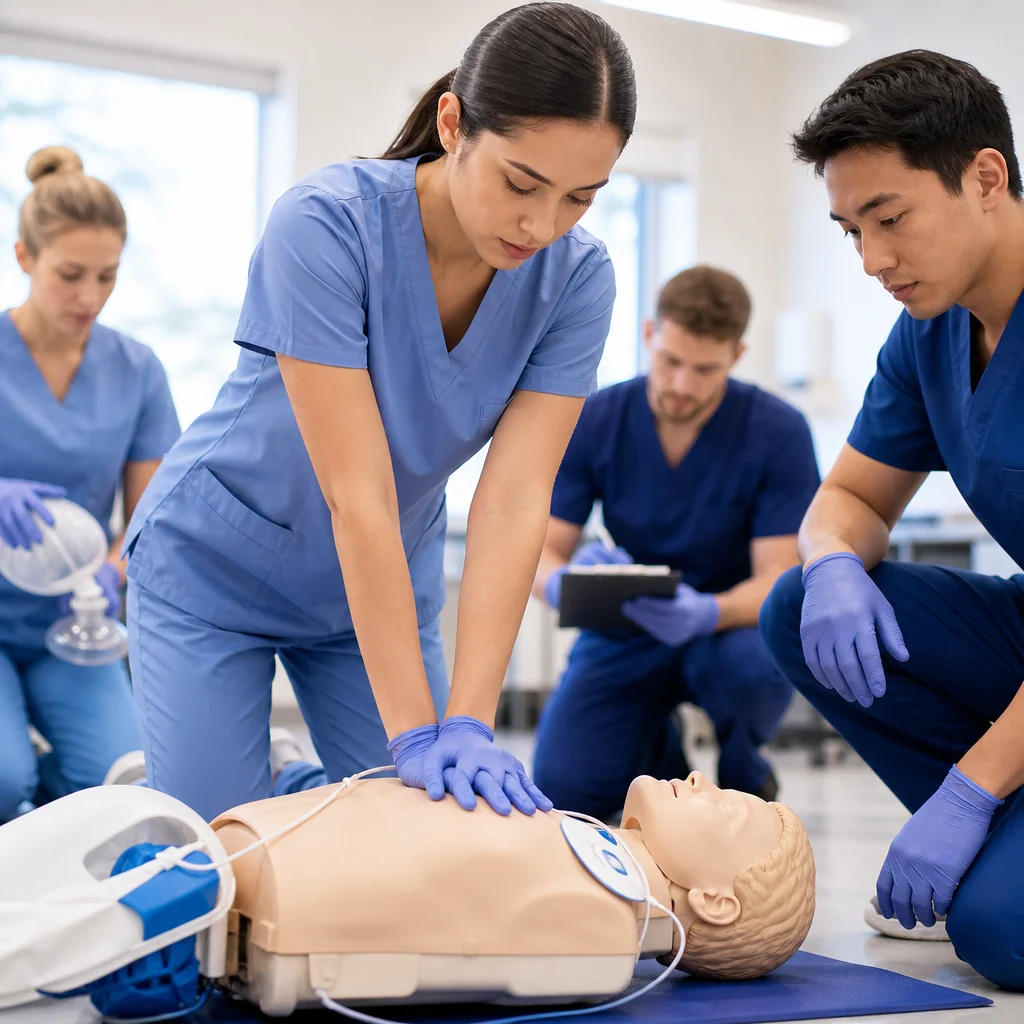
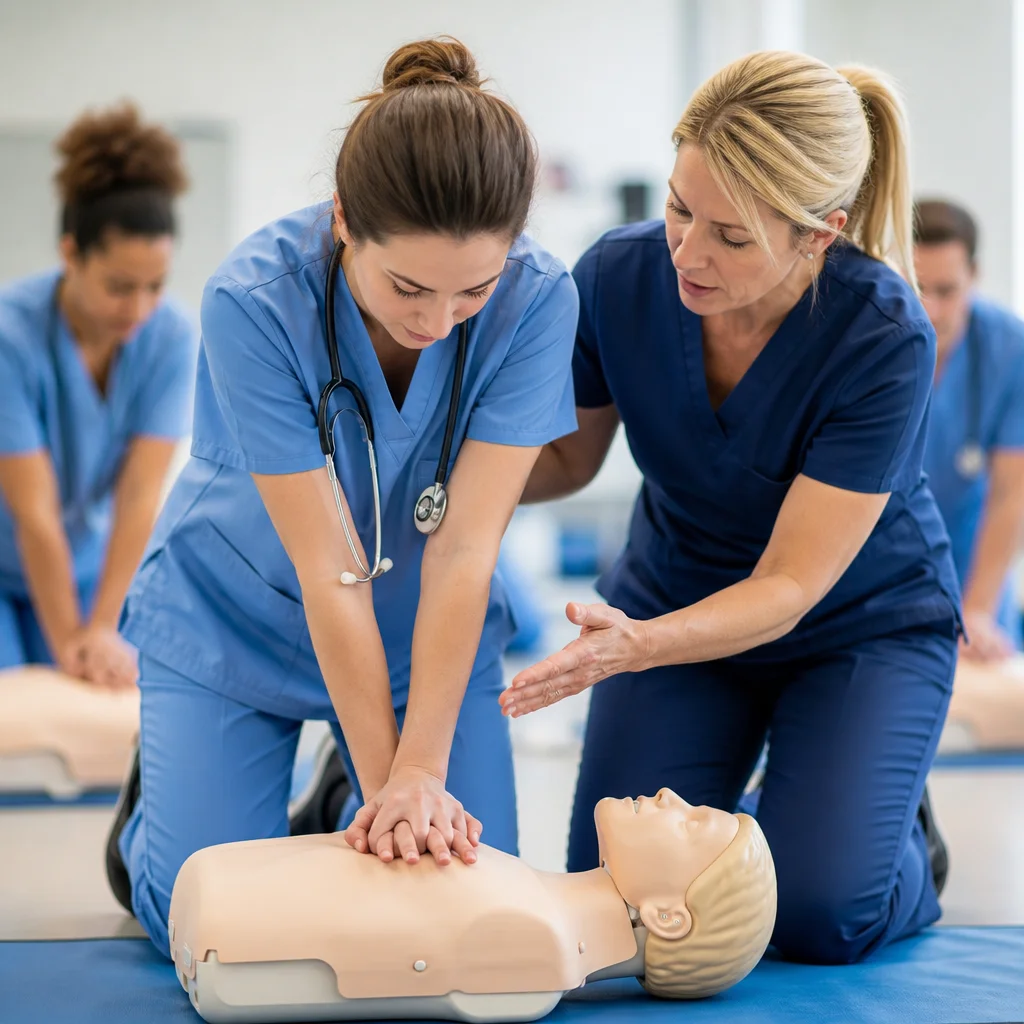
Then they attend a focused in-person session, typically 2-3 hours instead of 8, where they practice chest compressions, defibrillation, airway management, and real-world scenarios with experienced instructors. This concentrated practice builds confidence and ensures hands-on competency. Instructors observe individual technique, provide feedback, and confirm skill mastery before certification.
This structure works particularly well for larger hospitals managing diverse schedules. A charge nurse in San Francisco’s Mission District location can complete her online modules on her day off, then attend a Wednesday evening skills session. An EMS team in Fresno can coordinate a group session during their training day. Dentists in Campbell can schedule a Saturday morning class between patient appointments.
The blended approach also reduces certification costs because we’re not paying for 8-hour classroom facilities when 2-3 hours of hands-on practice delivers actual competency. We pass that savings directly to you.
Same-Day Certification and Immediate Compliance
Calendar delays create compliance risk. We eliminated them by offering same-day certification and immediate digital credential delivery.
After completing your in-person skills session, you pass your final assessment, and we issue your digital certification card on the spot. No waiting for printed copies. No processing delays. Your new certification is valid immediately, documented in our system, and accessible via our online verification portal that your hospital can access 24/7.
This same-day approach matters enormously during high-pressure transitions. If a staff member’s certification expires Friday and you’ve scheduled a course Thursday evening with us, they maintain continuous coverage. No lapse. No compliance documentation required from your licensing office. No emergency re-certification scrambling.
Our verification stations, available at multiple California locations, also allow staff to confirm their certification status instantly. This is particularly useful during compliance audits when your hospital needs rapid proof that your team maintains current credentials.
For hospitals managing regulatory deadlines, same-day certification eliminates the anxiety of tight windows and gives your compliance team concrete proof of action.
Over 100 California Locations for Convenient Access

Convenience isn’t luxury; it’s logistics. Requiring staff to travel 45 minutes for training adds three hours to an already-packed day. Over 100 training locations throughout California means most of your team can attend a course within 10-15 minutes of their current location or preferred neighborhood.
Whether your hospital operates in urban centers like San Jose (Downtown, Japantown, South, and Willow Glen locations) or regional hubs like Bakersfield, Visalia, or Santa Rosa (Downtown and Larkfield-Wikiup), we have training available nearby. Smaller communities like Davis, Woodland, and Tracy benefit from the same accessibility. Even specialized locations like our San Francisco Parnassus/UCSF center serve hospital-adjacent staff directly.
This geographic reach allows your hospital to decentralize scheduling. Rather than coordinating transportation to a single regional facility, departments schedule local training sessions. A physician in Walnut Creek (Downtown or Shadelands) attends nearby. A nurse in Oakland (Fruitvale, Lake Merritt, or Piedmont) chooses her nearest option. A dental team in Los Gatos finds a convenient evening slot without commute stress.
Multiple locations also solve the problem of course-full situations. If one location’s ACLS course books out on your preferred date, we can seamlessly move you to another location with availability, often just 5-10 minutes away.
Customized Group Training and Discounted Pricing
Hospital teams benefit enormously from group training because it builds cohesion, allows instructors to tailor scenarios to your specific protocols, and significantly reduces per-person costs.
We offer specialized group CPR and BLS courses designed for medical professionals. If your surgical team needs training together, your emergency department requires coordinated ACLS renewal, or your nursing unit wants to schedule during a joint training day, we build custom sessions around your calendar. Instructors can emphasize your hospital’s specific protocols, review your facility’s equipment setup, and create scenarios aligned with your patient populations and clinical challenges.
Group discounts scale with volume. Ten staff members cost less per person than five. Fifty staff members generate substantially better pricing. We guarantee transparent pricing with no hidden facility fees or materials charges, so you know exactly what you’ll spend.
This approach also strengthens team dynamics. Staff members practice together, reinforcing shared expectations and building confidence in each other’s skills. It’s particularly valuable for departments where team CPR coordination matters directly to patient outcomes.
As a concrete example, a 30-person nursing department scheduling a half-day Saturday ACLS group session with us costs significantly less than individuals booking separate full-day classes elsewhere, and it creates a shared training experience your team remembers.
Low Price Guarantee and Cost Predictability
We stand behind a low price guarantee. Find a lower rate from any comparable certified provider in California for the same certification level, same course format, and we’ll match it. No fine print. No exceptions.
This guarantee exists because we built our business model around volume and efficiency, not per-person markup. Our training centers operate in affordable locations across California, and our blended learning approach reduces facility overhead. We pass those savings to healthcare teams.
Cost predictability matters equally. When you schedule a group ACLS course for 25 staff members with us, the final invoice matches our quote. No per-person facility fees. No materials surcharges. No surprise invoicing. This transparency lets your finance team budget accurately and prevents the frustrating scenario where a provider’s final bill exceeds your contracted expectation.
For hospitals managing tight training budgets, this predictability is invaluable. You can confidently allocate resources knowing actual costs won’t fluctuate between quote and invoice.
Real-World Success: How Other California Hospitals Made the Switch
Hospitals throughout California have switched to us during their certification renewal cycles, and the operational results speak clearly.
A mid-sized hospital in the Fremont area transitioned its 60-person clinical staff over eight weeks. Rather than rushing everyone into new training simultaneously, they coordinated with our team to schedule departmental sessions. The emergency department went first (15 staff, ACLS focus), then surgical (12 staff, BLS), then nursing floors (33 staff, mix of certifications). By staggering over eight weeks around expiration dates, they maintained coverage at 99%+ throughout the transition and actually saved $4,200 compared to their previous provider’s annual costs.
A dental practice in San Mateo switched mid-year and discovered that our half-day BLS format allowed all six team members to train together on a Saturday without closing the practice. Previous full-day courses required staggered scheduling where staff trained separately, creating coverage gaps. Same certification, better scheduling, lower cost.

An EMS service in Stockton took advantage of our group customization. They scheduled a quarterly training day where 18 paramedics and technicians trained together in ACLS and refresher skills. Our instructor incorporated their local protocols and equipment, and the shared training day became a team-building event. They’ve renewed with us for three consecutive years.
The common thread: all these organizations saved time, reduced costs, and actually improved training quality by having instructors focus on their specific needs.
Getting Started with Your Provider Transition
Starting the switch is straightforward. Here’s your action plan:
First, gather your current certification expiration list. Pull data showing which staff members’ certifications expire in the next 90 days, what certifications they hold, and any specialized requirements (ACLS for ICU nurses, PALS for pediatric staff, NRP for delivery room personnel).
Second, contact our team directly with that expiration calendar and your preferred training locations. We’ll review timing, suggest a staggered schedule that maintains compliance, and recommend group sessions based on your department structure.
Third, review our available course dates and choose sessions aligned with your expiration timeline. Our team can also coordinate directly with your department managers to identify optimal training windows around your operational calendar.
Fourth, we’ll handle enrollment, maintain all records, and provide your hospital with a master compliance document showing all current certifications and expiration dates updated in real-time.
The transition typically takes 4-8 weeks depending on your team size and existing expiration dates. Throughout that window, we maintain zero lapse in certification coverage while your team experiences better scheduling flexibility and lower training costs.
We’ve helped hundreds of California healthcare organizations make this transition smoothly. Your team’s certification needs and operational constraints are unique, so we handle each transition as a custom engagement, not a one-size-fits-all process.
Ready to explore whether switching makes sense for your hospital? Reach out to us directly, and let’s build a transition timeline that works for your calendar and budget.
Register for a class today.
Frequently Asked Questions (FAQ)
How can we transition our hospital staff to your training program without disrupting patient care schedules?
We offer blended learning that combines virtual coursework with in-person skills sessions, allowing your team to complete theory work on their own time and schedule hands-on practice during gaps in their shifts. With over 100 locations across California and classes offered daily, we can work around your existing staffing patterns. Our group training options also let us coordinate multiple sessions that align with your hospital’s shift rotations and compliance deadlines.
What makes our certification valid for immediate hospital compliance?
Our certifications meet all mandatory AHA standards required for California healthcare facilities, and we issue credentials immediately upon successful completion. Your staff can return to full duties the same day they complete their in-person skills session without waiting for processing delays. We also maintain verification stations at multiple locations so your compliance team can confirm credentials instantly.
How does our pricing structure help hospitals budget predictably for recertification cycles?
We guarantee our low prices won’t increase during your contract period, giving your finance team stable training costs across multiple certification cycles. Our group discounts scale based on your hospital’s class sizes, and we can build customized packages that cover all required certifications (BLS, ACLS, PALS, NRP) at a single negotiated rate. This approach eliminates surprise cost increases when you renew certifications annually or biennially.