Why Blended Learning Transforms CPR Certification for Busy Healthcare Professionals
The reality of healthcare work doesn’t pause for training. You’re managing patient loads, on-call schedules, and mandatory certification deadlines all at once. Traditional all-day classroom CPR courses demand a significant time commitment upfront, while purely online programs leave you uncertain about whether you’ve truly mastered the hands-on skills employers demand.
This is where blended learning becomes transformative. We’ve designed our hybrid CPR certification approach specifically for professionals like you who need both flexibility and credibility. You complete theory and knowledge assessments online at your own pace, then come in for focused, efficient in-person skills sessions where you practice on high-fidelity manikins and receive direct instructor feedback.
The result? You finish faster, retain more, and gain the confidence that comes from hands-on validation. Most of our healthcare professionals complete their certification within one week instead of blocking out multiple days for classroom attendance.
Action takeaway: If you’re currently delaying recertification because of time constraints, blended learning likely cuts your commitment in half compared to traditional courses.
What Makes Our Blended Approach Different from Traditional Classroom Training
We didn’t just split a classroom course into online and in-person pieces. Our blended model fundamentally rethinks how adults learn critical skills under pressure.
Traditional classroom training frontloads lecture and passive learning. You sit through hours of content before touching a manikin, absorbing information at the instructor’s pace regardless of your background. By the time hands-on practice arrives, some concepts feel distant.
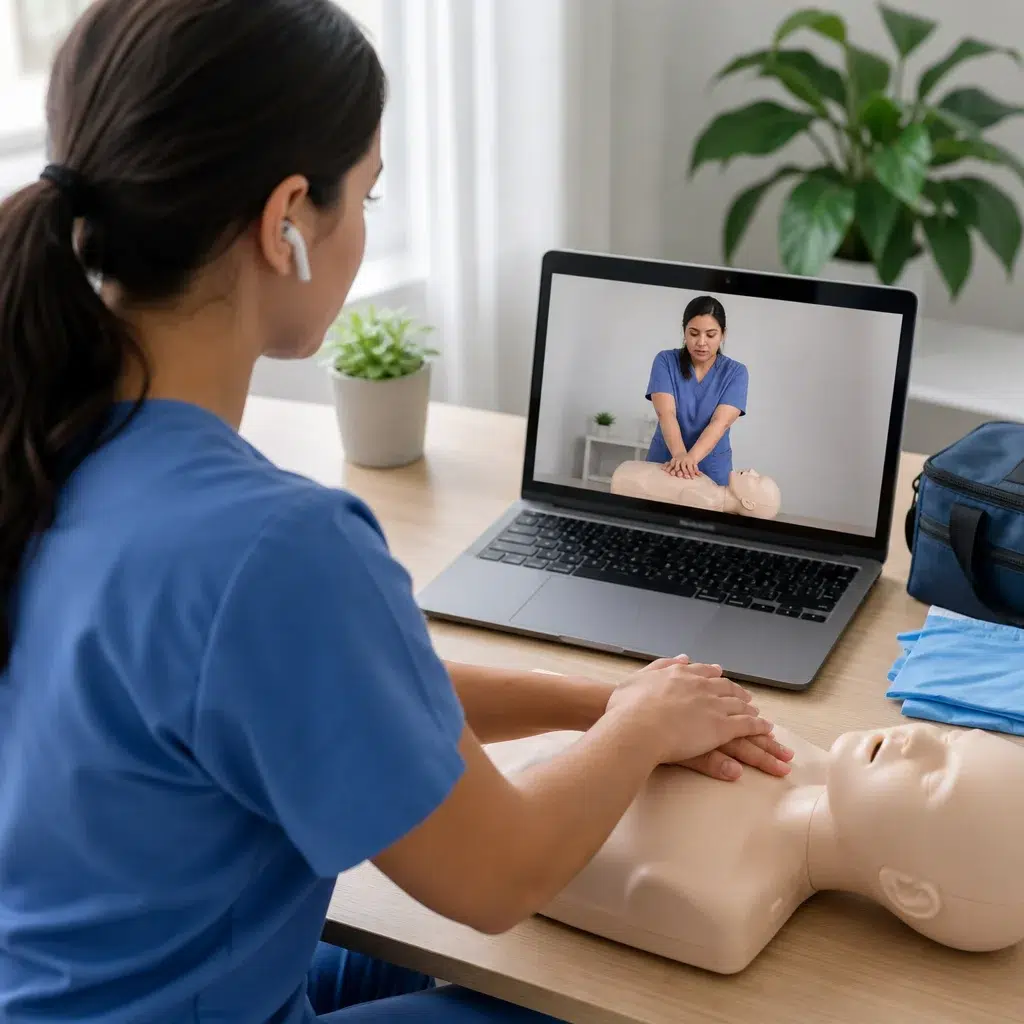
Our approach inverts that. The online phase targets exactly what you need: knowledge checks, algorithm review, and scenario-based questions tailored to healthcare settings. You move through this at your speed, rewatching videos on compressions or advanced airway management until the concepts stick. No wasted time in lecture halls.
Then you arrive for your in-person session already prepared. Rather than reintroducing concepts, our instructors dive straight into high-quality practice, corrections, and scenario application. You’re not learning basics; you’re refining and validating competency.
Here’s what we emphasize differently:
- Personalized pacing during the online phase rather than one-size-fits-all lecture timing
- Scenario-based learning reflecting actual healthcare environments you’ll encounter
- Focused, efficient skills practice instead of extended classroom sitting
- Immediate feedback loops during hands-on practice for real skill improvement
Action takeaway: If you’ve taken CPR before, our blended model treats you as someone who needs validation and refinement, not a beginner restart.
How Our Virtual Component Prepares You for In-Person Skills Assessment
The online portion isn’t busywork meant to occupy time before the “real” training begins. We’ve structured it as serious preparation that fundamentally improves your in-person performance and understanding.
You access our learning platform immediately after enrollment. The virtual content covers AHA-aligned curriculum including compression technique principles, airway management fundamentals, medication protocols (for ACLS), and decision-making frameworks for the scenarios you’ll actually encounter. Short video modules paired with interactive knowledge checks keep engagement high and cognitive load manageable.
Critically, you’ll work through scenario-based questions. Rather than isolated facts, you’re practicing clinical decision-making. A patient collapses unresponsive with gasping respiration. What’s your first action? Why? You answer, receive immediate feedback explaining the reasoning, and move forward. This kind of active recall strengthens memory far more than passive watching.
You’ll also take a proctored knowledge exam within the online platform before scheduling your in-person skills session. This ensures you arrive ready to focus entirely on hands-on practice without prerequisite knowledge gaps. Our instructors know exactly where you stand.
The timeline varies by your pace, but most healthcare professionals complete the online component in 2-3 hours spread across 2-3 days. This flexibility means you complete it during downtime, between shifts, or during quieter clinic hours.
Action takeaway: Come to your skills session with the virtual work completed; you’ll spend your in-person time actually practicing compressions and scenarios rather than learning theory.
Our In-Person Skills Sessions: Hands-On Practice with RQI Simulation Technology
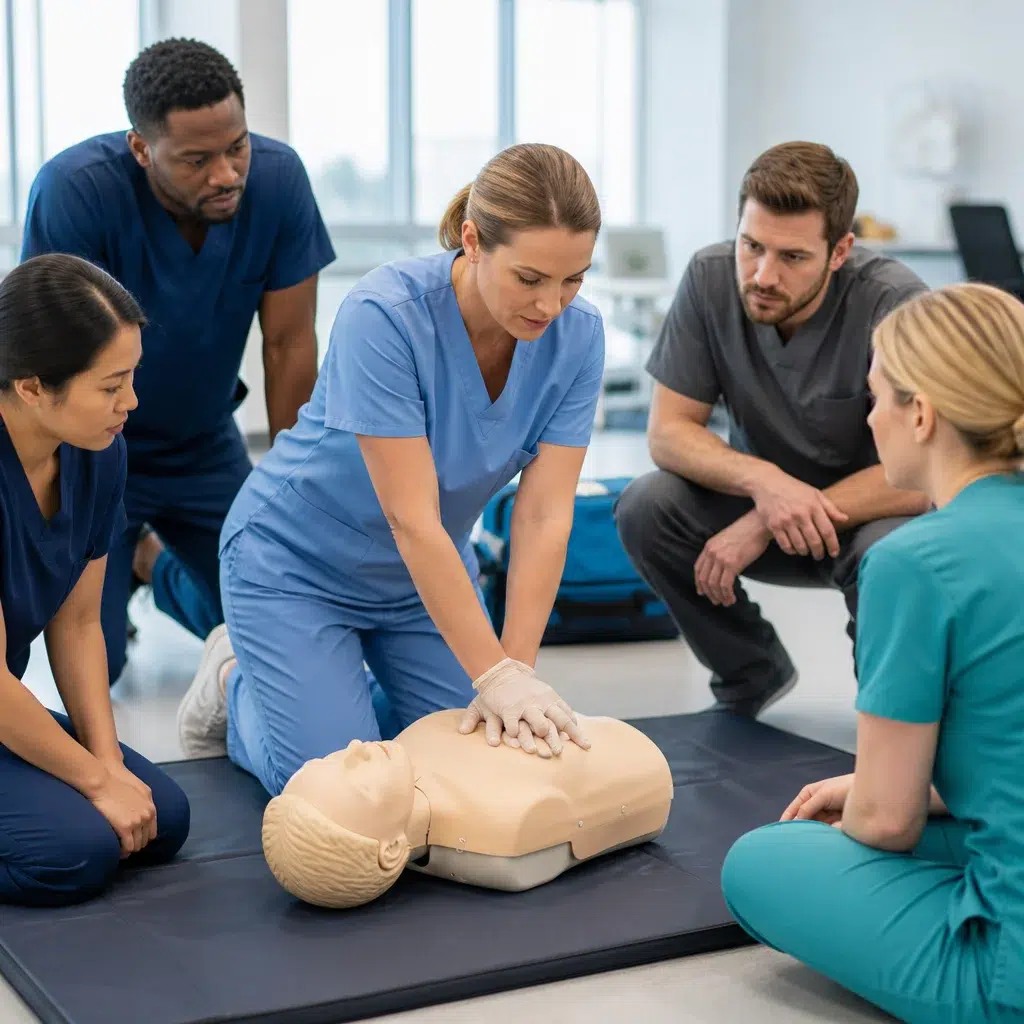
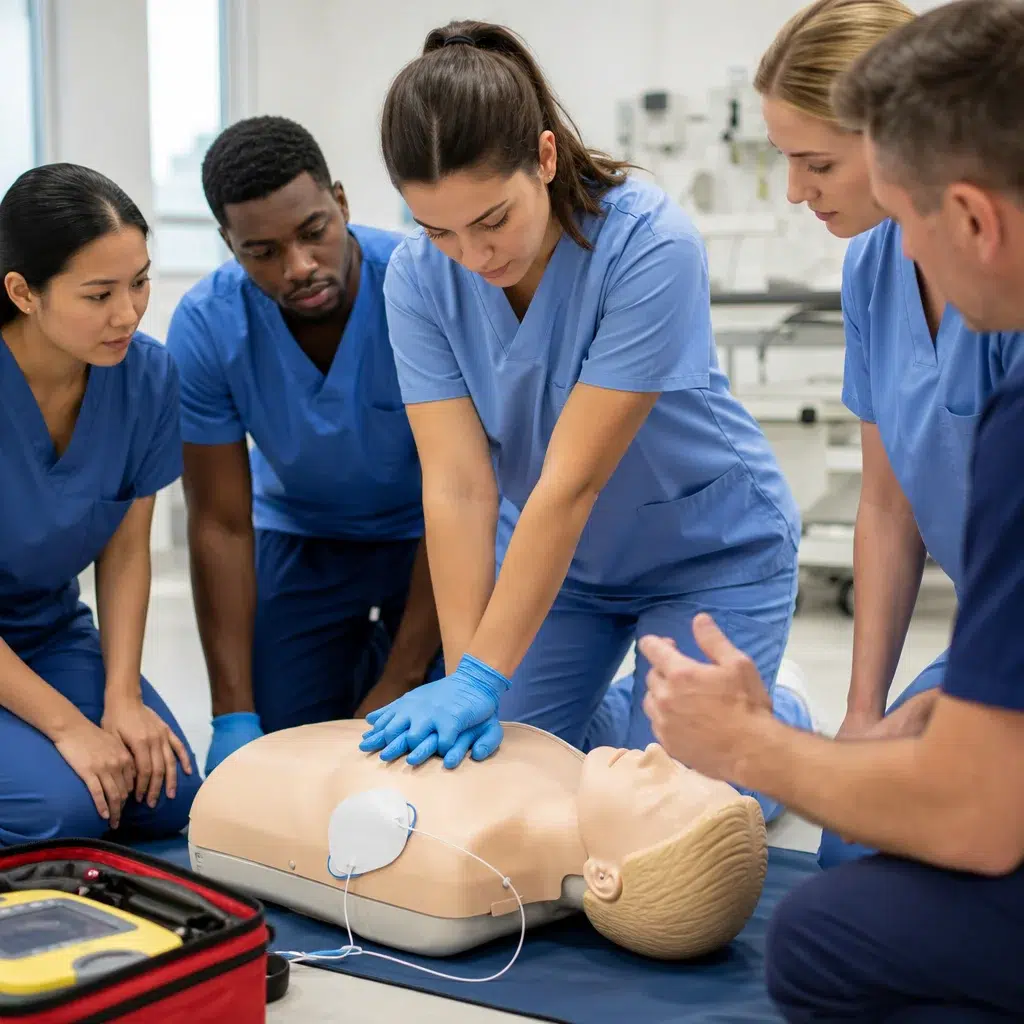
The in-person sessions are where blended learning becomes undeniably valuable. You step into one of our 100+ California training locations and encounter our RQI simulation stations equipped with VAM (Voice Activated Manikins) technology.
These aren’t basic rubber dummies. Our manikins provide real-time biofeedback on compression depth, hand placement, and recoil. When your compressions are too shallow, the manikin tells you. When your ventilation volume is insufficient, you hear the response. This immediate sensory feedback is how neural pathways for muscle memory form. You’re not guessing if you’re “doing it right” – you have objective validation in the moment.

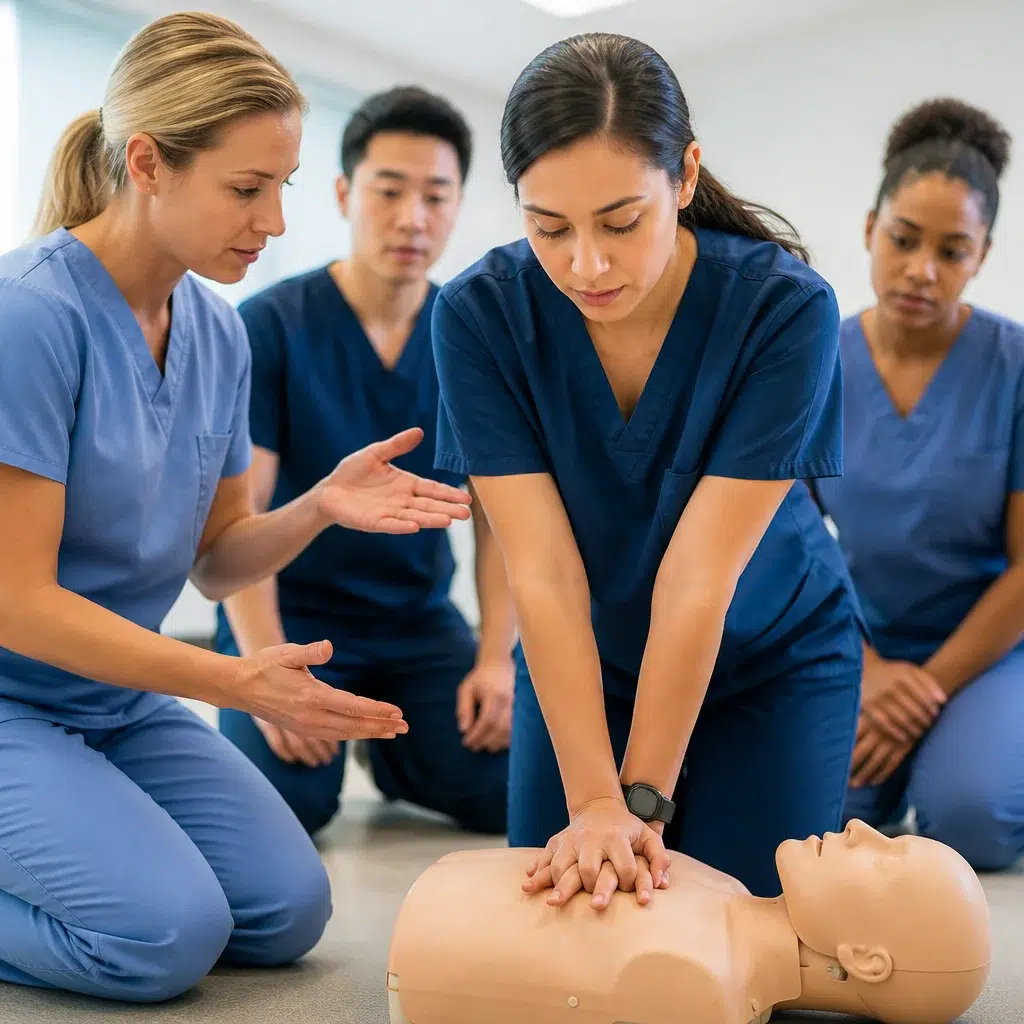
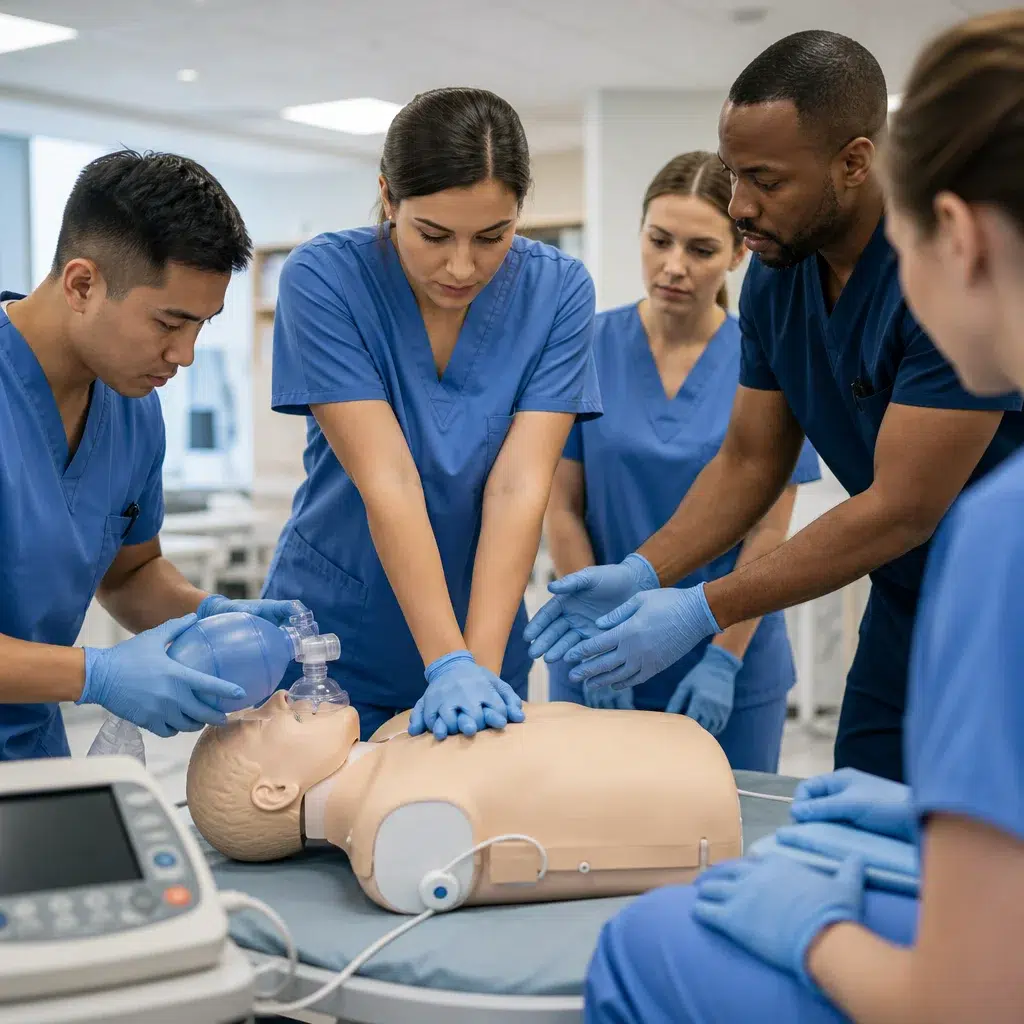
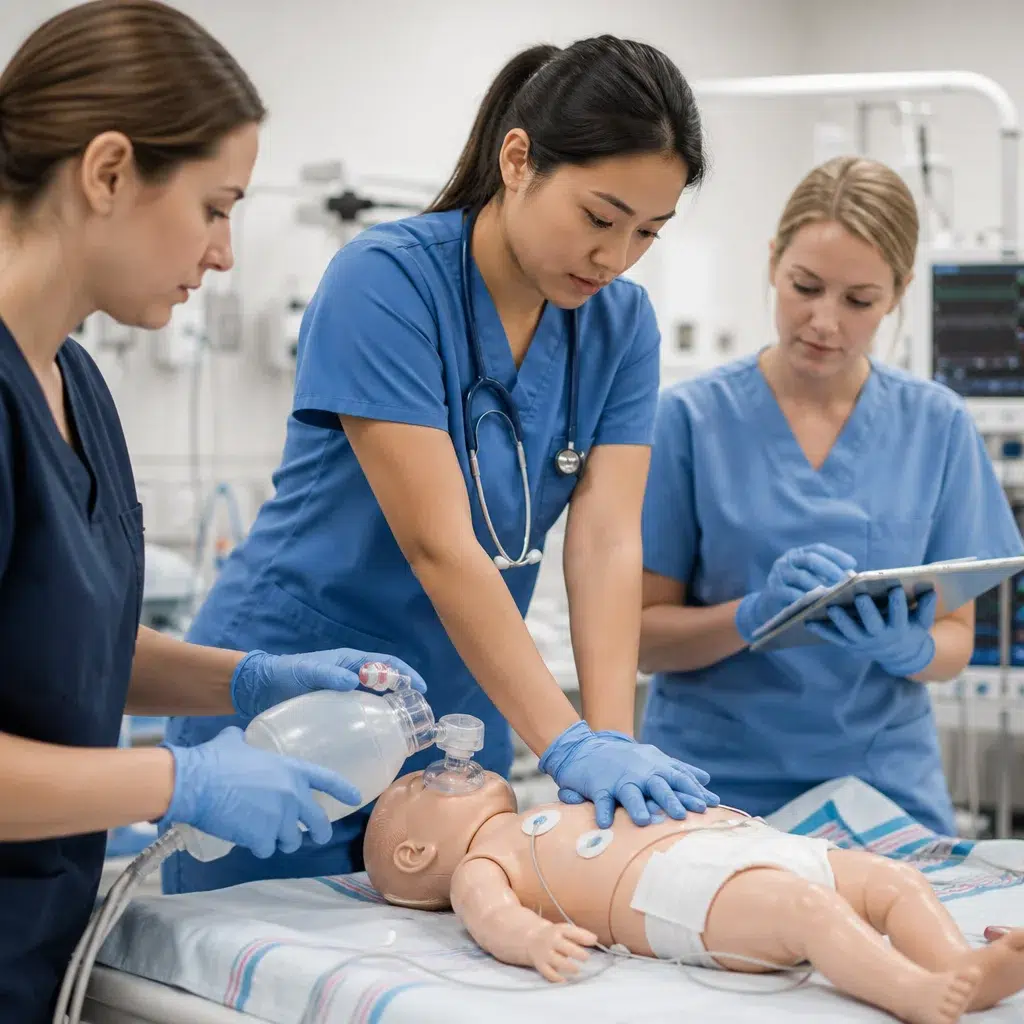
During a typical 2-3 hour session, you’ll complete multiple practice rounds on different manikins. Early rounds focus on single skills – compressions, rescue breathing, or rescue breathing with high-flow oxygen. Later rounds integrate full scenarios. A responsive patient who becomes unresponsive. A witnessed arrest with a bystander beginning compressions whom you must assess and direct. A pediatric code where compression-to-ventilation ratios differ.
Our instructors circulate, observe, correct technique in real-time, and answer questions immediately. Unlike classroom settings where one instructor manages 30 learners, we keep ratios manageable so you receive meaningful attention.
You’ll also practice on manikins of different sizes and configurations. If you’re a nurse working across adult and pediatric units, you practice on both. If you’re an EMS provider, you practice scenarios reflecting field protocols.
The session concludes with scenario validation where you’re assessed against certification standards. This determines whether you demonstrate competency for immediate certification or need brief additional practice.
Action takeaway: Arrive ready to practice with intention. Ask instructors to focus on scenarios matching your specific work environment.
Comparing Blended Learning Benefits Against Full Online and Traditional Methods
You have three realistic paths to CPR certification. Understanding the tradeoffs helps you choose what actually fits your life and job requirements.
Fully online courses offer maximum schedule flexibility. You complete everything at home on your timeline. The downside is significant: you have no hands-on practice validation, no real manikin experience, no objective proof you can perform compressions or airway management under pressure. Many employers, hospitals, and healthcare facilities explicitly reject purely online certifications for clinical staff. The cost might be low, but a rejected certification wastes everyone’s time.
Traditional classroom courses require 6-8 hours in a room with an instructor and 15-30 other learners. You get hands-on practice and official certification immediately. But you’re sacrificing flexibility entirely. If you work rotating shifts, finding a course that fits is months away. You’re paying for 1-2 hours of actual hands-on practice spread across an entire day of lecture. The wait and inflexibility often mean people delay recertification until the last minute, sometimes letting certifications lapse.
Blended learning splits the difference strategically. You gain flexibility through the online phase – complete it whenever you want, move at your pace, revisit difficult concepts. You also gain the hands-on validation that employers require and that actually builds confidence in your ability to perform under pressure. The in-person sessions are typically 2-3 hours rather than all-day affairs, making scheduling vastly easier. You complete your certification quickly and thoroughly.
Here’s the practical comparison:
| Method | Flexibility | Hands-On Practice | Employer Acceptance | Time Investment | When to Use | |——–|————|——————|——————-|—————–|————| | Online Only | Excellent | None | Poor/Rejected | 3-4 hours | Not recommended for healthcare professionals | | Traditional Class | Poor | Good | Excellent | 6-8 hours full day | When flexibility isn’t a concern | | Blended (Our Model) | Excellent | Good | Excellent | 4-5 hours spread over days | Healthcare professionals with shifting schedules |
We designed our blended model specifically because we listened to healthcare professionals like you describe the same problem: needing flexibility without sacrificing the rigor that employers demand.
Action takeaway: If your employer accepts only in-person skills validation (almost all do), blended learning gives you flexibility without compromise.
Scheduling Flexibility: Same-Day Certification Across 100+ California Locations
Scheduling has to work within the reality of healthcare staffing. You can’t always predict which week will be slow enough for a full day away from patient care.
We operate more than 100 training locations throughout California, from San Diego to the far north. This density of locations means you can find a skills session within driving distance and within a timeframe that works. Most locations offer sessions multiple times weekly, including early mornings, evenings, and weekends.
Once you’ve completed your online component, you schedule your in-person skills session. Most people book within 3-7 days of finishing the virtual work. Some book for the next available session – possibly that same week. You’re not waiting months for the next classroom course to fill up.
The session itself typically runs 2-3 hours. You walk in, practice, demonstrate competency, and walk out with your certification card the same day. No waiting for results. No “pending” status. Your certification is valid immediately, and you have the card in hand as proof.
We also offer corporate group training at discounted rates if your department, clinic, or EMS service wants to schedule multiple staff members. This works particularly well for facilities where several employees need recertification around the same time.
Our California locations page shows real-time availability and lets you filter by date, location, and course type. This transparency means you can see exactly what works for your schedule before committing.
Action takeaway: Check locations near your workplace or home first; you’ll likely find sessions available within days.
AHA-Aligned Curriculum Standards in Our Blended CPR and BLS Programs

Your employer and your professional license require certification aligned with the American Heart Association guidelines. This isn’t something to negotiate or compromise on.
We build all our CPR, BLS, ACLS, and PALS programs directly on AHA-aligned curriculum standards. Our content, scenarios, and competency assessments reflect current guidelines for adult, pediatric, and neonatal resuscitation. This alignment holds whether you’re learning through our online platform or practicing on our RQI manikins.
Our instructors are certified instructors trained specifically to teach within AHA curriculum frameworks. They’re not self-taught YouTube learners; they undergo regular instructor recertification and quality assurance audits to ensure consistency and adherence to standards.
The scenarios you practice reflect real clinical situations governed by those guidelines. ACLS students practice the cardiac arrest algorithms covered in the guidelines. PALS students practice pediatric-specific protocols. BLS students practice the compression-ventilation ratios and rescue breathing standards. Nothing is simplified for convenience; everything is standards-aligned.
This adherence matters when your state board of nursing, your hospital credentialing office, or your EMS director reviews your certification. They’re verifying that your credential comes from a provider following established guidelines, not from a fly-by-night online vendor.
Action takeaway: When choosing any CPR provider, verify their AHA alignment directly. We maintain current provider status and regularly audit our instructor network.
Our Low-Price Guarantee on Blended Learning Healthcare Certifications
Quality instruction and flexibility don’t require premium pricing. We’ve built our business model around accessibility for healthcare professionals without sacrificing standards.
Our blended CPR and BLS certifications are competitively priced – and we back that with our low-price guarantee. If you find a comparable blended learning certification from another provider charging less, we’ll match their price. We’ve been providing accessible, high-quality training since 1989, and that commitment extends to fair pricing today.
This pricing includes everything: the full online learning platform, the in-person skills session with our instructors and equipment, the RQI manikins with real-time feedback, and your same-day certification card. There are no hidden component fees, no surprise instructor charges, no “add-ons” that inflate your total cost.
For healthcare professionals managing multiple certifications – CPR, BLS, and possibly ACLS or PALS – we offer package pricing that reduces per-course costs further. We also provide substantial discounts for corporate group training when your department needs multiple staff certified around the same time.
The pricing reflects our conviction that cost shouldn’t be the barrier keeping healthcare professionals from maintaining current, quality certifications.
Action takeaway: Our guarantee means you can commit confidently without worrying you’re overpaying relative to other legitimate providers.
Step-by-Step Enrollment Process for Our Blended Certification Programs
Getting started is straightforward and typically takes less than 5 minutes.
Step 1: Choose your course. Decide whether you need CPR, BLS, ACLS, PALS, or another certification based on your role and employer requirements. Each program follows the same blended structure with content tailored to your specialty.
Step 2: Complete enrollment online. Visit our website, select your course, and enter your information. You’ll confirm your California location or nearest training site. Our checkout process is designed for speed – most people complete it in under 2 minutes.
Step 3: Access the online platform immediately. Upon completion, you’ll receive login credentials and can begin the virtual component right away. There’s no waiting for access codes or onboarding delays. You start learning the same day you enroll.
Step 4: Progress at your pace. Work through the video modules, scenario questions, and knowledge checks whenever your schedule allows. Most healthcare professionals finish within 2-3 days by dedicating 1-2 hours across a few sessions.
Step 5: Take the proctored knowledge exam. Once you’ve completed all online content, you’ll take a brief proctored exam within the platform. This confirms prerequisite knowledge before your skills session.
Step 6: Schedule your in-person skills session. After passing the knowledge exam, you’ll select an available skills session from our real-time calendar. Most people book within 3-7 days of finishing online work, though you can schedule further out if needed.
Step 7: Attend your skills session and earn certification. Come to your scheduled location, demonstrate competency on the manikins, and receive your certification card immediately. Your certification is valid as soon as you leave.
The entire process from enrollment to certification typically takes 4-7 days. Faster is possible if you have downtime to complete the online work quickly; you could theoretically finish within 3-4 days if circumstances allow.

Action takeaway: Start today – you can be certified within a week without disrupting your work schedule significantly.
Why Healthcare Professionals Choose Our Blended Learning Model
We’ve trained thousands of nurses, dentists, EMS providers, and other healthcare professionals across California. The consistent feedback tells us why blended learning resonates with your profession.
Flexibility matters because healthcare staffing is unpredictable. You can’t block out a full day four months in advance with confidence. Blended learning lets you complete online work whenever you find time, then book a short skills session when conditions align. This practical flexibility is why so many busy professionals choose us over traditional classroom courses.
Real hands-on practice matters because textbook knowledge doesn’t translate to muscle memory under pressure. You need to perform compressions, rescue breathing, and scenario responses enough times that your body knows what to do when adrenaline is high and time is critical. Our RQI manikins with real-time feedback make that practice genuinely valuable.
Credibility matters because your employer and your professional standards require it. A certificate from us carries weight because we operate to actual standards, our instructors are certified, and we maintain institutional accountability. Online vendors without facility infrastructure and instructor networks can’t offer that same credibility.
Same-day certification matters because you’re often working on tight timelines. You need your card in hand, not waiting for mail delivery or processing delays. Walking out with your certification ready to go eliminates administrative friction and gets you back to full compliance immediately.
Accessibility matters because cost shouldn’t determine whether you maintain current certifications. Our low-price guarantee and corporate discounts ensure you’re not choosing between certification and other professional expenses.
Action takeaway: These aren’t small conveniences – together they directly solve the practical barriers keeping healthcare professionals from maintaining current training.
Your Certification Results: Immediate Verification and Same-Day Cards
The moment you demonstrate competency during your in-person skills session, your certification is official. You’re not in a pending state. You’re not waiting for instructor paperwork processing. Your card is printed and in your hand the same day.
This immediate turnaround matters practically. If your facility needed proof of current certification by end-of-week, you have it. If you’re updating your professional profile, you can do so immediately rather than with uncertain timelines. If you’re scheduling a shift requiring current CPR certification, you’re covered without delay.
Your certification is registered in our verification system accessible to employers, regulatory bodies, and credentialing offices. When your hospital, clinic, or EMS service checks your credential status, they can confirm it’s current and valid. This transparency builds the professional accountability that institutions expect.
The certification remains valid for two years from issue date, at which point you’d schedule recertification. We typically send reminder communications as your expiration approaches, though professionals like you are usually already planning ahead on that timeline.
For healthcare professionals requiring multiple certifications – say, a critical care nurse needing CPR, BLS, and ACLS – you can stagger them across your two-year windows or stack them if your schedule allows one intensive week. Blended learning accommodates either approach.
Action takeaway: Plan your recertification approximately 4-6 weeks before expiration to avoid gaps in your credentials.
Start Your Blended CPR Certification with Safety Training Seminars Today
You’ve now seen how blended learning fundamentally solves the scheduling and flexibility challenges healthcare professionals face, while delivering the hands-on validation and credibility your employer requires. This isn’t a new concept – it’s a proven training model that works because it respects your reality: you need flexibility, quality, and results without compromise.
We’ve been providing certified life-saving instruction since 1989. We operate 100+ California locations. We use current AHA-aligned curriculum, RQI simulation technology, and certified instructors. We guarantee competitive pricing. We deliver same-day certification cards. We support your professional development with the access and flexibility modern healthcare work demands.
The next step is simple. Visit our website, select your course, and enroll today. You’ll access your online platform immediately and be on track for certification within a week. There’s no reason to delay – especially when blended learning makes maintaining current certifications so clearly manageable.
Your patients and your employer deserve your most current, validated training. You deserve a certification pathway that respects your schedule and professional standards. We’ve built our program to deliver exactly that.
Enroll now and join the thousands of California healthcare professionals who’ve completed their blended CPR certification with Safety Training Seminars.
Register for a class today.