
Master lifesaving skills with our CPR and First Aid Study Guide, designed for beginners and professionals. Aligned with AHA guidelines, it covers CPR, AED use, choking relief, and emergency care. Perfect for certification, recertification, or refresher training, ensuring confidence and readiness in real-life emergencies.
The CPR and First Aid Study Guide from Safety Training Seminars is designed for anyone who wants to gain confidence and competence in lifesaving emergency response. Following the American Heart Association (AHA) Guidelines 2025, this guide ensures that both healthcare professionals and laypersons are trained in current, evidence-based practices. From cardiac emergencies to minor injuries, this study guide equips you with the knowledge and skills needed to act quickly and effectively in any situation.
Our guide provides detailed instruction on performing Cardiopulmonary Resuscitation (CPR) for adults, children, and infants. It explains proper techniques for chest compressions, rescue breaths, and automated external defibrillator (AED) use, along with guidance on recognizing cardiac arrest and activating emergency medical services. By studying this guide, learners gain not only theoretical knowledge but also practical confidence, ensuring readiness to save lives in real emergencies.
Beyond CPR, the study guide covers critical first aid skills for a wide range of common emergencies. It includes techniques for choking relief, controlling bleeding, managing burns, and handling fractures, as well as responses to medical emergencies such as allergic reactions, seizures, and strokes. Each procedure is presented in clear, step-by-step paragraphs, ensuring that learners can understand and remember the actions needed to provide immediate care safely and effectively.
The CPR and First Aid Study Guide is ideal for a broad audience. Healthcare providers, including nurses, paramedics, and EMTs, will find it invaluable for certification and skill reinforcement. Educators, coaches, workplace safety personnel, caregivers, and parents can also benefit, as the guide ensures preparedness for emergencies that may occur at home, in schools, or in public spaces. This guide is suitable for both first-time learners and experienced providers seeking recertification or refresher training.
Performing CPR correctly can save lives in critical situations. The study guide walks learners through assessing responsiveness and breathing, calling for emergency help, and performing high-quality chest compressions. For adults, it emphasizes compression depth of at least 2 inches at a rate of 100–120 per minute, while for children and infants, it highlights appropriate compression depth and hand/finger placement. It also explains how to combine rescue breaths with compressions and how to safely use an AED when available, ensuring adherence to AHA Guidelines 2025.
Knowing how to use an AED can be the difference between life and death during sudden cardiac arrest. The guide teaches learners to turn on the AED, attach pads correctly, and follow the device prompts. It emphasizes safety precautions, ensuring no one touches the patient during shock delivery. The AED section is integrated with CPR instructions so that learners understand how to coordinate compressions, breaths, and shocks for maximum effectiveness.
Airway emergencies require fast, precise action. The guide explains how to recognize partial and complete airway obstruction, and details step-by-step methods for performing the Heimlich maneuver or back slaps and chest thrusts for infants. It also teaches how to monitor the patient after relief and when to seek additional medical help, following evidence-based AHA 2025 recommendations.
Effective bleeding control is a fundamental first aid skill. This section guides learners on applying direct pressure, using dressings or bandages, and elevating the injured limb. For severe cases, it explains tourniquet use, emphasizing safety and proper placement. Additionally, the guide teaches wound cleaning, infection prevention, and monitoring for shock, providing confidence in managing injuries until professional help arrives.
The study guide covers the management of minor and serious burns, broken bones, and sprains. For burns, it describes cooling techniques, dressing application, and when to seek medical attention. For fractures and sprains, it teaches immobilization, splinting, and safe transport, emphasizing patient comfort and safety. Each guide aligns with AHA 2025 standards for effective and evidence-based first aid care.
Beyond trauma, the guide provides guidance on common medical emergencies, including allergic reactions, seizures, strokes, heart attacks, and diabetic emergencies. Learners are instructed on recognizing warning signs, providing immediate care, and contacting emergency services promptly. The section stresses timely action and adherence to updated AHA protocols, helping learners respond confidently in critical situations.
Our study guide is carefully structured to combine AHA-compliant instruction with practical learning scenarios. It emphasizes clarity, accuracy, and real-world applicability, making it easy for learners to internalize skills. Following the AHA 2025 guidelines, the guide ensures that learners are prepared for certification exams and confident in their ability to respond to emergencies. With a focus on both knowledge and application, it equips learners to save lives with confidence and precision.
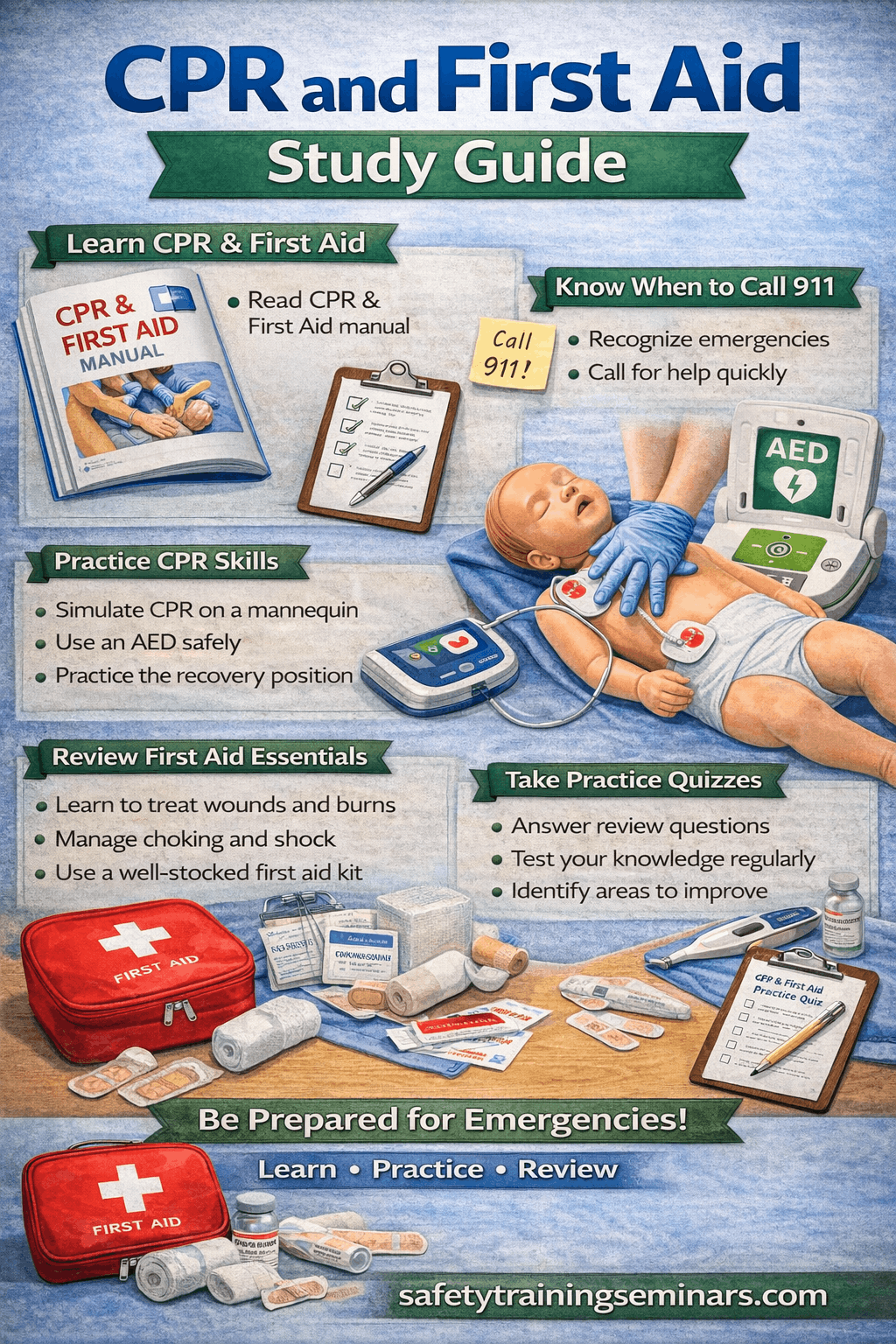
The CPR and First Aid Study Guide infographic provides a clear and concise visual summary of essential lifesaving techniques. Designed according to the American Heart Association (AHA) Guidelines 2025, it helps learners quickly understand and remember critical CPR and first aid procedures for adults, children, and infants.
The infographic illustrates key CPR steps, including hand placement, compression depth, compression rate, and the proper use of an Automated External Defibrillator (AED). It also highlights procedures for relieving choking emergencies, showing the correct techniques for back blows, abdominal thrusts, and infant chest thrusts.
In addition to CPR, the infographic covers basic first aid procedures, such as controlling bleeding, treating burns, splinting fractures, and managing sprains. Each section is visually simplified to help learners quickly recognize emergency scenarios and respond effectively.
Accompanying the visual elements, the infographic includes brief descriptions and key reminders that reinforce proper technique, safety precautions, and adherence to AHA 2025 evidence-based standards. This approach ensures that learners not only see the steps but also understand the reasoning behind each action, building confidence to respond in real emergencies.
Whether for certification preparation, refresher training, or general emergency readiness, this infographic serves as an easy-to-understand, high-value resource for anyone looking to master CPR and first aid skills and be prepared to save lives.
The CPR and First Aid Study Guide is a complete resource designed to help learners master lifesaving techniques, including cardiopulmonary resuscitation (CPR), choking relief, bleeding control, and emergency response, following current safety guidelines.
This guide is ideal for healthcare professionals, teachers, coaches, workplace safety personnel, and caregivers. It is useful for anyone preparing for CPR or First Aid certification or seeking to refresh emergency response skills.
The guide includes adult, child, and infant CPR, AED use, choking relief, wound care, burns, fractures, and medical emergencies. It also covers step-by-step procedures to handle common emergencies safely and effectively.
Using the CPR and First Aid Study Guide prepares learners for certification exams by providing a clear, structured review of all required skills and knowledge. It ensures readiness for practical and written tests.
Yes, the guide is perfect for recertification or refresher courses. It helps both new and experienced learners stay updated on best practices and maintain confidence in responding to emergencies.
Absolutely. The study guide follows the latest American Heart Association (AHA) guidelines, ensuring learners are trained in evidence-based practices for effective and safe emergency care.