
Table of Contents
- Why California Healthcare Professionals Need Current Safety Certifications
- Understanding Mandatory Certification Requirements for Nurses and Medical Professionals
- Our Blended Learning Approach to Hands-On Safety Training
- AHA-Aligned Curriculum and Same-Day Certification Cards
- Over 100 California Training Locations for Your Convenience
- Specialized Programs for Healthcare Providers, Dentists, and EMS Personnel
- Corporate Group Training and Discount Pricing Solutions
- Our Low Price Guarantee and Fast Checkout Process
- Real Verification Stations with Advanced Simulation Technology
- Flexible Scheduling with Daily BLS Certification Classes Available
- How We Support Your Ongoing Professional Development
- Get Your California Safety Training Certification Today
Why California Healthcare Professionals Need Current Safety Certifications
Working in healthcare means holding lives in your hands every single day. That responsibility demands more than good intentions—it requires current, validated training that proves you can act decisively in a crisis. We understand that California’s healthcare environment is fast-paced and demanding, which is exactly why regulatory bodies and employers take certification seriously.
Your CPR or BLS card isn’t just paperwork. It’s documentation that you’ve trained on the latest protocols, practiced on realistic scenarios, and can deliver life-saving interventions when seconds count. Patients, employers, and licensing boards all expect this proof. Without it, your career options narrow significantly, and your license itself may be at risk.
The stakes are straightforward: hospitals won’t hire you, your current employer may suspend clinical privileges, and your professional liability becomes a gray area. We’ve seen careers derailed by lapsed certifications that could have been renewed with a few hours of training. The investment in current safety training is one of the most practical career decisions you can make.
What to do next: Check your certification expiration dates today. If any are within 60 days of expiring, schedule a renewal class this week rather than waiting until the last moment.
Understanding Mandatory Certification Requirements for Nurses and Medical Professionals
California’s regulatory framework is specific about who needs what certifications, and the requirements vary by role, setting, and specialty. Registered nurses must maintain current BLS certification at minimum. Advanced practice nurses, especially those in critical care or emergency settings, typically need ACLS. Pediatric specialists require PALS. Each requirement exists because the patient populations you serve have distinct physiological needs.
We work with nurses across California daily, and the most common confusion centers on which certification level actually applies to each role. A med-surg nurse needs different skills than an ICU nurse, and both need different training than a pediatric emergency nurse. Your employer’s credentialing office can clarify your specific requirements, but we recommend not relying on their memory alone—verify directly with the California Board of Registered Nursing or your specialty certifying body.
Dentists and oral surgeons face their own mandate landscape. Most California dental boards require BLS for dentists and ACLS for those who administer sedation. EMS personnel need ACLS at minimum, with many agencies requiring paramedic-specific training that goes deeper into pharmacology and advanced interventions. These aren’t suggestions—they’re licensing prerequisites.
Action item: Contact your employer’s HR or credentialing department and request a written list of your required certifications, including expiration dates. Bring that list when you enroll with us so we can ensure you’re in the right courses.
Our Blended Learning Approach to Hands-On Safety Training
We’ve designed our training model around a simple reality: you can’t learn CPR compressions from a video, and you can’t understand medication interactions in a skills lab without context. That’s why we combine online theory with in-person hands-on sessions.
Your learning journey with us starts with a virtual component where you review protocols, study algorithms, and answer knowledge checks at your own pace. This part can happen at 10 p.m. on Tuesday or 6 a.m. on Saturday—whatever fits your schedule. You’re not sitting in a classroom for material that doesn’t require live feedback.
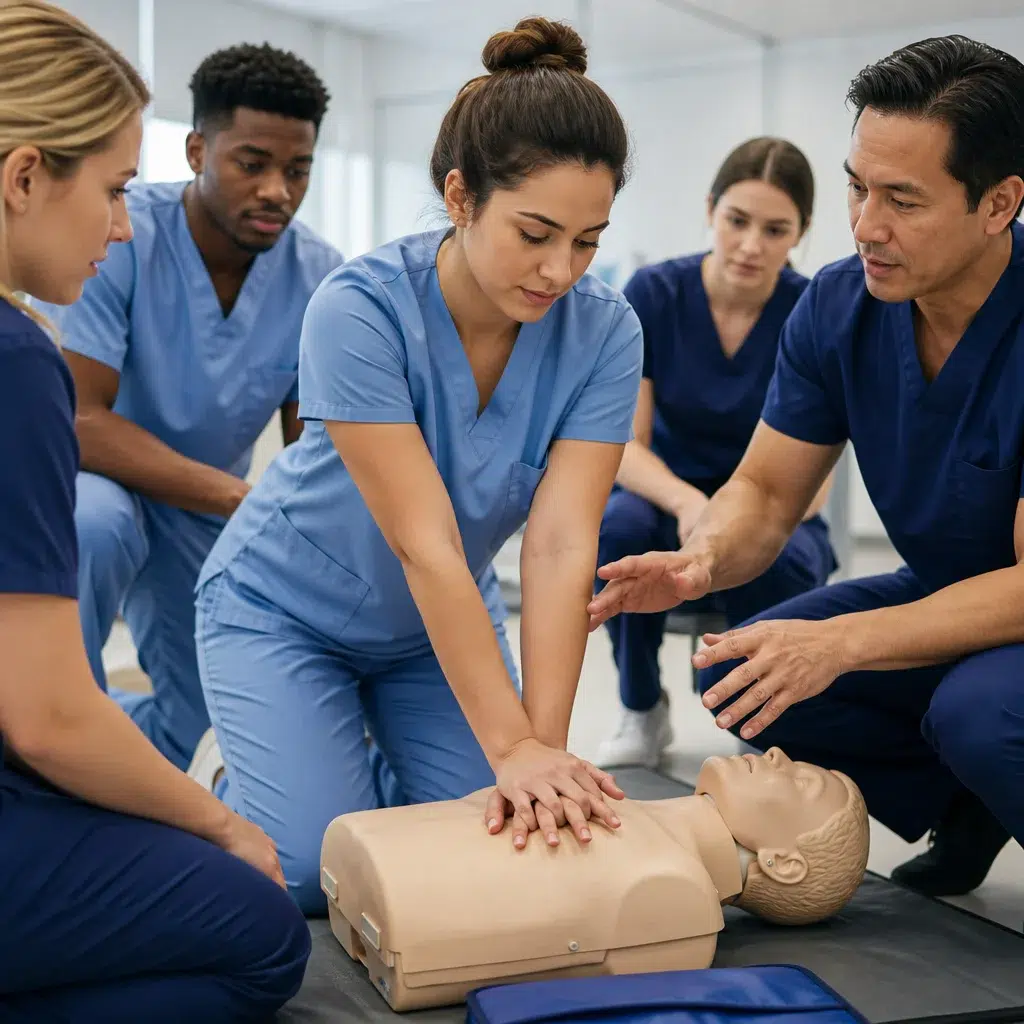
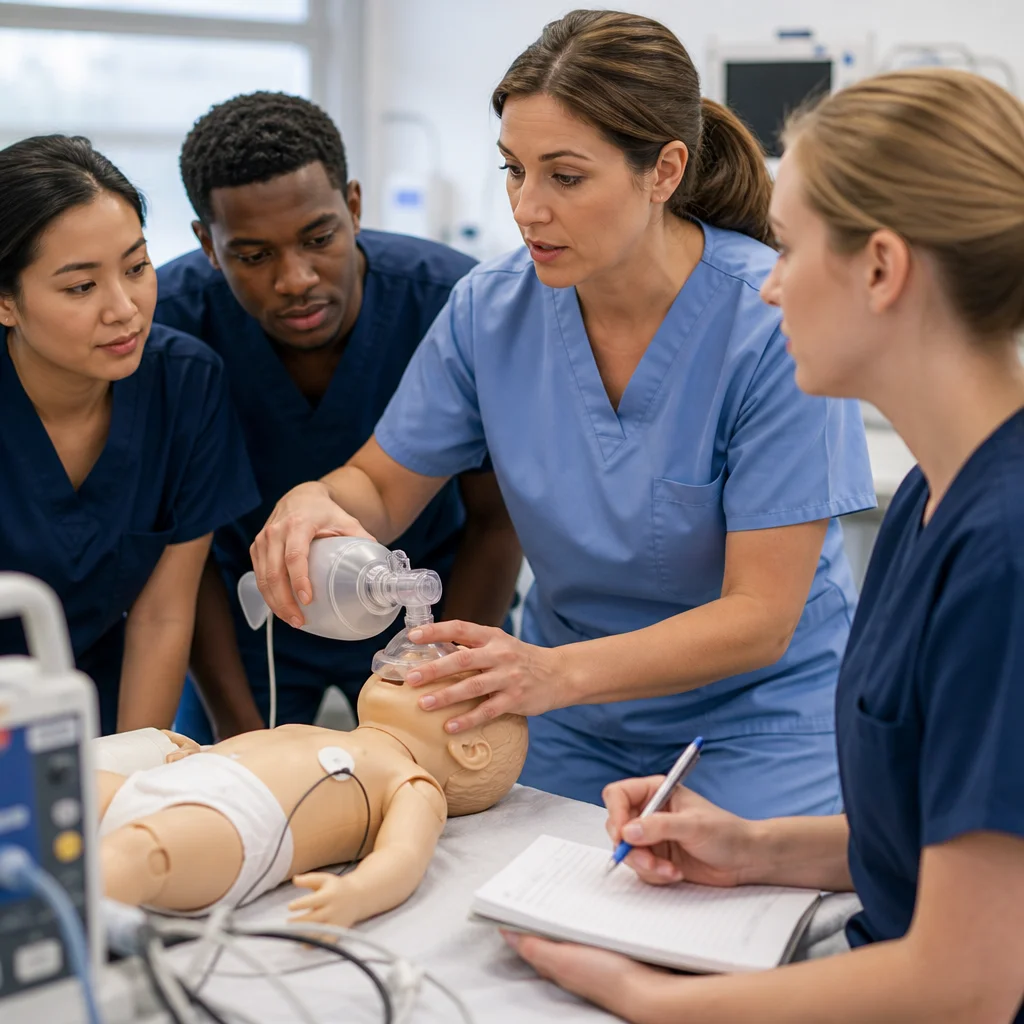
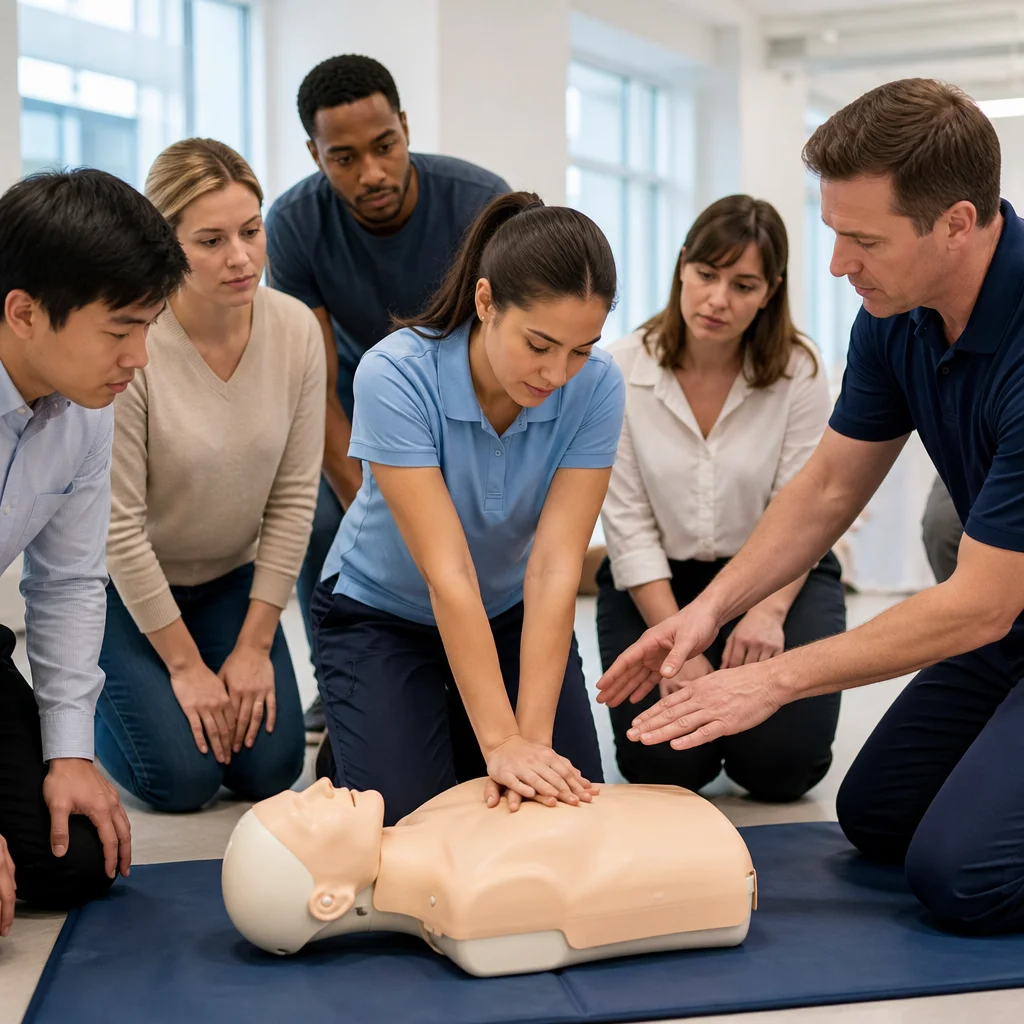
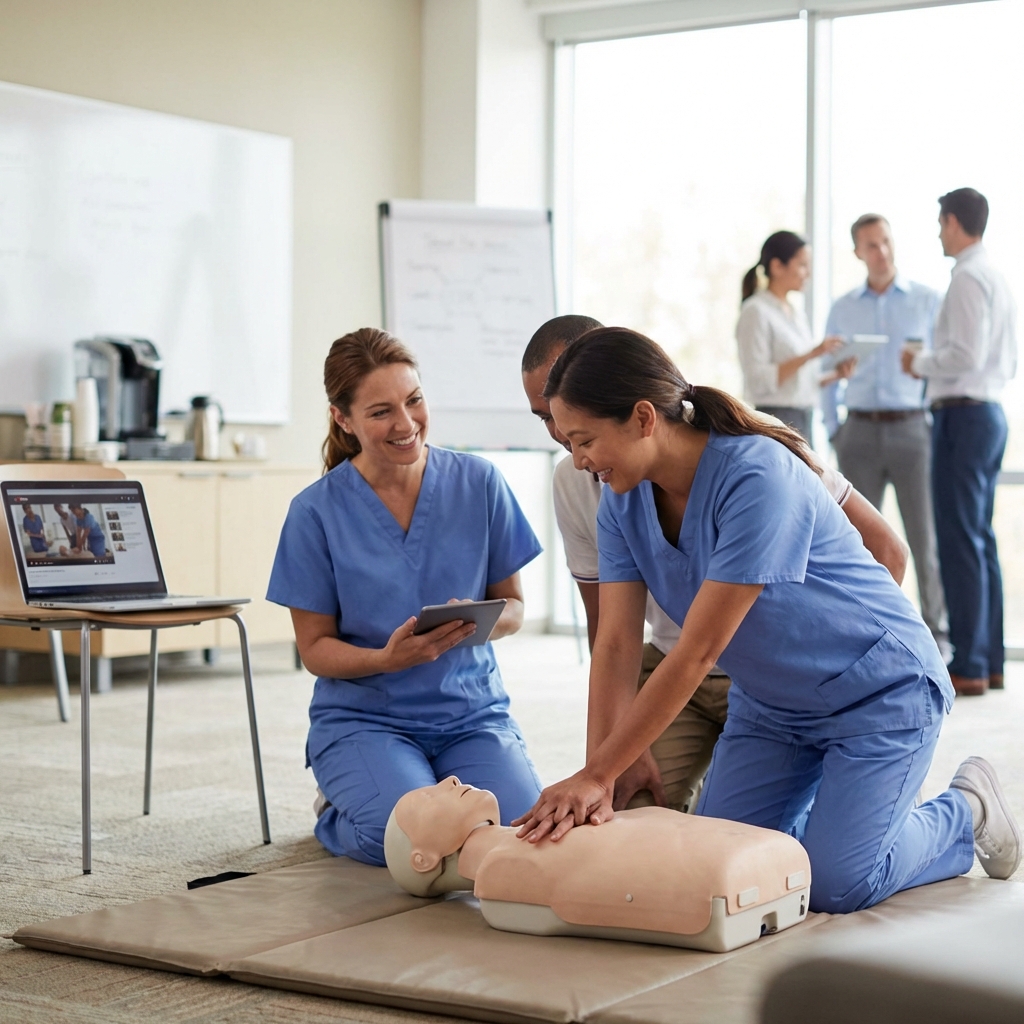
Then you come to one of our training locations for the skills session. Here’s where real learning happens. Our instructors watch your chest compression technique, correct your hand placement, coach you through a full megacode scenario, and ensure you can actually perform under stress. You’ll practice on manikins that give realistic feedback, work through timed scenarios with other participants, and leave knowing exactly what you’re capable of doing.
This blended model typically takes 4 to 6 hours of your time total, spread across a few days. Healthcare professionals consistently tell us it’s more efficient and more effective than sitting through an eight-hour classroom day.
Try this: Calculate how much paid time off you’d lose taking a full-day in-person course. Most of our participants find that the blended approach saves them a full work day compared to traditional training.
AHA-Aligned Curriculum and Same-Day Certification Cards

Our curriculum meets and aligns with the latest guidelines from the organization that sets the standard for resuscitation science. We update our materials quarterly, which means you’re learning protocols that match what hospitals are implementing right now, not what worked five years ago.
When you complete your skills session with us, your instructor verifies your competency on the spot. You walk out with a physical certification card the same day. No waiting for cards to arrive by mail in two weeks. No uncertainty about your certification status. This matters when your hospital is scheduling you for shifts next week or when you need proof immediately for a new job.
Our instructors are experienced clinicians themselves. Your ACLS instructor has actually used those algorithms in an ICU. Your pediatric PALS instructor understands the unique physiology of infants and children because that’s their daily work. This lived experience shapes how we teach, and it shows in the quality of conversations and the depth of explanations.
Next step: When you register for your class, confirm that your training date allows completion before your current certification expires. We can often accommodate rush scheduling on short notice.
Over 100 California Training Locations for Your Convenience
We maintain over 100 training locations throughout California, from San Diego to the Oregon border, coast to inland valleys. Wherever you practice in the state, you’re likely within 20 minutes of one of our sites.
This network exists because we know that a 45-minute commute cuts into your limited free time. A location near your hospital, clinic, or workplace means you can squeeze training into your schedule between shifts, before work, or during a scheduled day off. Several of our sites are co-located with medical facilities, making the commute essentially zero.
Our locations aren’t minimalist spaces either. We maintain proper equipment, realistic simulation scenarios, and professional environments that match the setting where you’ll be working. You’re training in an atmosphere that reflects the professional standards of your career.
You can browse our California locations and filter by city, course type, and available dates. Most locations offer multiple class times weekly, including early morning and evening slots to accommodate shift workers.
What to do: Search our location map for your preferred area, then review available dates for the next 30 days. Pick the option that requires the least schedule disruption.
Specialized Programs for Healthcare Providers, Dentists, and EMS Personnel
One-size-fits-all training misses the specific clinical reality of different professions. A nurse managing a post-operative patient faces different scenarios than a paramedic in the field or a dentist’s office staff member.
For nurses, we offer BLS for nurses that emphasizes hospital-based scenarios—code situations in monitored beds, IV access considerations, and team dynamics in clinical settings. Our ACLS training for nurses includes the types of rhythms you’ll actually encounter, medication administration protocols specific to hospital pharmacy stock, and how to communicate effectively with your code team.
Our PALS certification serves pediatric specialists, neonatal nurses, and emergency providers who work with children. This isn’t a watered-down version of adult ACLS. Pediatric physiology is fundamentally different, medication dosing is weight-based, and the emotional weight of pediatric codes demands specialized training.
For dentists and oral surgery teams, we tailor training to sedation-related emergencies. Your team practices managing airway compromise, recognizing stroke symptoms, and responding to vasovagal reactions—situations unique to your practice setting.
EMS personnel receive training that emphasizes pre-hospital decision-making, field protocols, and the medication toolkit available in your ambulance. We understand that your environment and decision constraints differ completely from a hospital provider.
Action: Identify which course is specific to your profession and role. Our team can match you to the exact certification path you need.
Corporate Group Training and Discount Pricing Solutions

If you manage staffing at a clinic, dental practice, hospital department, or EMS service, coordinating individual training is inefficient and expensive. We offer corporate group training where we come to your facility or coordinate cohorts of your staff at one of our locations.
Group training makes financial sense. We provide volume pricing that reduces per-person cost by 20 to 40 percent depending on group size. Your entire team trains together on a schedule that works for your operations, minimizing coverage gaps. One coordinator manages the logistics rather than 15 people booking 15 separate classes.
Beyond the cost savings, there’s a team cohesion benefit. Your staff practices scenarios together, which means they’ve rehearsed their actual team composition before a real emergency. That familiarity and synchronized training translates directly to better code performance.
We work with you to schedule training around clinical demands. If your hospital can release staff for training during a typically slower shift period, we’ll design classes around that window. If your practice prefers early morning before patient hours, that’s feasible too.
Next step: Contact our corporate training coordinator with your approximate number of staff members and your location. We’ll prepare a customized proposal with scheduling and pricing within 24 hours.
Our Low Price Guarantee and Fast Checkout Process
We believe cost shouldn’t be a barrier to getting certified. We maintain the lowest pricing in California for accredited training, and we’ll match any published rate from a competitor. This isn’t a gimmick—it’s a commitment to accessibility.
Our checkout process is equally straightforward. You register online, provide your information and preference for in-person or blended learning, select your location and date, and complete payment. No phone calls required unless you want to discuss something specific with our enrollment team. Most registrations are complete in under two minutes.
We accept all major payment methods, and we offer flexible payment plans for group registrations. For individuals, the upfront cost is low enough that most people just handle it outright and move on with their day.
Refund policy is fair and transparent. If you need to reschedule, we’ll move you to any available class with no fees. If you’re unsatisfied for any reason, we offer a 30-day satisfaction guarantee.
Action: Visit our course page and get a quote. You’ll see immediately that our rates undercut the competition, and you’ll have a certificate in hand within days.
Real Verification Stations with Advanced Simulation Technology
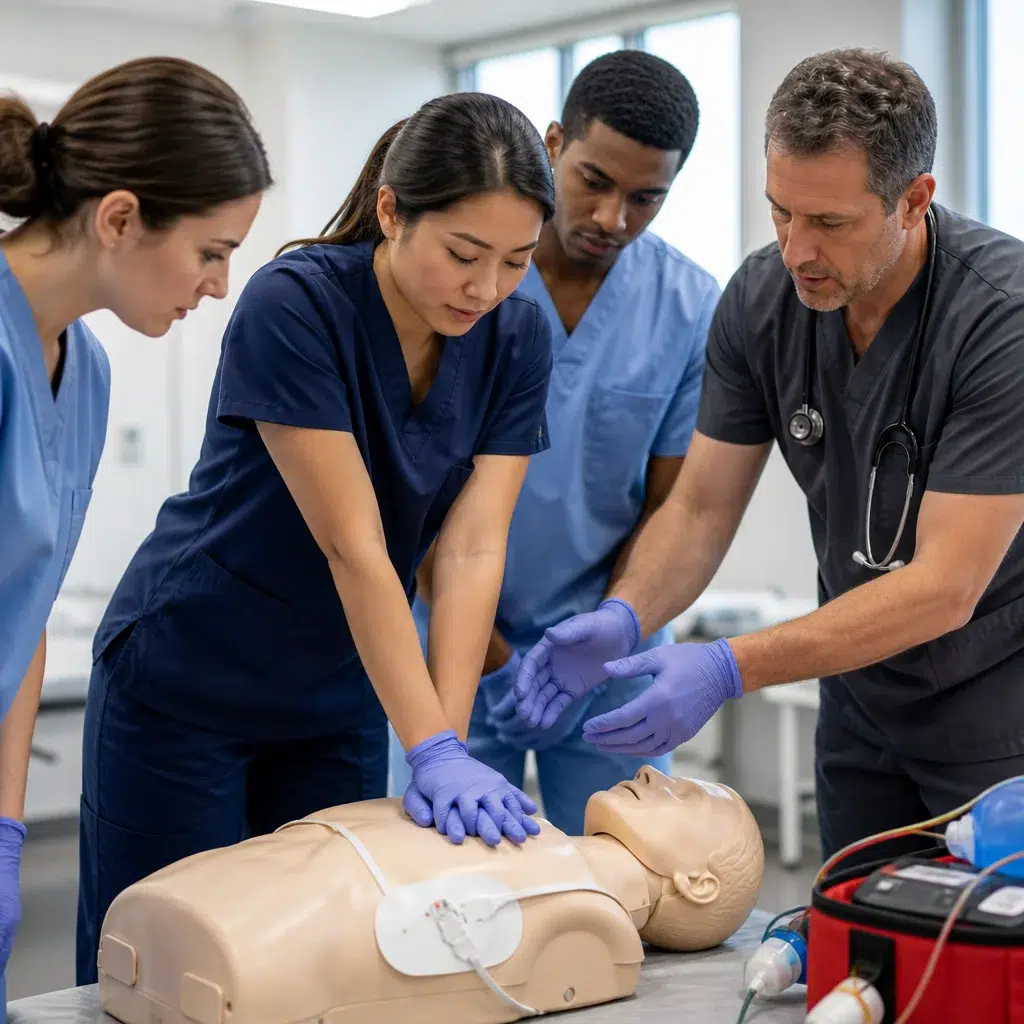
Learning resuscitation on a two-dimensional model doesn’t prepare you for the three-dimensional reality of an actual human body. Our training locations feature high-fidelity manikins that provide realistic feedback on compression depth and rate, chest recoil, and airway management.
Some of our stations use manikins that generate data on your technique. The system tells you in real time whether you’re compressing deeply enough, maintaining the right rate, and releasing fully between compressions. This instant feedback accelerates learning far beyond what an instructor’s observation alone can provide.
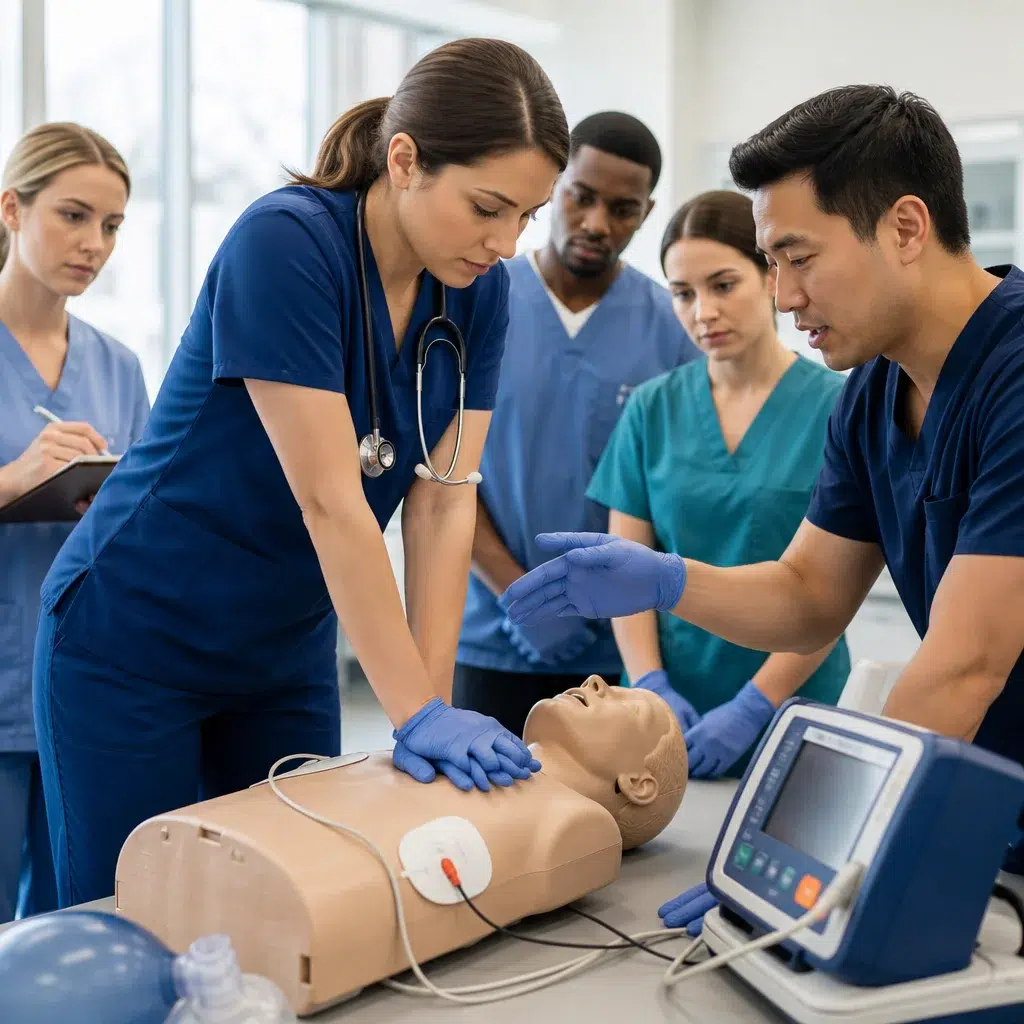
We regularly update our simulation technology to match hospital equipment you’ll encounter clinically. If your facility uses a particular defibrillator model, you’ll likely practice with that same equipment in our training. If your ICU uses a specific style of airway management, you’ll be comfortable with it before your first real shift.
Our verification stations also serve as quality checkpoints. Instructors use these stations to ensure competency before issuing your card. You’re not getting certified based on partial performance—you’re demonstrating full capability under realistic conditions.
What to do next: Ask your instructor which simulation technology is available at your scheduled location. If you have experience with a specific manikin or defibrillator model, let us know so we can ensure you train on similar equipment.
Flexible Scheduling with Daily BLS Certification Classes Available
Life as a healthcare professional doesn’t follow a 9-to-5 calendar. You work nights, weekends, and rotating shifts. Your continuing education should fit around your actual schedule, not force you to request specific time off.
We offer BLS certification classes every single day at most of our locations. Morning classes start at 7 a.m. for those coming off night shift. Afternoon classes accommodate lunch breaks or gaps between commitments. Evening classes serve those who prefer training after clinical duties. Weekend classes are available at major locations for professionals who can’t leave their posts during the week.
Our blended learning model adds even more flexibility. If you can’t make a specific skills session date, we’ll find another within a few days. The online portion has no deadline—you complete it whenever you have 90 minutes of uninterrupted time.
We understand that last-minute emergencies happen. If your certification expired unexpectedly, we often have availability within 48 hours. Call our enrollment team and describe your situation. Most likely, we can get you scheduled and recertified before your next shift.
Try this: Check our calendar for your location and see what times are available in the next week. Pick the option that requires the least schedule juggling.
How We Support Your Ongoing Professional Development
Certification is a milestone, not a destination. The healthcare field evolves constantly. New evidence changes protocols. New medications enter the market. New equipment reaches your facility. Staying current means ongoing education beyond the minimum requirements.
We offer advanced courses beyond basic BLS and ACLS. Want to deepen your understanding of cardiac physiology and EKG interpretation? We offer specialized ACLS programs that go beyond the basic course. Interested in pediatric advanced life support that includes neonatal resuscitation? We have structured pathways for progression.
Beyond formal certification, we provide updated resources and protocol information through our website. When major guideline changes occur, we notify everyone in our system so you’re aware before they take effect at your facility. We host occasional free webinars on emerging topics in resuscitation and emergency medicine.
Think of us as your ongoing partner in professional development, not just the vendor you call every two years for recertification.
Action: After your initial certification, bookmark our resource page. You’ll find protocol updates, case discussions, and upcoming advanced courses relevant to your specialty.
Get Your California Safety Training Certification Today
Your certification expiration date is fixed. Time moves in one direction. The best time to schedule your training was probably three months ago. The second-best time is today.
We’ve made enrollment effortless because we know the friction of scheduling is often the biggest barrier to actually getting it done. You can be registered for a class in the next 48 hours. You’ll complete your training blended across a few days. You’ll walk out with a card in hand. Your professional credentials will be current. Your mind will be at ease.
Your patients deserve a healthcare provider with current skills. Your employers expect it. Your licensing board requires it. Most importantly, you deserve the confidence that comes from knowing you can perform under pressure.
Start here: Visit our enrollment page, select your course type based on your role, choose your nearest location, and pick a date that works. You’ll be certified within days. Questions? Our team is available by phone or chat to guide you through any step.
Your professional safety training is just a few clicks away.
Register for a class today.