Table of Contents
- 1. Understanding Thermal Burns and Immediate Response
- 2. Chemical Burn Protocol: Decontamination and Care
- 3. Electrical Burn Assessment and Safety Procedures
- 4. The Rule of Nines: Calculating Burn Surface Area
- 5. Fluid Replacement Therapy in Severe Burns
- 6. Preventing Infection Through Proper Wound Management
- 7. When to Seek Emergency Medical Attention
- Frequently Asked Questions (FAQ)
1. Understanding Thermal Burns and Immediate Response
Burn injuries demand swift, decisive action. Whether you’re a nurse, dentist, or EMS professional, your response in the first few minutes can mean the difference between a patient’s full recovery and lasting complications. We’ve designed our burn first aid training modules to equip healthcare professionals across California with the knowledge and hands-on practice needed to handle thermal, chemical, and electrical burns with confidence.
Understanding burn classification, depth, and surface area forms the foundation of effective care. Each burn type requires a different treatment approach, and improvisation can worsen outcomes. That’s why we emphasize practical, evidence-based protocols throughout our training programs at locations from San Francisco to Fresno, ensuring you’re ready for real-world emergencies.
Thermal burns from flames, hot liquids, or contact with heated surfaces account for the majority of burn injuries you’ll encounter. Your immediate priorities are stopping the burning process and preventing further tissue damage.
First, remove the patient from the heat source immediately. Have them drop and roll if their clothing is on fire, or use a blanket or fire extinguisher if safe to do so. Once removed from danger, cool the burn with running water at room temperature for 10-20 minutes. Cold water constricts blood vessels, reduces swelling, and alleviates pain without risking thermal shock that ice water can cause.
After cooling, assess the burn depth:
- First-degree burns affect only the outer epidermis and appear red and painful but without blistering
- Second-degree burns penetrate to the dermis, causing blistering, severe pain, and possible edema
- Third-degree burns destroy full skin thickness and may appear white, charred, or leathery with minimal pain due to nerve damage
- Fourth-degree burns extend into subcutaneous tissue, muscle, or bone and require immediate emergency transport
Cover the cooled burn with a clean, dry, non-adherent dressing. Avoid ice, butter, ointments, or topical medications during this phase. Document the time of injury and mechanism, as this information guides hospital protocols. If the burn covers more than 10-15% of body surface area or affects joints and the face, prepare for transfer to a specialized burn center.
Your action step: practice cooling technique during hands-on training sessions so the reflex becomes automatic under pressure.
2. Chemical Burn Protocol: Decontamination and Care
Chemical burns penetrate tissue differently than thermal injuries because the chemical agent continues damaging tissue until fully removed. Your primary goal is rapid decontamination, which often prevents escalation to deeper tissue layers.
Identify the chemical if safely possible, but never delay decontamination to search for safety data sheets. Brush off dry chemical particles gently before flushing if the chemical reacts violently with water (such as white phosphorus). For most water-reactive chemicals, dry removal prevents exothermic reactions that generate heat.
Flush copiously with water for at least 15-20 minutes. Use low-pressure running water or a safety shower, pouring water from the center of the burn outward to avoid spreading the agent. Many healthcare settings in cities like Sacramento, San Jose, and Oakland have eyewash stations and emergency showers positioned near chemical storage areas, so familiarize yourself with their locations.
Never attempt neutralization with acids or bases. Neutralization reactions generate heat and can worsen tissue injury. Water dilution is universally safe and effective for nearly all chemical exposures.
After thorough rinsing, cover the area with a clean dressing. Certain chemicals like hydrofluoric acid require specialized medical intervention including calcium administration, so transport to an emergency department immediately. Have the patient monitor for systemic symptoms like nausea or muscle rigidity, which indicate systemic absorption.

Your action step: learn the chemical storage locations in your workplace and participate in a mock decontamination drill at least annually.
3. Electrical Burn Assessment and Safety Procedures
Electrical burns pose a hidden danger because surface appearance often underestimates internal tissue damage. High-voltage current creates a “iceberg effect” where deep muscle and organ damage exists beneath seemingly minor skin burns.
Your safety comes first. Never approach a patient still in contact with a live electrical source. De-energize the circuit at the breaker box, use a non-conductive object like a wooden broom handle to separate the patient from the source, or call for utilities dispatch if high-voltage lines are involved. Once the scene is safe, assess for entrance and exit wounds, which indicate the path the current traveled through the body.
Check for cardiac arrhythmias using a monitor or palpating the pulse. Electrical current disrupts normal cardiac conduction, sometimes causing delayed arrhythmias up to 24 hours after injury. Even low-voltage exposures (household current at 120 volts) can trigger fibrillation if the current crosses the chest. Transport any patient with electrical burn injury to an emergency department for cardiac monitoring, regardless of how stable they appear.
Look for compartment syndrome indicators, particularly in limbs with entrance and exit wounds. Swelling from electrical injury can compress blood vessels and nerves within muscle compartments, requiring surgical fasciotomy if missed. Pain out of proportion to the visual burn, numbness, or weakened grip strength are red flags.
Electrical burns in professional settings across the Bay Area and Central Valley frequently involve workplace incidents. Report all electrical injuries to occupational safety coordinators and ensure incident documentation for workers’ compensation and safety review.
Your action step: identify the circuit breaker locations and electrical hazards in your workplace, and review your facility’s electrical emergency protocol.
4. The Rule of Nines: Calculating Burn Surface Area
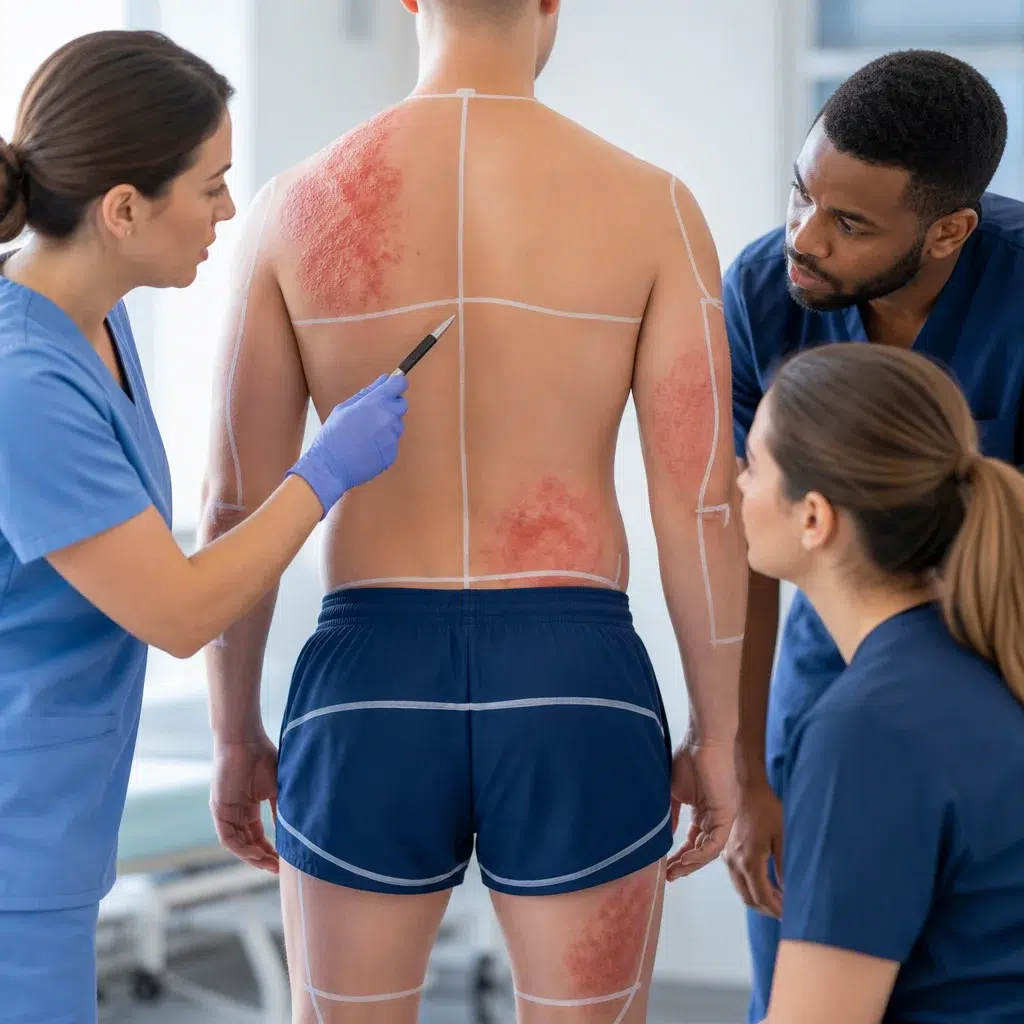
Accurate assessment of total body surface area (TBSA) involved in a burn determines fluid resuscitation volume, transfer decisions, and admission to specialized burn centers. The Rule of Nines divides the body into sections, each representing 9% or multiples thereof.
In adults, the calculation breaks down as follows:
- Head and neck: 9%
- Each arm: 9%
- Chest: 18%
- Abdomen: 18%
- Each leg: 18%
- Genitalia: 1%
For pediatric patients, the proportions differ because children have larger heads relative to body size. Adjust the head to 18% and each leg to 13.5% in children under 8 years.
Use this simple method: make a rough outline of the burned area on a body diagram, then sum the percentages. A burn affecting one entire leg plus the abdomen equals 36% TBSA. Burns exceeding 20% in adults or 10% in children require intensive fluid resuscitation and probable transfer to a burn center.
The Rule of Nines is not perfect for small, scattered burns (use the patient’s palm as 1% of their body surface for small areas), but it provides a rapid, reproducible estimate that guides immediate decisions. Document your calculation and communicate it clearly during transfer handoff, especially when coordinating with burn centers in larger California cities like San Francisco, Los Angeles, or San Diego.
Your action step: practice the Rule of Nines on anatomical models until you can estimate TBSA within 5% without referencing materials.
5. Fluid Replacement Therapy in Severe Burns
Major burns cause massive fluid shifts from the intravascular space into interstitial tissues, leading to hypovolemic shock within hours if untreated. Fluid resuscitation prevents organ failure and improves survival rates dramatically, but miscalculation either worsens outcomes.
Use the Parkland Formula as your starting point: multiply the TBSA percentage by the patient’s weight in kilograms by 4 milliliters. This yields the total fluid volume needed over the first 24 hours, with half administered in the first 8 hours and the remainder over the subsequent 16 hours.
For example, an 80-kilogram patient with 25% TBSA burn receives (25 x 80 x 4) = 8,000 milliliters total. Deliver 4,000 milliliters during the first 8 hours at a rate of 500 milliliters per hour, then adjust based on urine output.
Administer Lactated Ringer’s solution, not normal saline, because it better mirrors the electrolyte composition lost during burn injury. Insert two large-bore intravenous lines (16-gauge or larger) to accommodate high flow rates. Avoid peripheral lines if the burn crosses major veins; use central access.
Titrate the infusion rate to maintain urine output of 0.5 milliliters per kilogram per hour in adults and 1 milliliter per kilogram per hour in children. An indwelling urinary catheter allows precise monitoring. As fluid shifts reverse after 24-48 hours, reduce infusion rates carefully to prevent pulmonary edema. Monitor serum electrolytes, particularly potassium, which rises dramatically from cellular release.
Fluid resuscitation requires specialized knowledge and ongoing assessment. We emphasize this critical skill during our CPR and BLS training sessions, with detailed modules on burn shock management designed for nurses, EMS, and other front-line providers across our 100+ California training locations.
Your action step: familiarize yourself with your facility’s burn protocol and verify that large-bore IV supplies are readily accessible.
6. Preventing Infection Through Proper Wound Management
Burned tissue dies and provides an ideal medium for bacterial proliferation. Infection transforms a survivable injury into a life-threatening condition, making prevention your ongoing responsibility during wound care.
After the acute phase (typically 24-48 hours post-injury), cleanse the wound gently under anesthesia or sedation. Remove loose, nonviable tissue and fluid-filled blisters using sterile technique. Necrotic tissue debridement prevents bacterial encapsulation and promotes healing, but overly aggressive removal causes additional trauma.
Apply topical antimicrobial agents according to your facility’s protocol. Silver sulfadiazine, mafenide acetate, and bacitracin ointments all suppress bacterial growth without promoting resistance when used appropriately. Some facilities use newer, nanocrystalline silver dressings or enzymatic debriding agents for faster healing.
Change dressings daily or twice daily, depending on drainage and contamination risk. Each dressing change is an opportunity to assess for signs of infection: purulent drainage, foul odor, rapid eschar separation, or surrounding cellulitis warrant culture samples and possible systemic antibiotic therapy.
Maintain the patient’s tetanus vaccination status. Burn wounds are considered tetanus-prone injuries, so administer tetanus toxoid if the patient’s last vaccination was more than 5 years ago, or immunoglobulin if never previously vaccinated.
Keep the wound environment moist but not macerated. Dry wounds form thick eschar that sloughs over weeks; moist wounds promote re-epithelialization from wound margins. Modern dressings designed for burn care maintain this balance better than traditional gauze.
Your action step: review your facility’s current wound care protocol and practice aseptic technique during dressing changes until it becomes habitual.
7. When to Seek Emergency Medical Attention
Knowing which burns demand immediate emergency transport versus outpatient management prevents delays in critical care and avoids unnecessary transfers that stress patients.

Transport to an emergency department immediately if:
- TBSA exceeds 10% in adults or 5% in children
- Burn involves the face, hands, feet, genitalia, or joints
- Patient age is under 5 or over 60 years
- Circumferential burns exist (risk of compartment syndrome)
- Inhalation injury is suspected
- Chemical or electrical burn mechanism involved
- Pre-existing medical conditions complicate recovery
Even first-degree burns deserve medical evaluation if the patient reports severe pain, significant swelling, or concerns about scarring. Sunburns occasionally mask deeper injury if accompanied by heat exhaustion or dehydration.
For isolated, small second-degree burns (less than 5% TBSA on the torso or extremities) without complicating factors, your facility may provide outpatient care with close follow-up and explicit return precautions. Always err toward transport when uncertain; burn centers in major California metros like Sacramento, Oakland, and San Jose have resources to handle complications that small clinics cannot.
Coordinate with your local burn center in advance. Knowing their admission criteria, contact protocols, and expected transport times prevents communication delays during emergencies. Many regions have specific receiving facilities designated for burn transfers.
Your action step: identify your nearest verified burn center and document the direct transport protocol and phone contact in your facility’s emergency procedures manual.
—
Burn first aid training isn’t a one-time box to check; it’s a skillset that improves with regular practice and scenario-based learning. We’ve built our training programs to move beyond lecture and into hands-on application, where you practice cooling techniques, assess TBSA, and rehearse decontamination protocols with experienced instructors who understand the pressures of real healthcare work.
Whether you’re based in Bakersfield, Hayward, San Jose, or Chico, our blended learning format combines online foundational knowledge with in-person skills sessions at over 100 locations throughout California. You’ll walk away not just certified, but confident. Our low price guarantee ensures you invest in quality training without budget strain, and our daily course scheduling works with your shift patterns.
Ready to strengthen your burn injury response? Enroll in our specialized burn care and first aid training today. Your patients depend on your expertise, and we’re here to help you deliver it.
Register for a class today.
Frequently Asked Questions (FAQ)
Does your burn first aid training cover different types of burns?
Yes, our courses teach you how to respond to thermal, chemical, and electrical burns since each requires different immediate care protocols. We include hands-on practice for decontamination procedures, assessment techniques, and proper wound management so you’re prepared for any burn injury scenario you encounter in your healthcare setting.
Why do we emphasize the Rule of Nines in our training programs?
We focus on the Rule of Nines because calculating burn surface area accurately determines whether a patient needs emergency transport and specialized care. Our instructors walk you through this critical assessment method during both virtual and in-person sessions so you can confidently estimate burn severity and guide your treatment decisions.
How do your BLS and specialty certification courses prepare me for burn injury management?
Our comprehensive courses integrate burn response protocols into broader emergency care instruction, giving you the full clinical picture you need on the job. We offer daily certification classes at over 100 California locations, and our blended learning approach means you get both the theoretical knowledge and hands-on skills practice required for professional licensing and workplace compliance.