Table of Contents
- Why California Nurses Need Current AHA Certifications
- Understanding Recertification Timelines and Renewal Deadlines
- What Changes in the Updated AHA Curriculum
- How Our Blended Learning Model Fits Your Schedule
- Same-Day Certification: Getting Your Card Immediately
- Choosing Between ACLS, BLS, and Specialized Credentials
- Group Training Solutions for Your Healthcare Facility
- Our Low-Price Guarantee on All Recertification Courses
- Convenient Scheduling Across 100+ California Locations
- Staying Compliant Without the Hassle
- Frequently Asked Questions (FAQ)
Why California Nurses Need Current AHA Certifications
Your California nursing license depends on maintaining current life-saving certifications. The California Board of Registered Nursing requires nurses to hold active BLS (Basic Life Support) certification as a condition of licensure and clinical practice. For many specialty roles, ACLS (Advanced Cardiac Life Support) is equally non-negotiable.
These certifications aren’t paperwork exercises. They represent your competency in recognizing cardiac emergencies, performing high-quality chest compressions, and executing protocols that save lives during those critical first minutes. Employers verify your credentials before your shift starts, and patients benefit directly from your current knowledge.
We understand the stakes. A lapsed certification can mean suspension from clinical duties, delayed promotions, or inability to accept new positions. That’s why we’ve designed our recertification programs to fit directly into your schedule without compromising the hands-on skills practice that makes the difference in real emergencies.
Action step: Check your current certification expiration dates now. Most California healthcare facilities require notifications 30-60 days before expiration, giving you a clear deadline to plan your renewal.
Understanding Recertification Timelines and Renewal Deadlines
BLS and ACLS certifications remain valid for two years from the date of completion. Your renewal window actually opens at the 18-month mark, meaning you have a six-month buffer to complete recertification before your card expires.
Timing matters practically. Most hospitals and clinics require proof of current certification before you clock in, and scheduling recertification during a slow season at work prevents scrambling in emergencies. If you work in settings across multiple facilities in locations like San Jose, Sacramento, or the Bay Area, coordinating renewal across your employers becomes simpler when you plan ahead.
We track your certification expiration as part of our verification system. When you’re approaching renewal, our team can help you coordinate timing with your workplace requirements and personal schedule. Many nurses we work with in Fremont, Oakland, and San Francisco take advantage of our flexible scheduling to renew during slower clinical periods.
The renewal process itself is faster than initial certification because you’re refreshing skills you already know. We see most recertifying nurses complete the course, demonstrate competency, and walk out with their new card the same day.
Action step: Mark your expiration date in your phone calendar and your employer’s system now. Set a reminder for 60 days before expiration to book your course.
What Changes in the Updated AHA Curriculum
Curriculum updates happen regularly to reflect the latest research on cardiac care. Recent changes emphasize high-quality chest compressions, earlier defibrillation in witnessed arrests, and refined protocols for specific scenarios you encounter in clinical practice.
The current curriculum places stronger focus on teamwork and communication during resuscitation events. You’ll practice scenarios where miscommunication could delay treatment, then learn how structured team dynamics improve outcomes. Instructors drill the importance of clear role assignment and real-time feedback during compressions.
Another key update involves pediatric and neonatal considerations. Nurses working in maternity, pediatrics, or emergency departments will find expanded content on age-specific modifications and when standard adult protocols don’t apply. If you’re renewing in locations like Palo Alto, Berkeley, or Davis where medical centers serve diverse patient populations, this practical content directly impacts your daily work.

Updates also reflect evolving technology in monitoring and medication delivery. Your recertification course covers current equipment and techniques you’ll actually use in your facility, not outdated procedures from previous certifications.
Action step: Ask your facility which specific scenarios are most common in your department, then mention this during your course so the instructor can emphasize relevant content.
How Our Blended Learning Model Fits Your Schedule
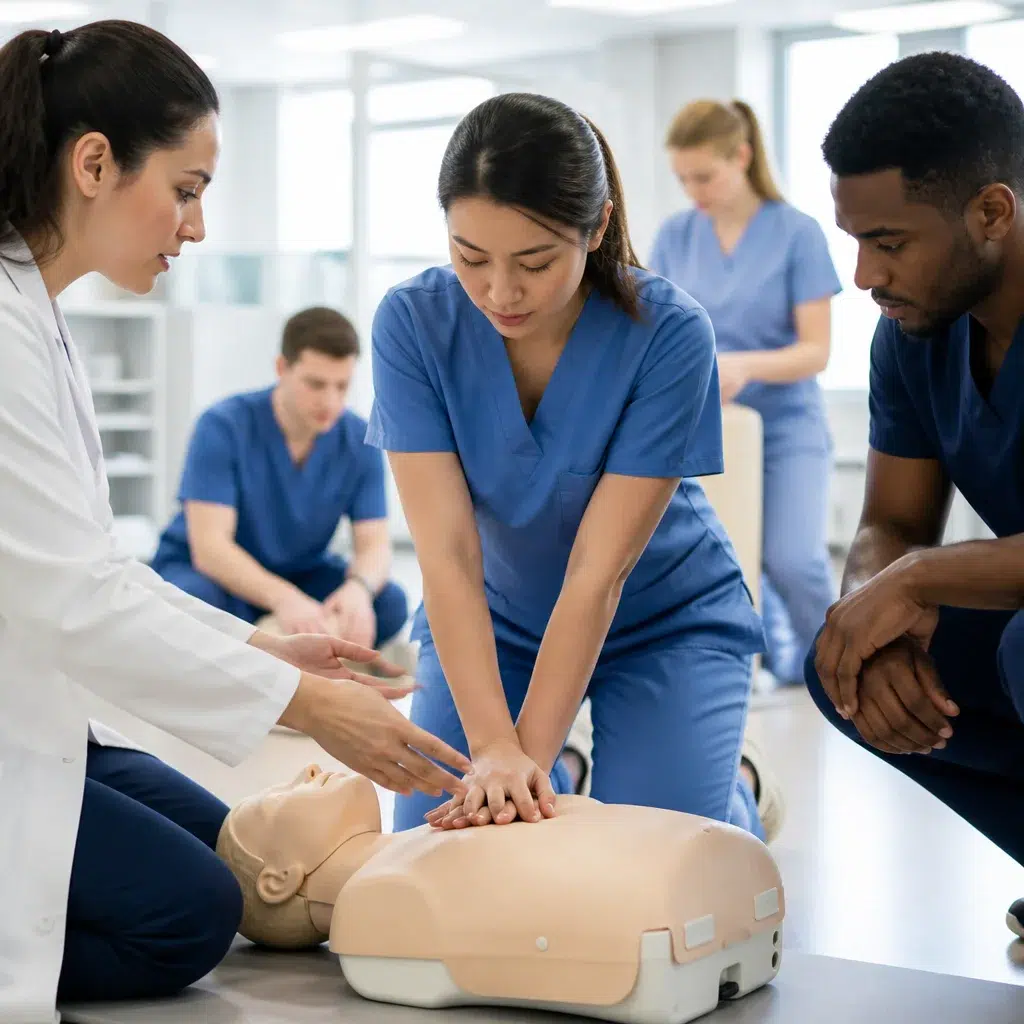
We’ve structured our courses to work with the reality of nursing shifts. Our blended approach combines online learning for cognitive content with hands-on skills practice in person. This means you complete the knowledge review from home, on your schedule, then attend a focused skills session where our instructors watch your technique and guide you through real scenarios.
The online component typically requires two to three hours and covers the algorithms, decision trees, and rationales behind each protocol. You can progress through it at midnight after a night shift or during your days off. Once complete, you attend a scheduled skills session lasting about three to four hours. This structure eliminates the all-day classroom requirement while ensuring you get instructor feedback on your performance.
We offer these blended sessions across our over 100 California locations. Whether you’re based in Bakersfield, Sacramento, the Bay Area, or Santa Cruz, we have scheduling options near you. Facilities in Walnut Creek, Antioch, and Stockton can access nearby training without long commutes.
Nurses working irregular schedules appreciate the flexibility. Weekend sessions, early morning starts, and evening classes mean you’re not forced to take time off work to recertify. We accommodate both individual nurses and group registrations for facilities coordinating multiple team members.
Action step: Check our calendar for classes near your location and preferred time. If nothing matches exactly, our scheduling team can discuss private group options for your facility.
Same-Day Certification: Getting Your Card Immediately
After you complete your skills assessment, we issue your new certification card on site. You don’t wait for mail or download a provisional certificate. You walk out with physical credentials you can show your employer, your facility can verify, and you can use to pick up shifts immediately.
This same-day approach eliminates the administrative gap many nurses face between course completion and credential verification. Your employer’s credentialing system gets updated in real time, so there’s no delay in your ability to practice. For nurses in locations like Modesto, Fresno, or Hayward who work multiple positions, having your new card immediately means no logistical complications across facilities.
Our verification stations throughout California ensure your credentials enter the system correctly and quickly. When your new certification is active, your name is flagged as current in our system, and we maintain records your employer can access.
Action step: Bring two forms of ID to your course. We’ll photograph you for your card during the session, so your ID arrives ready to use immediately.
Choosing Between ACLS, BLS, and Specialized Credentials
Your clinical role determines which certification you need. BLS is foundational and required for virtually all nurses. ACLS adds advanced protocols for managing cardiac rhythms, medications, and complex resuscitations. PALS (Pediatric Advanced Life Support) focuses on pediatric-specific scenarios. Your employer mandates which combination applies to your position.
Most bedside nurses in acute care settings maintain both BLS and ACLS. If you work in pediatrics, maternity, or pediatric intensive care, PALS becomes essential. Some nurses hold all three plus NRP (Neonatal Resuscitation Program) depending on their role scope.
Our instructors help you determine which certifications align with your current position and career goals. If you’re considering a move to a new specialty or facility, renewing ACLS even if not currently required protects your flexibility.
We offer BLS and ACLS courses specifically for nurses with content tailored to clinical practice. You’re not sitting in a classroom with non-clinical staff; your cohort includes your peers, and scenarios reflect real hospital situations.

Action step: Review your job description and your facility’s credentialing requirements. Ask your manager which certifications are required versus recommended for advancement.
Group Training Solutions for Your Healthcare Facility
We understand that coordinating recertification across an entire nursing unit creates scheduling nightmares. That’s why we offer dedicated group training at your facility or at one of our nearby training centers in your area.
Group sessions work on your timeline. We can schedule classes around your unit’s slow periods, split sessions across multiple days if needed, and provide pricing that reflects the volume. A 15-nurse cohort costs considerably less per person than 15 individual registrations.
Facilities in Sacramento, Oakland, San Jose, and throughout the Bay Area use our group model to ensure all staff recertify without disrupting patient care. Your educators can observe training and receive immediate feedback on team performance. We’ve worked with pediatric units in Palo Alto, trauma centers in Fresno, and emergency departments in Stockton who coordinate their entire staff recertification through group scheduling.
Our team handles the logistics: we send instructors to your location, coordinate equipment, manage registrations, and track completion for your credentialing office. This eliminates individual scheduling complexity and creates a cohesive training experience for your team.
Action step: Contact us with your unit size and preferred timeframe. We’ll provide a custom quote and flexible scheduling options tailored to your facility’s calendar.
Our Low-Price Guarantee on All Recertification Courses
We commit to offering the lowest pricing for quality recertification training. Our guarantee means you won’t find the same course content and instructor quality elsewhere for less. If you do, we’ll match it and refund the difference.
This pricing approach reflects our mission: cost shouldn’t be a barrier to staying current with life-saving certifications. Nurses often pay for recertification from their own pockets, and we keep that burden manageable. Our transparent pricing has no hidden fees, surprise charges, or upsells.
Group rates provide additional savings, with per-person costs dropping as cohort size increases. Individual nurses recertifying in locations like Concord, Pleasanton, or Newark benefit from our volume-based pricing that reflects our operational efficiency.
We also work with facilities on annual contracts, providing pre-negotiated rates for ongoing staff recertification throughout the year. This approach simplifies budgeting for your human resources team while delivering consistent training quality.
Action step: Request our current pricing for individual or group recertification. Ask about any facility contracts or package discounts available for your organization.
Convenient Scheduling Across 100+ California Locations
Whether you practice in a rural area like Visalia or Redding, a major metro like San Francisco or Los Angeles-adjacent regions, or everywhere between, we have training locations near you. Our network spans from the Sierra Nevada through the Central Valley and across the Bay Area and coastal regions.
Regular courses run daily at many of our established centers. You can find sessions in locations like San Rafael, Livermore, Fairfield, and Woodland on a weekly basis. Smaller communities like Lathrop, San Pablo, and Larkspur may have monthly sessions, with flexibility to add additional classes if demand increases.
Our online scheduling tool shows real-time availability. Filter by location, date, and certification type, then register immediately. If you’re willing to drive 20-30 minutes, your options multiply. A nurse in Milpitas or San Leandro might access classes in San Jose, Fremont, or Oakland. Someone in Campbell or Los Gatos can easily reach our San Jose locations.
We recognize that commute time matters when you’re already managing clinical shifts. That’s why our distributed network ensures most California nurses have training within a reasonable drive. We continue opening new locations based on nurse feedback and demand patterns across the state.

Action step: Visit our location finder and search for classes near your work or home. Filter by distance and preferred times, then book your preferred session.
Staying Compliant Without the Hassle
Compliance requires more than attending one course every two years. It involves tracking your expiration date, planning renewal timing, ensuring your new credentials reach your employer’s system, and maintaining organized documentation.
We handle the tracking through our verification stations. Once enrolled, your certification timeline enters our system. Your new card is issued immediately upon course completion, and we report your current status to the verification networks your employer checks.
Documentation is equally important. We provide detailed completion certificates, transcript records, and digital proof of certification you can share with employers or licensing boards. If your facility conducts random audits or your state board requests proof, you have immediate access to comprehensive records.
Many nurses appreciate that our approach eliminates the admin burden. You don’t manage mailed cards, delayed processing, or gaps between course completion and credential activation. We streamline the entire process so you focus on clinical practice, not paperwork.
Action step: Once recertified, download your digital certificate and upload it to your facility’s credentialing system immediately. This confirms your compliance status and prevents any scheduling complications.
—
Maintaining current AHA certifications is non-negotiable for your nursing career and your ability to serve patients effectively. We’ve designed our recertification courses to fit realistically into your life as a working nurse across California. Same-day certification, flexible scheduling across 100+ locations, blended learning options, and our low-price guarantee mean recertification doesn’t create stress or expense.
Your next step is simple: identify your expiration date, choose a convenient location and time, and book your course today. We’re here to support your compliance and your professional growth.
Register for a class today.
Frequently Asked Questions (FAQ)
What recertification timeline should I follow to maintain my nursing license in California?
We recommend renewing your certification before your current card expires to ensure continuous compliance with California licensing requirements. Most healthcare professionals recertify every two years, but we advise checking your specific employer or licensing board requirements since timelines can vary. We offer flexible scheduling across our 100+ locations, so you can find a class that fits your renewal deadline without stress.
How does our blended learning approach help busy nurses complete their recertification?
We combine virtual instruction with in-person skills sessions, allowing you to learn theory on your own schedule and complete hands-on practice when convenient for you. This format means you don’t need to take a full day off work for classroom time, and you can progress through material at a pace that works with your nursing shifts. Our same-day certification option also gets your updated card immediately after you complete the in-person skills portion.
Do you offer group training discounts for our hospital or healthcare facility?
We absolutely do. We provide specialized corporate group training with discount pricing for healthcare facilities across California, and our team works directly with your facility to schedule classes at times that minimize staffing disruptions. Simply contact us to discuss your team’s certification needs, and we’ll create a customized training plan that fits your facility’s requirements and budget.