
Table of Contents
- The Challenge of Onboarding Certified Staff in California Hospitals
- Why Traditional Certification Processes Create Bottlenecks for New Hires
- Our Blended Learning Approach Solves Your Hiring Timeline Problems
- How Our Network of 100+ California Locations Supports Your Team
- Daily BLS Certification Courses Keep Your Staff Compliant Year-Round
- Specialized Certifications for Every Role: ACLS, PALS, and Beyond
- Same-Day Certification Cards and Our Fast Checkout Process
- Why Healthcare Systems Choose Our Low-Price Guarantee
- Group Training Solutions for Streamlined Onboarding
- Flexible Scheduling That Works with Your Hospital's Calendar
- Getting Started with Your First Hospital Group Training Program
The Challenge of Onboarding Certified Staff in California Hospitals
When a new nurse, respiratory therapist, or physician joins your hospital team, the clock starts ticking. California regulations require specific certifications before staff can assume clinical duties, and any delay in getting those credentials means delayed start dates, stretched onboarding budgets, and gaps in your staffing plan.
We understand this pressure intimately. Healthcare administrators tell us repeatedly that certification delays create a cascade of problems. A single new hire waiting two weeks for BLS certification throws off your entire unit’s scheduling. When you’re onboarding a cohort of five nurses at once, the friction multiplies quickly.
The real cost isn’t just time. It’s the compounding effect: delayed certifications push back orientation schedules, which delays when new staff can take on full patient loads, which impacts your unit’s capacity and staff morale. Your hiring team completed the hard work of recruitment. Your new employees are ready to contribute. But without streamlined certification pathways, everyone sits in a holding pattern.
This is where most hospital hiring processes break down. The standard approach treats certification as an afterthought rather than a critical component of onboarding infrastructure.
Why Traditional Certification Processes Create Bottlenecks for New Hires
The typical certification journey for hospital hires looks something like this: new staff complete classroom instruction, wait for an available skills session, then hope the timing aligns with their onboarding schedule. Most training providers operate on fixed schedules with limited availability, meaning new hires often wait 7-14 days between the theory component and hands-on practice.
What compounds this problem is geography. If your hospital isn’t located near a training center, or if the nearest provider has a two-week waitlist, your staff sits idle. We’ve worked with hospital systems that reported new hires staying in “not yet certified” status for up to three weeks. That’s three weeks of salary for someone who can’t yet work independently on the floor.
Another friction point emerges when different departments need different certifications. Your ED nurses need ACLS and BLS. Your pediatric team needs PALS alongside BLS. Your perioperative staff might need NRP certifications. Coordinating across multiple providers to get everyone certified simultaneously becomes a scheduling nightmare.
Finally, there’s the verification hassle. Traditional centers issue cards after testing, but those cards arrive days later or sometimes require mail delivery. Your HR team can’t verify compliance in real time, which delays paperwork processing and the official start date.
The bottleneck isn’t actually training quality. It’s inflexible scheduling combined with geographic limitations and slow verification timelines.
Our Blended Learning Approach Solves Your Hiring Timeline Problems
We built our training model specifically to eliminate these delays. Our blended learning structure separates knowledge acquisition from skills testing, which means we can move fast without sacrificing rigor.
Here’s how it works: new hires complete the cognitive portion online on their schedule, whether that’s 8 p.m. on a Tuesday or 6 a.m. on Sunday. No waiting for a classroom to fill up. No traveling to a distant training center during work hours. The online component covers all the knowledge requirements and takes 2-3 hours for most certifications.
Then, the skills component happens in person at one of our 100+ California locations. This is where we see time savings multiply. Because we offer skills sessions daily at most locations, new hires typically schedule their hands-on test within 24-48 hours of completing the online portion. We’re not batching cohorts and waiting for minimum enrollment. Each day is a fresh opportunity to test.

For a hospital onboarding five new hires, this model means coordinating one group session instead of finding five separate testing slots across multiple providers. Your team contacts us, we schedule a single skills session at a nearby location, everyone tests on the same day, and certification cards are in hand immediately.
The efficiency gain is real. Instead of a 2-3 week certification timeline, we’re typically completing the entire process within 3-5 days from when someone starts the online component.
How Our Network of 100+ California Locations Supports Your Team
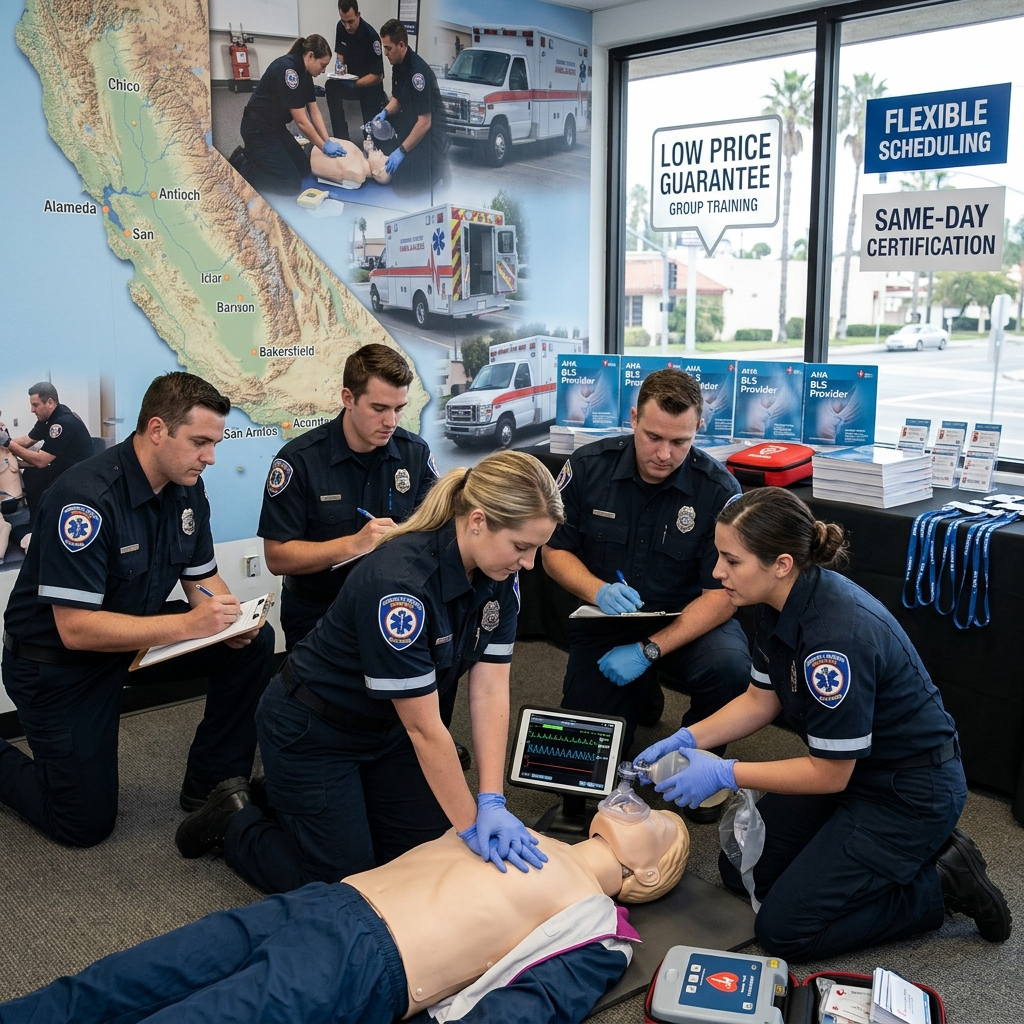
Geography shouldn’t be a barrier to timely certification. That’s why we invested in an extensive network across California. We operate over 100 training locations throughout the state, from major urban centers to smaller regional areas.
This density means that nearly every hospital in California has one of our centers within 15-30 minutes. Your new hire in Fresno doesn’t need to drive to San Francisco. Your Sacramento team doesn’t require a Los Angeles trip. This proximity eliminates travel time as a scheduling excuse and makes it realistic for staff to test on their actual start week.
Our location network also supports group training logistics. When you schedule a cohort session, we can often accommodate your preferred time slot within your region, sometimes even offering on-site training at your hospital if you have a larger group. This flexibility is particularly valuable for hospitals in rural areas where local certification options are sparse.
Beyond convenience, distributed locations mean we’re not creating a single point of failure. If one center reaches capacity on a given day, we have adjacent locations with availability. Your HR team never hears, “We can’t fit your team in until next month.”
Daily BLS Certification Courses Keep Your Staff Compliant Year-Round
BLS certification is the foundation requirement for virtually every clinical role. We offer BLS courses daily at the vast majority of our California locations, which means your staff always has testing availability regardless of season or staffing level.
This daily cadence solves a persistent problem: certification expirations. Most healthcare professionals need BLS renewal every two years. Rather than scrambling when someone’s card approaches expiration, staff can simply schedule renewal during a routine business day. No special cohort. No waiting period.
For new hires specifically, BLS is often the first certification they need. Because we test daily, onboarding can proceed immediately rather than waiting for a scheduled class. A nurse hired on Monday can test BLS on Wednesday and move into floor duties by Friday.
We also recognize that not all BLS training looks the same across organizations. Some hospitals require specific protocols or documentation. We work with your onboarding team to ensure our BLS instruction aligns with your institutional standards, so new hires walk onto the floor already familiar with your specific approach.
Specialized Certifications for Every Role: ACLS, PALS, and Beyond
Beyond BLS, clinical specialties demand role-specific credentials. Emergency department staff need ACLS. Pediatric nurses need PALS. Neonatal teams need NRP. We offer all these certifications and more through the same blended learning framework that accelerates BLS training.
ACLS training, for instance, integrates scenarios specific to adult resuscitation and cardiac emergencies. PALS focuses on pediatric protocols and unique considerations for treating children. NRP prepares staff for neonatal resuscitation situations. Each requires distinct knowledge and different skills assessments.

By offering these certifications on flexible schedules, we ensure that specialized staff can get role-appropriate credentials without holding up onboarding. A cardiac unit hiring three nurses can schedule them for BLS on day two and ACLS on day three, both at the same location. Your specialized departments get fully credentialed staff faster.
We also update our training materials regularly to reflect current AHA guidelines, so your team learns the most current protocols from day one.
Same-Day Certification Cards and Our Fast Checkout Process
The moment someone passes their skills test, time becomes critical. Every day your new hire waits for a physical card is a day they can’t officially work independently. We’ve engineered our verification and card-issuing process to eliminate this delay.
When someone passes their skills assessment with us, they receive their certification card immediately. Not by mail. Not after we process paperwork. Immediately. Our on-site checkout process prints and distributes cards the same day testing occurs.
This same-day approach also extends to verification. Your HR department can confirm certification status instantly through our system, which accelerates background clearance, credentialing paperwork, and the official start date. No chasing down card copies or waiting for documentation to arrive.
The operational impact is significant. When certification cards aren’t a bottleneck, your entire onboarding process moves at the pace determined by credentialing and HR processes, not by training logistics.
Why Healthcare Systems Choose Our Low-Price Guarantee
We stand behind a simple principle: certification costs shouldn’t become a barrier to hiring or compliance. That’s why we offer a low-price guarantee across all our offerings.
This guarantee means your hospital won’t find lower prices elsewhere for equivalent training quality. We regularly audit competitor pricing and adjust accordingly. For hospitals managing tight onboarding budgets, this consistency allows predictable cost forecasting.
Our group training discounts amplify this value. When you coordinate multiple staff members for simultaneous training, the per-person cost drops significantly compared to individual registrations. A hospital onboarding 10 new nurses benefits from economies of scale without sacrificing scheduling flexibility.
We also offer corporate pricing packages for ongoing professional development, which helps hospitals manage recurring certification renewals cost-effectively. Instead of budgeting for unpredictable training expenses throughout the year, you can lock in rates for your entire staff’s biennial renewals.
Group Training Solutions for Streamlined Onboarding
Coordinating individual certifications across a cohort of new hires creates unnecessary complexity. That’s why we designed dedicated group training solutions for hospital systems.
When your hiring team identifies new staff needing certification, they contact us with the cohort details: how many staff, which certifications they need, and preferred dates. We then schedule a group skills session that aligns with your onboarding calendar. Everyone tests on the same day at a location convenient to your hospital.
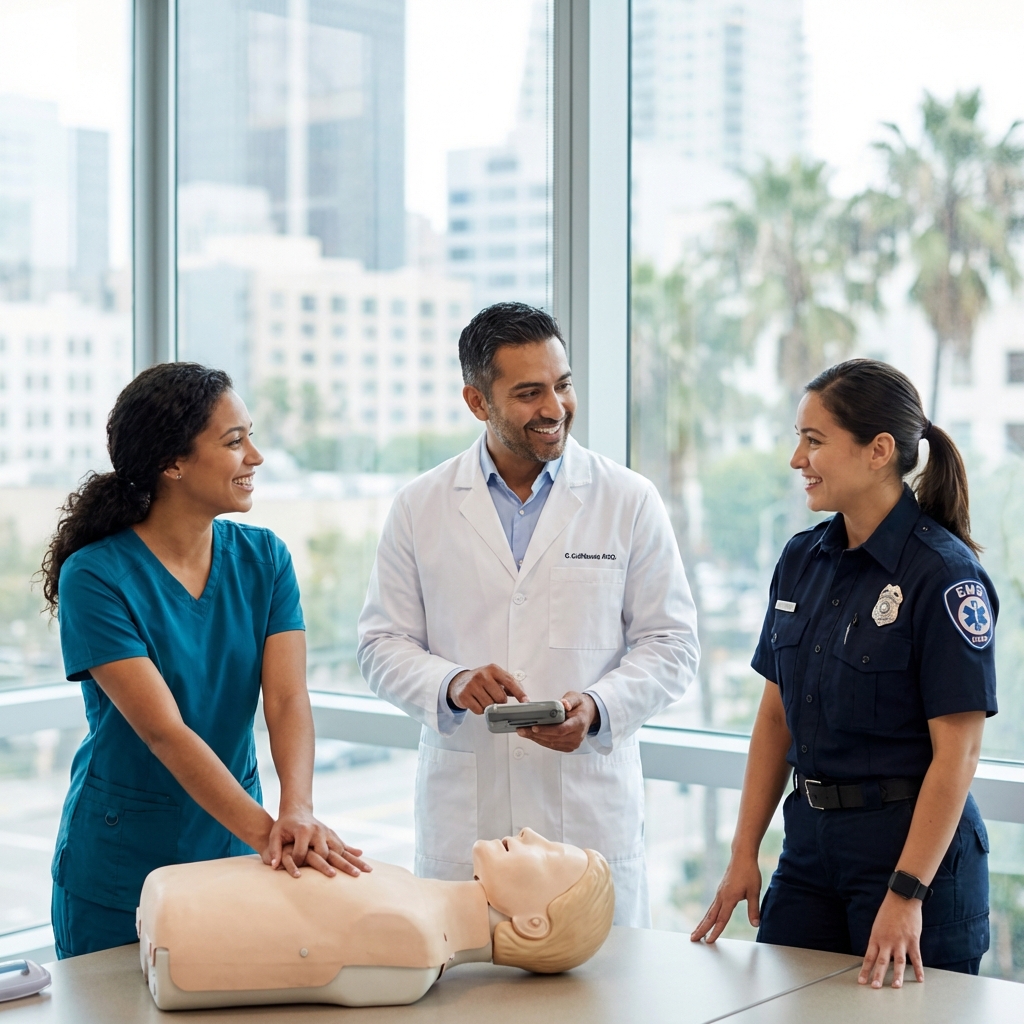
Group sessions offer multiple advantages beyond scheduling convenience. They create peer learning during practice scenarios, which builds camaraderie among new hires. Staff see colleagues performing resuscitation techniques and cardiac protocols alongside them, which reinforces learning and creates informal mentorship moments.
Group training also simplifies your HR documentation. Instead of processing five separate certification records, you handle one group completion record, which speeds credential verification and official start date processing.
For hospitals with regular hiring cycles, we can establish standing agreements for group sessions. Essentially, you reserve a regular time slot at a nearby location, and we schedule new hires as they’re onboarded. This consistency removes the back-and-forth coordination email chains.
Flexible Scheduling That Works with Your Hospital’s Calendar
Hospital hiring doesn’t follow a predictable pattern. You might bring on several new nurses in Q1, then a different department hires unexpectedly in Q3. Your certification provider should adapt to your actual hiring patterns, not the other way around.
Our scheduling flexibility reflects this reality. We accommodate evening and weekend skills sessions for staff who’ve completed online training but can’t test during standard business hours. This is particularly valuable for nurses transitioning from night shifts or staff coordinating training around clinical duties.
We also recognize that seasonal factors affect hospital hiring. Many systems onboard larger cohorts ahead of summer volume or following budget cycles. Our capacity planning accounts for these patterns, and we proactively work with hospital partners to ensure availability during their busy onboarding periods.
Additionally, we can sometimes arrange on-site testing at your hospital if you’re onboarding a substantial cohort. This eliminates travel time entirely and allows your onboarding team to coordinate testing within your facility’s schedule.
Getting Started with Your First Hospital Group Training Program
Starting a group training partnership with us is straightforward. First, contact our hospital partnerships team with basic details: approximate number of new hires annually, which certifications they typically require, and your preferred training locations.
We’ll provide a customized pricing proposal reflecting your anticipated volume and preferred sessions. Most hospitals see 15-25% savings versus individual registrations when committing to group training arrangements.
Once you’ve approved pricing, we’ll coordinate a dedicated account representative who becomes your primary contact. This person learns your onboarding process, understands your scheduling patterns, and proactively suggests training dates aligned with new hire batches.
For your first group session, we recommend scheduling 4-6 new hires to test the process. This gives your team experience with our workflow and allows us to optimize scheduling for subsequent cohorts.
Ready to streamline your hospital’s certification timeline? Reach out today, and we’ll walk you through how our blended learning model, extensive California network, and group training solutions can accelerate your onboarding while keeping costs predictable and compliance guaranteed.
Register for a class today.