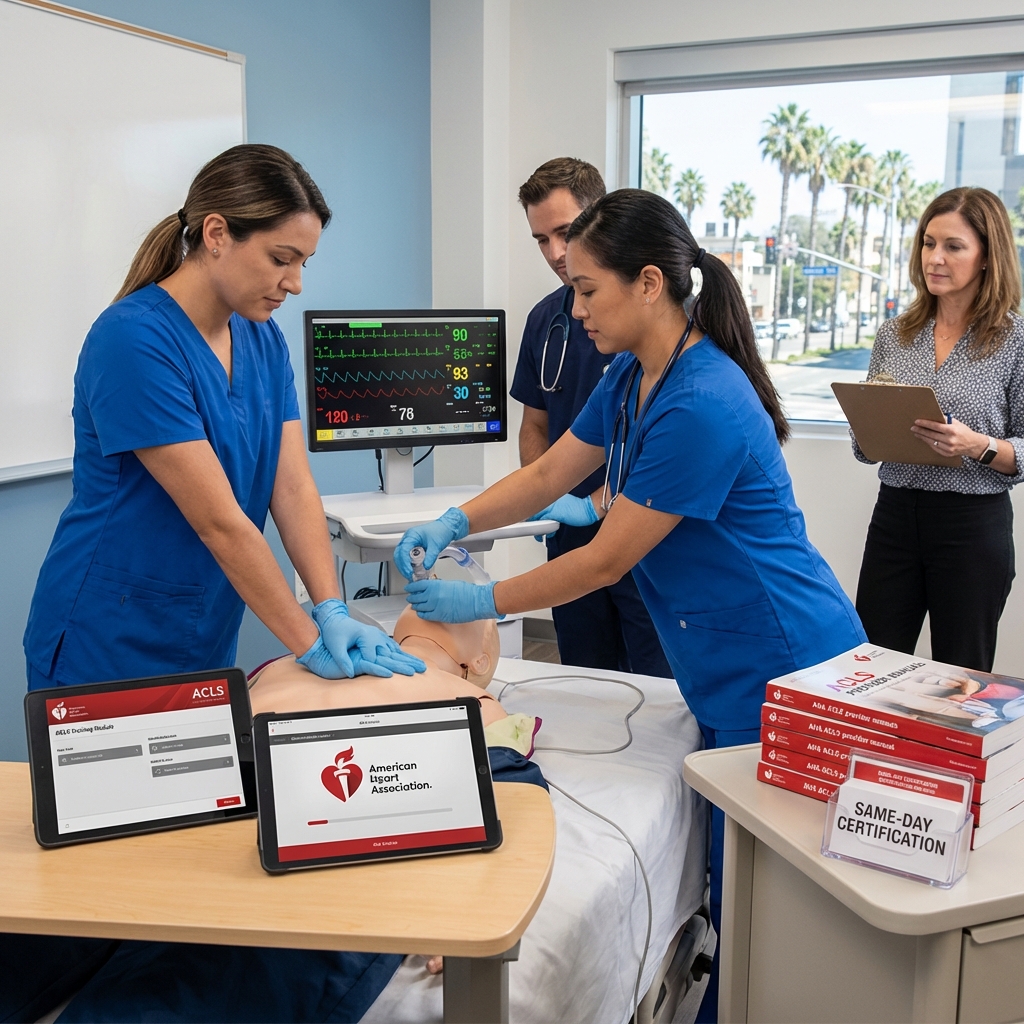
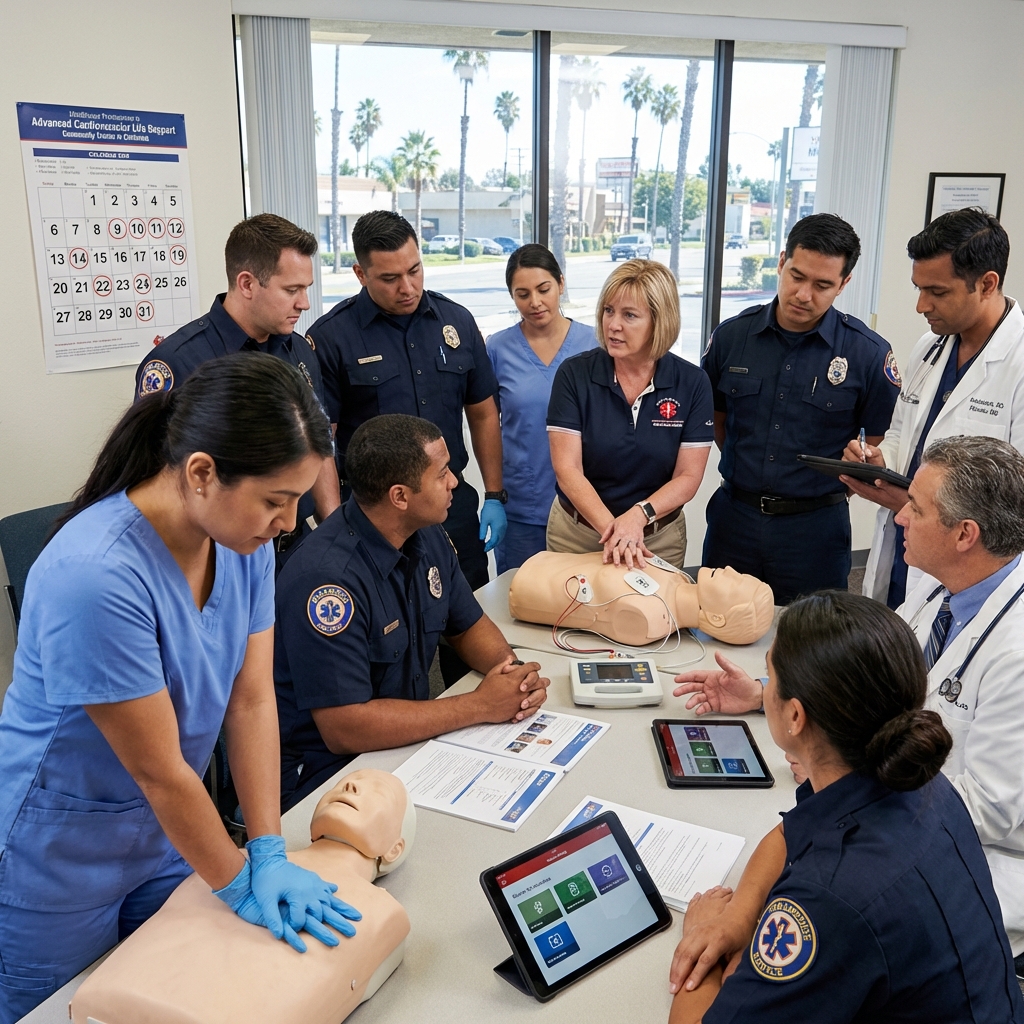
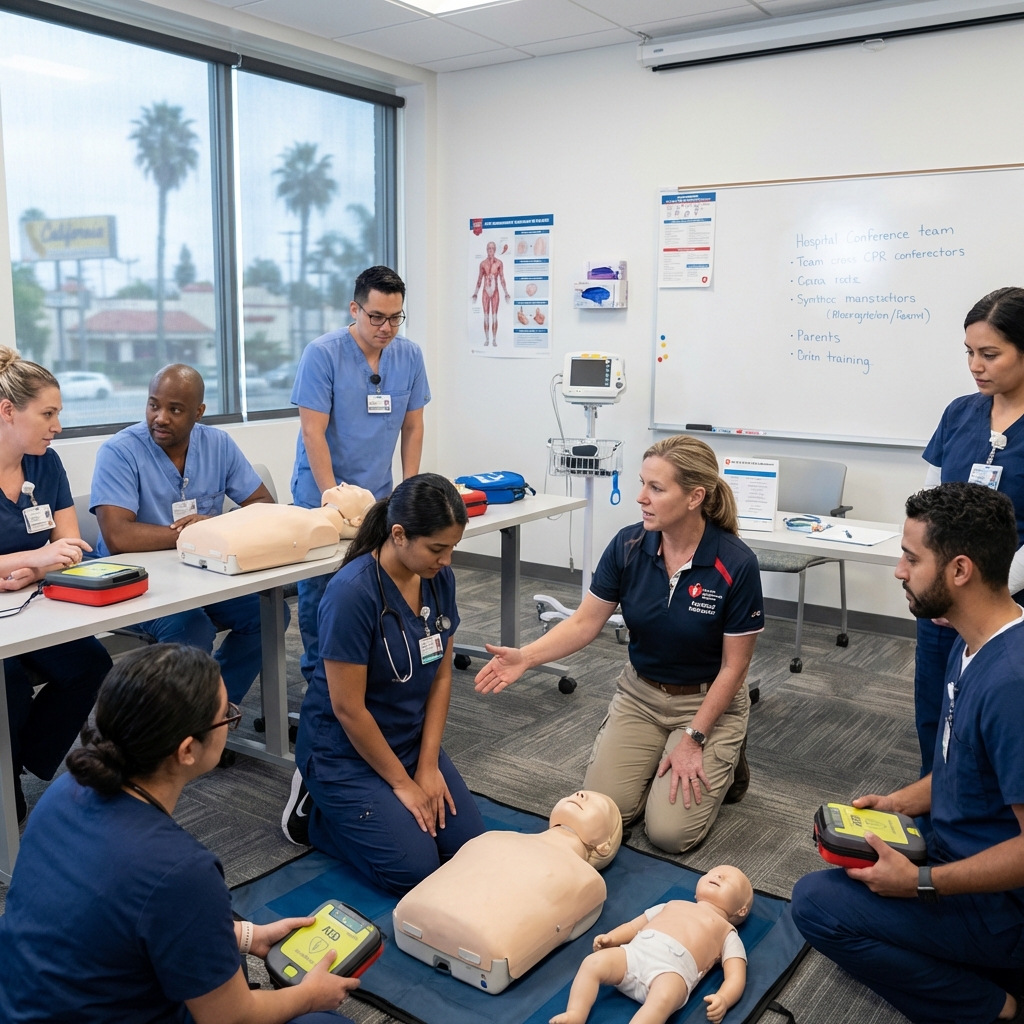
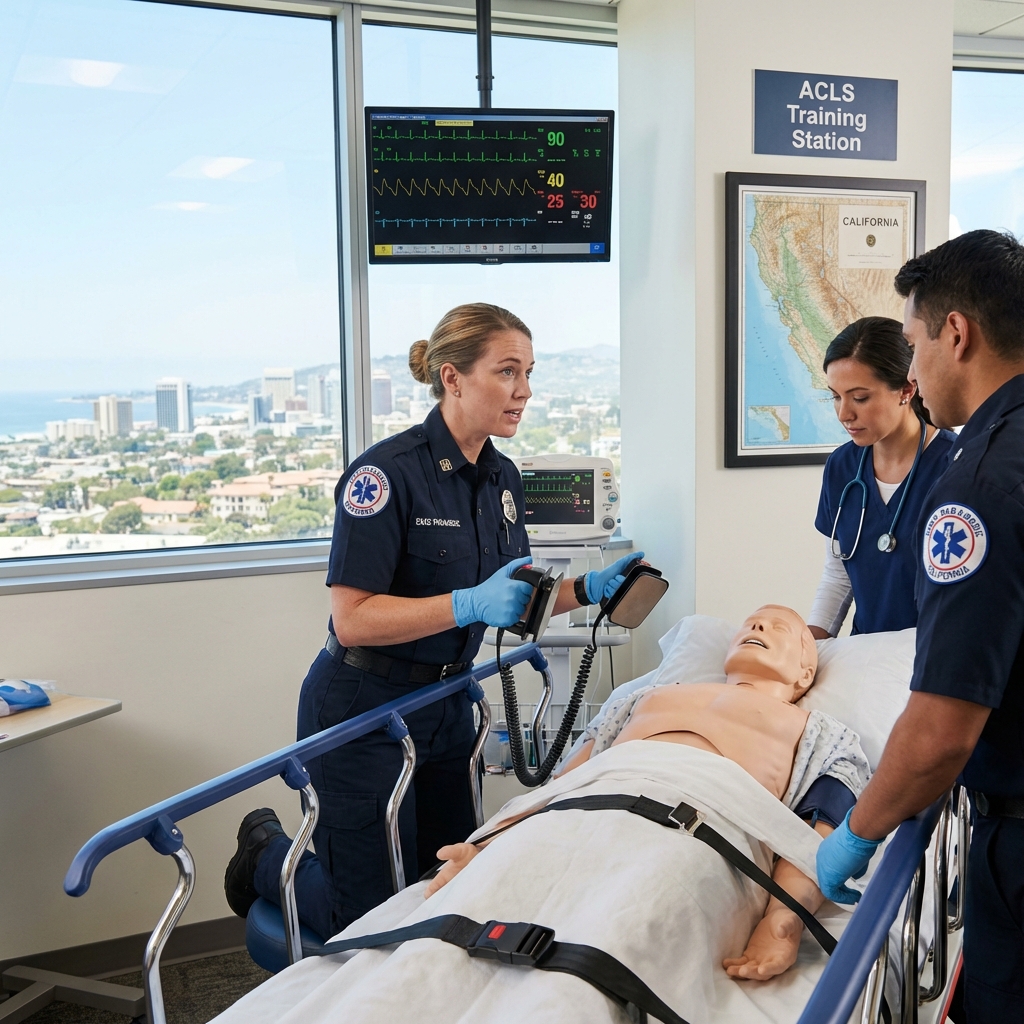
Introduction: The Importance of the Practical Skills Session for ACLS and PALS
For California clinicians, the hands‑on skills check is where your study turns into performance. The AHA certification practical exam is designed to confirm you can recognize life‑threatening rhythms, deliver high‑quality CPR, manage the airway, defibrillate safely, and lead or support a resuscitation team under time pressure. Passing matters for patient outcomes and for compliance with hospital policy and licensing requirements.
Examiners aren’t looking for perfection—they’re looking for a safe, organized approach and adherence to algorithms. Across ACLS and PALS, they typically expect you to demonstrate:
- Immediate scene safety and activation of help, then BLS first: compressions at 100–120/min, full recoil, minimal pauses (<10 seconds), early defibrillation when indicated, and compressor rotation every 2 minutes.
- Accurate rhythm recognition and energy selection for defibrillation or cardioversion, with clear “I’m clear, you’re clear, we’re all clear” safety checks.
- Airway and ventilation choices appropriate to the scenario (BVM seal, rate control, confirmation of advanced airway placement, capnography use).
- Correct medication selection, timing, and dosing, with verbal read‑backs (e.g., early epinephrine in PEA/asystole).
- Closed‑loop communication, role assignment, and brief post‑event debrief elements.
- For PALS skills check expectations: weight‑based dosing, use of length‑based tapes, pediatric‑specific ventilation rates, and recognition that respiratory failure often precedes arrest.
Common ACLS exam pitfalls and megacode scenario mistakes include delaying the first shock for VF/pVT while troubleshooting equipment, over‑ventilating the patient (causing hypotension), and letting compressions lapse during airway placement or rhythm checks. Others include incorrect energy selection, forgetting to switch compressors at the 2‑minute mark, and medication timing errors. In PALS, a frequent error is treating rhythms before correcting oxygenation and ventilation in a child with impending arrest.
Practical, advanced life support testing tips: rehearse a consistent opening script (“Check responsiveness, call for help, start compressions…”) to anchor your sequence under stress. Build a one‑page card with must‑know numbers (compression rate, defib energy ranges, epinephrine intervals) and practice closed‑loop phrases out loud. Strong ACLS PALS skills session tips also include running timed mock codes, using metronomes for CPR cadence, and practicing with local defibrillators so pad placement and energy selection are automatic.
Safety Training Seminars offers blended learning that mirrors real testing conditions: complete your online modules, then refine performance during in‑person megacode practice at 100+ California locations with AHA‑certified instructors. You’ll get precise feedback on algorithm flow, communication, and equipment use—key areas that determine pass/fail—backed by a low price guarantee and flexible scheduling for individuals and corporate teams. If you’re a dentist or other provider confirming compliance, review these ACLS and PALS certification requirements before booking.
Understanding the Examiner’s Perspective: Key Assessment Criteria for Healthcare Providers
Examiners approach the AHA certification practical exam with standardized checklists that emphasize safe, organized care. They are not looking for perfection under pressure—they are looking for consistency: adherence to algorithms, clear communication, and rapid correction when something isn’t working. Use these ACLS PALS skills session tips to align with how assessors score performance during megacode and scenario stations.
What examiners typically evaluate in ACLS/PALS:
- Algorithm adherence and clinical reasoning: Identify the rhythm or condition quickly, state your differential (including Hs and Ts), and choose the next best action supported by guidelines. Verbalize reassessment every 2 minutes and pivot when the patient’s status changes.
- High-quality CPR: Rate 100–120/min, adequate depth with full recoil, minimal pauses, compressor switch every 2 minutes, and immediate resumption after shocks. Use capnography and pulse checks appropriately.
- Defibrillation and cardioversion safety: Choose energy per device guidance (e.g., adult biphasic defibrillation often starts around 200 J; pediatrics use J/kg), ensure “oxygen away,” announce “clear,” and confirm everyone is clear before delivering energy.
- Airway and ventilation: Prioritize effective bag-mask ventilation with a two-person technique when possible, avoid hyperventilation, and titrate oxygen. Confirm advanced airway placement and monitor end-tidal CO2.
- Medication accuracy: Correct drug, dose, route, and timing (e.g., adult epinephrine 1 mg every 3–5 minutes in cardiac arrest; pediatric epinephrine 0.01 mg/kg of 1:10,000). Call out contraindications and check for weight-based calculations in PALS.
- Team leadership and communication: Assign roles, use closed-loop communication, set expectations (“compressor, switch on my count at 2 minutes”), and summarize the plan out loud. Request needed resources early.
- Post-ROSC priorities: Oxygenation/ventilation targets, blood pressure support, glucose/temperature management, and considering coronary reperfusion when indicated.
Common ACLS exam pitfalls and megacode scenario mistakes include delaying the first shock in VF/pVT, failing to resume compressions immediately after defibrillation, over-ventilating, skipping rhythm/pulse checks at the right intervals, and incorrect pediatric weight-based dosing. In PALS, examiners also watch for incomplete pediatric assessments, poor bag-mask technique, and neglecting glucose or IO access when IV is delayed.
Advanced life support testing tips to meet PALS skills check expectations: think out loud, assign a timer, and confirm each order was executed (“Confirm epinephrine 0.01 mg/kg IV pushed now”). Keep algorithms top of mind, but focus on the next correct step rather than reciting the entire card. If you make an error, self-correct quickly—examiners reward safe course correction.
If you want structured practice with feedback that mirrors examiner scoring, Safety Training Seminars offers blended learning and in-person hands-on skills assessment sessions across California. With over 100 locations and low price guarantees, their ACLS and PALS programs help healthcare providers build repeatable habits that translate directly to testing—and real resuscitations.
Common Pitfalls in ACLS MegaCode and PALS Pediatric Scenarios
Many ACLS MegaCode and PALS pediatric scenarios are lost on basics, not obscure algorithms. The most helpful ACLS PALS skills session tips focus on timing, sequence, and communication under pressure. Knowing what examiners look for helps you avoid megacode scenario mistakes before they snowball.
- Delayed or unsafe defibrillation: In adult VF/pVT, resume compressions while the defibrillator charges, clear loudly, and shock promptly. If you don’t know the biphasic energy, start at 200 J and escalate; in pediatrics, use 2 J/kg then 4 J/kg, then ≥4 J/kg up to 10 J/kg.
- Rhythm-cardioversion mismatch: Learners often forget synchronized cardioversion for unstable SVT or atrial fibrillation/flutter. Use sync mode for regular tachyarrhythmias; wide irregular tachycardia requires unsynchronized defibrillation.
- Medication dose and interval errors: Adult epinephrine is 1 mg IV/IO every 3–5 minutes; amiodarone 300 mg then 150 mg for refractory VF/pVT. In PALS, epinephrine is 0.01 mg/kg of 0.1 mg/mL (1:10,000) every 3–5 minutes; amiodarone 5 mg/kg—double-check concentration and weight estimates.
- Hyperventilation and poor ventilation technique: With an advanced airway in ACLS, ventilate 1 breath every 6 seconds; in PALS, 1 breath every 2–3 seconds. Avoid long pauses for intubation; prioritize high-quality BVM with a good seal and minimal interruptions.
- Compression quality and turnover: Maintain 100–120/min at appropriate depth, allow full recoil, and switch compressors every 2 minutes. ETCO2 < 10 mmHg suggests inadequate compressions or a need to troubleshoot.
- Weak team dynamics: Failing to assign roles, use closed-loop communication, or call out time marks leads to ACLS exam pitfalls. Keep a visible timer, verbalize rhythm checks, meds, and Hs & Ts.
Examiners also listen for what you say. In both ACLS and PALS, explicitly verbalize Hs & Ts, post-ROSC steps (airway, oxygen titration, blood pressure support, 12-lead), and reassessment. In PALS skills check expectations, mention glucose checks, weight-based dosing, and reassessment of work of breathing and perfusion.
Use cognitive aids early. Algorithm cards, length-based tapes, and defibrillator quick-reference labels are encouraged in the AHA certification practical exam and help prevent advanced life support testing tips from becoming afterthoughts. Place pads correctly, verbalize safety, and don’t move on until the team acknowledges your commands.

If you want structured practice with real-time feedback, Safety Training Seminars offers blended learning and skills sessions across 100+ California locations tailored to ACLS/PALS testing. Instructors walk you through common ACLS exam pitfalls and pediatric scenario nuances so you meet examiner expectations the first time—backed by a low price guarantee and options for corporate groups.
The Critical Role of Closed-Loop Communication and Team Dynamics
Examiners weigh communication as heavily as algorithm recall. Strong closed-loop communication and deliberate team dynamics are core ACLS PALS skills session tips because they prevent errors and keep the megacode moving. In an AHA certification practical exam, they’re listening for clear orders, read-backs, time stamps, and confirmation that tasks were completed.
Make every directive specific and require a read-back. Example (adult): “Give epinephrine 1 mg IV now.” Responder: “Epinephrine 1 mg IV now—administered at 09:42.” Example (peds): “Patient is 18 kg; shock at 4 J/kg—charge to 72 J.” Responder: “Charging to 72 J—clear—shock delivered.” After any shock, say, “Resume compressions—two-minute timer started,” and confirm rhythm and pulse checks are coordinated. Verbalize critical monitor data: “ETCO2 is 22; compressions are effective.”
Effective team dynamics start with role clarity. The leader assigns airway, compressor, defibrillator, medications, and a timekeeper/recorder, then maintains a shared mental model: “Suspected hypoxia—prioritizing airway; preparing for reversible causes—H’s and T’s.” Encourage assertive followership: team members speak up on dosing or rhythm interpretation, and the leader invites it: “If you see something, call it out.”
Avoid these common ACLS exam pitfalls and megacode scenario mistakes:
- Failing to use read-backs, leading to wrong drug/dose or route.
- Missing the two-minute compressor switch and rhythm/pulse checks.
- Delays resuming compressions post-shock; CPR should restart immediately.
- Not calling out medication times, causing epi intervals to be off.
- Neglecting waveform capnography to confirm ETT placement and CPR quality (ETCO2 <10 suggests inadequate compressions).
- For PALS, skipping weight-based dosing or Broselow tape, or using adult pads/doses on children.
- Overlooking early pad placement and IV/IO access; waiting until arrest to act.
- Ignoring reversible causes; no one assigned to search the H’s and T’s.
- Leader fails to summarize or update the plan, causing task duplication.
- Not verbalizing post-ROSC care: airway, oxygenation, blood pressure, glucose, and 12‑lead.
Build these habits before test day with deliberate practice and structured debriefs. Safety Training Seminars integrates team roles, closed-loop drills, and realistic megacodes in blended ACLS and PALS courses across California, aligning with PALS skills check expectations and AHA standards. Their instructors offer advanced life support testing tips tailored to nurses, dentists, and EMS personnel, so you avoid costly retakes and perform confidently under pressure.
Technical Proficiency: Mastering Rhythm Recognition and High-Quality Compressions
Examiners expect fast, accurate rhythm recognition paired with impeccable compressions. Your best ACLS PALS skills session tips start with identifying shockable versus non-shockable rhythms in seconds and transitioning immediately to the correct action. Avoid staring at the monitor; make your interpretation, give a clear verbal diagnosis, and direct the team.
Anchor your pattern recognition with a few high-yield visual cues:
- Ventricular fibrillation: chaotic, no organized complexes; treat as shockable even if “fine” VF—don’t mistake it for asystole.
- Pulseless VT: wide, regular QRS without pulses; defibrillate and resume compressions immediately.
- Asystole/PEA: flatline or organized rhythm without a pulse; confirm asystole in two leads before calling it and never shock.
- SVT vs sinus tach: SVT is very regular with absent/hidden P waves and minimal rate variability; adult sinus tach often varies with stimulus.
- Atrial flutter: sawtooth waves with fixed conduction; treat per stability.
- AV blocks: Mobitz II and complete heart block imply risk of instability; prepare for pacing.
- Pediatrics: bradycardia with poor perfusion is often hypoxia-driven—prioritize oxygenation and ventilation before drugs or pacing.
High-quality compressions are the backbone of every AHA certification practical exam. Hit a rate of 100–120/min, depth of at least 2 inches (5–6 cm) in adults, and allow full chest recoil. For children, compress at least one-third the chest’s anterior-posterior diameter (about 2 inches/5 cm in children, 1.5 inches/4 cm in infants). Keep pauses under 10 seconds, switch compressors every 2 minutes, and resume compressions the moment a shock is delivered.
Manage ventilation deliberately. Without an advanced airway, use 30:2 for single-rescuer adults and 15:2 for two-rescuer infants/children; once an advanced airway is placed, give 1 breath every 6 seconds without pausing compressions. Avoid hyperventilation—a common ACLS exam pitfall—because it raises intrathoracic pressure and lowers coronary perfusion. Use waveform capnography when available; an ETCO2 consistently below 10 mmHg suggests you should improve compression quality.
Common megacode scenario mistakes include diagnosing rhythms off artifact, forgetting to confirm asystole in two leads, overreliance on “organized” monitors without a pulse check, and delaying defibrillation to discuss medications. For PALS skills check expectations, verbalize weight-based thinking even if dosing isn’t tested and state your plan to treat hypoxia early in bradycardia. These advanced life support testing tips show examiners you can lead decisively and safely.
Need structured practice before test day? Safety Training Seminars offers AHA-aligned ACLS and PALS blended learning with skills sessions across 100+ California locations, plus mock megacodes that target rhythm recognition and compression quality. Flexible schedules, corporate options, and a low price guarantee make polishing these skills convenient for busy clinicians.

Pharmacological Readiness: Critical Medications and Dosages to Remember
Pharmacology is where many otherwise solid candidates stumble, so build automaticity with first-line agents and weight-based calculations before you step into the AHA certification practical exam. The best ACLS PALS skills session tips focus on a short list of high-yield drugs, when to give them, and how to say the dose out loud as you push. Examiners expect rapid, confident selection, correct concentrations, and clear verbalization of indications.
Core arrest and tachy-brady medications to know cold:
- Epinephrine: Adults (cardiac arrest) 1 mg IV/IO every 3–5 minutes; Pediatrics 0.01 mg/kg IV/IO of 1:10,000 (0.1 mL/kg) every 3–5 minutes.
- Amiodarone or Lidocaine for refractory VF/pVT: Adults amiodarone 300 mg IV/IO bolus, then 150 mg; Pediatrics amiodarone 5 mg/kg IV/IO bolus, may repeat to a total of 15 mg/kg. Lidocaine alternative: Adults 1–1.5 mg/kg then 0.5–0.75 mg/kg (max 3 mg/kg); Pediatrics 1 mg/kg (max 3 mg/kg total).
- Atropine for symptomatic bradycardia: Adults 1 mg IV every 3–5 minutes (max 3 mg); Pediatrics 0.02 mg/kg IV/IO (min 0.1 mg; max single 0.5 mg child, 1 mg adolescent), may repeat once.
- Adenosine for regular, narrow-complex SVT with a pulse: Adults 6 mg rapid IV push with immediate flush, then 12 mg if needed; Pediatrics 0.1 mg/kg (max 6 mg), then 0.2 mg/kg (max 12 mg). Use a proximal IV and a two-syringe method.
- Magnesium sulfate for torsades de pointes: Adults 1–2 g IV/IO; Pediatrics 25–50 mg/kg IV/IO (max 2 g).
Don’t overlook adjuncts and post-ROSC care. Treat hypoglycemia: adults 25 g IV (e.g., D10W 250 mL or D50W 50 mL); PALS favors D10W 5–10 mL/kg. For opioid-associated emergencies with respiratory depression, titrate naloxone (adults 0.04–0.4 mg IV or 2 mg IN; pediatrics 0.1 mg/kg up to 2 mg). Post-arrest hypotension often requires an infusion—adults commonly start norepinephrine or epinephrine; pediatrics may start epinephrine at 0.05–0.1 mcg/kg/min. Reserve sodium bicarbonate and calcium for specific indications (e.g., hyperkalemia, TCA overdose), not routine arrest care.
Common ACLS exam pitfalls and megacode scenario mistakes:
- Confusing epi concentrations (1:10,000 IV/IO in arrest; avoid 1:1,000 IV).
- Failing to give adenosine as a rapid push with an immediate flush or using it for irregular/wide rhythms.
- Skipping maximum dose limits or minimum pediatric atropine dose (risk of paradoxical bradycardia).
- Giving an antiarrhythmic before confirming a shockable rhythm or forgetting to resume compressions immediately after shocks.
- Not verbalizing indications, doses, and reassessment, which affects PALS skills check expectations.
Advanced life support testing tips: prepare a quick-reference card with pediatric weight-based doses, practice mg-to-mL conversions, and rehearse saying dose, route, and concentration. Safety Training Seminars’ blended AHA courses provide targeted megacode practice and drug-dosing drills across 100+ California locations, helping you avoid ACLS exam pitfalls and pass your skills check with confidence—all backed by a low price guarantee.
Conclusion: Best Practices for Passing Your California Skills Assessment
Success on the AHA certification practical exam comes down to disciplined basics, clear communication, and smart preparation. Use these ACLS PALS skills session tips to demonstrate mastery under pressure and meet examiner expectations across California sites.
Do the following every time:
- Lead with BLS: start compressions within 10 seconds, rate 100–120/min, depth appropriate to patient, minimize pauses to under 10 seconds, and rotate compressors every 2 minutes.
- Run the algorithm out loud: identify rhythm, defibrillate promptly when shockable, resume compressions immediately after shocks, give epinephrine 1 mg IV/IO every 3–5 minutes in adult arrest, and consider amiodarone 300 mg then 150 mg for refractory VF/pVT.
- Manage airway pragmatically: prioritize bag-mask ventilation; once an advanced airway is placed, ventilate 1 breath every 6 seconds and avoid hyperventilation.
- Use closed-loop communication: assign roles, confirm orders, time-stamp interventions, and call out rhythm checks every 2 minutes.
- Think Hs & Ts: hypoxia, hypovolemia, hypo-/hyperkalemia, hydrogen ion (acidosis), hypothermia; tension pneumothorax, tamponade, toxins, thrombosis (coronary/pulmonary).
Avoid these ACLS exam pitfalls and common megacode scenario mistakes:
- Delaying defibrillation or failing to escalate biphasic energy (e.g., 200 J, then 300–360 J).
- Forgetting to resume compressions immediately after a shock or during IV attempts.
- Giving medications without confirming rhythm or indications (e.g., adenosine 6 mg then 12 mg only for stable narrow-complex SVT).
- Intubating too early or ventilating too fast.
- Not escalating access to IO after two failed IV attempts or 90 seconds.
For PALS, align your actions with PALS skills check expectations and weight-based dosing. Use length-based tape, give epinephrine 0.01 mg/kg (1:10,000) every 3–5 minutes in cardiac arrest, and defibrillate at 2 J/kg then at least 4 J/kg (do not exceed 10 J/kg or adult dose). Distinguish respiratory distress vs. failure and types of shock (hypovolemic, distributive, cardiogenic) and treat accordingly before intubation. Keep pediatric ventilation gentle and slow; avoid over-oxygenation in post-ROSC care.
On exam day, bring your government ID and the HeartCode completion certificate, arrive early, and verbalize your plan so the examiner hears your advanced life support testing tips in action. Ask for resources you would use in real care (e.g., Broselow tape, waveform capnography), and confirm orders clearly. In California, choose a nearby session to avoid traffic delays and review parking or building access instructions in advance.
If you want structured practice and consistent grading against AHA checklists, Safety Training Seminars offers blended ACLS and PALS with online HeartCode plus in-person skills at over 100 California locations. Instructors coach you on algorithm timing, drug dosing, and team dynamics, helping you sidestep errors before testing. With a low price guarantee and options for corporate groups, it’s a reliable way to prepare and pass on your first attempt.
Register for a class today.