

Safety Training Seminars

The Bradycardia ACLS Algorithm based on AHA 2025 Guidelines provides a clear, step-by-step approach to identify symptomatic bradycardia, assess patient stability, and deliver timely interventions. Learn updated medication dosing, pacing indications, and clinical decision pathways essential for effective advanced cardiac life support.
The Bradycardia ACLS Algorithm provides a systematic approach for healthcare providers to manage patients with symptomatic bradycardia, which is a heart rate slower than 50 beats per minute. A slow heart rate can lead to serious complications if it causes instability, such as hypotension, altered mental status, or signs of shock.
The algorithm guides clinicians through a sequence of assessments and interventions. The primary goal is to quickly identify and treat the underlying cause while stabilizing the patient’s condition. Key steps in the current (2020) algorithm include:
Following this structured algorithm ensures that patients receive timely and appropriate care, improving their chances of a positive outcome.
The AHA updates its resuscitation guidelines approximately every five years to incorporate the latest evidence-based research. Here is what we know about the upcoming 2025 changes:
The release of new AHA guidelines is a critical time for all healthcare professionals to renew their certifications and refresh their knowledge. While the 2020 guidelines are still in effect, it’s never too early to plan for the upcoming transition. Staying certified ensures you are always prepared to deliver the highest standard of care.
At Safety Training Seminars, we are an official American Heart Association Training Center committed to providing accessible and high-quality certification courses. With over 70 locations across California, we make it convenient for you to get certified in BLS, ACLS, and PALS. Our courses offer a 100% pass rate, and you receive your card the same day you complete your training.
We encourage you to check your certification expiration date and book a course with us to stay current. When the 2025 guidelines are released, we will be ready to offer updated training to keep you at the forefront of emergency cardiovascular care. Contact us today to find a class near you and ensure you’re prepared for what’s next.
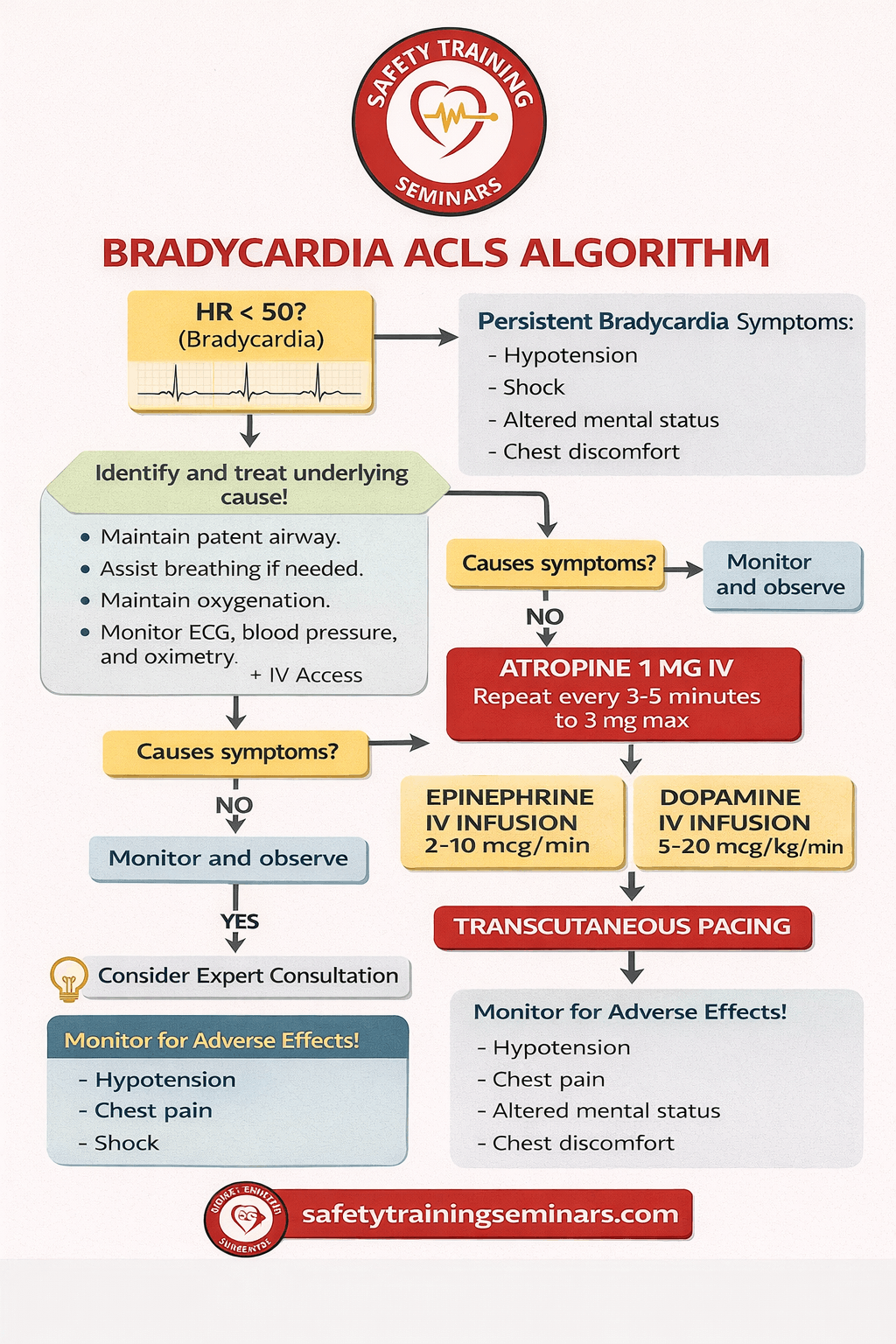
The Bradycardia ACLS Algorithm is a critical decision-making pathway used by healthcare providers to quickly identify and manage symptomatic bradycardia in adult patients. The infographic visually breaks down each step, starting with rapid patient assessment, heart rate evaluation (typically under 50 beats per minute), and identification of symptoms such as hypotension, altered mental status, signs of shock, ischemic chest discomfort, or acute heart failure. This structured approach ensures providers act swiftly while minimizing errors during high-stress cardiac emergencies.
The infographic clearly illustrates the initial management steps, emphasizing airway support, oxygen administration, cardiac monitoring, IV access, and 12-lead ECG acquisition. It highlights Atropine as the first-line medication, including the correct dosage and repeat intervals. When Atropine is ineffective, the algorithm smoothly transitions to second-line interventions such as transcutaneous pacing, dopamine infusion, or epinephrine infusion. These visual cues help learners understand not just what to do, but when to escalate care based on patient response.
Finally, the Bradycardia ACLS Algorithm infographic reinforces the importance of continuous reassessment and expert consultation. It reminds providers to identify and treat underlying causes, such as hypoxia, electrolyte imbalances, drug toxicity, or myocardial infarction. For students and professionals training with Safety Training Seminars, this visual explanation enhances retention, improves real-world application, and supports ACLS certification success. By translating complex protocols into a clear, step-by-step visual guide, the infographic ensures confident, guideline-compliant management of bradycardia in emergency and clinical settings.
The ACLS bradycardia algorithm guides treatment for adults with a slow heart rate causing symptoms. It focuses on airway support, oxygen, IV access, monitoring, and medications like atropine. If ineffective, pacing or infusions are used. Safety Training Seminars ensures providers understand each step thoroughly.
Atropine is given for symptomatic bradycardia, typically 1 mg IV every 3–5 minutes up to 3 mg. It helps increase heart rate. If atropine fails, pacing or dopamine/epinephrine infusions are considered. ACLS courses at Safety Training Seminars cover correct dosing and timing.
Hypotension, confusion, chest pain, shortness of breath, or signs of shock indicate clinically significant bradycardia. These symptoms require immediate action. Early recognition prevents cardiac arrest. Safety Training Seminars trains providers to identify and manage these warning signs rapidly.
Pacing is used when atropine is ineffective or likely to fail, especially in high-grade AV blocks. It stabilizes heart rate until advanced care is available. ACLS training teaches correct pad placement and pacing settings for safe treatment.
Nurses, physicians, paramedics, and emergency responders should master it. Bradycardia can quickly worsen without proper care. Safety Training Seminars provides hands-on ACLS certification that builds real-world competence.