
Introduction to the 2025 AHA Guideline Updates for Healthcare Providers
The American Heart Association issues major guideline updates on a five‑year cycle, with focused updates in between. As the 2025 AHA algorithm changes are finalized, clinicians in California can expect refinements that translate directly to bedside decisions in ACLS, BLS, and PALS. These updates inform the ACLS provider manual updates, PALS resuscitation guidelines, and course assessments, so aligning early helps maintain licensure, hospital credentialing, and high‑quality patient care.
While the specifics will be published by the AHA at release, historical patterns point to clarifications rather than wholesale overhauls. Expect emphasis on measurable CPR quality, timing of interventions in shockable versus non‑shockable rhythms, airway strategies based on patient condition, and post–cardiac arrest care bundles. For pediatrics, look for streamlined recognition of respiratory failure and shock, weight‑based dosing reminders, and team communication checkpoints that reduce delays.
Key areas to watch for advanced cardiovascular life support updates and pediatric advanced life support changes include:
- High‑quality CPR targets and feedback use (rate, depth, recoil, minimal pauses)
- Defibrillation strategy and safety steps for biphasic devices in refractory VF/pulseless VT
- Vasopressor and antiarrhythmic timing relative to rhythm checks
- Airway management sequencing, including supraglottic devices, waveform capnography, and ventilation rates
- Post‑ROSC care: oxygenation/ventilation targets, temperature management, hemodynamics, and neuroprognostication windows
- Special circumstances: opioid‑associated emergencies, pregnancy, hypothermia, electrolyte‑driven arrhythmias, and toxicologic arrests
- Pediatric shock pathways, respiratory support escalation, and bradycardia/tachycardia algorithms
- Training logistics and BLS certification requirements 2025 as they relate to provider and renewal pathways
These refinements affect common scenarios. For example, a bradycardic adult with hypotension may trigger earlier pacing versus repeated pharmacologic attempts depending on algorithm cues, and a pediatric patient in respiratory failure may prompt quicker transition from bag‑mask to supraglottic airway when ventilation targets are not met. In post‑arrest adults, updated bundles could tighten targets for oxygenation and early coronary evaluation to prevent secondary injury.
To prepare, hospitals and clinics should pre‑plan for quick policy updates, revise crash cart reference cards, and align order sets once the AHA publishes final text. Safety Training Seminars will incorporate the 2025 AHA algorithm changes across ACLS, BLS, and PALS courses through blended learning and skills sessions, with over 100 California locations and options for corporate group training. Their low price guarantee and rapid adoption of new curricula help nurses, dentists, EMS, and other providers stay compliant without disrupting schedules.
Key Changes in BLS Protocols: Improving Chest Compression Quality
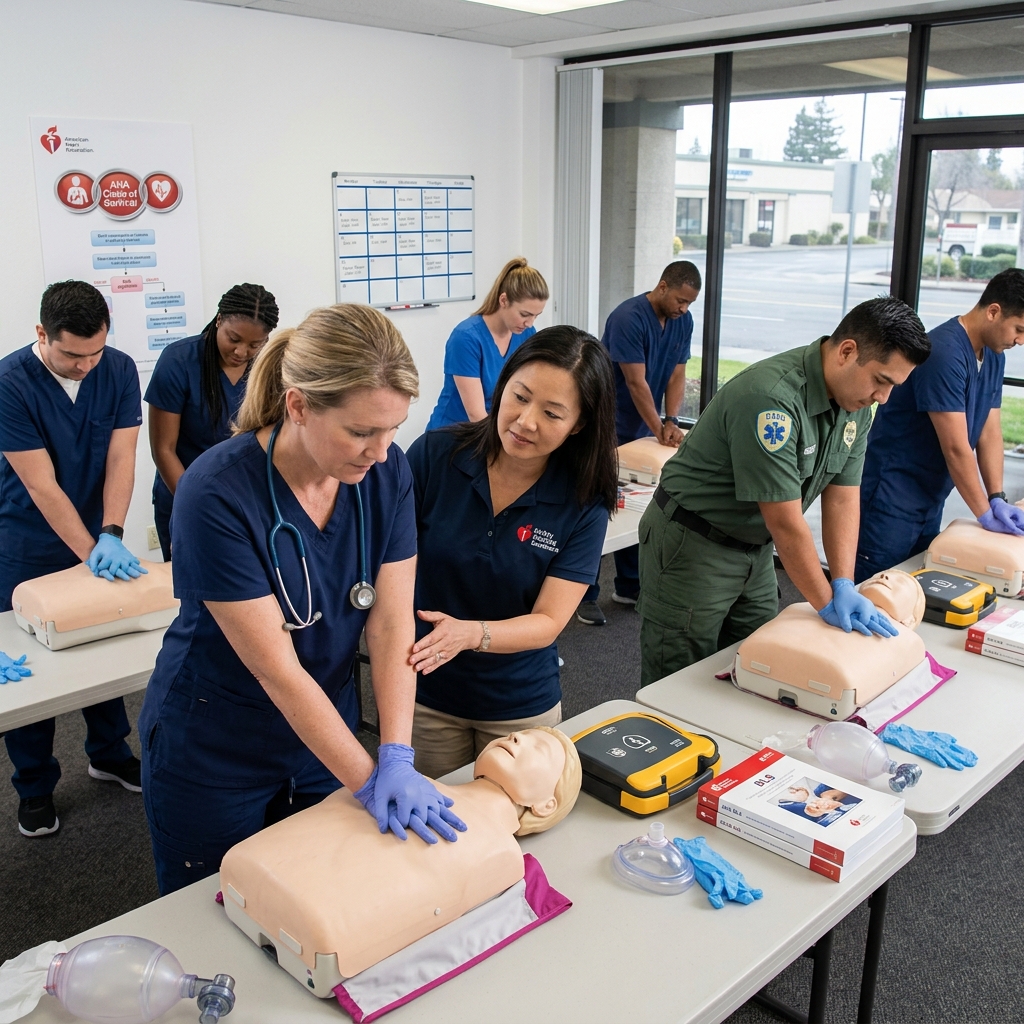
For Basic Life Support, the 2025 AHA algorithm changes are widely expected to sharpen the focus on measurable chest compression quality, because high-fidelity compressions still drive survival across settings. BLS fundamentals anchor every resuscitation, so even as advanced cardiovascular life support updates evolve, the biggest gains often come from doing the basics better and more consistently. Teams should standardize metrics, use real-time feedback, and design workflows that keep hands on the chest.
Core targets remain clear: compress at 100–120/min with adequate depth, allow full recoil, and minimize interruptions. Adults require a depth of 5–6 cm (about 2–2.4 inches); children and infants need at least one-third the anterior–posterior chest diameter. Aim for a compression fraction of at least 80% with pauses under 10 seconds for rhythm checks, defibrillation, and airway adjustments.
Practical ways to improve compression quality include:
- Use a metronome set to 110 bpm to stabilize rate.
- Rotate compressors every 2 minutes or earlier if performance declines.
- Place an AED early; resume compressions immediately after shock delivery.
- Coordinate airway care to avoid over-ventilation and long pauses.
- Without an advanced airway, use 30:2 for adults and 15:2 for two-rescuer child/infant CPR; with an advanced airway, deliver 1 breath every 6 seconds without interrupting compressions.
Objective monitoring supports better decisions at the bedside. Real-time feedback devices on manikins and clinical pads help maintain depth and recoil; waveform capnography guides quality during ongoing CPR. If PETCO2 trends below 10 mmHg, consider switching compressors, increasing depth, or addressing ventilation; when invasive monitoring is present, targeting higher arterial diastolic pressures can also indicate improved perfusion.
Expect alignment between ACLS provider manual updates and BLS practice, with the PALS resuscitation guidelines and pediatric advanced life support changes reinforcing pediatric-specific nuances. For infants, the two-thumb encircling technique typically achieves more consistent depth and recoil than two-finger compressions. Across age groups, limiting peri-shock pauses and coordinating airway management with compressions will remain central themes.
To meet BLS certification requirements 2025 while translating guidance into reliable performance, California clinicians can train with Safety Training Seminars. Their blended learning model pairs online modules with in-person skills that use feedback-enabled manikins across 100+ locations statewide, with options for corporate group sessions and a low price guarantee. Courses are updated promptly as new AHA certifications and guidance become available, helping nurses, dentists, and EMS teams stay compliant and confident.
Updated ACLS Algorithms: New Pharmacological and Airway Management Standards
The 2025 AHA algorithm changes sharpen the sequence and timing of key interventions, especially around medication use and airway strategy during resuscitation. In the ACLS provider manual updates, expect clear guidance on early vasopressor administration, antiarrhythmic selection for refractory VF/pVT, and physiologic targets to guide high-quality CPR. BLS certification requirements 2025 continue to emphasize compression-first care, rapid AED use, and minimal pauses, aligning basic and advanced workflows.
For adult ACLS pharmacology, core practices remain but with tighter cues on when and why to give specific drugs. Practical priorities include timing epinephrine in nonshockable rhythms, choosing an antiarrhythmic in persistent VF/pVT, and reserving adjuncts for defined indications. Example: in a shockable arrest unresponsive to two shocks and high-quality CPR, deliver epinephrine and consider amiodarone while troubleshooting Hs & Ts.

- Epinephrine: 1 mg IV/IO every 3–5 minutes; give early in asystole/PEA and after defibrillation attempts in VF/pVT.
- Antiarrhythmics for refractory VF/pVT: amiodarone 300 mg IV/IO bolus, then 150 mg; lidocaine is a reasonable alternative if amiodarone is unavailable or contraindicated.
- Magnesium sulfate: for polymorphic VT/torsades de pointes or suspected hypomagnesemia.
- Targeted adjuncts: calcium for hyperkalemia or calcium-channel blocker overdose; sodium bicarbonate for TCA overdose or severe hyperkalemia; avoid routine use without a clear indication.
Airway management standards reinforce a stepwise, interruption-minimizing approach. Prioritize effective bag-mask ventilation with two-person technique, add an oropharyngeal airway when appropriate, and use a supraglottic airway if endotracheal intubation delays compressions. Confirm advanced airway placement with continuous waveform capnography; aim for ETCO2 ≥10 mmHg during CPR and ventilate at 10 breaths/min once an advanced airway is in place. After ROSC, titrate oxygen to maintain SpO2 92–98% and avoid hyperventilation.
PALS resuscitation guidelines and pediatric advanced life support changes continue to highlight ventilation-first strategies in bradycardia due to hypoxia, weight-based dosing, and careful fluid administration. Examples include initial shock energy at 2 J/kg (then 4 J/kg) for pediatric VF/pVT and epinephrine 0.01 mg/kg of 1:10,000 for nonshockable rhythms. Reassess after 10–20 mL/kg crystalloid in shock and escalate to vasoactive infusions when fluid-refractory.
To apply these advanced cardiovascular life support updates quickly and confidently, California clinicians can complete updated ACLS and PALS training with Safety Training Seminars. Their blended learning format, 100+ locations, and low price guarantee make it straightforward to practice the new algorithms in realistic scenarios, with options for corporate group training across the state.
Pediatric Resuscitation: Critical Adjustments to the PALS Guidelines
Pediatric cardiac arrest remains rare but high risk, and the 2025 AHA algorithm changes sharpen the focus on early recognition, high‑quality CPR, and physiologic targets that prevent secondary injury. The pediatric advanced life support changes largely reinforce proven practices while clarifying decision points for defibrillation, vasoactive selection, and post–return of spontaneous circulation care. Expect close alignment between the PALS resuscitation guidelines and advanced cardiovascular life support updates to streamline team workflows across mixed-age settings. Clinicians should review the official PALS and ACLS provider manual updates as they are released to confirm dosing and sequence details.
High‑quality pediatric BLS remains foundational. Compress at a rate of 100–120/min to a depth of at least one‑third the chest’s anterior–posterior diameter (about 4 cm in infants, 5 cm in children), with full recoil and minimal pauses; use 15:2 for two rescuers and 30:2 for a single rescuer. With an advanced airway, provide continuous compressions with 10 breaths/min and avoid hyperventilation; titrate oxygen to maintain SpO2 94–99% rather than routinely using 100%. These points are central to BLS certification requirements 2025 and carry directly into PALS team performance.
For non‑shockable rhythms, give epinephrine as soon as possible, ideally within the first 3–5 minutes of pulselessness, while ensuring effective ventilation and compressions. For shockable rhythms, defibrillate at 2 J/kg for the first shock and 4 J/kg for the second; subsequent shocks are ≥4 J/kg, not to exceed 10 J/kg or the adult dose. If an AED is the only option, use a pediatric attenuator when available; if not, use a standard AED rather than delaying defibrillation. For example, a 20‑kg child would receive 40 J, then 80 J, with later shocks at ≥80 J as needed.
In pediatric bradycardia with poor perfusion, start CPR if the heart rate remains under 60/min despite oxygenation and effective ventilation. Treat reversible causes, administer epinephrine, and consider atropine when a vagal mechanism or AV block is suspected. Prepare for transcutaneous pacing if pharmacologic therapy fails.
Shock and post‑arrest care emphasize careful fluids and early vasoactives. Give 10–20 mL/kg isotonic boluses with frequent reassessment to avoid fluid overload, and start epinephrine (or norepinephrine in vasodilatory shock) early if perfusion does not improve. After ROSC, target normoxia and normocapnia, maintain temperature control (avoid fever), and use capnography to guide ventilation and monitor CPR quality (ETCO2 typically >10–20 mmHg during compressions).
To operationalize these updates:
- Standardize weight‑based dosing tools and defibrillator energy presets by kilogram.
- Stock pediatric attenuators and supraglottic airways; train on rapid IO access.
- Embed sepsis pathways that escalate promptly to vasoactives.
- Conduct brief, structured debriefs and use cognitive aids/checklists during codes.
Safety Training Seminars offers statewide PALS programs that incorporate the latest PALS resuscitation guidelines and 2025 AHA algorithm changes through blended learning and in‑person skills. California clinicians can also bundle BLS and ACLS to stay current with advanced cardiovascular life support updates, with group options and a low price guarantee to support team readiness.
Implementing Algorithm Changes at the Bedside for Nurses and EMS
Translating the 2025 AHA algorithm changes into bedside practice starts with tightening the link between protocols, equipment, and team roles. For nurses and EMS, the priority is to make the “next step” obvious in real time, whether the rhythm is shockable, airway is secured, or perfusion is improving. Align your local standing orders and cognitive aids with the latest ACLS provider manual updates so the flow of actions matches what’s taught and what’s stocked in your cart or ambulance.
Hardwire the advanced cardiovascular life support updates into the environment. Update defibrillator defaults, label drawers to reflect new first-line meds, and preload checklists in the code binder. Ensure pocket cards, monitor presets, and EHR smart phrases mirror the most current PALS resuscitation guidelines and adult algorithms so documentation and debrief are consistent.
Quick wins to operationalize at the bedside and in the field:

- Team brief: call out the algorithm branch (e.g., shockable vs. non-shockable) and verify timing/sequence per the newest ACLS provider manual updates.
- Defibrillation: place pads early, confirm energy settings, and rehearse escalation pathways per protocol without interrupting compressions.
- Airway: prioritize two-person bag-mask ventilation with waveform capnography; plan for the first-pass success strategy and use a supraglottic airway or ETT based on skill and conditions.
- Medications: pre-draw epinephrine and have antiarrhythmics ready with clear tall-man labels; confirm weight-based dosing tools are at hand for pediatrics (Broselow/Handtevy).
- CPR quality: use a metronome (100–120/min), rotate compressors every 2 minutes, ensure full recoil, and track ETCO2 to guide effectiveness.
- Pediatrics: apply pediatric advanced life support changes by standardizing weight-estimation, preparing appropriate-size airway equipment, and rehearsing bradycardia and shock energy steps for children.
- Post-ROSC: initiate temperature management per local guidance, treat hypotension promptly, and begin targeted diagnostics while maintaining oxygenation and ventilation goals.
EMS teams should pre-brief en route, verbalize the algorithm pathway, and assign “pit-crew” roles to reduce hands-off time. Nurses can mirror this approach by scripting the first 2 minutes of any code: who grabs the backboard, who tracks time and meds, and who calls out rhythm checks. Use debriefs to examine time to first shock, first epinephrine, compression fraction, and adherence to the selected algorithm branch.
Stay ahead of BLS certification requirements 2025 by integrating these skills into routine drills, mock codes, and onboarding. Safety Training Seminars offers blended AHA courses and in-person skills sessions across more than 100 California locations, helping teams practice with current advanced cardiovascular life support updates and pediatric advanced life support changes. For units or agencies, their corporate training and low price guarantee make it straightforward to update competencies as new 2025 AHA algorithm changes roll out.
Best Practices for Maintaining Certification and Clinical Proficiency
Staying current with the 2025 AHA algorithm changes starts with a deliberate update cadence. Subscribe to official AHA notices and bookmark the Guidelines On‑The‑Go app so you can compare new flowcharts against your unit’s standing orders. Create a simple “change log” to track what’s different from your last renewal (for example, altered decision points, sequence adjustments, or timing changes) and circulate it at huddles so the entire team aligns quickly.
Make the ACLS provider manual updates and PALS resuscitation guidelines your primary study sources, then map those to local policies. Keep laminated pocket cards or a secure digital folder with the latest adult and pediatric algorithms, post–cardiac arrest care steps, and medication references. If your facility requires BLS certification requirements 2025 verification, confirm course type (initial vs. renewal), skills testing, and any facility-specific competencies that layer on top of AHA standards.
Convert knowledge into muscle memory with short, high-yield drills. Use feedback manikins to reinforce high-quality CPR metrics: rate 100–120/min, adult depth 2–2.4 inches, full recoil, minimal pauses under 10 seconds, and ventilation about 1 breath every 6 seconds with an advanced airway. Rotate through team roles using closed-loop communication, practice defibrillator pad placement and peri-shock pauses under 10 seconds, and run pediatric scenarios with length‑based dosing aids to reflect pediatric advanced life support changes.
- Do a 10-minute “algorithm of the week” review (e.g., adult bradycardia, tachycardia with a pulse, pediatric respiratory failure).
- Stage a monthly mock code with timed 2-minute compression cycles and real-time feedback, then debrief to identify one behavior to keep and one to change.
- Standardize medication prep using vetted cognitive aids; verify dosing against the most current manual before every shift.
- Check airway and defibrillator readiness at the start of shifts; log any gaps and close them before patient care.
- Earn CE tied to advanced cardiovascular life support updates and document competencies in your professional portfolio.
Plan recertifications early so practice never lapses. Most ACLS, BLS, and PALS credentials renew on a two‑year cycle; if modalities or timelines shift with the 2025 updates, adjust your schedule and use blended learning to minimize time off the floor. Safety Training Seminars offers AHA-aligned blended courses with virtual modules and in‑person skills sessions at 100+ California locations, plus group options and a low price guarantee—useful for individual renewals or coordinating department-wide updates.
Finally, tether training to real outcomes. Review code blue data for compression fraction, first‑shock time, and airway timing, then update your checklists to reflect gaps and any new guideline elements. Maintain a readiness binder with updated algorithms, equipment lists, and post‑event debrief templates so your team can translate new guidance into reliable bedside performance.
Conclusion: Enhancing Patient Outcomes Through Current Resuscitation Standards
Keeping pace with the 2025 AHA algorithm changes is ultimately about translating evidence into faster, more reliable care at the bedside. When teams share a common mental model for high-quality compressions, shock timing, airway strategy, and medication sequencing, variability drops and survival improves. For pediatric cases, aligning workflow with current PALS resuscitation guidelines reduces dosing errors and ensures age-appropriate interventions from the first minute of care.
To operationalize new guidance, build changes into systems—not just individual memory. Practical steps include:
- Update unit policies, cognitive aids, and wall posters to reflect advanced cardiovascular life support updates and pediatric advanced life support changes.
- Revise EHR order sets, code smart-phrases, and post–cardiac arrest care pathways to match algorithm flow and medication tables.
- Standardize code carts with color- or length-based pediatric dosing tools and clearly labeled drawers for rapid access.
- Schedule interdisciplinary mock codes that stress-test team roles, closed-loop communication, and early defibrillation.
- Deploy CPR feedback devices when available and track metrics like compression depth, rate, recoil, chest compression fraction, and time to first shock/epinephrine.
Competency must be refreshed alongside policy. As ACLS provider manual updates and PALS resuscitation guidelines are released, host microlearning sessions that highlight what’s changed and why. Use brief, high-frequency simulations followed by structured debriefs to hardwire improvements; for example, review delays uncovered in rhythm checks or airway attempts and adjust role assignments accordingly. Incorporate case-based scenarios that mirror your patient mix—STEMI arrest in the cath lab, septic shock progressing to PEA on the floor, or an infant with respiratory failure in the ED.
Finally, ensure credentialing keeps pace with practice. Map your facility’s BLS certification requirements 2025 to staffing plans so every clinician touching resuscitation has current cards, and align renewal cycles with internal skills days for minimal downtime. For California teams, Safety Training Seminars offers AHA-compliant BLS, ACLS, PALS, and NRP courses with blended learning, over 100 statewide locations, corporate group scheduling, and a low price guarantee—making it easier to roll out updates quickly and consistently. Partnering with an experienced provider helps you convert guideline language into reliable performance where it matters most: at the point of care.
Register for a class today.