A choking emergency involving a baby is one of the most terrifying moments a caregiver can face. Infants explore the world with their mouths, and even a small object or improper feeding can quickly block their airway. In these moments, knowing exactly how to help can turn fear into focused action. That is why choking relief for infants is a critical component of any BLS (Basic Life Support) course.
At Safety Training Seminars, BLS courses Infant choking response is taught step by step, with hands-on practice designed to prepare parents, caregivers, and professionals to act immediately. This guide explains how infant choking is addressed in a BLS course and how these lifesaving skills truly make a difference.
Why Infant Choking Training Is Essential in BLS
Infants are especially vulnerable to choking because their airways are small and their chewing and swallowing skills are still developing. Unlike adults, babies cannot cough forcefully or communicate distress clearly. As a result, airway obstructions can escalate rapidly.
In a BLS course, infant choking is treated as a medical emergency requiring immediate intervention. Training emphasizes early recognition, correct body positioning, and proper technique to remove the obstruction safely. Without training, even well-intentioned actions can cause harm or delay effective care.
Most importantly, choking is one of the leading causes of preventable injury in infants. Learning infant choking relief as part of First Aid, CPR, and BLS training equips individuals with practical knowledge on how to save a baby before the situation becomes life-threatening.
How to Recognize a Choking Baby Quickly
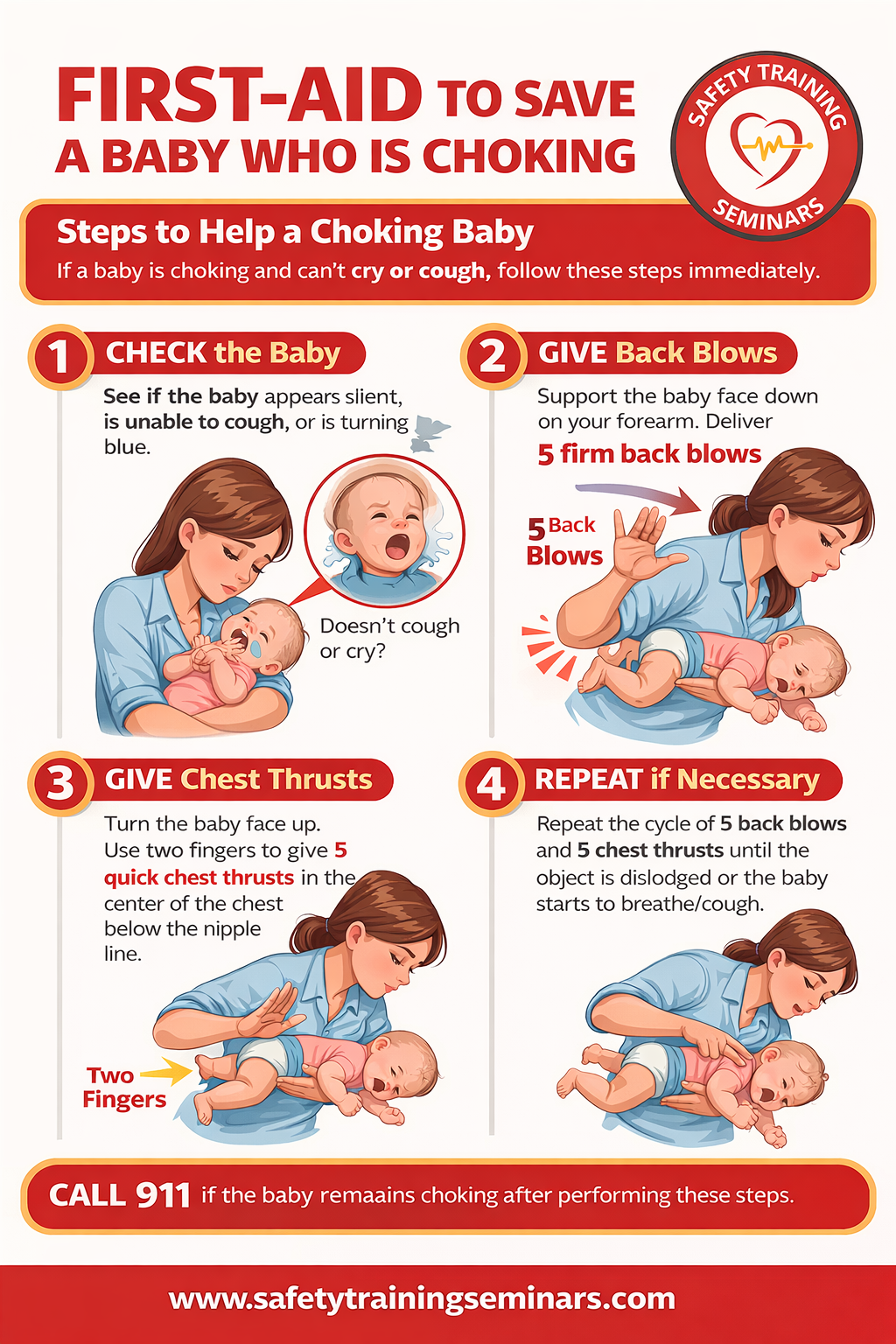
The first step in saving a choking baby is recognizing the problem. In BLS training, students learn how to distinguish between mild and severe airway obstruction, which determines the appropriate response.
Signs of severe choking in an infant include:
- Inability to cry or make sounds
- Weak or absent coughing
- Difficulty breathing or no breathing
- Bluish color around lips or face
- Loss of consciousness if untreated
If an infant is coughing forcefully or making sounds, they may still be able to clear the airway on their own. However, if the baby cannot breathe or make noise, immediate action is required. Recognizing these signs quickly is essential to understanding how to help effectively.
Proper Positioning Before Giving Back Blows
Correct positioning is critical for infant choking relief. A BLS course teaches that infants must be supported securely to allow gravity to assist in removing the obstruction.
To position the infant:
- Place the baby face down along your forearm
- Support the head and jaw, keeping the head lower than the chest
- Rest your forearm on your thigh for stability
This position protects the infant’s neck while allowing forceful air movement when back blows are delivered. Improper positioning can reduce effectiveness or increase injury risk, which is why hands-on BLS training is so valuable.
How to Perform Back Blows for a Choking Baby
Back blows are the first intervention taught in infant choking relief. Their purpose is to create enough force to dislodge the object blocking the airway.
In a BLS course, students learn to:
- Deliver five firm back blows between the shoulder blades
- Use the heel of the hand
- Maintain head and neck support throughout
Each back blow should be deliberate and controlled, not panicked or excessive. After five back blows, the airway should be reassessed. If the object does not come out, the responder immediately transitions to chest thrusts. This sequence is a core part of how to save a choking infant safely.
Using Chest Thrusts to Clear the Airway
If back blows are unsuccessful, chest thrusts are the next step. Chest thrusts help force air upward through the airway to expel the obstruction.
To perform chest thrusts:
- Turn the infant face up while supporting the head
- Place two fingers in the center of the chest, just below the nipple line
- Deliver five quick chest thrusts, pressing down about 1.5 inches
Chest thrusts must be performed with precision. Too little force may be ineffective, while too much force can cause injury. BLS training ensures that rescuers understand the correct depth, placement, and rhythm to maximize effectiveness.
Repeating the Cycle Until the Airway Clears
Infant choking relief follows a repeated cycle until the airway is clear or the infant becomes unresponsive. In a BLS course, students practice this rhythm to ensure smooth transitions.
The cycle includes:
- 5 back blows
- 5 chest thrusts
- Continuous reassessment
This pattern continues until the object is expelled, the infant begins breathing or crying, or emergency responders arrive. Consistency and calm repetition are essential. Understanding this process helps rescuers stay focused during a highly emotional situation.
What to Do If the Baby Becomes Unresponsive
If a choking infant becomes unresponsive, the emergency escalates to CPR. This transition is a critical part of BLS training, ensuring no time is wasted.
At this point:
- Place the infant on a firm, flat surface
- Begin infant CPR with chest compressions
- Check the mouth for visible objects before giving breaths
- Do not perform blind finger sweeps
CPR continues until the airway clears or advanced medical help takes over. This seamless shift from choking relief to CPR and First Aid highlights why infant airway emergencies are taught together in BLS courses.
Common Mistakes BLS Training Helps Prevent
Without training, people often make mistakes that delay care or cause injury. BLS courses focus heavily on preventing these errors through repetition and instructor feedback.
Common mistakes include:
- Shaking the infant
- Holding the baby upright during back blows
- Using excessive force
- Delaying emergency activation
By learning the correct techniques, individuals gain confidence and clarity. This preparation ensures that when an emergency occurs, actions are guided by knowledge rather than panic.
Why Learning How to Save a Choking Baby Matters
Choking emergencies are unpredictable, but preparation is not. Infant choking training empowers parents, caregivers, and professionals to respond immediately when seconds matter most.
At Safety Training Seminars, BLS courses are designed to be practical, supportive, and medically accurate. Students learn not only how to save a life, but also how to help with confidence and control. These skills protect the most vulnerable and strengthen entire communities.
When you know what to do, you become a lifeline. Infant choking training is not just education—it is responsibility, readiness, and compassion in action.
Final Thoughts: Turning Training Into Lifesaving Action
Saving a choking baby requires fast thinking, proper technique, and calm execution. Through First Aid, CPR, and BLS training, individuals gain the tools needed to act when it matters most.
Safety Training Seminars remains committed to teaching lifesaving skills that truly work in real-world emergencies. When knowledge meets action, lives are saved—and that is the ultimate goal of every BLS course.