ALS vs BLS
When it comes to life-saving emergency care, both BLS (Basic Life Support) and ALS (Advanced Life Support) are essential. However, they serve different purposes, require different skill levels, and are targeted toward different audiences. Safety Training Seminars provides AHA-aligned BLS and ALS certification programs, available in in-person, online, and blended learning formats, allowing healthcare professionals and first responders to gain skills and certification on their schedule.
- Official AHA BLS Card
- Daily Classes Available
- 1–2 Hour Online Course
- Lowest Price Guaranteed

Lowest BLS Prices in Northern California - Instant Certification - Classes Daily
American Heart Association® BLS CPR Classes are designed for healthcare professionals and first responders who need high-quality, hands-on life-saving training. Our courses follow the latest AHA guidelines and focus on real-world skills you can confidently apply in emergency situations. Whether you’re a nurse, doctor, EMT, dental professional, or part of a clinical team, our BLS CPR certification ensures you meet workplace and regulatory requirements.
What Is BLS?
Basic Life Support (BLS) is the foundational level of emergency care used to maintain vital functions in the early stages of a medical emergency. It is typically performed by first responders, healthcare providers, or trained individuals at the scene.
Key Features of BLS:
- Focuses on immediate, life-sustaining interventions such as CPR, rescue breaths, and AED use
- Aims to stabilize patients with cardiac arrest, respiratory failure, or choking until advanced care arrives
- Can be referred to as BCLS (Basic Cardiac Life Support); there is no difference between BLS and BCLS
- Available through flexible learning formats, including:
- In-person classes with certified instructors
- Blended learning, combining online modules and hands-on skills sessions
BLS certification equips participants with practical skills, confidence, and the ability to save lives in emergency situations.
What Is ALS?
Advanced Life Support (ALS) builds on the foundation of BLS, providing more complex medical interventions for critically ill or injured patients. ALS is primarily used in pre-hospital or clinical settings, such as ambulances, emergency departments, or critical care units.
Key Features of ALS:
- Incorporates advanced airway management, IV access, medication administration, and advanced cardiac life support techniques
- Designed for healthcare professionals who respond to severe emergencies, including cardiac arrest, stroke, or acute coronary syndromes
- Also referred to as ACLS (Advanced Cardiac Life Support); ALS and ACLS are equivalent
- Emphasizes critical thinking, problem-solving, and psychomotor skill integration for optimal patient outcomes
ALS ensures patients receive high-level care from the first response through hospital transfer, improving survival and recovery chances.
BLS vs ALS: Key Differences
Feature | BLS (Basic Life Support) | ALS (Advanced Life Support) |
Purpose | Immediate life-saving support to stabilize patients | Advanced interventions for critically ill or injured patients |
Audience | First responders, healthcare providers, trained laypersons | Healthcare professionals (physicians, nurses, paramedics, anesthesiologists, dentists) |
Skills | CPR, AED use, airway management, choking relief | Advanced airway management, IV/medication administration, cardiac monitoring, ACLS protocols |
Equipment | AED, basic airway tools | Advanced airway devices, cardiac monitors, medications |
Setting | On-scene emergencies, community or workplace | Pre-hospital care, emergency departments, critical care units |
Summary: BLS is the first line of emergency care, while ALS provides specialized, high-level interventions when patient conditions are critical.
Which Should You Take First?
ALS requires a solid foundation in BLS, so completing BLS certification is a prerequisite before starting ALS training. Most ALS courses provide a brief BLS refresher, but mastery of basic skills is essential to progress safely.
Who Needs BLS or ALS Certification?
BLS Certification is recommended for:
- Teachers, coaches, lifeguards, personal trainers, and caregivers
- Healthcare providers and first responders as a foundational requirement
ALS Certification is designed for:
- Physicians, nurses, anesthesiologists, paramedics, EMTs
Dentists, dental hygienists, and other healthcare professionals managing critical emergencies
Training Formats
Safety Training Seminars offers flexible learning options for both BLS and ALS:
- In-Person Classes: Hands-on instruction with certified instructors
- Online Courses: Self-paced modules covering theory and protocols
- Blended Learning: Combines online coursework with in-person skills verification, allowing participants to demonstrate competency and earn full certification
All programs comply with AHA standards and provide recognized certification.
Certification and Validity
- BLS Certification: Valid for 2 years, includes CPR and life-support skills
- ALS Certification: Also valid for 2 years, covers advanced interventions for critical care
- Both certifications can be renewed through refresher courses or recertification programs
Frequently Asked Questions
Do I need BLS before taking ALS?
Yes. BLS is a prerequisite for ALS training, ensuring participants have mastered fundamental life-saving techniques before moving to advanced interventions.
Can non-healthcare professionals take ALS?
No. ALS is intended for trained healthcare providers who require advanced skills to manage critical emergencies. Non-healthcare professionals should start with BLS.
How often do BLS and ALS certifications need renewal?
Both BLS and ALS certifications are valid for two years. Renewal courses are recommended to maintain competency and stay up-to-date with the latest AHA guidelines.
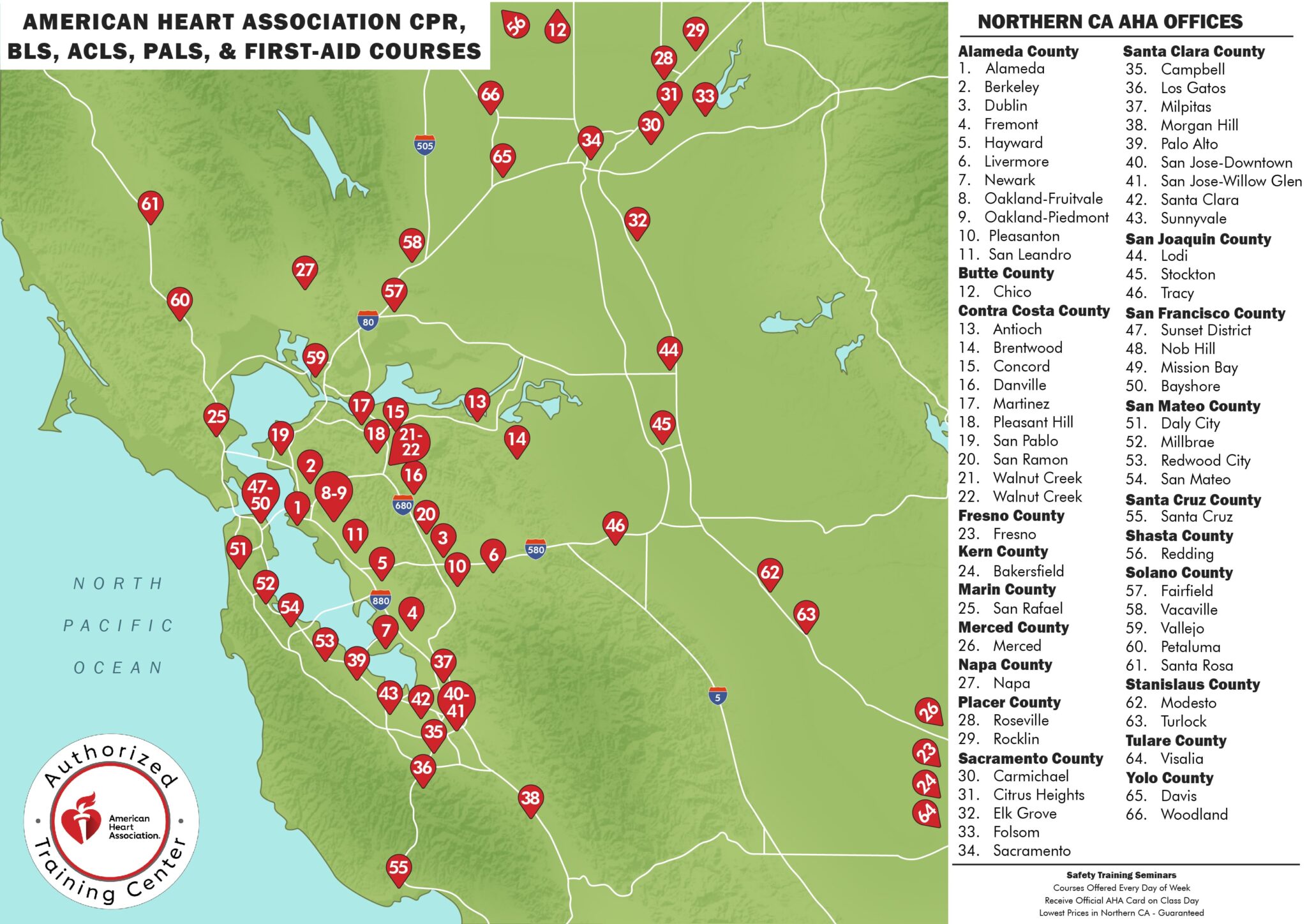
Cities Safety Training Seminars Serve in Northern and Central California
Safety Training Seminars offers American Heart Association® BLS, CPR, ACLS, PALS & NRP certification classes across a wide network of locations throughout Northern and Central California. Our training centers make it easy for healthcare professionals, first responders, and workplace teams to find convenient, local BLS CPR classes with flexible scheduling and same-day certification.
We currently provide BLS CPR classes in Alameda, Antioch, Bakersfield, Berkeley – Downtown, Berkeley – Solano, Brentwood, Campbell, Carmichael, Chico, Citrus Heights, Concord – Treat, Concord – Willow Pass, Daly City, Danville, Davis, Dublin, Elk Grove, Fairfield, Folsom, Fremont, Fresno, Hayward, Livermore, Lodi, Los Gatos, Martinez, Millbrae, Milpitas, Modesto, Morgan Hill, Napa, Newark, Oakland – Fruitvale, Oakland – Lake Merritt, Oakland – Piedmont, Palo Alto, Petaluma, Pleasant Hill, Redding, Redwood City, Rocklin, Roseville, Sacramento – Arden, Sacramento – Midtown, Sacramento – Oak Park, Sacramento – Rosemont, San Francisco – Bayshore, San Francisco – Mission Bay, San Francisco – Mission District, San Francisco – Nob Hill, San Francisco – Parnassus/UCSF, San Francisco – Sunset, San Francisco – Telegraph Hill, San Jose – Downtown, San Jose – Japantown, San Jose – South, San Jose – Willow Glen, San Leandro, San Mateo, San Pablo, San Rafael, San Ramon, Santa Clara, Santa Cruz, Santa Rosa – Downtown, Santa Rosa – Larkfield-Wikiup, Stockton, Sunnyvale, Tracy, Vacaville, Vallejo, Visalia, Walnut Creek – Downtown, Walnut Creek – Shadelands, and Woodland.
Each location follows the latest AHA guidelines, offering a streamlined format that includes an online course combined with hands-on skills testing. With daily classes, multiple time slots, and convenient neighborhood locations, Safety Training Seminars makes earning or renewing your BLS, CPR, ACLS, PALS & NRP certification Classes simple, efficient, and accessible wherever you’re located.