

Safety Training Seminars

The ACLS Study Guide provides a step-by-step, expert approach to mastering Advanced Cardiovascular Life Support. Learn to recognize cardiac emergencies, perform high-quality CPR, manage arrhythmias, and utilize life-saving medications effectively. This guide equips healthcare professionals to confidently pass certification tests and deliver fast, safe, and effective patient care.
You are likely here because your ACLS certification is coming up. Maybe it is your first time taking the course, or perhaps you are due for a renewal. Either way, the Advanced Cardiovascular Life Support (ACLS) exam can feel intimidating. The algorithms seem complex, the pharmacology list is long, and the pressure of a Mega Code scenario is real.
But here is the good news. You do not need to memorize every single page of the provider manual to pass. You just need a strategic approach to studying the right material.
This guide covers everything you need to know to navigate your ACLS course with confidence. We break down the core algorithms, simplify the essential pharmacology, and highlight the latest 2025 American Heart Association (AHA) updates. We also include local data that emphasizes why this training matters right here in California.
At Safety Training Seminars, we have been helping healthcare professionals like you get certified since 1989. With over 70 locations across California, we understand exactly what it takes to succeed. Let’s dive in.
ACLS is not just another card to keep in your wallet. It is a critical skillset that saves lives. When a patient goes into cardiac arrest, the quality of the resuscitation effort determines whether they survive and if they walk out of the hospital neurologically intact.
Let’s look at the numbers. According to the 2022 CARES Survival Report, the national survival rate for out-of-hospital cardiac arrest to hospital discharge is roughly 9.4%. That is a sobering statistic. It means that for every ten people who suffer a cardiac arrest outside of a hospital, only one typically survives.
However, high-quality training moves the needle. In Alameda County, local EMS systems implemented rigorous training updates—focusing on high-quality CPR and team dynamics similar to what you learn in ACLS. The result? They saw return of spontaneous circulation (ROSC) rates jump from 29% to over 42% in recent years.
This proves that what you learn in your ACLS course works. It is not just theory. It is the difference between life and death.
Before you tackle the advanced material, you must have a solid foundation. Many students struggle in ACLS not because the advanced concepts are too hard, but because their basic skills are rusty.
You should know the primary drugs used in cardiovascular emergencies. We will cover these in detail later, but you should be familiar with Epinephrine, Amiodarone, Atropine, and Adenosine.
In any emergency, panic is your enemy. The AHA teaches a systematic approach to ensure you do not miss anything. This structure keeps you calm and focused.
Reversible causes are the most common reasons a resuscitation attempt fails. If you fix the rhythm but do not fix the cause, the patient will not stabilize. You must memorize the Hs and Ts.
This is the core of ACLS. You will face this in your Mega Code. The algorithm splits into two paths based on whether the rhythm is “shockable” or “non-shockable.”
Study Tip: Notice that Epinephrine is given for all cardiac arrests, but Amiodarone is only for shockable rhythms that do not respond to shocks.
Bradycardia is defined as a heart rate less than 50 bpm. But remember, we treat the patient, not the monitor. Is the patient symptomatic?
Tachycardia is a heart rate greater than 100 bpm, but usually, symptoms appear when the rate exceeds 150 bpm.
You saved them! The heart is beating again (Return of Spontaneous Circulation – ROSC). Now the real work begins to save the brain.
Keep oxygen saturation between 92% and 98%. Do not over-oxygenate. Avoid excessive ventilation, which decreases blood flow to the brain.
Keep the blood pressure up. Aim for a Systolic BP > 90 mmHg or a Mean Arterial Pressure (MAP) > 65 mmHg. You may need IV fluids or vasopressor infusions (Epinephrine, Dopamine, Norepinephrine).
Obtain a 12-lead ECG within 10 minutes of arrival. If it shows ST elevation, the patient needs the Cath Lab (PCI) within 90 minutes.
Time is brain. You must quickly identify a potential stroke and get the patient to a CT scan to rule out a bleed.
We know you have choices for your certification, but we believe we offer the most stress-free experience in California. Since 1989, we have trained thousands of medical professionals.
We offer a Low Price Guarantee. You won’t find a legitimate American Heart Association course for less. Plus, we issue your official AHA certification card on the same day. No waiting around for weeks to show your employer you are compliant.
We have over 70 locations throughout the state, from San Francisco to San Diego. We offer classes every single day, including weekends, because we know your shift schedule is crazy.
When you book with us, you are choosing a woman-owned, local business that cares about your success. We make the booking process easy, and our instructors are there to help you learn, not to intimidate you.
Passing your ACLS certification is about more than just memorizing a few charts. It is about preparing yourself to lead a team during the worst day of someone’s life. It is about having the confidence to say, “I know what to do.”
By focusing on the systematic approach, understanding the “why” behind the medications, and keeping calm under pressure, you will not only pass the exam but also be a better clinician.
We hope this guide serves as a valuable resource in your preparation. If you are ready to schedule your course, we would love to see you at one of our centers.
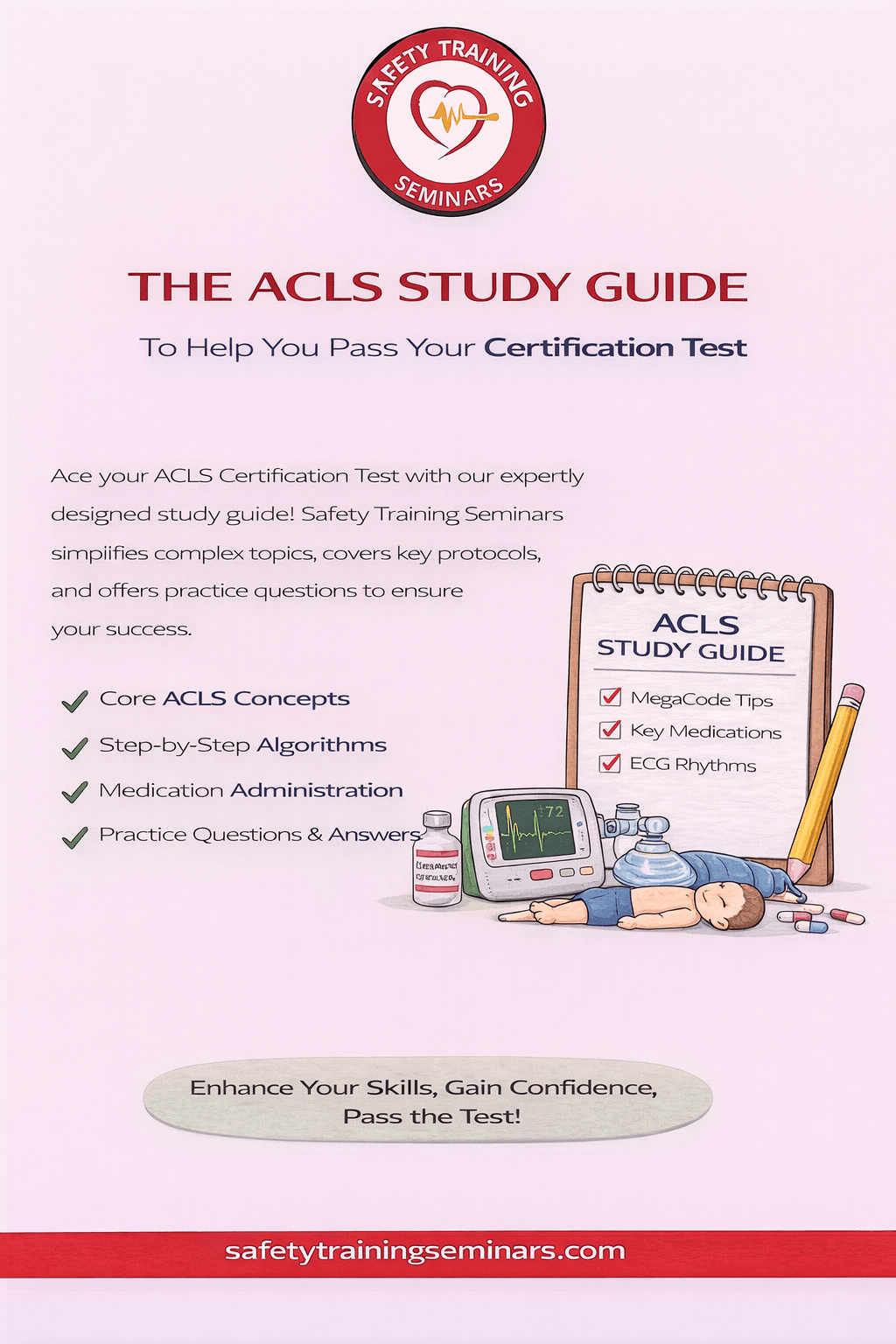
Preparing for your Advanced Cardiovascular Life Support (ACLS) certification can feel challenging, but a clear and structured approach makes it manageable. This infographic breaks down the most important information you need, including cardiac arrest procedures, airway management, critical medications, and patient assessment steps. By presenting these topics visually, it helps healthcare professionals quickly understand and retain essential knowledge for the exam.
The infographic clearly outlines all key ACLS algorithms, including adult and pediatric resuscitation, defibrillation, and post-cardiac arrest care. Each section combines easy-to-read visuals with concise explanations, so you not only memorize the steps but also understand why each action is important. This approach improves retention and prepares learners to respond accurately and confidently in both exams and real-life situations. Important tips and reminders are also highlighted to avoid common mistakes and ensure critical steps are never missed.
Along with the protocols, the guide provides practical advice on exam preparation, time management, and hands-on practice. Focusing on high-priority topics and scenario-based learning helps build confidence and readiness for the certification test. With this ACLS study guide from Safety Training Seminars, you have a reliable, well-organized, and easy-to-follow resource that simplifies studying, strengthens understanding, and gives you the confidence to pass your ACLS certification on the first try.
An ACLS study guide covers advanced cardiac life support topics including cardiac arrest algorithms, arrhythmia recognition, airway management, medications, and post-cardiac arrest care. Safety Training Seminars presents this information in a clear, structured format to support exam success and clinical performance.
Physicians, nurses, paramedics, respiratory therapists, and other advanced healthcare providers should study an ACLS guide before certification or renewal. It ensures familiarity with algorithms, drug dosages, and team leadership roles during cardiac emergencies.
An ACLS study guide helps learners understand algorithms, rhythm interpretation, and treatment priorities. It prepares students for scenario-based questions and megacode testing. Safety Training Seminars emphasizes practical understanding, not memorization alone.
Key algorithms include cardiac arrest, bradycardia, tachycardia, acute coronary syndromes, and post-resuscitation care. Understanding when to use medications, defibrillation, or cardioversion is essential for passing the ACLS exam and managing real emergencies.
Safety Training Seminars offers AHA-aligned ACLS education with expert instructors and structured study support. Their training builds confidence in critical decision-making, improves patient outcomes, and helps healthcare professionals succeed in both certification and real-life cardiac events.