What is Blended Learning CPR Training?
Blended Learning vs. Traditional CPR Training: Which Minimizes Clinical Staff Downtime
Healthcare teams live by efficiency. When a nurse, dentist, or paramedic steps away for mandatory recertification, that gap affects patient care capacity and operational costs. The question isn’t whether your team needs CPR training—it’s how to get certified without fracturing your schedule.
Two approaches dominate: blended learning, which splits theory online and hands-on practice in-person, and traditional classroom instruction, where everything happens in one room on one day. Both meet regulatory standards. Both deliver valid certifications. But their impact on staff availability, budget, and skill retention differs significantly. Understanding these differences helps you protect your team’s schedule while maintaining the high safety standards your patients depend on.
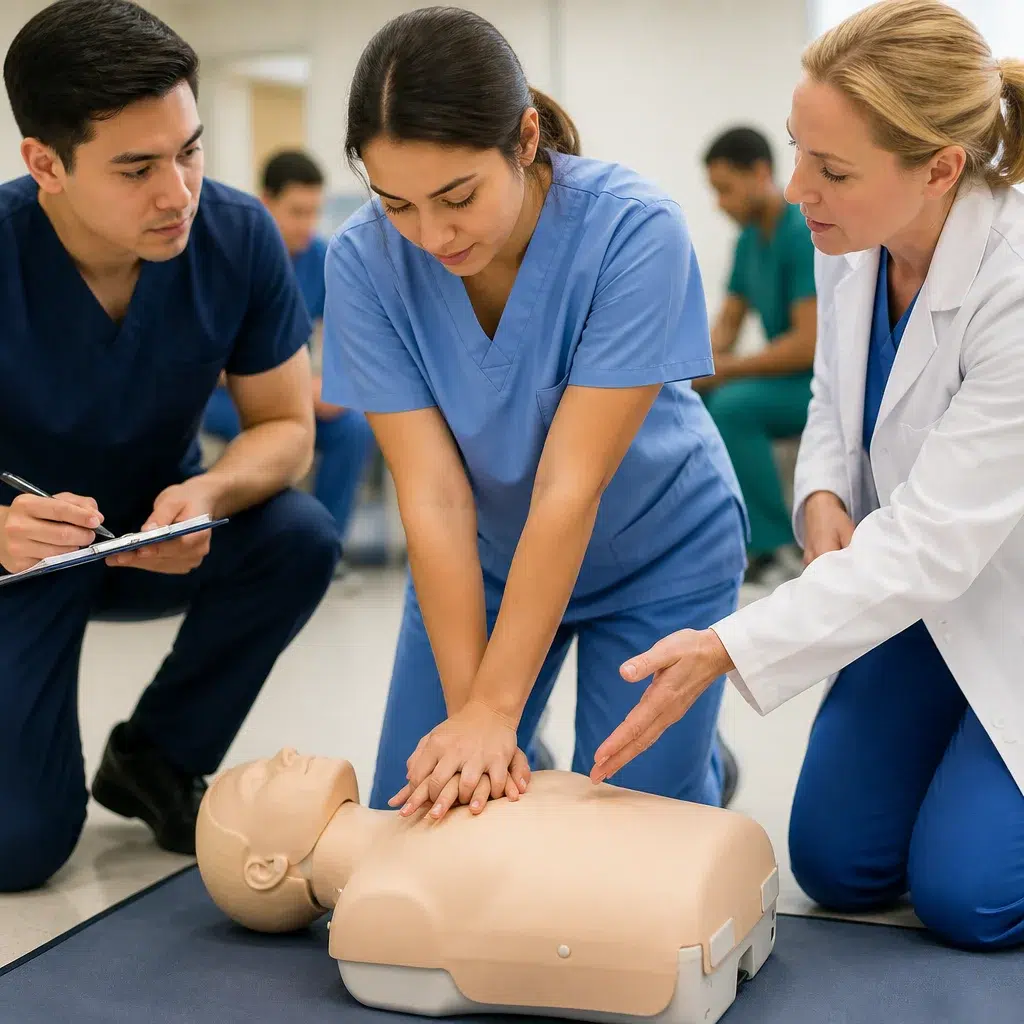
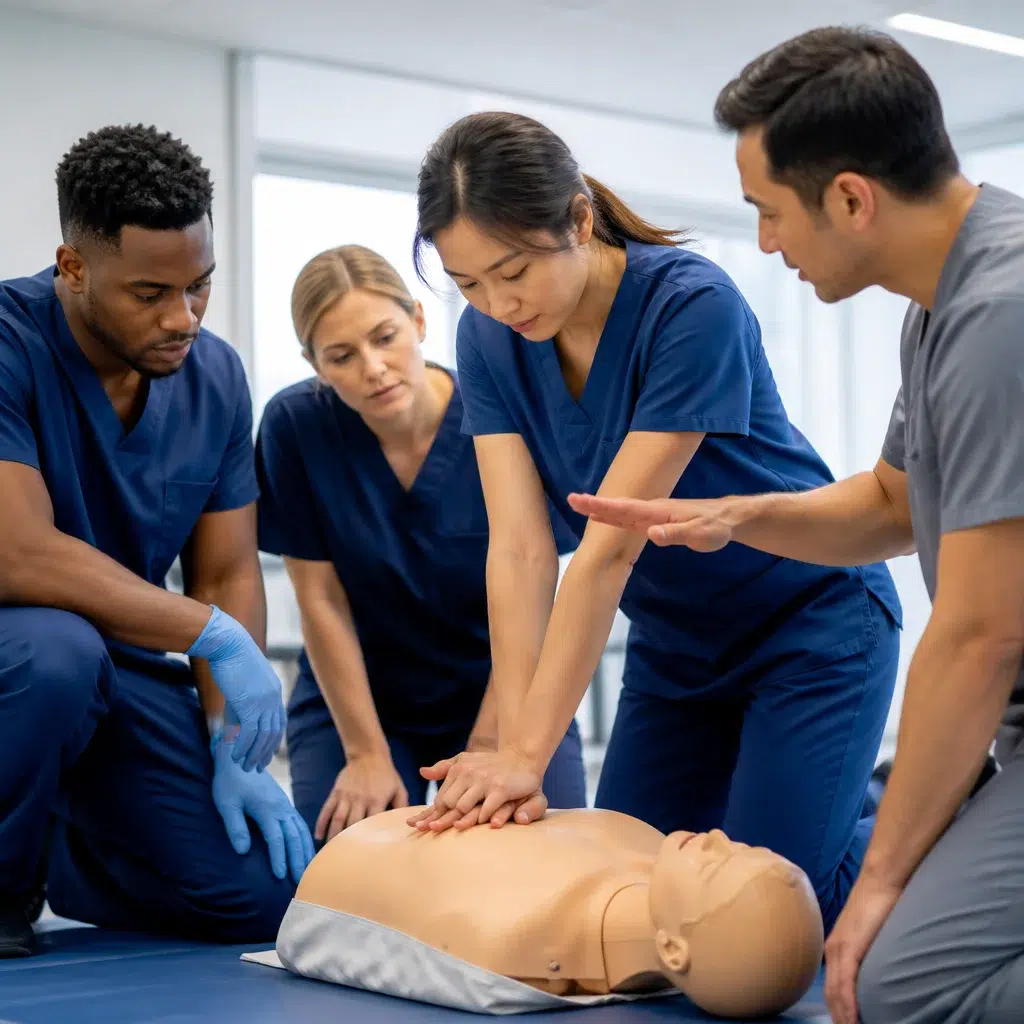
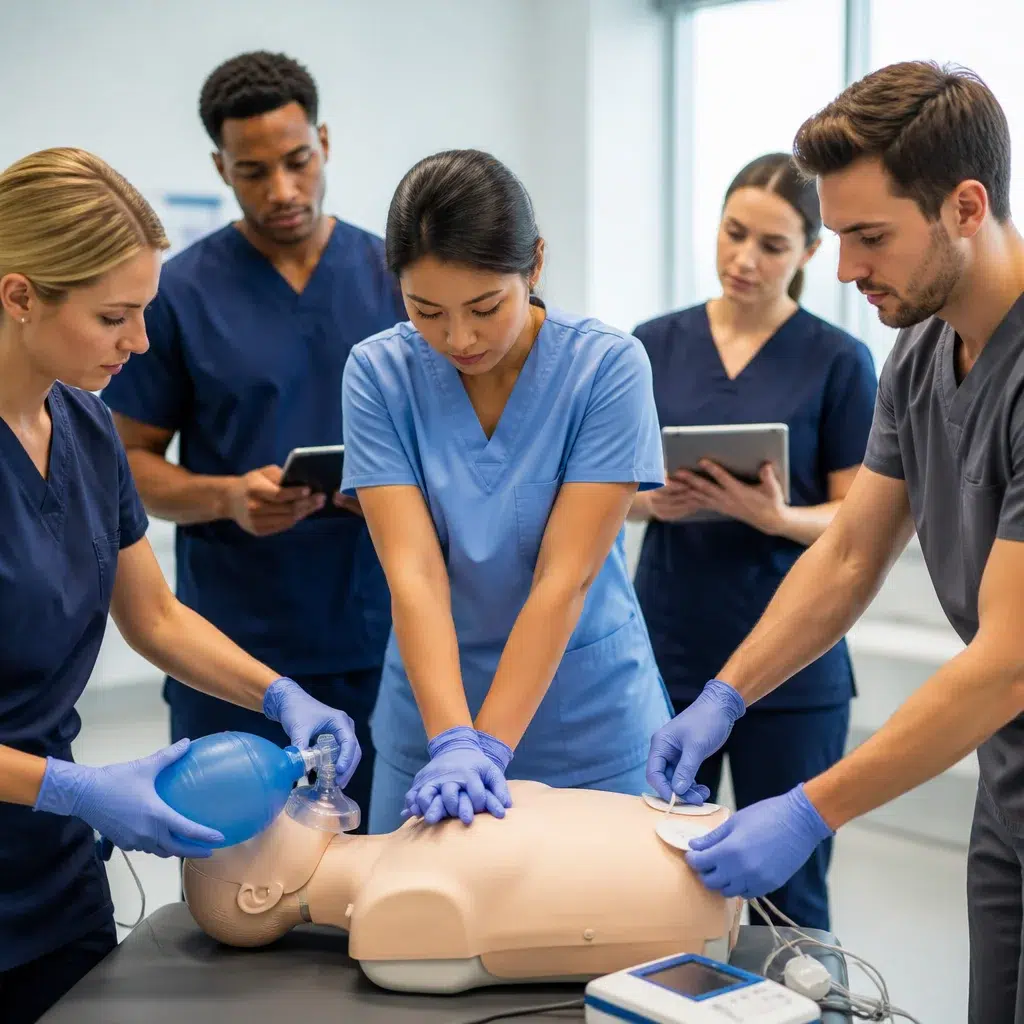
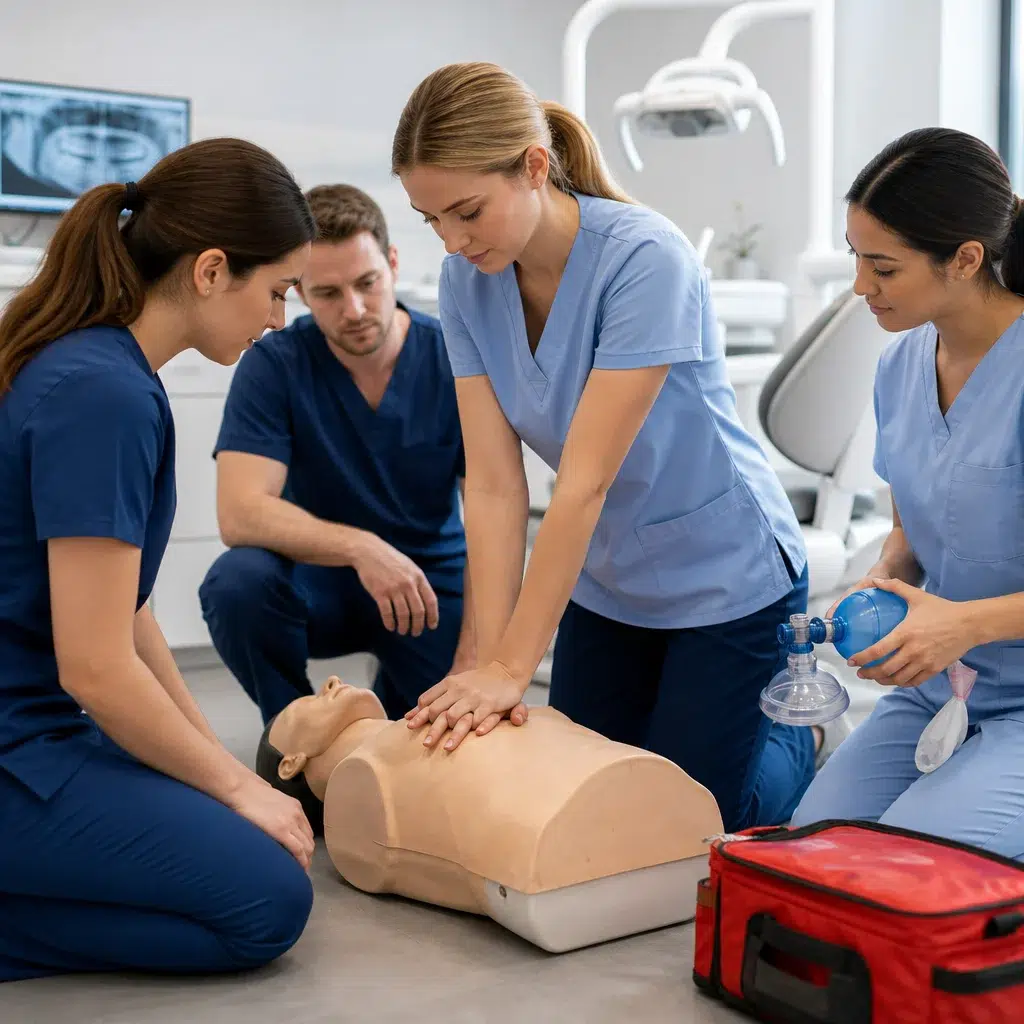
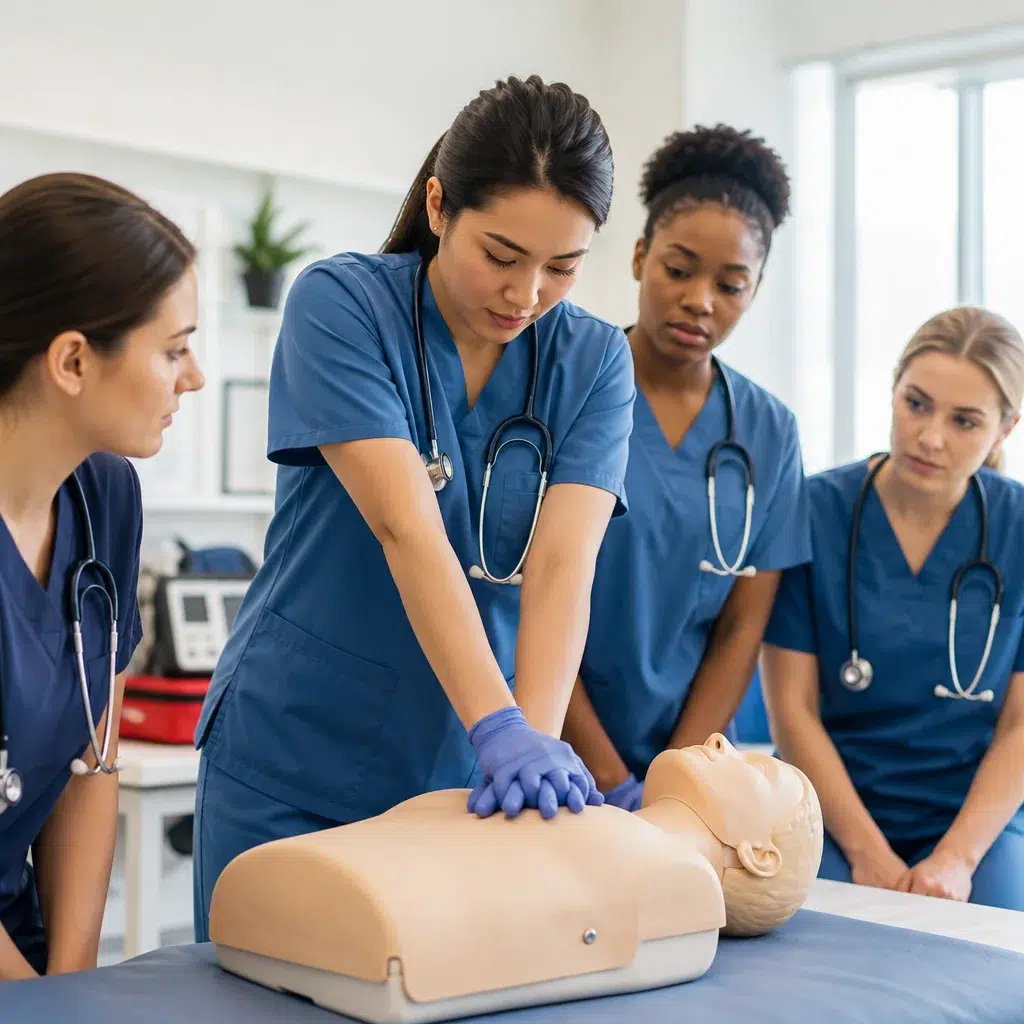
Blended learning splits CPR certification into two distinct phases. Your staff completes video-based knowledge modules and written assessments online, typically finishing in 30-60 minutes from any device. Then they attend a focused, hands-on skills session at a training center where instructors evaluate their chest compressions, rescue breathing, and equipment operation.
This structure eliminates classroom lecture time. No sitting through information your team could absorb asynchronously. Instead, the in-person component zeros in purely on physical performance, feedback, and practical mastery. A nurse completes her online modules Tuesday evening at home, then attends a two-hour skills session Saturday morning. Her total time investment is roughly three hours across a full week rather than eight consecutive hours on one day.
The online portion isn’t a shortcut; it mirrors the same curriculum your staff would hear in a traditional class. Instructors verify knowledge through quizzes before your team steps foot in the lab. The hands-on session then focuses entirely on what online modules cannot teach: how to position hands correctly, how hard to push, how to recognize fatigue, and how to coordinate with a partner. This separation of knowledge from skill assessment often produces stronger practical competency because instructors spend zero minutes re-teaching concepts.
Blended delivery accommodates real clinical schedules. A dental hygienist working three 10-hour days each week can schedule her two-hour skills session between shifts without losing a full workday. Parents and single-income households benefit from spreading the commitment across multiple days.
Understanding Traditional In-Person CPR Training
Traditional CPR training bundles everything into a single session, usually four to eight hours depending on the certification level. Your staff shows up, sits through classroom instruction for 2-3 hours, then practices skills for the remaining time. Everyone in the room follows the same pace regardless of prior knowledge.
This approach works well for cohort-building and offers undeniable convenience for some: one appointment, one date, done. A healthcare facility can send five employees on a Tuesday afternoon, and by end-of-day, all five hold valid certifications. The classroom instructor covers knowledge points, demonstrates techniques, answers questions live, and oversees skill stations all under one roof.
The downside emerges in real-world clinic operations. Pulling five staff members for a full workday creates a staffing gap. If your facility operates Monday through Saturday, finding a time when five people can leave simultaneously becomes a scheduling puzzle. Someone’s shift swaps with someone else. Part-time staff must come in on their day off. Weekend coverage gets compromised. These indirect costs pile up quickly in labor burden and operational friction.
Additionally, traditional sessions assume everyone learns at the same pace. A paramedic who renews certification every two years might sit through the same knowledge section as a dentist who renews every three years. Neither gains much from information review. Both still must endure it to reach the skills portion. The class rhythm, not individual readiness, determines progress.
Traditional training also front-loads all your certification renewal into narrow windows. If an instructor offers classes on Tuesdays and Thursdays, you must schedule your entire team within those slots. Adding a new hire mid-month means waiting until the next class cohort forms.
Schedule Flexibility and Staff Availability Comparison

This is where the operational advantage becomes tangible. Blended learning decouples your team from instructor schedules and class start dates.
With blended delivery, your nurse can complete her online module any day, any time, during breaks between patient rooms or at 11 p.m. from home. She then books a two-hour skills appointment from dozens of available slots throughout the week. If she misses her scheduled time, rescheduling typically takes minutes online rather than waiting for the next class to fill. Safety Training Seminars, for example, offers over 100 training locations across California and schedules skills sessions daily, which eliminates the “next available class” bottleneck entirely.
Traditional scheduling locks staff into fixed cohorts. Your entire team must attend the same four-hour session because that’s when the instructor is available. This concentration creates unavoidable clinic downtime. If you operate with tight margins and rely on every clinician seeing patients, losing four people for four hours on Tuesday afternoon translates directly to cancelled appointments or extended wait times.
Blended learning also accommodates last-minute additions. A newly hired emergency room nurse needs BLS certification before her first shift. With blended learning, she completes the online work one evening and schedules a skills session the next morning. With traditional training, she might miss her start date waiting for the next cohort to form.
Actionable takeaway: Calculate your team’s total wages for the time investment. Compare a four-hour group session at full staff cost versus individual two-hour appointments staggered across the week. Often the blended approach delivers lower total labor cost despite slightly higher per-person training fees.
Cost Efficiency and Training Investment Analysis
Blended learning introduces a per-person online module cost that traditional classroom training avoids. However, the total cost picture shifts dramatically when you factor in labor, opportunity cost, and indirect expenses.
A traditional CPR class might cost $80-120 per person but demands a four-hour commitment. For five people earning an average of $45 per hour, that’s roughly $900 in direct labor cost to training time alone. Add scheduling friction, rescheduling costs, and temporary staffing coverage to fill the gap, and the true cost reaches $1,200-1,500 for the group.
Blended learning typically costs $100-150 per person because providers invest in platform infrastructure and support, but your team only loses two hours of clinic time rather than four. The labor cost drops to roughly $450 for five people. Even if the per-person course fee is higher, you’re investing less total capital. Facilities with high hourly rates (specialist dental practices, anesthesia teams) see even greater savings per certification.
Safety Training Seminars operates under a low-price guarantee, which means you aren’t paying a premium for flexibility. The blended option often costs the same or less than traditional classroom instruction while reducing your operational friction by 50%.
Group discounts apply to both formats, but blended learning scales better for large organizations. Scheduling 50 nurses for traditional class across one month requires multiple cohorts and instructor coordination. Blended learning lets those 50 nurses spread online work across weeks and select individual skills slots, eliminating the need for coordinated classroom scheduling.
Retraining and compliance tracking also favor blended learning. If your team member lets certification lapse by one month, she only needs a two-hour skills refresh rather than the full four-hour course. Blended platforms typically flag lapsed certifications and allow streamlined renewal paths.
Skill Acquisition and Certification Quality Standards
Both formats meet the same national certification standards. Your team earns identical, legally recognized credentials. However, the learning pathway differs enough to affect skill retention and confidence.
Blended learning isolates knowledge assessment from skill evaluation. Your staff proves they understand guidelines, contraindications, and algorithm steps before they ever touch a manikin. This separation clarifies expectations: you pass the knowledge quiz, then you demonstrate the skill. There’s no ambiguity. An instructor can’t inflate a skill score because someone aced the written portion. Performance at the manikin stands on its own merit.

Traditional classroom instruction blends these elements, which creates subtle pressure dynamics. An instructor might give benefit-of-the-doubt on hand placement because a student did well on the written test. Or conversely, an instructor might scrutinize performance more closely for a student who struggled with knowledge concepts. These biases, conscious or not, don’t determine certification validity, but they do affect whether each individual truly demonstrates competency.
Hands-on skill mastery benefits from focused, unrushed practice. In a traditional four-hour session, instructors must lecture for 2-3 hours before skills stations. Your team practices compressions for maybe 30-45 minutes total. In a blended two-hour skills session, you might practice compressions for 80+ minutes because there’s no lecture to deliver. More repetition builds automaticity, the unconscious mastery that matters during real emergencies when thinking slows down response.
Both approaches verify competency through the same methods: chest compression rate and depth, proper hand positioning, rescue breathing technique, and defibrillator operation. Certification cards carry the same weight in an emergency room or dental office.
Real difference: Blended learners often retain skills longer because they’ve experienced more hands-on repetition in a focused setting. They also demonstrate higher confidence during the skills assessment because they’re mentally fresh rather than fatigued from hours of classroom sitting.
Implementation Timeline and Certification Speed
If your facility needs immediate, bulk certification, traditional classroom training offers predictable scheduling: book five staff for a specific date, and all five hold current certifications by end-of-day.
Blended learning accelerates individual timelines at the cost of staggered completion. Your nurse starts her online module today and schedules skills for Thursday. Your paramedic starts Monday and schedules skills for Wednesday. Your dentist starts tomorrow and schedules skills for Friday. Within one week, your entire team is certified, but they didn’t all cross the finish line on the same day.
For ongoing operations, blended learning typically delivers faster total implementation. Your team doesn’t wait for the next class cohort. A new hire completes the online work in two days and schedules a skills appointment from dozens of available slots weekly. She’s certified within three to five days of joining your team. With traditional training, she might wait 7-10 days for the next scheduled class.
Safety Training Seminars schedules skills sessions daily across California locations, which means your team rarely waits more than 2-3 days from online completion to in-person skills verification. Same-day certification cards are issued immediately after passing skills assessment, so there’s no administrative delay.
For renewal cycles, blended learning spreads recertification workload evenly throughout the year. Your team doesn’t need everyone certified on the same date. You build recertification into normal operations: one person schedules a session each week rather than all five disappearing for a day.
Real-World Application for Healthcare Professionals
A 10-person dental practice with hygienists, assistants, and office staff all holding active BLS requires consistent recertification. Traditional scheduling demands selecting one date when all 10 can leave. Inevitably, one hygienist works a critical patient case that day. The office schedules her separately, which means organizing two training sessions instead of one.
With blended learning, each team member completes their online module during lunch breaks across a two-week window. Skills sessions spread across available afternoons and weekend slots. The practice maintains full coverage throughout. One person is away for two hours while nine remain operational.
An emergency department faces even tighter constraints. Clinical staff never fully leaves. Blended learning lets nurses complete online work during administrative time or off-duty hours. They schedule 30-minute skills sessions in pairs during slower shift periods rather than losing four hours simultaneously. The ED maintains continuous readiness while still keeping certifications current.
A paramedic working 24-hour shifts needs ACLS renewal. Traditional scheduling forces choosing between a workday (paying him for non-work hours) or a day off (his personal time). Blended learning lets him complete the online module during a 24-hour shift and schedule a two-hour skills session on an actual day off, reducing his total personal time commitment.

These real scenarios reveal why blended learning addresses healthcare’s unique operational demands. Clinical work cannot stop. Patients don’t reschedule because your team needs CPR certification.
Why Safety Training Seminars Blended Approach Wins
Safety Training Seminars operates a proven blended model specifically engineered for healthcare professionals’ schedules. The platform integrates online CPR courses with daily skills sessions across over 100 California locations, which solves the geographic and scheduling friction that derails many training initiatives.
Their approach combines curriculum alignment with national standards, same-day certification cards, and automated compliance tracking. Your team completes knowledge assessment online, then attends focused skills verification. No wasted classroom time. No waiting weeks for the next cohort to form.
Pricing reflects a low-price guarantee, which means you’re not paying premium rates for the flexibility and convenience. For facilities managing multiple certifications (CPR, ACLS, PALS, BLS, pediatric certifications), Safety Training Seminars provides streamlined pathways. A cardiac nurse might complete BLS online-plus-skills, then register for an afternoon ACLS skills session without repeating knowledge modules she’s already mastered.
The company’s woman-owned status since 1989 brings institutional knowledge about healthcare compliance. They understand that your staff cannot afford to miss clinical time. Their platform architecture reflects that constraint.
Key differentiator: Same-day certification cards and instant digital records eliminate the administrative lag many training centers create. Your compliance manager receives updated records immediately rather than waiting for processing.
Making the Right Choice for Your Team
The correct format depends on your specific operational constraints, team size, and certification mix.
Choose traditional in-person CPR training if your team rarely needs simultaneous certification, you already have a predictable training window, or your staff prefers single-session completion. Small practices with part-time staff sometimes find one group session easier to coordinate.
Choose blended learning if your team operates in shifts, requires rapid onboarding for new hires, manages multiple certification types, or works in patient-care settings where coverage matters. Any facility billing by the hour benefits from reduced operational downtime. Any practice with 10+ staff members will find scheduling relief through staggered sessions.
For healthcare professionals specifically, blended learning addresses the fundamental conflict between training mandates and patient care demands. You maintain operational capacity while meeting compliance requirements. Your team experiences less personal time disruption. Your training budget often decreases despite seemingly higher per-person costs.
Safety Training Seminars’ blended platform removes the usual friction points: geographic inconvenience (100+ locations), appointment scarcity (daily skills sessions), and administrative delays (same-day cards). For California-based healthcare professionals, the combination of flexible online modules and abundant in-person skills slots represents the most efficient path to current certifications.
Start by mapping your team’s current certification schedule and calculating total staff hours lost to training. Compare that to a blended approach where your team schedules individual appointments. The numbers typically favor flexibility, and your operational continuity improves immediately.
Register for a class today.