
Master the Neonatal Resuscitation Program with our comprehensive NRP Study Guide, designed for healthcare professionals seeking certification success. Covering the latest NRP guidelines, algorithms, practice scenarios, and exam-focused insights, this guide helps you confidently prepare, perform, and pass the NRP exam on your first attempt.
The Neonatal Resuscitation Program (NRP) Study Guide by Safety Training Seminars is a comprehensive educational resource designed to help healthcare professionals master neonatal resuscitation and confidently pass NRP certification or renewal exams. This guide is developed in alignment with the latest American Academy of Pediatrics (AAP) NRP guidelines, ensuring accuracy, clinical relevance, and exam-focused preparation for real-world neonatal emergencies.
The Neonatal Resuscitation Program is an evidence-based training system that prepares healthcare providers to assess and manage newborns who require assistance during the first critical moments after birth. NRP emphasizes rapid evaluation, effective ventilation, and timely escalation of care to improve neonatal survival and long-term outcomes. This study guide explains the program’s structure and clinical priorities in a clear, easy-to-understand format for learners at all experience levels.
NRP certification is required for healthcare professionals involved in labor, delivery, and neonatal care, including nurses, physicians, midwives, respiratory therapists, and emergency personnel. This study guide helps providers understand their roles during neonatal resuscitation while reinforcing teamwork, communication, and clinical decision-making skills that are essential in high-pressure delivery room environments.
A major focus of the NRP Study Guide is the initial assessment of the newborn immediately after birth. The guide explains how to evaluate breathing, heart rate, muscle tone, and gestational age while maintaining proper thermoregulation. Emphasis is placed on preventing hypothermia, ensuring airway patency, and initiating appropriate interventions based on the newborn’s condition within the first moments of life.
Understanding the NRP algorithm is critical for both exam success and clinical performance. This study guide provides detailed explanations of each step in the neonatal resuscitation flow diagram, highlighting decision points based on heart rate, respirations, and oxygenation. By clearly outlining when to proceed with ventilation, chest compressions, or advanced interventions, the guide helps learners develop confident and accurate clinical judgment.
Effective ventilation is the cornerstone of neonatal resuscitation, and this NRP Study Guide provides in-depth instruction on airway management and positive pressure ventilation. It explains proper mask placement, ventilation techniques, and corrective steps when ventilation is ineffective. The guide also covers indications for advanced airway placement and emphasizes strategies to achieve optimal chest rise and oxygen delivery.
Appropriate oxygen administration is essential to avoid complications associated with hypoxia or hyperoxia. This study guide explains recommended oxygen concentrations, target oxygen saturation levels by minute of life, and the use of pulse oximetry and ECG monitoring. Learners gain a clear understanding of how to adjust oxygen delivery based on the newborn’s response during resuscitation.
After successful resuscitation, newborns require careful monitoring and stabilization. This study guide discusses post-resuscitation care, including temperature management, glucose monitoring, respiratory support, and preparation for NICU transfer when needed. Clear communication with neonatal care teams is emphasized to ensure continuity of care and optimal outcomes.
Safety Training Seminars is a trusted provider of neonatal resuscitation education, offering high-quality training materials designed by experienced instructors. This NRP Study Guide is structured to be practical, clinically focused, and aligned with real exam scenarios, helping healthcare professionals prepare efficiently and perform confidently during both certification testing and real-life neonatal emergencies.
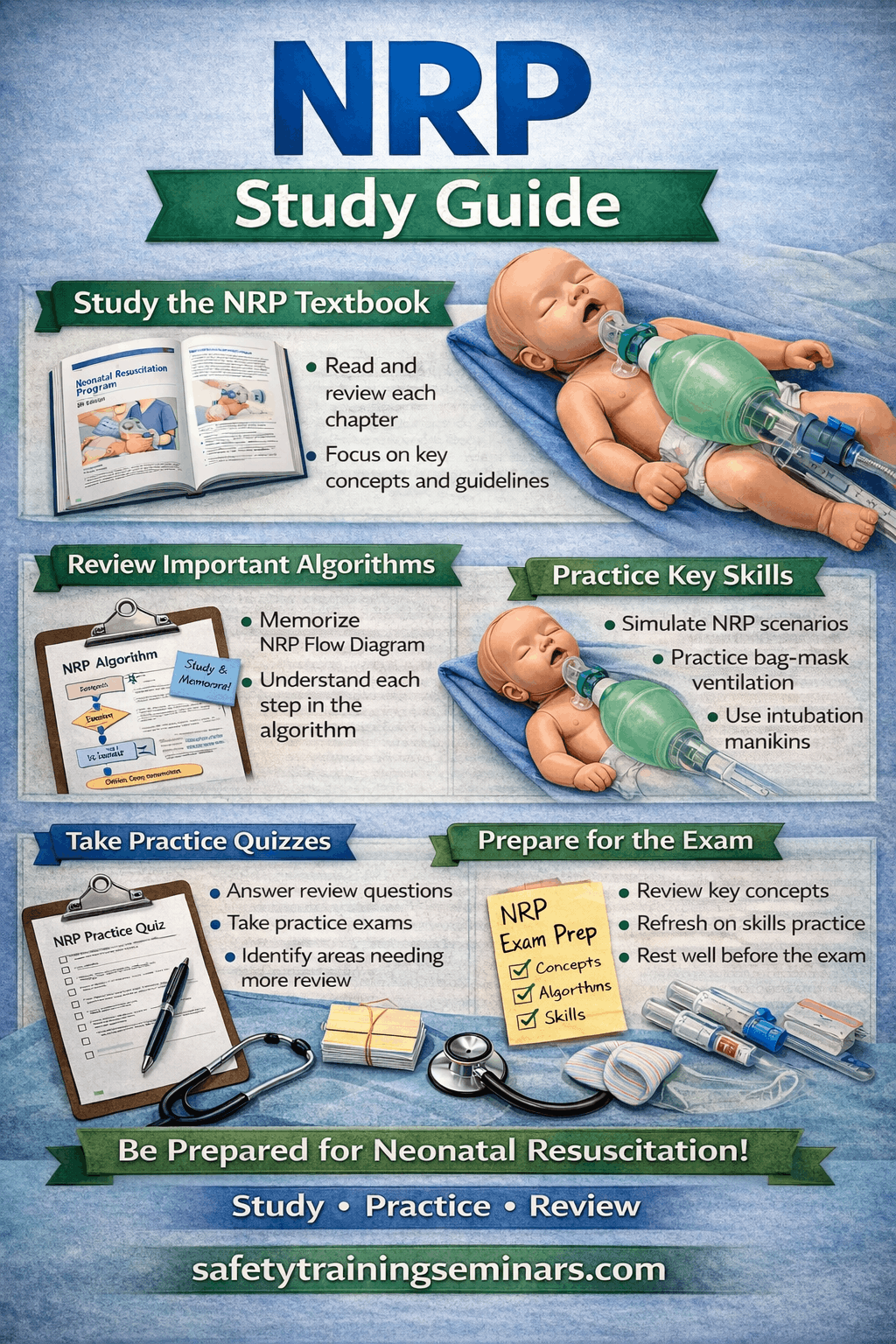
Our NRP Study Guide infographic is designed to give healthcare professionals a clear, visual roadmap for mastering neonatal resuscitation. Placed alongside this guide, the infographic reinforces critical concepts from the Neonatal Resuscitation Program by breaking complex steps into easy-to-follow actions that support both exam preparation and real-world clinical performance.
The infographic walks learners through the most important elements of NRP preparation, beginning with structured textbook review and progressing through algorithm mastery, hands-on skill practice, and exam readiness. By visually summarizing the NRP flow diagram, ventilation techniques, and resuscitation priorities, it helps reinforce memory retention and rapid decision-making during high-pressure neonatal emergencies.
This visual study tool emphasizes the importance of repeated practice, including simulated NRP scenarios, bag-mask ventilation, and airway management skills. It also highlights the value of practice quizzes and focused review to identify weak areas before the NRP exam. When used alongside our written NRP Study Guide, the infographic serves as a powerful reinforcement tool that supports faster learning and deeper understanding.
At Safety Training Seminars, we combine visual learning with clinically accurate, guideline-based instruction to help healthcare professionals prepare with confidence. This NRP Study Guide infographic is ideal for quick review sessions, last-minute exam preparation, or reinforcing key neonatal resuscitation concepts before hands-on training or certification testing.
The NRP Study Guide is a comprehensive resource designed to help healthcare providers learn and review the latest neonatal resuscitation techniques according to the AHA Guidelines 2025. It covers assessment, airway management, ventilation, and critical decision-making for newborn care.
The NRP Study Guide is intended for pediatricians, nurses, respiratory therapists, and other healthcare professionals who care for newborns. It is essential for anyone seeking NRP certification or renewal in line with AHA 2025 standards.
This guide covers initial assessment of newborns, heart rate evaluation, positive-pressure ventilation, chest compressions, medication use, and post-resuscitation care, all updated according to the AHA 2025 neonatal guidelines.
Using the NRP Study Guide allows learners to master skills and knowledge required for the NRP exam, ensuring they are fully prepared for practical and written assessments needed for official AHA certification.
Yes, the AHA Guidelines 2025 include updates on resuscitation sequence, oxygen use, and advanced interventions. The NRP Study Guide integrates these updates to ensure healthcare providers are trained in current evidence-based neonatal resuscitation practices.