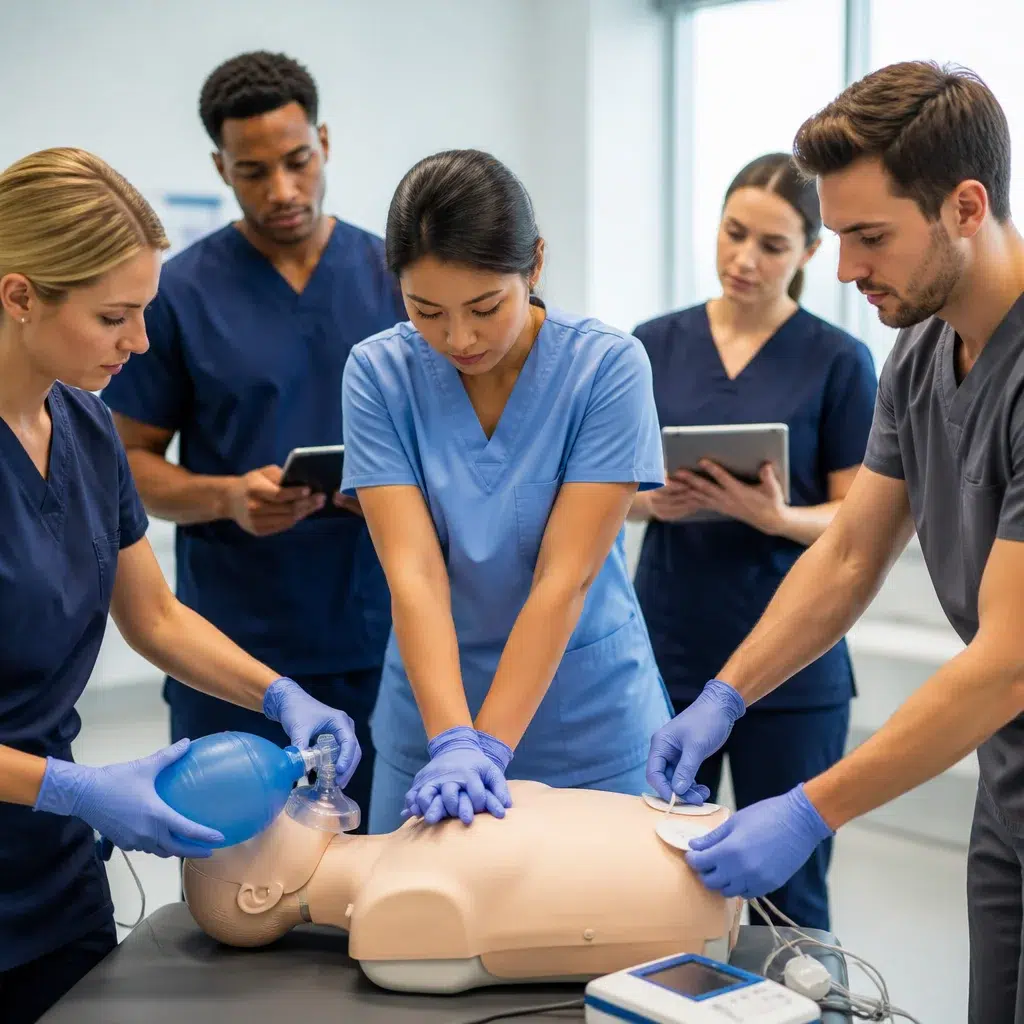

Introduction: The Importance of Structured Training for Healthcare Compliance
California providers operate under overlapping federal, state, and accreditation rules, making structured education programs essential to meet healthcare training compliance standards. CMS Conditions of Participation, Joint Commission competence requirements, and California licensing boards all expect verifiable, role-based training that stays current with AHA guidelines. Without a clear framework, organizations risk survey findings, credentialing delays, and staffing disruptions when a certification lapses.
A resilient clinical education infrastructure aligns policy, people, and technology so training is predictable, auditable, and job-relevant. Build the program around standardized curricula, validated equipment, and repeatable workflows that stand up to inspections and internal quality reviews.
Core components of a compliant training infrastructure:
- Governance: written policies mapping job roles to required courses (e.g., BLS for all clinical staff; ACLS for ED/ICU; PALS for pediatric units; NRP for perinatal teams)
- Instructor and site standards: AHA-aligned instructors; manikins with instrumented, audiovisual feedback devices for adult CPR per AHA requirements
- Scheduling cadence: renewal cycles planned at least 90 days before expiration (typically every two years)
- Documentation workflow: issuance and verification of AHA eCards, skills checklists, remediation records, and rosters
- Audit readiness: centralized access, version control for policies, and clear traces from training to competency assessments
Medical training documentation requirements should be explicit and centralized. Maintain mandatory AHA certification records (e.g., BLS/ACLS/PALS eCards), attendance rosters, skills/megacode checklists, instructor credentials, and equipment maintenance logs; AHA Training Centers retain course records for at least three years. Track dependencies by role so BLS and ACLS certification tracking triggers alerts before deadlines—e.g., an ED nurse’s ACLS renewal or a dental team maintaining BLS and, when providing sedation, ACLS/PALS per California provider certification requirements.
Operationally, integrate training data with HR or LMS systems and build dashboards that show compliance by unit, role, and expiration window (30/60/90 days). Use digital AHA eCards for real-time verification during onboarding and Joint Commission tracers. Tie post-class competency validation to department-specific scenarios to satisfy regulatory compliance for healthcare training while improving clinical performance.
Safety Training Seminars supports this structured approach with AHA-certified BLS, ACLS, PALS, and NRP courses delivered via blended learning and in-person skills sessions across 100+ California locations. For groups, on-site sessions and standardized rosters make employer audits simpler, while low price guarantees help control education budgets. Their digital course completions and guidance on verification streamline evidence gathering for surveys without adding administrative burden.
Essential Infrastructure for Effective Medical Skills Development
Building reliable clinical education infrastructure starts with environments that mirror real settings and capture every learning event. Dedicated skills labs should include adult, child, and infant manikins with feedback, airway trainers, AED trainers, ECG rhythm simulators for ACLS, and adequate supplies to practice bag-mask ventilation and suction. Mobile kits allow onsite delivery in clinics, dental offices, and EMS bases without sacrificing scenario fidelity. Clear signage, accessible layouts, and decontamination stations support safety and inclusivity.
Equally important is a digital backbone that enforces healthcare training compliance standards. A modern LMS should integrate AHA eLearning modules and eCard issuance, support single sign-on, and sync with HRIS to avoid dual data entry. Role-based permissions protect PHI and limit access to testing materials, while dashboards surface BLS and ACLS certification tracking, expirations, and remediation needs.
To meet medical training documentation requirements and audit readiness, maintain a standardized record set across all locations and courses:
- Attendance rosters and identity verification for every session
- Skills checklists and scenario evaluations with instructor sign-offs
- Remediation plans, retest outcomes, and learner feedback
- Instructor credentials, course versions, and lesson plans used
- Equipment maintenance logs, cleaning records, and incident reports
- AHA eCard issuance reports and mandatory AHA certification records
- Data retention policies aligned to AHA Training Center and California licensing agency timelines
Operational standards tie it all together. Follow AHA course policies on instructor-to-learner and manikin ratios, ensure scenarios align with current algorithms, and use structured debriefing tools to reinforce clinical reasoning. For regulatory compliance for healthcare training, define procedures for ADA accommodations, infection control for manikins and simulators per manufacturer guidance, and secure storage of exams and answer keys. Establish internal audits to spot gaps before an external review and document corrective actions.
Safety Training Seminars helps California providers implement this end-to-end framework with blended learning, scalable skills labs at 100+ statewide locations, and centralized reporting across ACLS, PALS, BLS, and NRP. For multi-site teams, STS can deploy onsite faculty, standardize checklists, and consolidate tracking to streamline renewals and audits. Organizations seeking consistent delivery and bulk pricing can explore STS’s efficient staff training programs, supported by a low price guarantee and enterprise-friendly scheduling.
Standardizing Documentation for AHA Certification and Licensure
Consistent, verifiable records are central to healthcare training compliance standards in California. Hospitals, clinics, and EMS agencies face Joint Commission surveys, payer credentialing, and licensing board audits that expect clear proof of current BLS, ACLS, PALS, and related AHA credentials. Standardizing both the content and storage of these records reduces risk, shortens audit response time, and supports uninterrupted clinical operations.
Start with a defined core record set for each course. AHA now issues digital eCards that display the course type, issue and expiration dates, Training Center ID, and a unique eCard code—each element should be captured in your system. Establish a verification workflow that includes checking eCard authenticity via the AHA eCard Verification portal and storing a PDF of the certificate along with skills checklists and rosters for BLS and ACLS certification tracking.
For medical training documentation requirements, build a minimum dataset that appears uniformly across files and systems:
- Learner identifiers (name as on license, employee ID, license number and board)
- Course details (AHA course type, modality, location, instructor name/ID)
- Dates (completion, issue, expiration) and eCard code/Training Center ID
- Status flags (initial vs renewal, remediation notes)
- Source documents (skills sheets, exam/knowledge checks where applicable)
- CE/CPD documentation if required by the licensing board
Retention rules should align with regulatory compliance for healthcare training. The AHA Program Administration Manual requires Training Centers to retain course records for at least three years; employers should mirror or exceed this window. The California Board of Registered Nursing requires RNs to retain continuing education documentation for four years in case of audit, so keep CE and mandatory AHA certification records for at least that period. Protect personally identifiable information and follow internal security policies; while these records are not PHI, they are sensitive.

Operationalize standardization with process controls. Use a consistent file naming convention (for example: LastName_FirstName_ACLS_2026-03-15_eCardCode.pdf), store records in a centralized LMS or HRIS, and enable 90/60/30-day renewal reminders. Conduct quarterly reconciliations by sampling employee files against the AHA eCard database and your staffing roster to catch gaps early.
For multi-site organizations, partner workflows simplify clinical education infrastructure. Safety Training Seminars issues same-day AHA eCards, provides blended learning documentation (online completion plus in-person skills verification), and supplies rosters in exportable formats to feed HR systems. With over 100 California locations and corporate group options, they help standardize records at scale while meeting local scheduling needs and maintaining a low price guarantee.
Maintaining Compliance with State and Federal Regulatory Bodies
Keeping pace with healthcare training compliance standards in California requires aligning your program with multiple authorities. Hospitals and clinics should map requirements from the California Department of Public Health, Board of Registered Nursing, Dental Board of California, Emergency Medical Services Authority and local EMS agencies, as well as federal and accrediting bodies like OSHA/Cal/OSHA, CMS, and The Joint Commission. Ensure your American Heart Association (AHA) course delivery and recordkeeping adhere to AHA policies in addition to regulatory compliance for healthcare training.
Medical training documentation requirements typically include course rosters, skills checklists, exam scores, instructor credentials, and mandatory AHA certification records (eCards with unique IDs). Maintain a written retention schedule that meets or exceeds agency rules—e.g., AHA course records for at least three years; nursing continuing education documentation per BRN rules; and EMS files per your LEMSA. Store records in a secure system with role-based access, audit trails, and the ability to export complete training packets on demand.
Build role-based rules into your clinical education infrastructure. For example, ICU nurses commonly require current BLS and ACLS, pediatric ED nurses require PALS, dentists need BLS, and paramedics maintain BLS and often ACLS/PALS depending on agency policy. Implement BLS and ACLS certification tracking with automated reminders 60–90 days before expiration, and integrate with HRIS/credentialing files so supervisor dashboards reflect real-time status.
Use this checklist to stay audit-ready:
- Verify all courses are delivered by AHA-authorized instructors and follow current AHA guidelines.
- Standardize naming conventions for learners, locations, and course types to prevent duplicate records.
- Define retention periods by credential (AHA, BRN, Dental Board, EMSA/LEMSA) and enforce them in your LMS.
- Schedule monthly exception reports for expiring certifications and missed skills sessions.
- Keep instructor files current (monitor updates to AHA instructor cards and instructor-to-student ratios).
- Document policies and SOPs for remediation, skills validation, and Cal/OSHA training records.
Auditors from CMS or The Joint Commission will expect primary-source verification of credentials and evidence of timely renewals. Maintain a compliance calendar keyed to renewal cycles, and attach AHA eCards with verifiable QR codes or IDs to each employee’s file. Conduct quarterly spot-checks to confirm that system records match physical badges and unit schedules.
Safety Training Seminars helps California providers operationalize these standards by issuing AHA eCards, supplying complete digital rosters and skills checklists, and supporting enterprise-level reporting across more than 100 locations. Their blended learning options simplify scheduling while preserving documentation integrity, and corporate group training can be synchronized with your credentialing deadlines. For organizations needing scalable, low-friction compliance, STS offers reliable BLS, ACLS, PALS, and NRP pathways aligned to regulatory expectations.
Streamlining Record-Keeping for Specialized Certifications
High-performing teams treat certification records as part of their clinical education infrastructure, not an afterthought. A clear system reduces rework, supports staffing decisions, and withstands audits tied to healthcare training compliance standards. Start by mapping required credentials by role (e.g., ED RNs: BLS + ACLS; pediatric units: BLS + PALS; dentists providing sedation: BLS + ACLS/PALS as applicable), then align documentation to each role’s risk profile.
At minimum, medical training documentation requirements should cover identity, credential details, and validation data. For American Heart Association courses, capture the eCard verification link and code to prove authenticity. Store the evidence of the skills component for blended learning formats, since auditors often ask how competence was assessed.
- Provider name and employee ID; job title and department
- Certification type (BLS, ACLS, PALS, NRP) and course format (provider vs. renewal; blended vs. instructor-led)
- Issuing Training Center, instructor name/ID, and training site
- AHA eCard ID, verification URL, issue date, and expiration date
- Skills session date, instructor sign-off, and roster ID
- Any remediation notes, scenario checklists, and equipment used
- Policy reference tying the certification to job role requirements
Set retention to meet the strictest applicable rule. AHA credentials are typically valid for two years; California BRN-approved CE providers retain learner records for four years, and EMSA Title 22 requires CE providers to keep course and student records for four years—benchmarks many facilities adopt to demonstrate regulatory compliance for healthcare training. Hospitals accredited by The Joint Commission and CMS Conditions of Participation also expect current competency files that verify ongoing ability to perform assigned duties.
For reliable BLS and ACLS certification tracking, build a centralized ledger in your HRIS or LMS. Standardize file names for easy retrieval, such as: LastName_FirstName_ACLS_AHA_eCardID_IssueYYYYMMDD_ExpYYYYMMDD.pdf. Keep version history so renewals never overwrite prior records, and link each record to the employee profile and unit-level staffing matrix.
Automate oversight with dashboards and alerts. Use color-coded expiration windows (90/60/30-day notices), bulk reports for unit managers, and exception lists for new hires and travelers. A quarterly audit sampling 10% of files—verifying eCard authenticity at eCards.heart.org and matching skills session documentation—helps validate mandatory AHA certification records.
Protect privacy with role-based access, encryption at rest, and immutable audit logs that record who viewed or edited files. Avoid storing unnecessary personal data, and ensure backups are tested and recoverable within defined RTO/RPO targets.

Safety Training Seminars supports statewide programs with blended learning options, over 100 California locations, and specialized ACLS/PALS/NRP courses for healthcare providers. For corporate groups, they can coordinate sessions and provide consolidated completion documentation and verifiable AHA eCards, helping organizations maintain clean, audit-ready files while meeting low price guarantees.
Leveraging Blended Learning Models for Efficient Staff Training
Blended learning—pairing AHA-approved online coursework (eLearning/HeartCode) with an in-person skills session—lets California providers train large, shift-based teams without disrupting patient care. When structured against healthcare training compliance standards, it shortens time away from units, standardizes clinical skill validation, and supports consistent documentation for audits. For BLS, ACLS, and PALS, the online cognitive portion builds knowledge while the live skills check-off confirms psychomotor competence as required for AHA cards.
Operationalizing this model starts with capacity planning. Map online module assignments to staffing patterns, then reserve rolling skills labs across all shifts so nurses, dentists, and EMS personnel can complete hands-on assessments within their renewal windows. Many hospitals schedule 30–60 minute BLS skills stations and longer ACLS/PALS megacode sessions, bundling them with annual competencies or preceptorship milestones to improve completion rates.
To satisfy medical training documentation requirements, capture the full compliance chain: AHA course completion certificates for the eLearning portion, skills checklists with instructor signatures, course rosters, and final eCard issuance with unique IDs and expiration dates. Maintain instructor credentials, equipment calibration/maintenance logs for manikins and defibrillators used in testing, and attendance records that link each learner to their job role and unit. A practical rule is to retain records for at least two renewal cycles to support regulatory compliance for healthcare training and internal audits.
Build your clinical education infrastructure around a tracking system that creates a single source of truth for mandatory AHA certification records. Core capabilities should include:
- BLS and ACLS certification tracking with real-time status (active, expiring, lapsed)
- Automated reminders at 90/60/30 days pre-expiration
- AHA eCard verification links and secure storage of completion artifacts
- Supervisor dashboards by unit and role, with exportable audit reports
- LMS/HRIS data exchange (roster imports/exports) and immutable audit trails
- Policy controls to ensure blended learning equivalence to traditional formats
Safety Training Seminars supports this model statewide through blended BLS, ACLS, PALS, and NRP pathways, offering the online cognitive portion plus convenient in-person skills sessions at 100+ California locations. For enterprise teams, they provide coordinated scheduling, group pricing, and post-class reports that include rosters and eCard details for seamless upload to your tracking system. Pairing their low price guarantee with your internal reminders and dashboards creates a reliable, scalable solution for maintaining healthcare training compliance standards with minimal operational overhead.
Conclusion: Best Practices for Sustainable Compliance Management
Sustained compliance depends on building habits, not one-off projects. Align governance, technology, and day-to-day workflows so your team consistently meets healthcare training compliance standards while minimizing administrative drag. Treat training data as operationally critical, with clear ownership and reliable processes for creation, review, and retention.
Establish governance first. Define policy owners, approval workflows, and version control for course catalogs (e.g., AHA BLS Provider, ACLS Provider, PALS Provider, NRP) and recertification intervals. Map onboarding/offboarding checklists to role-based requirements so no clinician or contractor starts work without confirmed credentials.
Document with precision and consistency. Medical training documentation requirements should translate into standardized artifacts and naming conventions that are easily auditable. For mandatory AHA certification records, capture the complete chain of evidence from enrollment to issuance and verification.
At minimum, maintain:
- Learner identity match (name, employee ID, license number if applicable)
- Course title, version/date, modality (blended, instructor-led), and Training Center
- AHA eCard number with issue and expiration dates (typically valid for two years)
- Skills evaluation checklist signed by an authorized instructor
- Instructor name and Instructor/TC ID
- Attendance logs and time stamps for online and in-person components
- Remediation notes and retest outcomes, if applicable
- Manager attestation for role-specific requirements
- Exceptions and approvals with expiration dates
- Audit trail of edits and access to records
Invest in resilient clinical education infrastructure. Use a centralized LMS or credentialing system with role-based access, audit logs, and automated alerts for BLS and ACLS certification tracking across departments and locations. Integrate with HRIS/scheduling to prevent assignments when credentials lapse, and enable secure verification of eCards and rosters during surveys.
Validate continuously. Schedule internal spot-checks and quarterly audits against regulatory compliance for healthcare training, including AHA program updates and payer or accreditation expectations. Track KPIs like completion rates, time-to-recertify, and exception counts, then close gaps with documented corrective actions.
Leverage experienced training partners to reduce friction. Safety Training Seminars delivers blended AHA courses statewide across 100+ California locations and provides reliable rosters and eCards that slot into credentialing systems, helping streamline mandatory AHA certification records. Their corporate group options and low price guarantee make it practical to standardize training schedules and maintain compliance at scale for ACLS, PALS, NRP, and BLS.
Register for a class today.