
Criteria for Evaluating Clinic Training Needs Assessment Tools
Choosing the right tool for training needs assessment for clinics starts with regulatory alignment. In California, clinics should verify that the tool maps competencies to Cal/OSHA requirements (for example, Bloodborne Pathogens and exposure control plans) and payer or accreditor expectations. It should also reflect professional licensing rules, such as mandatory Basic Life Support (BLS) for dental and medical staff, with options to layer ACLS, PALS, or NRP based on scope of practice and patient population.
Look for credential specificity tied to roles and services. A dental practice that offers moderate sedation may need ACLS for the dentist and BLS for assistants and hygienists, while pediatric outpatient settings often require PALS for designated responders. If your clinic treats children or special-needs populations, ensure the tool can elevate pediatric competencies and emergency equipment drills. When evaluating dental clinic safety assessment features, confirm it captures oxygen, suction, AED readiness, and medication kit checks alongside staff competencies.
A robust platform should gather multiple inputs to build an accurate profile of medical staff training requirements. That includes incident and near-miss reports, mock code outcomes, device onboarding (e.g., new monitors or AEDs), and scope-of-service changes such as adding sedation or minor procedures. It should also incorporate self-assessments and manager validations, not just course completions, to reveal skills gaps.
Key criteria to compare across tools:
- Role-based competency matrices that map positions (dentist, RN, MA, DA, front office) to required certifications and skills.
- Certification tracking with reminders and verification for AHA eCards (BLS, ACLS, PALS, NRP) and OSHA trainings.
- Integration with HRIS/LMS and support for blended learning, enabling online modules plus scheduled in-person skills check-offs.
- Reporting that is audit-ready for California safety compliance, with site-level dashboards, exportable records, and drill documentation.
- Update cadence aligned to AHA guideline releases and state regulatory changes, including content tailored to outpatient clinic certification needs.
- Scalability for multi-site groups across California, mobile access, multilingual options, and clear data privacy controls.
Cost and operational impact matter. Favor tools with transparent pricing, efficient scheduling, and group management to minimize clinical downtime. California-based partners like Safety Training Seminars can help translate assessment findings into action by aligning courses to your matrix and offering blended learning with over 100 locations, specialized ACLS/PALS/NRP certifications, corporate group training, and a low price guarantee.
For dental practices specifically, confirm the tool highlights BLS for dental professionals as baseline, then elevates requirements for sedation or pediatric care. The ideal workflow: the assessment flags gaps, generates a prioritized plan, and your team closes those gaps quickly through scheduled skills sessions and verified certifications.
Recommendation 1: Job-Specific Compliance Gap Analysis
Start with a role-by-role map of what each job must know and prove. Anchoring your training needs assessment for clinics in specific duties keeps it aligned with California safety compliance and accreditation expectations, rather than generic checklists.
Identify the governing rules that apply to each role. For dental teams, the Dental Board of California requires BLS for license renewal; sedation permit holders typically maintain ACLS or PALS based on the patient population served. Outpatient settings often follow facility policy and accreditor standards that require ACLS/PALS for clinicians involved in moderate sedation or emergency response. Layer in Cal/OSHA requirements (Bloodborne Pathogens annually, Hazard Communication, IIPP training; ATD if applicable) and HIPAA for the entire workforce.
Use a matrix to match roles with concrete requirements and competencies:
- Dentists providing pediatric or sedation services: BLS for dental professionals; ACLS or PALS as applicable; Bloodborne Pathogens; emergency drill participation.
- Dental hygienists and assistants: BLS; Bloodborne Pathogens; Hazard Communication; sharps injury prevention; exposure control procedures.
- RNs/NPs/PAs in outpatient cardiology, GI, surgery centers, or urgent care: BLS plus ACLS; moderate sedation competencies; Bloodborne Pathogens; Hazard Communication.
- Medical assistants: BLS; Bloodborne Pathogens; Hazard Communication; triage and emergency activation procedures.
- Front desk and administrative staff: CPR/AED, emergency communication and evacuation, privacy basics; no ACLS/PALS unless involved in clinical care.
Inventory current credentials against the matrix. Track expiration dates 60–90 days out and require evidence such as AHA eCards, course rosters, and skills checklists. Note gaps in both certifications and practical competencies (e.g., airway management, AED use, anaphylaxis response).
Translate gaps into a prioritized plan. Address high-risk roles and deadlines first, schedule blended learning to reduce downtime, and select nearby skills sessions to minimize travel. Safety Training Seminars offers AHA BLS, ACLS, PALS, and NRP across 100+ California locations with flexible blended options and a low price guarantee; clinics can also arrange discounted group CPR training to bring entire teams current efficiently.

Validate readiness beyond certificates. Incorporate scenario-based drills (cardiac arrest in operatory, syncope in reception, laryngospasm during sedation), document debriefs, and tie findings to your dental clinic safety assessment, emergency kit checks, and crash cart logs.
Reassess quarterly and whenever services change (e.g., adding pediatric sedation or procedural sedation). Track metrics like percent fully compliant by role, average time to complete required courses, and drill pass rates to ensure medical staff training requirements are met and outpatient clinic certification needs remain on target.
Recommendation 2: AHA BLS and ACLS Certification Audits
Make periodic AHA BLS and ACLS certification audits a core element of your training needs assessment for clinics. These audits verify that every provider’s credentials align with current scope of practice and patient risk, reducing exposure during emergencies and inspections. They also shine a light on hidden gaps, such as expired cards, new hires awaiting skills checks, or shifts without adequate resuscitation coverage.
Start by mapping medical staff training requirements to roles, procedures, and California safety compliance expectations. For example, BLS for dental professionals is required for California dentists and commonly for allied dental staff, and clinics performing moderate sedation or higher-risk procedures should ensure ACLS-qualified providers are present. This approach keeps your dental clinic safety assessment aligned with licensure rules and payer or accreditation standards that apply to outpatient settings.
- Build a role-competency matrix: front office with AED familiarity, dental assistants with BLS, dentists with BLS (and ACLS if providing sedation), RNs/NPs/MDs in outpatient procedure suites with ACLS as appropriate.
- Export a full staff roster, including contractors and per-diem clinicians, with hire dates, roles, locations, and shift assignments.
- Validate credentials through AHA eCards verification and retain digital copies; flag cards expiring within 60–90 days.
- Check shift and site coverage to confirm that at least one ACLS-capable clinician is present when sedation, infusions, or cardiac-risk procedures occur.
- Identify high-risk services (sedation dentistry, oral surgery, GI endoscopy, infusion therapy) and set stricter recertification lead times.
- Create a remediation plan: enroll staff in blended learning, schedule skills sessions, and document interim risk controls until training is complete.
- Establish an audit cadence—quarterly for high-risk clinics and semiannual for low-risk practices—and report metrics to leadership.
Document the audit with a centralized tracker showing credential type, issue/expiration dates, skills check completion, and site coverage status. Useful metrics include percent compliant by site, days-to-expire by role, and open remediation items. Pair audits with brief mock-code drills to verify that certified staff can locate equipment and execute roles under time pressure.
Safety Training Seminars can streamline outpatient clinic certification needs statewide. With blended AHA courses, over 100 California training locations, onsite group skills sessions, and a low price guarantee, they make it easier to close gaps quickly. Corporate coordinators can receive compliance dashboards and automated reminders, while clinicians choose convenient class times without disrupting patient care. This partnership helps clinics maintain continuous readiness and document compliance before surveys or incidents occur.
Recommendation 3: Skills Proficiency and Blended Learning Assessments
A rigorous training needs assessment for clinics should go beyond tracking course completions to verify hands-on competence through blended learning. In California, pairing online modules with live skills verification aligns well with California safety compliance while minimizing schedule disruptions. Build assessments that confirm the specific resuscitation and emergency management skills each role must perform, then document outcomes for audits and risk mitigation.
Start by mapping competencies to job functions and patient populations. For example, BLS for dental professionals is foundational across front- and back-office dental staff, while ACLS is appropriate for oral surgery or sedation teams, and PALS for pediatric practices or urgent care settings. This role-based map clarifies medical staff training requirements and highlights outpatient clinic certification needs tied to payer, insurer, and facility policies.
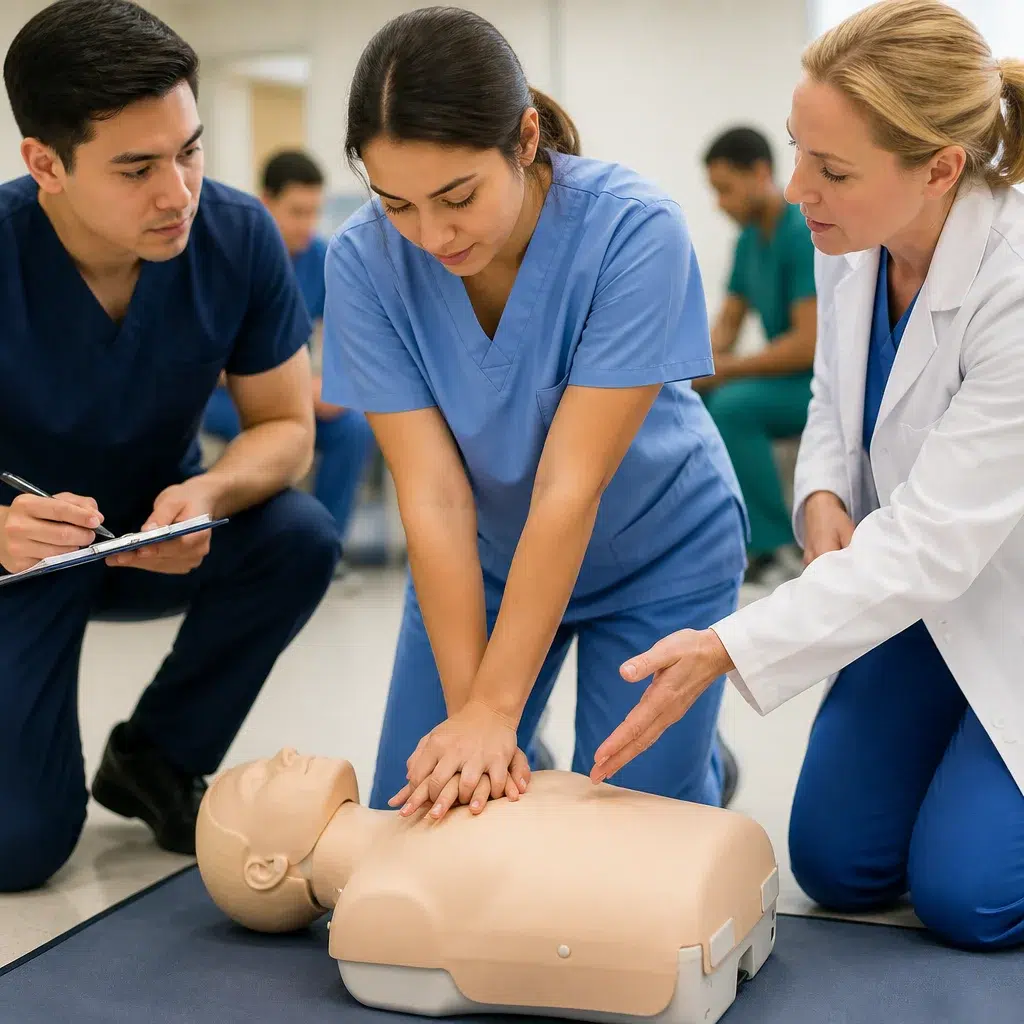
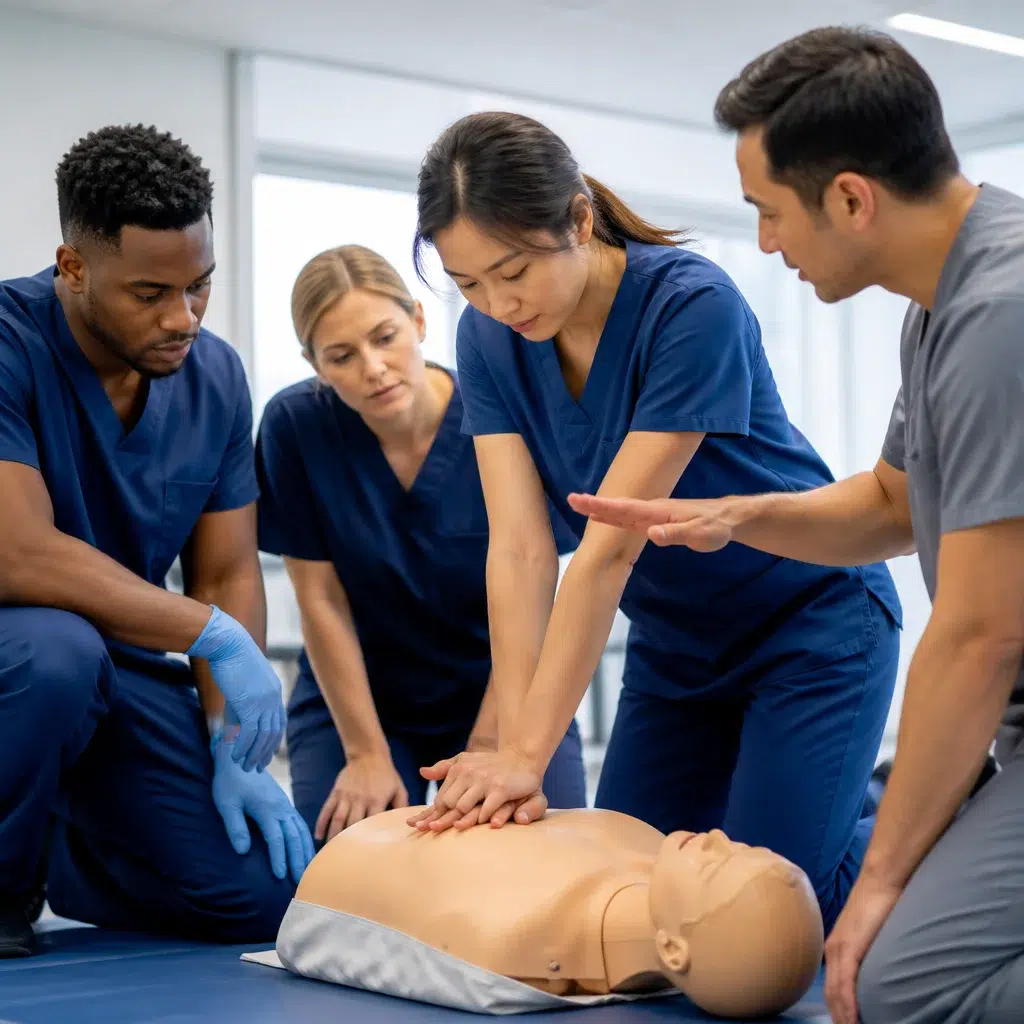
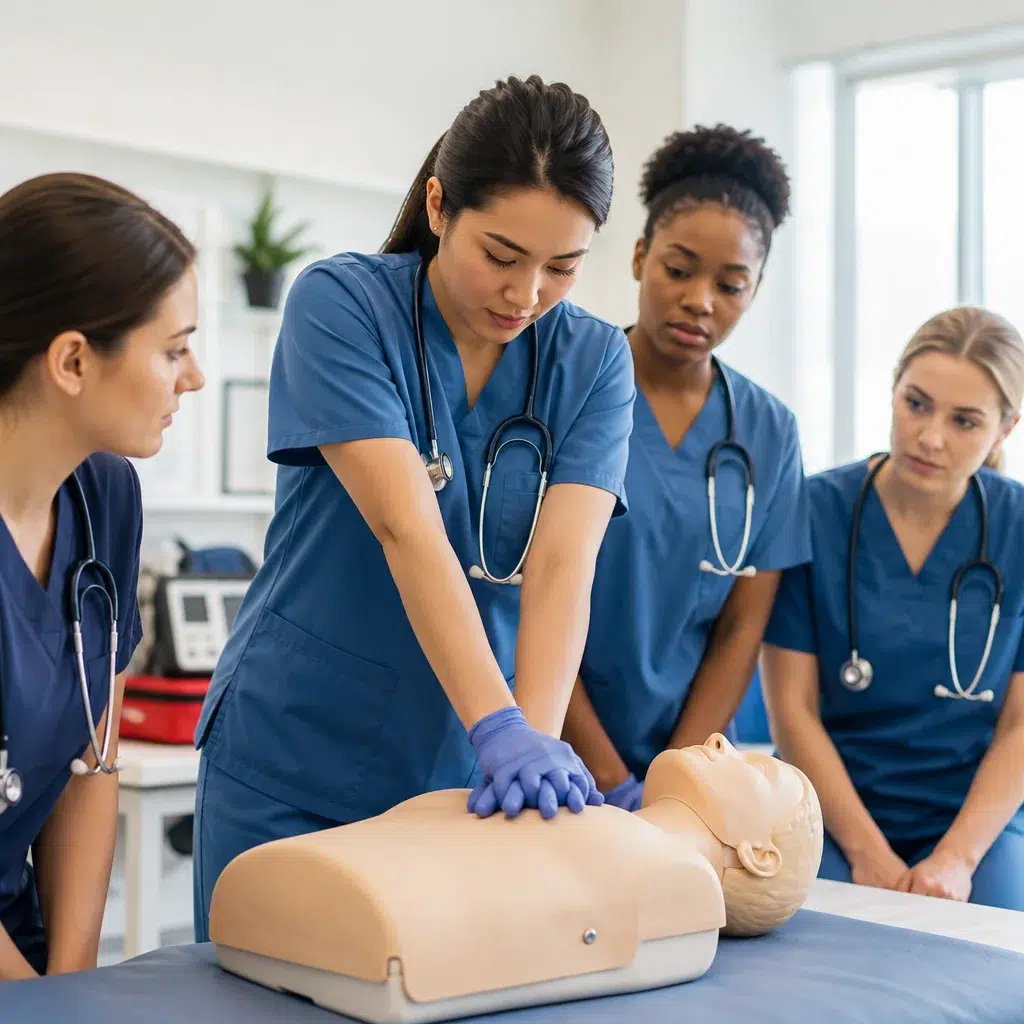
Use a blended learning pathway to measure proficiency efficiently. Have clinicians complete AHA-aligned eLearning for knowledge, followed by in-person skills sessions with feedback manikins and standardized checklists. Capture objective metrics—compression quality, ventilation technique, AED use, pharmacology accuracy—and require remediation if benchmarks are not met.
Scenario-based evaluations make the assessments realistic and defensible:

- Dental office: vasovagal syncope at chairside, anaphylaxis after local anesthetic, laryngospasm during nitrous/enteral sedation, and management of an avulsed tooth with bleeding control.
- Primary/urgent care: chest pain to cardiac arrest progression with team roles and defibrillation, pediatric respiratory failure with BVM and medication dosing, and opioid overdose with naloxone administration.
- Cross-cutting skills: emergency communication, role assignment, equipment setup, post-event documentation, and debriefing.
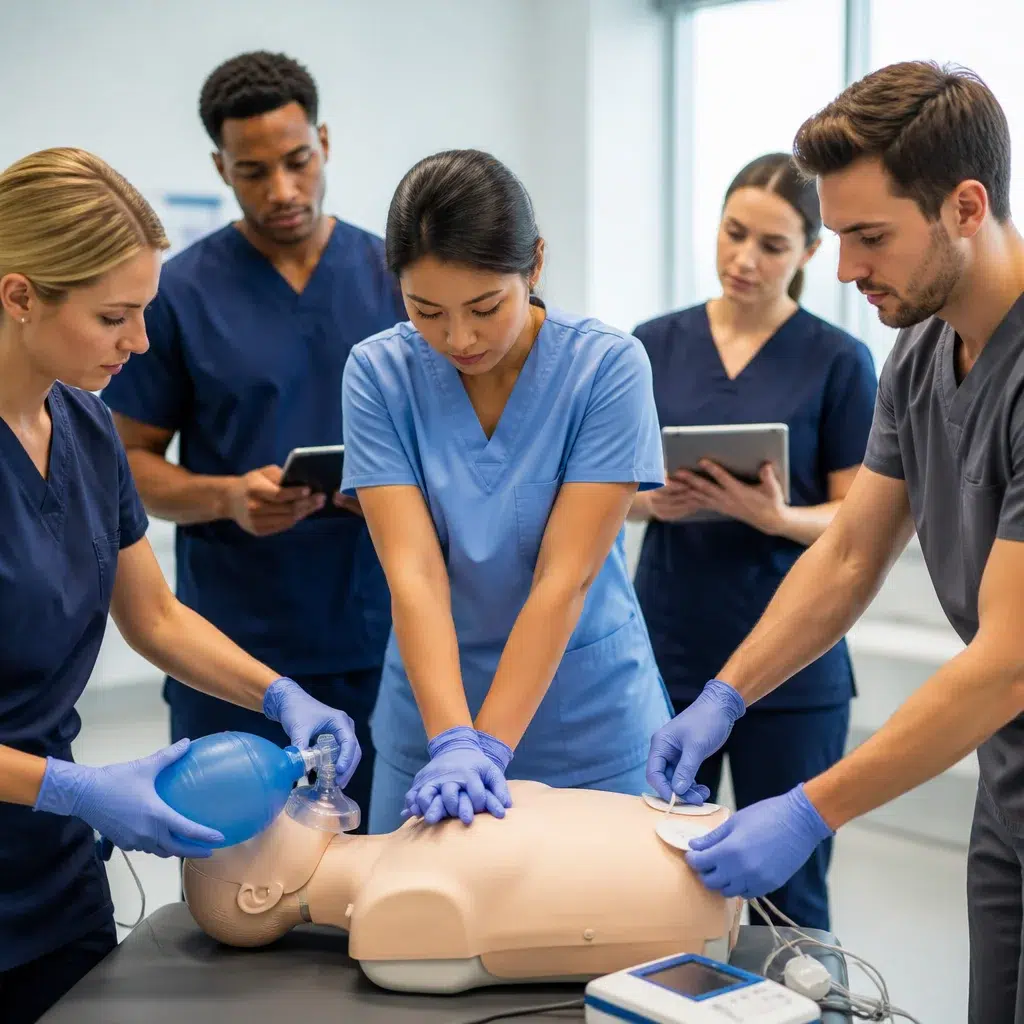
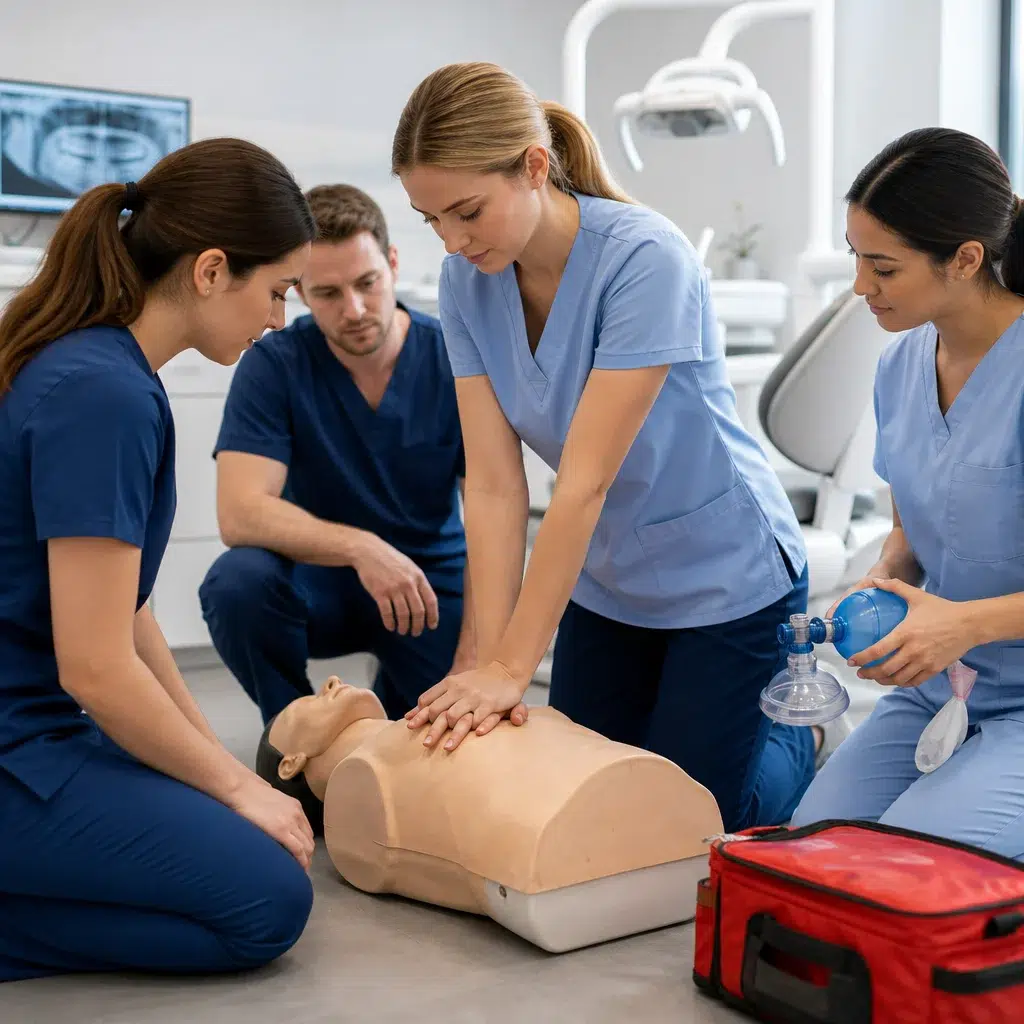
Integrate a dental clinic safety assessment alongside skills checks. Verify AED placement and readiness, oxygen and suction function, emergency drug inventory and expiration tracking, and accessibility of bag-mask devices and airway adjuncts. Tie each equipment item to a related skill (e.g., BVM ventilation, rhythm recognition, epinephrine for anaphylaxis) to ensure the team can perform under pressure and your records support California safety compliance.
Finally, set a cadence for reassessment—at onboarding, after scope changes, and at least annually for high-risk skills. Safety Training Seminars can streamline this with blended BLS, ACLS, PALS, and NRP pathways, skills sessions at 100+ California locations or onsite for groups, corporate scheduling support, and a low price guarantee. Their AHA-aligned evaluations provide the documentation clinics need when demonstrating a thorough training needs assessment for clinics.
Summary Comparison of Assessment Methods for California Providers
A practical training needs assessment for clinics compares several methods to capture both compliance and real-world performance. For California providers, the goal is to align medical staff training requirements with daily risk, patient mix, and California safety compliance expectations. Below is a concise comparison to help dental and outpatient leaders decide what to use, when, and why.
- Regulatory and role-based mapping: Match each role to mandated or expected credentials (AHA BLS for dental professionals, ACLS/PALS for sedation or urgent care settings; annual Bloodborne Pathogens under Cal/OSHA). Best for establishing a baseline and clarifying outpatient clinic certification needs. Example: a dental clinic that occasionally provides pediatric sedation may map dentists to PALS and all staff to BLS.
- Competency checklists and direct observation: Validate skills beyond the card—AED pad placement, high-quality compressions, airway maneuvers, and team communication. Ideal for a dental clinic safety assessment or urgent care triage refreshers.
- Certification lifecycle/HRIS audit: Inventory who has what and when it expires to prevent lapses. Useful for multi-site groups tracking BLS for dental professionals, ACLS for procedural RNs, or PALS for pediatric providers.
- Incident and near-miss review: Analyze fainting episodes, anaphylaxis after local anesthetic, needlesticks, or delayed 911 activation. Data-driven approach that prioritizes training on the events you actually experience.
- Mock codes and scenario drills: Run short, role-specific drills (adult arrest in the waiting room, pediatric airway obstruction, local anesthetic toxicity). Fast way to test team roles, crash cart readiness, and debrief gaps.
- Staff surveys and interviews: Surface barriers to performance (e.g., confidence using the bag-mask, location of suction tips, or after-hours coverage). Combine with patient volume and acuity trends for a fuller picture.
- External review or third-party audit: Brings objective benchmarking and recommendations. Safety Training Seminars can align AHA course selection with your service mix and plan blended learning to minimize downtime.
- Risk stratification by services and populations: Higher-risk services (sedation, minor procedures, pediatrics, geriatrics) merit ACLS/PALS emphasis and more frequent drills. Low-acuity clinics focus on BLS and rapid activation of EMS.
- Cost and impact analysis: Compare staff time away, travel, and rescheduling costs versus blended learning with local skills checks. This helps justify frequency and format selection.
For small practices, a lean mix—role mapping, lifecycle tracking, and quarterly drills—often covers most training needs assessment for clinics. Larger outpatient groups benefit from HR dashboards, incident-driven curricula, and periodic external reviews. Safety Training Seminars supports both with AHA-certified BLS/ACLS/PALS, blended learning, over 100 California locations, corporate group options, and a low price guarantee to keep compliance predictable and accessible.
Selection Guide for California Dental and Outpatient Facilities
Start by framing a training needs assessment for clinics around risk, scope of services, and California safety compliance. Inventory the procedures you perform (e.g., pediatric sedation, stress testing, endoscopy) and the patient populations you serve. Then map those activities to medical staff training requirements and renewal cycles so you can select certifications that are both compliant and practical to maintain.
Build a role-and-service matrix so requirements are clear and defensible during audits and payer credentialing. Examples that commonly satisfy outpatient clinic certification needs include:
- All patient-facing staff: AHA BLS for dental professionals and healthcare providers; many clinics train all employees who may assist in emergencies.
- Sedation or general anesthesia (dental or ambulatory surgery): ACLS for the sedation team; PALS when providing pediatric sedation.
- Adult urgent care, endoscopy, cardiology/stress testing: ACLS for licensed providers; BLS for support staff.
- Pediatric clinics and oral surgery serving children: PALS for providers who may lead a pediatric code; BLS for all clinical staff.
- Perinatal or newborn services in outpatient settings: NRP for clinicians who attend deliveries or stabilize neonates.
Confirm state, licensing board, and accreditor rules that apply to your setting. The Dental Board of California requires BLS for license renewal, and sedation permit holders typically need ACLS and, for pediatric sedation, PALS. For medical clinics, check Medical Board guidance and any ASC or clinic accreditor standards. Cal/OSHA Bloodborne Pathogens training, exposure control planning, and post-exposure procedures should be part of your dental clinic safety assessment and annual refresher plan.
Select delivery formats that minimize disruption while maintaining quality. Blended learning (online coursework plus brief in-person skills checks) helps busy providers renew on time, while on-site group sessions are efficient for larger teams or new-site openings. Safety Training Seminars offers AHA BLS, ACLS, PALS, and specialized courses statewide with over 100 California locations, blended options, corporate scheduling support, and a low price guarantee—useful when standardizing training across multiple clinics.
Operationalize the plan with clear documentation and cadence. Set renewal reminders at 90/60/30 days; most AHA cards renew every two years. Schedule quarterly mock codes tailored to your risks (e.g., anaphylaxis in dental sedation, adult cardiac arrest in endoscopy, pediatric respiratory failure in urgent care), and include AED checks and oxygen readiness. Keep rosters, cards, and Cal/OSHA training records centralized for survey readiness and continuous improvement.
Register for a class today.