FREE DOWNLOADABLE CPR POSTERS WITH THE NEW 2025 GUIDELINES: FREE CPR POSTERS


Safety Training Seminars

AHA logo
AHA logo

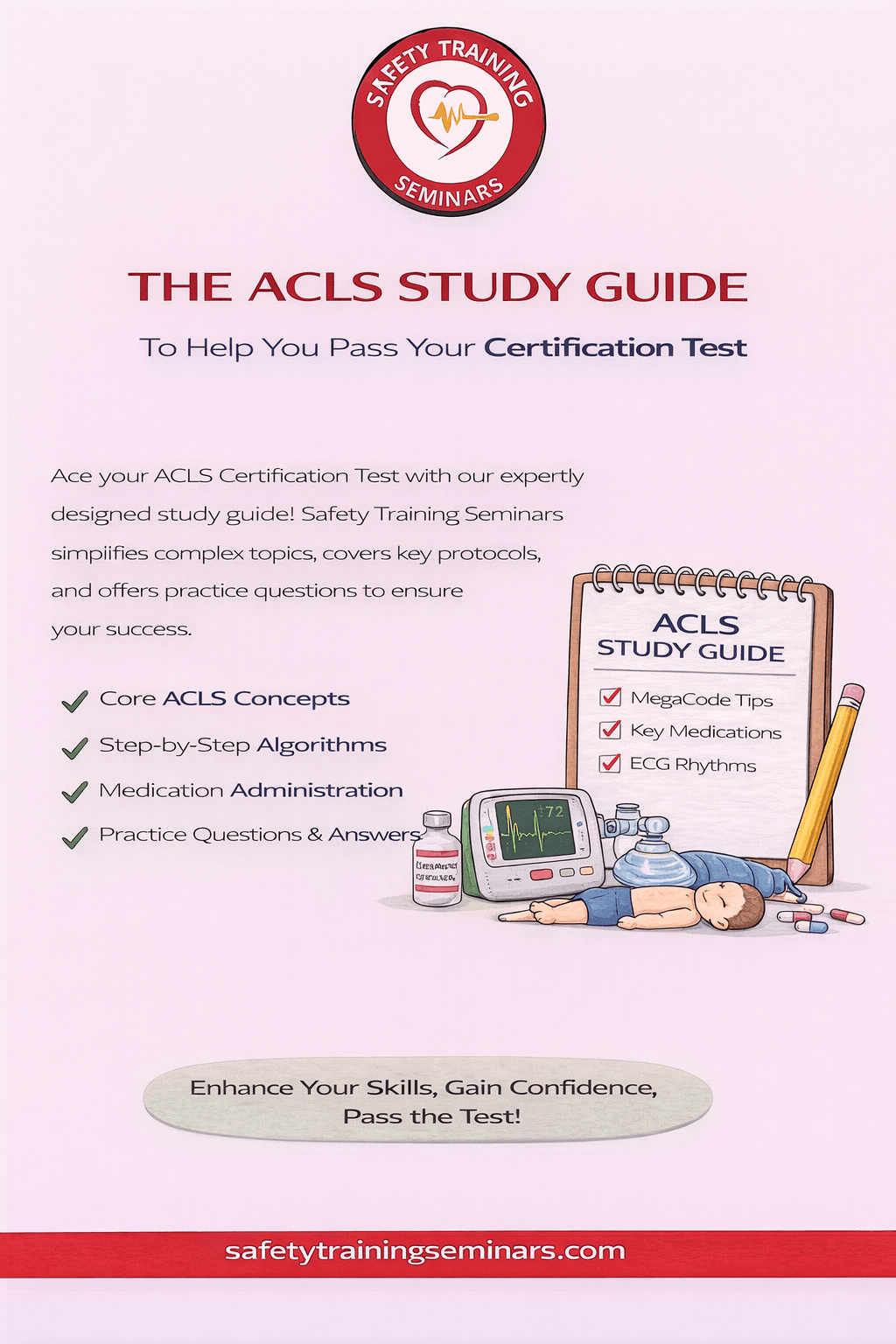
The Ultimate ACLS Study Guide to Help You Pass Your Certification

ACLS study guide

You are likely here because your ACLS certification is coming up. Maybe it is your first time taking the course, or perhaps you are due for a renewal. Either way, the Advanced Cardiovascular Life Support (ACLS) exam can feel intimidating. The algorithms seem complex, the pharmacology list is long, and the pressure of a Mega Code scenario is real.

But here is the good news. You do not need to memorize every single page of the provider manual to pass. You just need a strategic approach to studying the right material.

This guide covers everything you need to know to navigate your ACLS course with confidence. We break down the core algorithms, simplify the essential pharmacology, and highlight the latest 2025 American Heart Association (AHA) updates. We also include local data that emphasizes why this training matters right here in California.

At Safety Training Seminars, we have been helping healthcare professionals like you get certified since 1989. With over 70 locations across California, we understand exactly what it takes to succeed. Let’s dive in.

Why ACLS Certification Matters More Than You Think

ACLS is not just another card to keep in your wallet. It is a critical skillset that saves lives. When a patient goes into cardiac arrest, the quality of the resuscitation effort determines whether they survive and if they walk out of the hospital neurologically intact.

Let’s look at the numbers. According to the 2022 CARES Survival Report, the national survival rate for out-of-hospital cardiac arrest to hospital discharge is roughly 9.4%. That is a sobering statistic. It means that for every ten people who suffer a cardiac arrest outside of a hospital, only one typically survives.

However, high-quality training moves the needle. In Alameda County, local EMS systems implemented rigorous training updates—focusing on high-quality CPR and team dynamics similar to what you learn in ACLS. The result? They saw return of spontaneous circulation (ROSC) rates jump from 29% to over 42% in recent years.

This proves that what you learn in your ACLS course works. It is not just theory. It is the difference between life and death.

Prerequisites You Need Before You Start

Before you tackle the advanced material, you must have a solid foundation. Many students struggle in ACLS not because the advanced concepts are too hard, but because their basic skills are rusty.

High Quality BLS is the Foundation

You cannot run a successful code without high-quality Basic Life Support (BLS). The AHA emphasizes that high-quality CPR is the single most important intervention in cardiac arrest.
  • Compressions: Push hard (at least 2 inches) and fast (100–120 beats per minute).
  • Recoil: Allow the chest to fully recoil after each compression. Do not lean on the chest.
  • Interruptions: Minimize interruptions in compressions to less than 10 seconds.

ECG Rhythm Recognition

You must be able to identify cardiac rhythms on a monitor. You do not need to be a cardiologist, but you need to instantly recognize:
  • Sinus Bradycardia
  • Supraventricular Tachycardia (SVT)
  • Ventricular Tachycardia (V-Tach)
  • Ventricular Fibrillation (V-Fib)
  • Asystole
  • Pulseless Electrical Activity (PEA)
  • Heart Blocks (1st degree, 2nd degree Type I and II, 3rd degree)

Basic Pharmacology Knowledge

You should know the primary drugs used in cardiovascular emergencies. We will cover these in detail later, but you should be familiar with Epinephrine, Amiodarone, Atropine, and Adenosine.

The Systematic Approach to Emergency Care

In any emergency, panic is your enemy. The AHA teaches a systematic approach to ensure you do not miss anything. This structure keeps you calm and focused.

The BLS Assessment

This is your first step. Is the scene safe? Is the patient responsive?
  1. Check Responsiveness: Tap and shout.
  2. Activate Emergency Response: Get help and an AED.
  3. Check Breathing and Pulse: Look for chest rise and feel for a carotid pulse for no more than 10 seconds.
  4. Defibrillation: If no pulse, start CPR and attach the AED/monitor as soon as possible.

The Primary Survey (ABCDE)

Once you have established the patient is unconscious or in arrest, move to the Primary Survey.
  • Airway: Is the airway patent? Do you need an advanced airway?
  • Breathing: Are ventilations effective? Is the chest rising? Maintain oxygen saturation >94%.
  • Circulation: How is the quality of CPR? Do you have IV/IO access? What is the rhythm?
  • Disability: Check neurological function quickly (AVPU: Alert, Voice, Pain, Unresponsive).
  • Exposure: Remove clothing to perform a physical exam but prevent hypothermia.

The Secondary Survey (SAMPLE and Hs & Ts)

This is where you play detective. Why did this happen?
  • S: Signs and Symptoms
  • A: Allergies
  • M: Medications
  • P: Past medical history
  • L: Last meal
  • E: Events leading up to the emergency

Understanding the Hs and Ts

Reversible causes are the most common reasons a resuscitation attempt fails. If you fix the rhythm but do not fix the cause, the patient will not stabilize. You must memorize the Hs and Ts.

The 5 Hs

  1. Hypovolemia: Low blood volume. Look for rapid heart rate and narrow QRS complexes. Solution: Fluid bolus.
  2. Hypoxia: Lack of oxygen. Ensure your airway is open and oxygen is flowing.
  3. Hydrogen Ion (Acidosis): Often caused by prolonged respiratory failure. Solution: Good ventilation. Sodium bicarbonate is rarely used routinely now.
  4. Hypo/Hyperkalemia: Potassium issues. Look for peaked T-waves (hyper) or flattened T-waves (hypo).
  5. Hypothermia: The patient is cold. You cannot pronounce a patient dead until they are warm and dead.

The 5 Ts

  1. Tension Pneumothorax: Air trapped in the chest cavity collapsing the lung and heart.
    • Signs: Tracheal deviation, unequal breath sounds.
    • Solution: Needle decompression.
  2. Tamponade (Cardiac): Fluid in the pericardial sac squeezing the heart.
    • Signs: Muffled heart sounds, distended neck veins.
    • Solution: Pericardiocentesis.
  3. Toxins: Drug overdose (opioids, beta-blockers, etc.).
    • Solution: Antidotes if available.
  4. Thrombosis (Pulmonary): Pulmonary Embolism (PE).
  5. Thrombosis (Coronary): Myocardial Infarction (MI).

Mastering the Cardiac Arrest Algorithm

This is the core of ACLS. You will face this in your Mega Code. The algorithm splits into two paths based on whether the rhythm is “shockable” or “non-shockable.”

The Shockable Rhythms

These are Ventricular Fibrillation (V-Fib) and Pulseless Ventricular Tachycardia (pVT).
  1. Shock: Defibrillate immediately. This is the priority.
  2. CPR: Resume CPR immediately for 2 minutes. Do not check the pulse right after the shock.
  3. Shock: Check rhythm. If persistent, shock again.
  4. Drug – Epinephrine: Give 1 mg IV/IO every 3-5 minutes.
  5. Drug – Antiarrhythmic: Consider Amiodarone (300 mg bolus, then 150 mg) or Lidocaine (1-1.5 mg/kg).

The Non-Shockable Rhythms

These are Asystole and Pulseless Electrical Activity (PEA).
  1. CPR: Start CPR immediately.
  2. Epinephrine: Give 1 mg IV/IO as soon as possible. Repeat every 3-5 minutes.
  3. Search for Causes: Review your Hs and Ts vigorously.
  4. No Shock: You cannot shock these rhythms. Defibrillation will not help.

Study Tip: Notice that Epinephrine is given for all cardiac arrests, but Amiodarone is only for shockable rhythms that do not respond to shocks.

Navigating the Bradycardia Algorithm

Bradycardia is defined as a heart rate less than 50 bpm. But remember, we treat the patient, not the monitor. Is the patient symptomatic?

Symptoms of Unstable Bradycardia

  • Hypotension (Low BP)
  • Altered mental status
  • Signs of shock
  • Ischemic chest discomfort
  • Acute heart failure

Treatment Steps

  1. Atropine: The first-line drug. Dose is 1 mg IV. You can repeat it every 3-5 minutes up to a total of 3 mg.
  2. Pacing: If Atropine fails, move to Transcutaneous Pacing (TCP). Do not delay pacing for unstable patients.
  3. Dopamine or Epinephrine Infusion: If pacing is unavailable or ineffective, consider a drip.

Simplifying the Tachycardia Algorithm

Tachycardia is a heart rate greater than 100 bpm, but usually, symptoms appear when the rate exceeds 150 bpm.

Stable vs Unstable

Just like bradycardia, your first question is: Is the patient unstable?
  • Unstable: Immediate Synchronized Cardioversion. Do not mess around with drugs if the patient is crashing.
  • Stable: You have time to diagnose and treat with medication.

Stable Tachycardia with Narrow QRS

This is usually SVT.
  1. Vagal Maneuvers: Ask the patient to bear down.
  2. Adenosine: 6 mg rapid IV push. If it doesn’t convert, give 12 mg. Warning: The patient will feel terrible for a few seconds (chest tightness, flushing). Warn them.

Stable Tachycardia with Wide QRS

This is likely V-Tach (with a pulse).
  1. Amiodarone: 150 mg IV over 10 minutes.
  2. Consult: Get expert consultation.

Post Cardiac Arrest Care and ROSC

You saved them! The heart is beating again (Return of Spontaneous Circulation – ROSC). Now the real work begins to save the brain.

Respiratory Optimization

Keep oxygen saturation between 92% and 98%. Do not over-oxygenate. Avoid excessive ventilation, which decreases blood flow to the brain.

Hemodynamic Support

Keep the blood pressure up. Aim for a Systolic BP > 90 mmHg or a Mean Arterial Pressure (MAP) > 65 mmHg. You may need IV fluids or vasopressor infusions (Epinephrine, Dopamine, Norepinephrine).

Targeted Temperature Management (TTM)

This is a critical update. According to the 2023 AHA guidelines, all comatose adult patients with ROSC should receive TTM.
  • Target: Select a constant temperature between 32°C and 37.5°C.
  • Duration: Maintain for at least 24 hours.
  • Why: This protects the brain from injury caused by reperfusion.

Acute Coronary Syndromes (ACS)

Time is muscle. Your goal is to identify a STEMI (ST-Elevation Myocardial Infarction) and open the vessel.

Immediate Treatment (MONA)

While “MONA” is the classic mnemonic, the order has changed, and morphine is used less often.
  • Oxygen: Only if sats are < 90%.
  • Aspirin: 162-325 mg (chewed). Give this early!
  • Nitroglycerin: Sublingual tablet or spray every 5 mins for chest pain.
  • Morphine: Use with caution. Only for chest pain unresponsive to nitro.

The 12-Lead ECG

Obtain a 12-lead ECG within 10 minutes of arrival. If it shows ST elevation, the patient needs the Cath Lab (PCI) within 90 minutes.

Recognizing and Treating Acute Stroke

Time is brain. You must quickly identify a potential stroke and get the patient to a CT scan to rule out a bleed.

The Cincinnati Prehospital Stroke Scale

  • Facial Droop: Have the patient smile.
  • Arm Drift: Have the patient close eyes and hold out arms.
  • Speech: Have the patient say, “You can’t teach an old dog new tricks.”

The CT Scan

This is the priority intervention. You need to know if the stroke is Ischemic (clot) or Hemorrhagic (bleed).
  • Ischemic: May be eligible for Fibrinolytics (tPA) if within 3-4.5 hours of symptom onset.
  • Hemorrhagic: Do NOT give fibrinolytics.

Essential Pharmacology Review

A pharmacology review is essential for passing your test. Here are the “Big 5” you will use most often.
  • Epinephrine: The adrenaline kick. Increases heart rate and blood pressure. Used in Cardiac Arrest (every 3-5 mins), Bradycardia, and Anaphylaxis.
  • Amiodarone: The anti-arrhythmic. Used for V-Fib/V-Tach. Cardiac arrest dose: 300 mg then 150 mg. Stable V-Tach dose: 150 mg drip.
  • Adenosine: The reset button. Used for SVT. Stops the heart briefly to allow the sinus node to take back over. Rapid push!
  • Atropine: The speed-up drug. Used for symptomatic Bradycardia. Blocks the vagus nerve.
  • Lidocaine: The alternative to Amiodarone. Used for V-Fib/V-Tach.

Updates from the 2025 AHA Guidelines

Medicine evolves, and so do the guidelines. The 2025 Focused Update brought a few key changes you should note for your exam.
  • Routine Drugs: Routine administration of calcium, sodium bicarbonate, and magnesium is not recommended for cardiac arrest unless a specific cause (like hyperkalemia) is identified.
  • Epinephrine Timing: Administer Epi as soon as possible for non-shockable rhythms. For shockable rhythms, give it after the first failed shock.
  • Seizure Management: Seizure activity after ROSC should be treated and EEG monitoring is recommended for comatose patients.
  • ECPR: Extracorporeal CPR (using a bypass machine during CPR) is reasonable for select patients if feasible.

Effective Team Dynamics

You can know every drug and algorithm, but if you cannot lead a team, you will fail the Mega Code. The AHA tests your ability to communicate.
  • Closed-Loop Communication: When the Team Leader gives an order (“Give 1mg Epinephrine”), the Team Member repeats it back (“Giving 1mg Epinephrine”) and confirms completion (“1mg Epinephrine given”).
  • Clear Roles: Everyone should know their job (Compressor, Monitor, Meds, Airway, Recorder, Leader).
  • Constructive Intervention: If you see a mistake about to happen, speak up! “Stop, I think that dose is incorrect.”
  • Knowledge Sharing: The leader should ask for input. “Does anyone have other ideas for the cause?”

How to Prepare for Your Mega Code

The Mega Code is the practical exam. You will lead a team through a cardiac case that evolves (e.g., starts as bradycardia, goes into V-Fib, achieves ROSC).

Tips for Success

  1. Stay Calm: Take a deep breath.
  2. Talk Out Loud: Let the instructor know what you are thinking. “I see V-Fib. I am clearing the patient to shock.”
  3. Use Your Team: Don’t do CPR yourself. Assign roles. “John, start compressions. Sarah, get the monitor.”
  4. Follow the Algorithms: Do not freelance. Stick to the script.

Why Choose Safety Training Seminars?

We know you have choices for your certification, but we believe we offer the most stress-free experience in California. Since 1989, we have trained thousands of medical professionals.

We offer a Low Price Guarantee. You won’t find a legitimate American Heart Association course for less. Plus, we issue your official AHA certification card on the same day. No waiting around for weeks to show your employer you are compliant.

We have over 70 locations throughout the state, from San Francisco to San Diego. We offer classes every single day, including weekends, because we know your shift schedule is crazy.

When you book with us, you are choosing a woman-owned, local business that cares about your success. We make the booking process easy, and our instructors are there to help you learn, not to intimidate you.

Frequently Asked Questions

Here are the most common questions we get from students preparing for ACLS.

Can I take ACLS if I don't have a current BLS card?

Technically, a current BLS certification is a prerequisite for ACLS. However, at Safety Training Seminars, we often allow you to renew your BLS during the same session or offer a combo course. Check the specific course details when you register.

How long is the ACLS certification good for?

Your American Heart Association ACLS provider card is valid for two years from the end of the month in which you completed the course.

What happens if I fail the Mega Code?

Don’t panic. Our goal is for you to pass. If you struggle with the Mega Code, our instructors will usually provide remediation—reviewing what went wrong and letting you try again. We want you to leave confident and certified.

Is the pre-course self-assessment mandatory?

Yes. The AHA requires you to complete the Pre-Course Self-Assessment and Pre-Course Work before attending the class. You must print your certificate (or show it on your phone) to enter the class. It helps identify your weak spots so you can study effectively.

Do I need to buy the provider manual?

The AHA mandates that every student has access to the current ACLS Provider Manual before, during, and after the course. You can use a physical book or an eBook.

What is the difference between HeartCode ACLS and the traditional class?

HeartCode ACLS is a “blended learning” format. You complete the cognitive portion (videos and exams) online at home, then come into one of our offices for a short skills check. The traditional class is entirely in-person. Both result in the exact same AHA card.

How much does the ACLS course cost?

At Safety Training Seminars, our ACLS renewal course is approximately $290, which includes the online course, the skills testing, and the certification card. We back this with our Low Price Guarantee.

Can I take ACLS online only?

No. You cannot get an official AHA ACLS card entirely online. You must demonstrate your physical skills (CPR and AED use) in front of an authorized instructor. Beware of websites selling “instant” online-only cards; most employers will not accept them.

What should I wear to the class?

Wear comfortable clothing. You will be practicing CPR on manikins, which involves kneeling on the floor and physical exertion.

How quickly will I get my card?

With Safety Training Seminars, you receive your digital eCard immediately after successfully completing the course. You can claim it, download it, and email it to your manager before you even leave the parking lot.

Final Thoughts on Your ACLS Journey

Passing your ACLS certification is about more than just memorizing a few charts. It is about preparing yourself to lead a team during the worst day of someone’s life. It is about having the confidence to say, “I know what to do.”

By focusing on the systematic approach, understanding the “why” behind the medications, and keeping calm under pressure, you will not only pass the exam but also be a better clinician.

We hope this guide serves as a valuable resource in your preparation. If you are ready to schedule your course, we would love to see you at one of our centers.