
Introduction: Essential Criteria for Selecting a BLS Course in California
Choosing the right BLS certification for healthcare providers in California is about more than convenience—it directly affects job readiness, regulatory compliance, and hospital credentialing. Employers and licensing bodies expect courses aligned to nationally recognized healthcare provider training standards and issued by authorized training centers. The most widely accepted credential is the American Heart Association (AHA) BLS Provider eCard, and many California hospitals specifically require it to meet medical professional CPR requirements.
Verify acceptance criteria based on your role. For dentists and dental hygienists, the Dental Board of California requires basic life support certification California with an in-person skills component; online-only CPR is not sufficient. For EMTs and paramedics, local EMS agencies typically expect AHA BLS (or equivalent) that includes adult, child, and infant skills with AED use; always confirm with your agency. For nurses, nursing license certification compliance is handled separately by the BRN, but nearly all acute care facilities require current AHA BLS for employment and privileging.
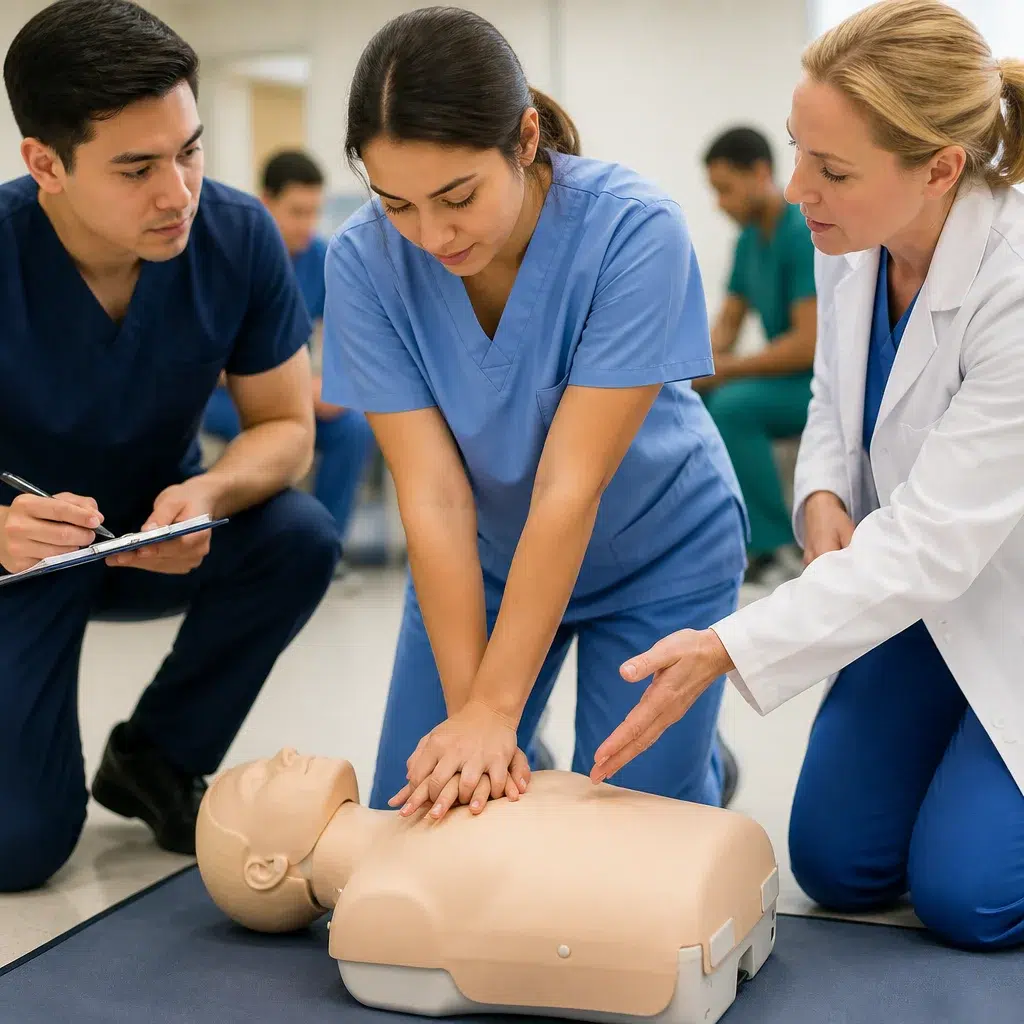
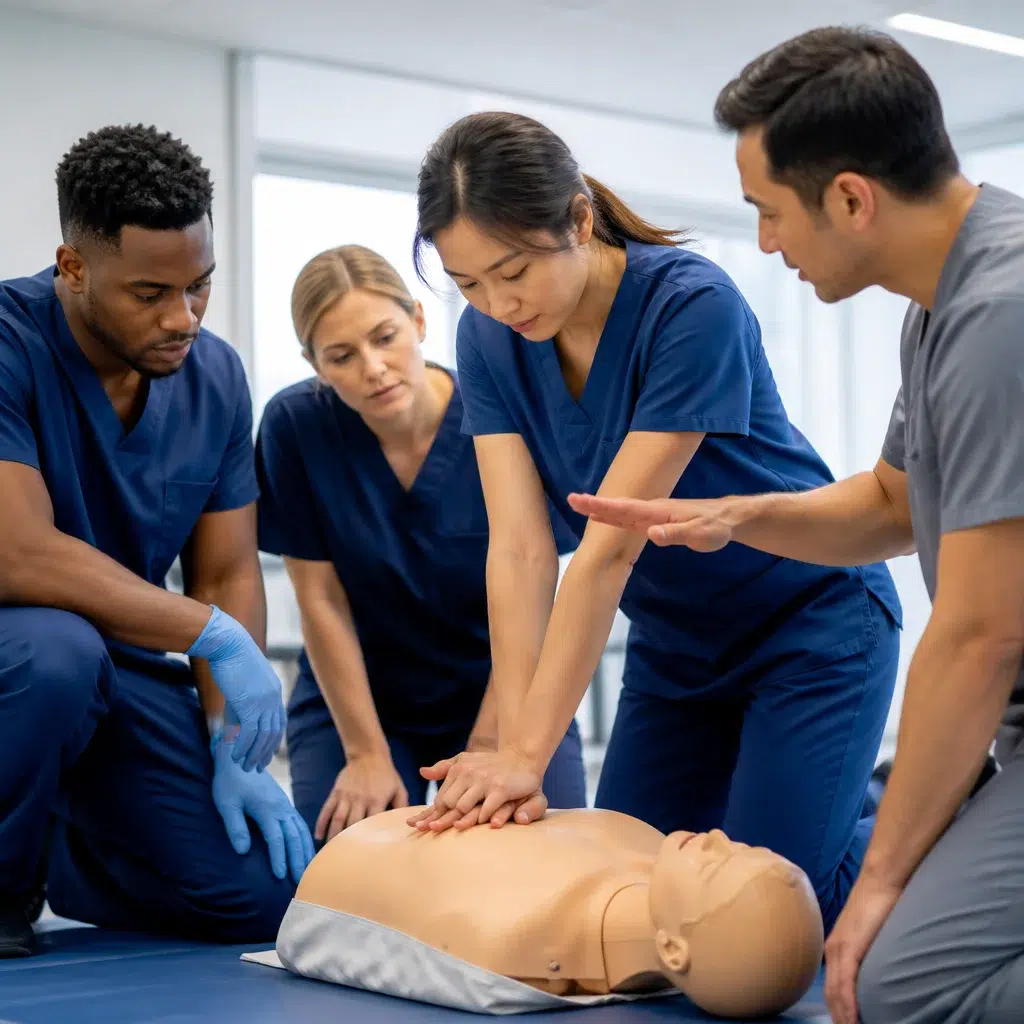
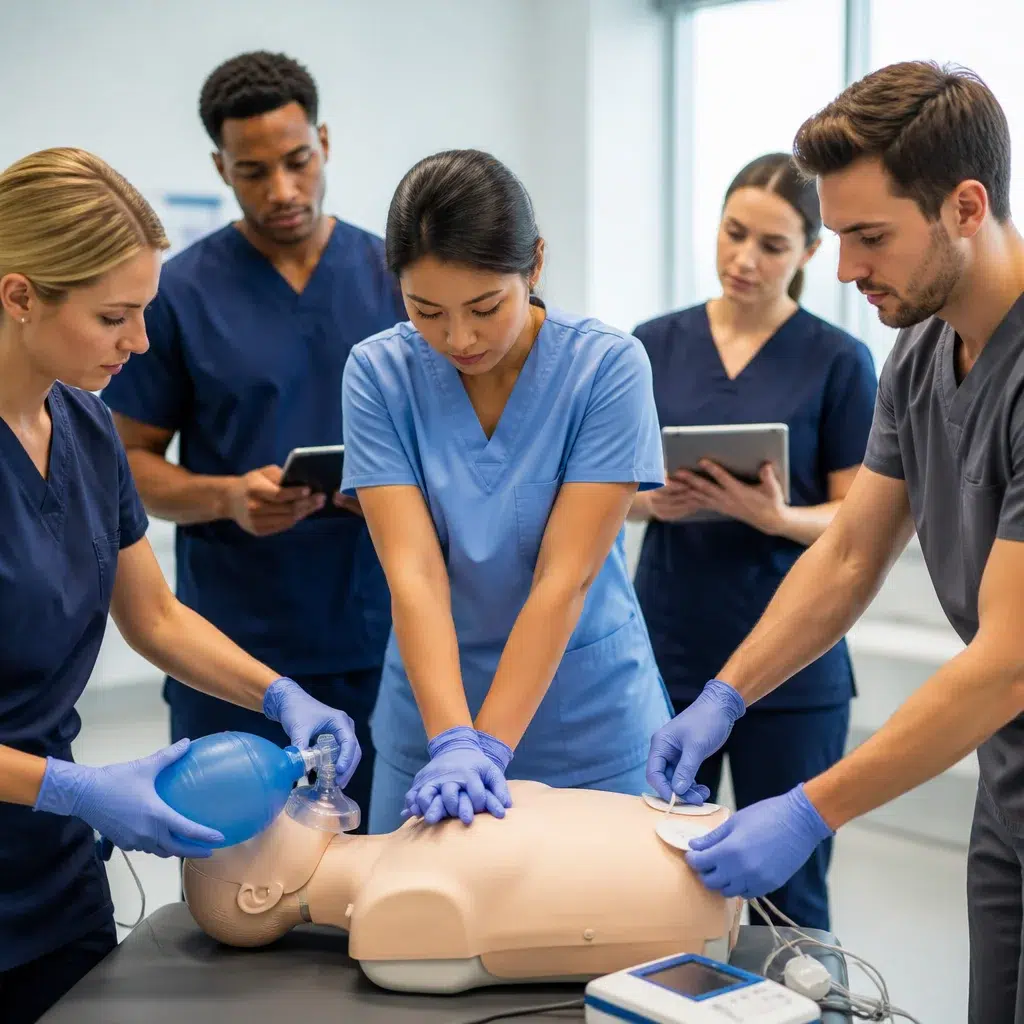
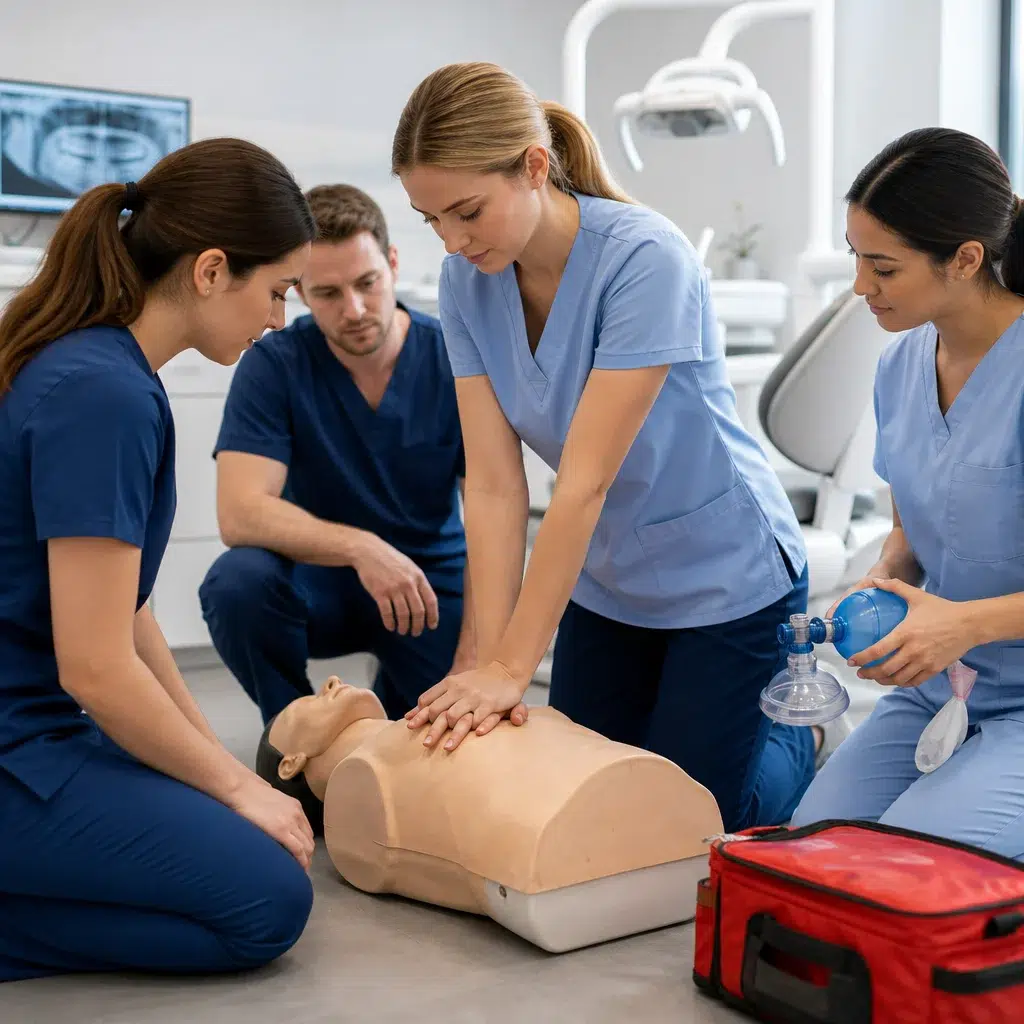
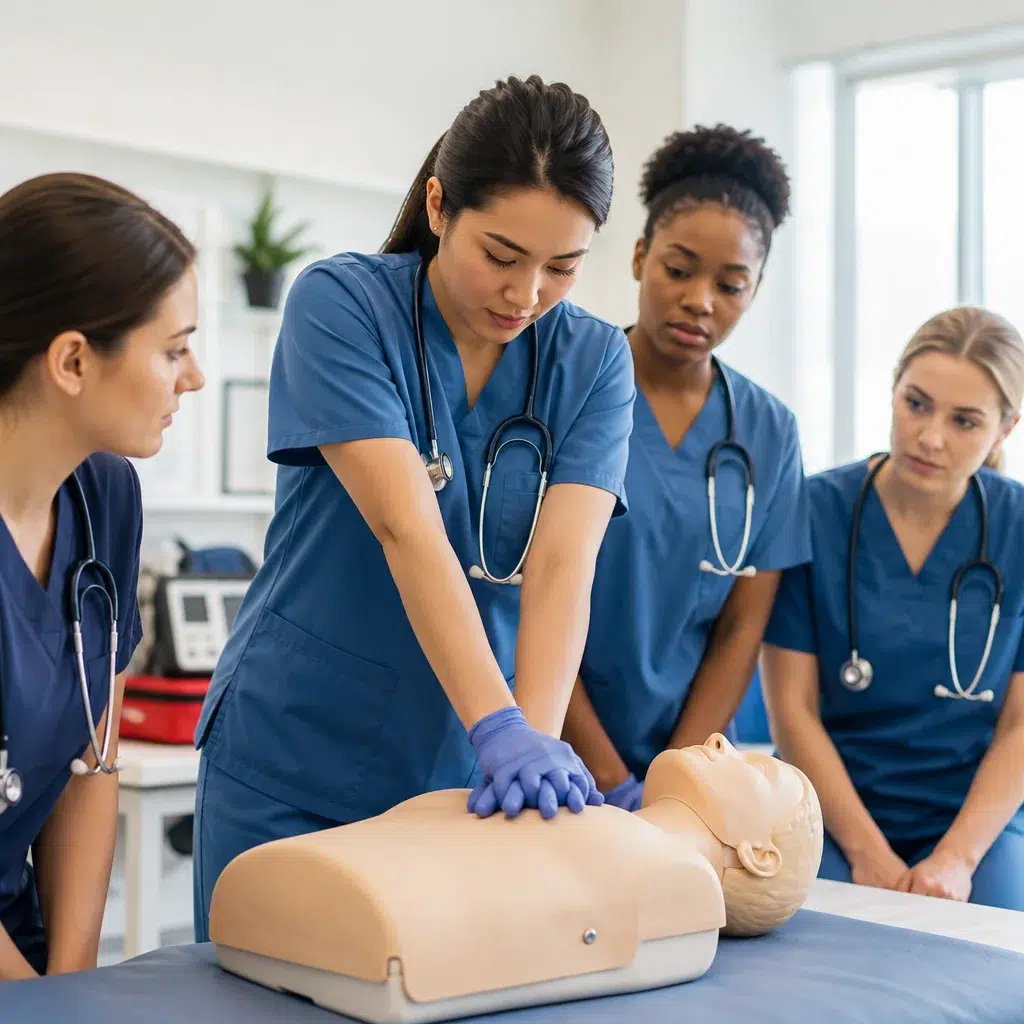
Decide on the right format by weighing online versus blended learning CPR. Blended options (eLearning plus a brief, scheduled hands-on skills session) are popular with clinicians who need flexibility without sacrificing the required skills check. Expect the skills session to cover high-quality compressions, ventilation with a bag-valve-mask, team dynamics, and defibrillation using an AED, often with feedback manikins to verify rate and depth.
Key criteria to evaluate before enrolling:
- Accreditation and card type: AHA BLS Provider eCard (or employer-approved equivalent) with easy employer verification.
- Hands-on requirement: A proctored skills check; avoid online-only CPR for healthcare roles.
- Instructor and equipment quality: Experienced instructors, feedback-enabled manikins, and realistic scenarios.
- Scheduling and access: Frequent classes, evenings/weekends, and locations close to major hospitals and clinics.
- Documentation: Fast eCard issuance, replacement card support, and digital records you can share with HR.
- CE and agency approvals: If you need CE credits, confirm BRN/EMSA acceptance in advance.
- Group options: Onsite corporate sessions, volume discounts, and centralized roster management.
- Transparent pricing: Clear fees, recertification options, and a low price guarantee.
Safety Training Seminars is a California-based option that aligns with these expectations, offering blended learning with convenient in-person skills sessions across 100+ statewide locations. Healthcare teams can also book onsite group trainings with discount pricing and streamlined documentation support. Whichever provider you choose, confirm the exact credential your employer requires and ensure the course format, card type, and turnaround time meet your facility’s standards.
Top Recommendation for Clinical Compliance: Official Provider Classroom Training
For the highest level of acceptance in hospitals and clinics, choose an official, instructor‑led BLS Provider course with hands-on skills verification. This path to BLS certification for healthcare providers aligns with the most widely recognized healthcare provider training standards and satisfies typical medical professional CPR requirements used by California employers. In acute care, perioperative, and procedural settings, managers look for AHA BLS Provider cards (or equivalent with documented skills) because they demonstrate psychomotor competency and team-based response skills that a video-only course cannot confirm.
While the California Board of Registered Nursing does not mandate BLS for license renewal, most health systems require current BLS Provider as a condition of employment and unit assignment, making it critical for nursing license certification compliance in practice. Joint Commission–accredited facilities also expect staff to demonstrate competence in resuscitation, which is best met with an official provider classroom format. For basic life support certification California stakeholders will accept across departments—from ED to ambulatory surgery—select a course that clearly documents instructor oversight and skills testing.
Be cautious with online-only CPR offers. Many California hospitals, ASC administrators, and dental practice owners will not accept fully online, no-skills BLS for patient-facing roles. If scheduling flexibility is important, consider online versus blended learning CPR by pairing an accredited online module with an in-person skills session; this blended route is widely accepted because it preserves the hands-on evaluation.
To streamline audits and onboarding, your completion record should include:
- Course title “BLS Provider” (Healthcare Provider level) and issue/expiration dates
- Evidence of a hands-on skills session (adult, child/infant, bag-mask, AED, team dynamics)
- Instructor name/ID and Training Center information
- Unique eCard or certificate ID with verification link/QR code
- Written exam score or competency checklist, when provided
Role-specific examples underscore why classroom verification matters. A new RN starting in a Los Angeles telemetry unit typically must upload an AHA BLS Provider eCard before orientation. Dentists renewing permits often need BLS with live skills for staff who assist during sedation, and EMTs must meet local EMS agency requirements that specify healthcare-level BLS with documented psychomotor competence.
Safety Training Seminars offers official provider classroom and blended options with in-person skills at over 100 locations statewide, making compliance straightforward for busy clinicians. Instructors follow current guidelines and issue verifiable eCards that meet hospital onboarding and audit needs. For teams, corporate group training and discount pricing help standardize credentials across departments while honoring low price guarantees.

Best Alternative Options for General Medical and Dental Professionals
If you work in general medical or dental settings that don’t require advanced credentials, the primary need is a BLS certification for healthcare providers that meets employer and board expectations. In California, acceptance is driven mostly by facility policy and payer requirements, so always confirm your medical professional CPR requirements before enrolling. Most boards do not mandate a single issuer but expect training aligned with current AHA science and healthcare provider training standards.
American Heart Association (AHA) BLS Provider remains the most universally accepted option, particularly for hospitals, surgery centers, and larger health systems. American Red Cross (ARC) BLS is often accepted in private dental practices and outpatient clinics and satisfies many basic life support certification California needs. For nursing license certification compliance, the California BRN defers to employer requirements, so hospital-employed RNs often choose AHA to avoid re-training during onboarding. When in doubt, AHA is the safest bet statewide.
HSI (formerly ASHI) Basic Life Support can be appropriate for some dental offices or ambulatory clinics that explicitly allow it. However, community-level CPR/AED or “Heartsaver” courses are not equivalent to provider-level BLS and typically will not meet healthcare employer standards. For example, a dental hygienist in private practice may be allowed ARC or HSI BLS, while a nurse floating to acute care floors will almost always need AHA BLS Provider.
Consider format and scheduling before you decide between online versus blended learning CPR:
- Blended learning (online coursework plus in-person skills) satisfies hands-on requirements while reducing seat time; it’s widely accepted for provider-level renewals.
- Fully online, no-skills courses do not meet employer standards for healthcare providers in California.
- Safety Training Seminars offers AHA blended BLS with flexible skills sessions at over 100 locations statewide, plus a low price guarantee and group options for offices and clinics.
Use these quick guidelines to choose confidently:
- Acute care hospital, ED, or surgery center staff: Choose AHA BLS Provider.
- Private dental practice or hygiene: ARC or AHA typically acceptable; confirm with your practice manager and malpractice carrier.
- Outpatient primary care, urgent care, imaging, or dialysis: AHA is most portable if you might change employers or float to hospital-affiliated sites.
Safety Training Seminars delivers AHA-compliant training in both blended and in-person formats, making it easier to maintain compliance across California and avoid last-minute retakes if you transition to a stricter employer. Recertification is typically every two years; scheduling your renewal early helps ensure uninterrupted credentials.
The Risks of Online-Only Certification for California State Board Licensing
For BLS certification for healthcare providers, many online-only courses fail to meet California’s healthcare provider training standards. The American Heart Association (AHA) requires a hands-on, instructor-led skills evaluation for BLS Provider courses, which is not included in purely web-based programs. Choosing an online-only CPR option can leave you with a certificate that looks legitimate but is rejected by state boards, hospitals, or staffing agencies.
AHA-compliant pathways such as HeartCode BLS use online modules for cognitive learning but still require an in-person skills session with feedback devices. Without that skills check, your record will not produce an AHA BLS Provider eCard—the credential most California employers and facilities expect. This is a critical difference in the online versus blended learning CPR discussion and one that often determines acceptance.
California regulators and employers commonly specify hands-on requirements. The Dental Board of California requires a BLS course with live skills evaluation for license renewal. Local EMS agencies across the state require EMTs and paramedics to hold current AHA or equivalent BLS with documented skills testing. While the California Board of Registered Nursing does not require BLS to renew an RN license, hospital privileging, unit competencies, and nursing license certification compliance policies frequently mandate an AHA BLS Provider card; online-only CPR typically will not satisfy these medical professional CPR requirements.
Relying on an online-only certificate carries practical risks: onboarding delays, denied hospital badges, canceled travel assignments, and audit issues during license or sedation permit renewals. In worst cases, a board or employer may suspend work until an approved basic life support certification California is completed. These setbacks cost time, income, and in some cases, jeopardize patient care coverage.
To avoid problems, verify acceptance before you enroll:

- Confirm the course issues an AHA BLS Provider eCard (or ARC/HSI equivalent accepted by your board/employer).
- Ensure a live, in-person skills session with an authorized instructor is included.
- Match the course level to your role; “BLS Provider” for clinicians, not “Heartsaver” or lay-rescuer CPR.
- Keep completion emails, eCards, and receipts for audits and credentialing.
- Check your facility’s policy and, if applicable, your local EMS agency or state board guidance.
Safety Training Seminars delivers AHA-blended BLS with convenient online modules plus in-person skills sessions at over 100 locations across California, aligning with healthcare provider training standards. Medical professionals receive same-day AHA eCards recognized by hospitals, EMS agencies, and boards, with a low price guarantee and options for ACLS, PALS, and NRP when required. For teams, corporate group training and discount pricing streamline compliance across multiple sites.
Comparison Summary: Employer Acceptance Levels for Certification Types
Employer acceptance in California varies by issuing organization and course format, and that difference can determine whether your BLS certification for healthcare providers is cleared by HR or rejected at onboarding. Large hospital systems and surgery centers tend to follow stricter healthcare provider training standards than outpatient clinics or private practices. Always check the exact language in job postings and policy manuals before enrolling.
- American Heart Association (AHA) BLS Provider: Highest acceptance across California acute-care hospitals, academic medical centers, surgery centers, EMS agencies, and many dental groups. Both classroom and HeartCode (online module plus in-person skills) are typically accepted when the hands-on session is completed at an AHA Training Center. Many hospital job listings explicitly state “AHA BLS required,” reflecting medical professional CPR requirements in high-acuity settings.
- American Red Cross (ARC) BLS: Widely accepted, especially in outpatient and dental settings, with growing hospital acceptance. Some hospital systems still specify “AHA only,” so ARC holders should verify departmental policy in advance. ARC blended (online plus in-person skills) is generally acceptable when a skill check is documented.
- ASHI/Other nationally recognized BLS: Sometimes accepted by clinics, long-term care, or dental offices, but less commonly approved by hospital systems and EMS agencies. If you float between facilities, these alternatives can lead to re-training costs.
- Online-only CPR/BLS (no skills check): Almost never accepted for clinical roles, Joint Commission audits, or travel nurse agencies. These do not meet basic life support certification California requirements for hands-on competency.
Course delivery matters as much as the issuer. Employers overwhelmingly accept blended learning when the hands-on skills session is completed and documented, while rejecting online-only. This is the key distinction in the online versus blended learning CPR debate.
Role-specific notes help avoid compliance gaps. For nurses, the California BRN does not require BLS for license renewal, but employers do; most hospitals prefer AHA for nursing license certification compliance and audit readiness. The Dental Board of California expects a BLS course with live skills practice (AHA or ARC commonly cited), and local EMS agencies typically require AHA or ARC BLS for EMT/paramedic credentialing—check your LEMSA policy.
Safety Training Seminars simplifies acceptance risk by offering AHA BLS in both classroom and HeartCode formats, with over 100 California locations for quick skills verification. If you also need ACLS, PALS, or NRP, completing them through the same AHA Training Center streamlines employer acceptance and documentation, and the company’s low price guarantee helps control compliance costs for both individuals and corporate groups.
Selection Guide: Verifying License Compliance Before Registering for a Course
Before you register, confirm that the course you choose satisfies your employer’s and any board-specific rules. For most roles, the benchmark is BLS certification for healthcare providers issued by the American Heart Association (AHA) or American Red Cross (ARC), with an in-person skills assessment. Avoid generic lay-rescuer CPR. In California hospitals and clinics, credentialing teams typically verify an AHA BLS Provider eCard and the course’s alignment with current healthcare provider training standards.
Be cautious with online versus blended learning CPR. Fully online BLS without a hands-on test is rarely accepted for clinical practice. A widely accepted path is AHA HeartCode BLS (online module) paired with a proctored, in-person skills session—this is considered blended learning and meets most medical professional CPR requirements. Always verify that your training center is AHA-authorized and issues official AHA eCards valid for two years.
Know the nuances by license or role in California:
- Nurses: The California BRN does not require BLS for license renewal, but employers nearly always do. Many acute-care units also require ACLS (and sometimes PALS) in addition to BLS; check your unit policy for nursing license certification compliance at the employer level.
- Dentists and RDHs: The Dental Board of California requires current basic life support certification California-wide for renewal (AHA/ARC or equivalent), including adult/child/infant CPR, AED, and choking management. Dentists with sedation permits may need ACLS or PALS.
- EMS (EMT/Paramedic): State certification and most LEMSAs require healthcare-level CPR with a hands-on skills check; NREMT also requires provider-level CPR. Online-only CPR is not accepted.
Use this quick checklist before enrolling:
- Confirm the exact course title is “AHA BLS Provider” (not Heartsaver or layperson CPR).
- Ensure an in-person skills session is included; verify the format if choosing blended learning.
- Ask if the provider issues same-day AHA eCards and if your hospital’s credentialing accepts them.
- Check add-on requirements (ACLS/PALS/NRP) for your specialty or unit.
- Verify CE availability if you need it and that dates align with your renewal cycle.
- For EMS, confirm acceptance with your LEMSA and NREMT policies.
Safety Training Seminars is an AHA Training Center offering AHA BLS Provider via traditional classroom or HeartCode blended options, plus ACLS, PALS, and NRP for advanced roles. With over 100 California locations, same-day AHA eCards, and corporate group training, it’s a straightforward way to meet employer and board expectations while keeping costs low. Before booking, share the course details with your manager or credentialing office to ensure full compliance.
Register for a class today.